Choosing the Best Cannabis Strains for you: Full Guide to Sacred Seeds Australia’s Lineup

Choosing the Best Cannabis Strains for you: Full Guide to Sacred Seeds Australia’s Lineup

We’re Jess and Jason, and this collection is the result of over a decade spent travelling, growing, and building direct relationships with the breeders behind the world’s best genetics. Amsterdam, California, Oregon, South Africa β€” we’ve spent a lot of time in a lot of grow rooms, and every strain in this catalogue earned its place through performance, flavour, and results from Australian growers who’ve actually run them.

50+ strains across indica, sativa, hybrid, auto, fast version, and CBD. Old-school legends that shaped the culture, and modern award-winners that are redefining what cannabis can be. Whatever you’re after β€” a heavy indica to close the week, a cerebral sativa for a creative afternoon, or something in between β€” scroll down and find your grow.

Blue Dream auto seeds

Seed Catalog

Click below to see every seed we sell. Scroll down to see a table/ listΒ  of all seeds.

🍍 For Tropical Vibes & Everyday Uplift

Auto Pineapple Express / Pineapple Express – Sweet pineapple aroma, smooth smoke, and that easy-going balanced effect that works morning or afternoon. The auto finishes fast and stays compact. The photo version rewards the extra time with heavier yields and the same tropical character. A crowd-pleaser for a reason.


🍭 For Next-Level Flavour

Auto Runtz / Runtz – Zkittlez x Gelato. Candy-sweet terpenes, creamy smoke, and a balanced hybrid effect that sits right in the middle β€” euphoric lift with a mellow body underneath. One of the most sought-after genetics of the last five years, and the results back it up. The photo version throws bigger, stickier yields.

Auto Gorilla Zkittlez / Gorilla Zkittlez – GG4 x Zkittlez. The resin density of Gorilla Glue meets the rainbow candy terpene profile of Zkittlez. Extraordinarily frosty, sweet-fruity aroma with a potent balanced effect that punches well above what the flavour profile suggests. One of the standout additions to the range.

Auto Girl Scout Cookies / Girl Scout Cookies – OG Kush x Durban Poison. Dessert-sweet with that classic GSC earthiness underneath, up to 24% THC, and a happy, settled body buzz that doesn’t flatten you. Consistently one of the best-loved strains on the site since day one.

Fast Gelato – Gelato genetics in a fast version format, finishing 2–3 weeks ahead of the standard photoperiod. Sweet, creamy, dessert-forward aroma with a smooth indica-leaning effect. All the flavour, less of the wait β€” ideal for growers working with a tighter season.


πŸš€ For the Creative Daydreamers… or Those That Wanna Get Sh*t Done

Uplifting, cerebral, and genuinely motivating. These are the strains for projects, deep conversations, long walks, and yes β€” cleaning the whole house top to bottom, including the toilet.

Auto Amnesia Haze / Amnesia Haze – Two-time Cannabis Cup winner and Jess’s all-time favourite. 80% sativa, lemon zest and diesel aroma, electric cerebral effect that builds and holds. Up to 25% THC. The photo version takes longer (10–11 weeks flower) but every day of the wait is accounted for at harvest.

Fast Sour Diesel – Classic Sour Diesel genetics in a fast version format, finishing 2–3 weeks earlier than the standard photoperiod. Fuel-forward aroma, sharp cerebral onset, and that characteristic Diesel energy that keeps things moving. The outdoor grower’s answer to wanting a proper sativa without gambling on the season.

Auto Jack Herer / Jack Herer – 21–24% THC, peppery zest, and that well-known clarity that made Jack Herer a staple of the sativa world. Energising without being overwhelming, focused without being clinical. A benchmark sativa hybrid that has aged extremely well.

Auto Durban / Durban Poison – Pure landrace sativa from South Africa. Pine-sweet aroma, clean energising effect, and one of the few genuinely 100% sativa autoflowers available. Outstanding for outdoor growing in Australia’s longer climates.


πŸ’₯ For the Ultimate Heavy Hitters

The strongest genetics in the range β€” selected because the numbers are backed by the full package. Trichome density, complex terpene profiles, and the kind of genetic stability that delivers consistent results run after run.

Auto Godfather OG / Godfather OG – XXX OG x Alpha OG. Up to 30% THC in the photo version, grape-pine-diesel terpene profile, and a sedating full-body effect that builds over the first hour. Best Indica at the 2013 Cannabis Cup. The auto holds its own β€” compact, stealthy, and hitting well above its size.

Auto Gorilla Glue / Gorilla Glue (GG4) / Fast Gorilla Glue – The scissors-test benchmark. 24–28% THC, pungent pine-diesel aroma, and a resin coverage that earns every word of its reputation. Heavy euphoric onset that settles into full-body relaxation. Available in auto, photoperiod, and fast version β€” the fast version finishes 2–3 weeks ahead of the standard photo with no compromise on output. Jason’s go-to when the week has been long.

Auto Bruce Banner / Bruce Banner / Fast Bruce Banner – OG Kush x Strawberry Diesel. 25–28% THC with an intensely energetic onset rather than the sedating body effect of the indica-dominant picks. Strawberry-diesel terpene profile, big resin production, and available across all three formats. The fast version is Jason’s pick when the calendar is tight but the standard isn’t negotiable.

Auto Gorilla Zkittlez / Gorilla Zkittlez – GG4 x Zkittlez brings together two of the most resin-heavy genetics in the range. Expect the trichome density of GG4 with a sweet fruity terpene profile layered underneath β€” potent, sticky, and a genuinely impressive grow.

Auto Moby Dick / Moby Dick – A sativa-dominant powerhouse. 22–26% THC, enormous yields, and an energetic cerebral effect that hits fast and rides long. White Widow x Haze genetics β€” leans into the experience rather than the body stone.

Auto Permanent Marker / Permanent Marker – Biscotti x Jealousy x Sherb BX. One of the highest-THC genetics we carry, regularly testing 28–30%, now part of our Sigma collector range. The name is not metaphorical β€” the gas, sherbet, and Gelato funk is unmistakable. Dense and extraordinarily frosty.

Purple Glam Kush – Berry aroma, purple-tinted buds, and a heavy indica calm that builds from the first exhale. Ultra-sticky at harvest and a standout for bag appeal. Mid-to-high THC with the kind of visual finish that makes the grow worth photographing.


πŸ›‹οΈ For Deep Relaxation & Peaceful Nights

Auto Northern Lights / Northern Lights – The classic indica that built a generation. 18–20% THC, sweet-earthy aroma, famously stable genetics, and a clean body effect that winds the day down without drama. One of the easiest grows in the range β€” consistent, forgiving, and reliable every time.

Fast OG Kush – Classic OG Kush genetics in a fast version format, finishing 2–3 weeks ahead of the standard photo. Earthy pine-lemon aroma, relaxing indica-dominant effect, and the structural reliability OG Kush is known for. The fast version to run when you want the full OG experience without committing to a long-season photo.

Auto Black Domina / Black Domina – Northern Lights x Ortega x Hash Plant x Afghani. Deep indica lineage, fast flowering, spicy hashy flavour, and a sedating body effect that earns the name. Compact structure and a short finish make this one of the better indoor options in the relaxation category.

Auto Super Skunk / Super Skunk – 85% indica with old-school skunk funk that makes no apologies. Calming body stone, stress and tension relief, and a pungent aroma that fills the room. Bred for effect first β€” everything else follows.

Auto White Widow / White Widow – The strain that put Dutch coffee shops on the map. Slightly indica-leaning, crystal-coated, up to 20% THC, and a balanced euphoric stone with enough body effect to unwind properly. A foundational strain that has never gone out of style.

Auto Blue Dream / Blue Dream – Blueberry x Haze. 50/50 hybrid, berry-sweet aroma, and a smooth effect that sits right in the middle β€” clear-headed enough to stay present, settled enough to feel like the evening has properly started. 18–22% THC.


β€οΈβ€πŸ©Ή For Balance & Therapeutic Well-being

Auto Charlotte’s Web / Charlotte’s Web – The strain that changed the conversation around CBD. Less than 1% THC, up to 22% CBD in the photo version, and a reputation for therapeutic use that speaks for itself. The auto finishes in 9–10 weeks and stays compact. The photo version rewards the extra time with substantially larger yields. Grown for clarity, calm, and function rather than effect.

Auto CBD White Widow / CBD White Widow – True 1:1 THC:CBD profile at approximately 8–9% each. The familiar White Widow structure and aroma with the psychoactivity dialled right back. Smooth, functional, and well-suited to anyone wanting the full-plant experience without the intensity of high-THC genetics.


🌱 How to Choose: Quick Reference

Fast harvest? Auto-flowering varieties finish in 9–11 weeks from seed. Auto Godfather OG and Auto Charlotte’s Web are two of the quickest in the range.

Maximum potency? Godfather OG, Gorilla Glue, and Bruce Banner are the top end of the THC range.

Heavy yields? Moby Dick, Amnesia Haze, and Girl Scout Cookies are consistently the big producers in the range.

Flavour-first grow? Gorilla Zkittlez, Runtz, and Fast Gelato are the standouts for terpene profile.

Deep relaxation? Northern Lights, Black Domina, and Super Skunk are the indica end of the range.

Daytime energy and focus? Durban Poison, Jack Herer, and Amnesia Haze are the go-to sativas.

CBD and therapeutic use? Charlotte’s Web and CBD White Widow are the two dedicated CBD options in the range.

Not sure where to start? Drop us a message β€” we’re always happy to help narrow it down.

πŸ‘‰ Browse the full seed catalogue β€” with filters and a comparison table view.

Mimosa Strain Review β€” Purple Punch Γ— Clementine, Grown in Australia

Mimosa Strain Review β€” Purple Punch Γ— Clementine, Grown in Australia

Archived Strain Guide

We no longer stock Mimosa seeds, but we’ve kept this guide online as part of our cannabis knowledge library for Australian collectors and growers. If you’re looking for a modern fruity, citrus-forward hybrid with similar uplifting characteristics, we recommend our Pineapple Express Feminised Seeds.

Mimosa is one of the few strains that Jason and Jess both reach for β€” and that alone says something. Jason tends toward the heavy indica end of the catalogue: Godfather OG, Northern Lights, GG4. Jess leans sativa β€” Amnesia Haze is her benchmark. Mimosa sits in the narrow overlap between those preferences: genuinely uplifting and clear-headed like a well-grown sativa, with enough body ease from the Purple Punch genetics to keep it balanced. The limonene-dominant terpene profile produces a citrus aroma that’s immediately distinctive, and the effect β€” social, focused, mood-elevating without being racy β€” suits a wider range of situations than most strains in the catalogue.

This is the complete Mimosa strain review and grow guide β€” genetics and origin, effect profile with terpene analysis, full Australian grow guide with week-by-week table, outdoor timing by state, and a comparison with the strains it’s most often measured against. Mimosa Feminised is available now.

Mimosa β€” Strain Specs

Genetics Purple Punch Γ— Clementine
Breeder Symbiotic Genetics β€” California
Type Sativa-dominant hybrid β€” Feminised Photoperiod
THC 22–26% β€” exceptional phenotypes pushing higher
CBD <1%
Flowering time 9–10 weeks from 12/12 flip
Indoor yield 400–550 g/mΒ² under optimised conditions
Outdoor yield 550–650 g/plant in full season
Height 100–170 cm β€” significant stretch in early flower
Outdoor harvest (AU) North: late March β€’ Mid: early April β€’ South: mid April
Terpene profile Limonene (dominant) β€’ Caryophyllene β€’ Linalool β€’ Myrcene
Aroma Fresh orange, citrus zest, tropical fruit, light floral undertones

Mimosa feminised cannabis seeds showing the Purple Punch x Clementine genetics and characteristic citrus terpene expression

Mimosa Strain Review: Genetics, Origin, and What Makes It Different

Mimosa was bred by Symbiotic Genetics in California β€” a boutique breeder with a track record of producing distinctive, high-quality genetics rather than chasing volume. The cross that produced Mimosa brings together two very different parents whose combination is more interesting than either individually.

Purple Punch is Larry OG Γ— Granddaddy Purple β€” a deep indica with heavy grape and berry terpenes, pronounced body relaxation, and the dense resinous bud structure of its Afghani-lineage parents. On its own it’s an evening strain. Clementine is Tangie Γ— Lemon Skunk β€” a bright, citrus-forward sativa with elevated limonene content, uplifting mood effects, and the energetic quality of its tangerine-derived terpene profile. On its own it’s a daytime strain.

What Symbiotic Genetics achieved in crossing them is a hybrid where the Clementine’s limonene-dominant citrus character dominates the aroma and the opening effect, while the Purple Punch genetics contribute body ease, structural density, and visual appeal without tipping the experience into sedation. The result is a strain that functions across a wider range of times and situations than most sativa-dominant hybrids β€” genuinely uplifting without the edge, genuinely relaxing without the weight.

The visual expression of the genetics is immediately distinctive. Dense buds with deep green base colour, bright orange pistils, and under the right conditions β€” cool nights in late flower β€” purple hues from the Granddaddy Purple lineage in the Purple Punch parentage. The trichome density is exceptional, which reflects the resin-producing genetics from both sides of the cross.

🌿 Jess β€” On Why Mimosa Is Special

Amnesia Haze is still my number one β€” nothing touches it for the full-throttle sativa experience. But Mimosa is the strain I’d pick if I wanted something uplifting that I could share with Jason without him immediately falling asleep. It has the citrus terpene brightness that I love in a sativa, with enough body ease from the Purple Punch genetics that it doesn’t have that jittery edge some pure sativas carry. The orange aroma when you open the jar is genuinely extraordinary β€” there’s nothing else in the catalogue that smells quite like it. It’s the strain we’d both reach for at the end of a good afternoon.

Mimosa Effects β€” What the Terpene Profile Produces

Mimosa cannabis strain showing characteristic dense bud structure with orange pistils and heavy trichome coverage

The limonene dominance in Mimosa’s terpene profile is what determines the character of the experience β€” and limonene is one of the more pharmacologically interesting terpenes for understanding why this strain does what it does.

Limonene elevates mood through serotonin pathway modulation. It enhances CBD’s anxiolytic effects even at the trace CBD concentrations present in Mimosa, and at higher concentrations it can offset THC-induced anxiety β€” which is why Mimosa at 22–26% THC produces significantly less anxiety than many strains at equivalent potency. The citrus brightness in the aroma directly reflects the compound producing the mood elevation in the effect.

Caryophyllene is the secondary terpene β€” the spicy, peppery backbone under the citrus. It activates CB2 receptors directly, contributing anti-inflammatory and physical ease without sedation. This is the mechanism behind Mimosa’s body component: not the heavy myrcene-CB1 sedation of an indica, but a lighter caryophyllene-CB2 physical ease that keeps the experience functional.

Linalool adds a floral anxiolytic quality β€” reducing the anxiety that high-limonene strains can occasionally carry in more sensitive users. Myrcene is present but not dominant, which is precisely why Mimosa doesn’t sedate: the myrcene-to-limonene ratio tips toward the uplifting rather than toward the sedative.

Effect progression

Onset (10–20 min): Immediate mood elevation. The limonene effect is fast and clear β€” a brightening of the mental state rather than a psychoactive hit. Sociable and talkative from the first few minutes. Appetite often increases early.

Early phase (20–60 min): Clear-headed focus alongside the mood elevation. Creative work, social situations, and physical activity all feel enhanced. The caryophyllene body ease arrives alongside the mental lift without compromising function. This is the window where Mimosa is most useful for daytime application.

Mid-to-late phase (60–120 min): The Purple Punch genetics become more present as the limonene peak settles. Body relaxation deepens while the mental component remains pleasant rather than fogged. At moderate doses this stays functional throughout. At higher doses the indica influence is more noticeable in the second half of the experience.

Duration: 2–3 hours at typical doses. The citrus terpene profile contributes to a cleaner finish than myrcene-heavy indicas β€” less residual heaviness, less next-day fogginess at moderate use.

🧠 Jason β€” On the Mimosa Effect Profile

What I find interesting about Mimosa from a terpene standpoint is the limonene-to-myrcene ratio. Most sativa-dominant hybrids with high THC still carry enough myrcene to sedate at moderate doses β€” the myrcene amplifies the THC’s CB1 sedation regardless of the sativa genetics. Mimosa has enough limonene dominance that the mood-elevating serotonin pathway effect stays on top of the THC effect rather than being buried by it. The caryophyllene body component comes through CB2 rather than CB1 β€” which is why the body ease doesn’t knock you down the way a high-myrcene indica would at the same dose. It’s a well-constructed terpene profile for what it’s trying to do.

Growing Mimosa Seeds β€” Complete Guide

Mimosa cannabis bud close-up showing dense trichome coverage deep green colouration and bright orange pistils

Mimosa is an intermediate grow β€” not the most demanding strain in the catalogue, but not forgiving of neglect. The Clementine sativa genetics drive vigorous growth and significant stretch in early flower that needs to be managed. The Purple Punch indica genetics contribute dense, resinous buds that need humidity management in the final weeks. Get both of those variables right and Mimosa produces one of the most rewarding harvests in the catalogue.

Structure and training

Mimosa grows to 100–170 cm finished height with 50–75% stretch in early flower β€” pronounced sativa growth behaviour that needs to be accounted for before the flip. Flip when the plant is at 40–50% of available height. The structure is multi-branched with good lateral development β€” it fills a SCROG screen efficiently and the technique is well-suited to this genetics. Topping at week three to four of veg produces multiple productive colas. LST from early veg opens the canopy and manages the vigorous growth without the recovery cost of more aggressive techniques.

Feeding strategy

Seedling (days 1–14): Plain water or 1/4 strength. EC below 0.6. Mimosa seedlings establish quickly with the vigour of both parent genetics.

Early veg (weeks 2–4): Build to full strength by week three. EC 1.0–1.4, nitrogen-forward. The sativa vigour in veg benefits from consistent nitrogen β€” watch the tips for browning as the first sign to ease back.

Late veg (weeks 4–6): EC 1.2–1.6. CalMag support if running coco or RO water. Begin height planning before flip β€” Mimosa will add significant height in the first three weeks of flower.

Early flower / stretch (weeks 1–3 of 12/12): Transition to bloom. Reduce nitrogen, build phosphorus. EC 1.4–1.8. The stretch is pronounced β€” flip earlier than you think you need to.

Mid flower (weeks 4–7 of 12/12): Full bloom profile. EC 1.6–2.0. Potassium support from week five improves resin density and terpene expression. The limonene profile builds from week four β€” keep temperature below 26Β°C to preserve the citrus terpene character that makes this strain distinctive.

Late flower / pre-flush (weeks 7–9 of 12/12): Taper nutrients as natural yellowing begins. EC 1.0–1.2.

Flush (final 10–14 days): Plain pH-adjusted water only. The limonene and caryophyllene terpene profile is particularly responsive to a thorough flush β€” the citrus character is significantly cleaner in properly flushed material.

Climate

Temperature: 21–26Β°C through veg and early flower. Drop to 20–24Β°C from week five of flower. Cool nights of 18–20Β°C in the final two weeks improve terpene expression and trigger the purple phenotype expression from the Granddaddy Purple lineage in the Purple Punch parentage.

Humidity: Seedling 65–70% RH. Veg 55–65% RH. Early flower 50–55% RH. Mid-to-late flower 40–50% RH, dropping to 40–45% in final two weeks. The dense Purple Punch-influenced bud structure is susceptible to botrytis from week five of flower β€” airflow and consistent RH management are important.

Light: 18/6 veg, 12/12 flower. PPFD: 400–600 Β΅mol/mΒ²/s veg, 800–1000 Β΅mol/mΒ²/s flower. Mimosa responds well to high light intensity in flower β€” the trichome density and terpene production both benefit from adequate PPFD.

Mimosa Week-by-Week Grow Guide

Phase / Week What’s Happening Key Actions Watch Out For
Weeks 1–2
Seedling
Taproot establishing. First true leaves emerging. Vigorous early growth from both parent genetics. Plain water or 1/4 strength. 18/6 light. 65–70% RH. pH 6.0–6.5 soil. Overwatering β€” water in a ring around the seedling. Wait until top 2 cm is dry.
Weeks 3–4
Early veg
Rapid growth. Multi-branched sativa structure developing. Good lateral branching from the start. Build to full strength nutrients. EC 1.0–1.2. Begin LST. Top or FIM at week 3–4. Height planning β€” significant stretch ahead. Track how tall the plant is relative to your available space.
Weeks 5–6
Late veg
Vigorous canopy filling. Multiple bud sites developing. Height approaching flip point. EC 1.2–1.6. Fill SCROG or continue LST. Flip at 40–50% of available height β€” no later. Don’t delay the flip. Mimosa stretch is pronounced β€” flipping late creates a height management problem.
Weeks 1–3 of flower
Stretch
50–75% height increase. Pre-flowers and first trichomes appearing. Early citrus aroma building. Transition to bloom. EC 1.4–1.8. Reduce nitrogen. Light defoliation of shading fan leaves. Height β€” continue training during stretch. Any plant approaching the light needs immediate attention.
Weeks 4–6 of flower
Early-mid flower
Buds stacking rapidly. Orange citrus aroma intensifying from week four. Heavy trichome production beginning. Full bloom nutrients. EC 1.6–2.0. Potassium from week 5. Carbon filter essential. Drop RH to 45–50%. Humidity β€” Purple Punch bud structure is susceptible from week 4. RH above 55% raises botrytis risk. Maintain airflow.
Weeks 7–8 of flower
Late flower
Buds fattening. Full citrus-tropical aroma. Trichome production at peak. Pistils darkening. Purple hues developing with cool nights. Check trichomes from day 49. Taper nutrients to EC 1.0–1.2. Drop RH to 40–45%. Cool nights 18–20Β°C. Harvest timing β€” mostly milky for maximum uplifting effect; 10–20% amber for more body ease. Don’t harvest early.
Weeks 9–10 of flower
Flush and harvest
Final ripening. Fan leaves yellowing. Dense, resinous, aromatic colas. Some plants showing purple tones. Plain pH-adjusted water 10–14 days. Harvest at trichome target. Slow dry at 15–18Β°C, 55–60% RH for 10–14 days. Rushing the dry β€” the citrus terpene profile is volatile. Slow dry and minimum 3-week cure develops the full orange aroma.
Post-harvest
Cure
The full citrus and tropical terpene profile develops in the jar. Fresh Mimosa is good. Properly cured Mimosa is exceptional. Jar at 60–65% RH. Burp daily for two weeks. 3 weeks minimum. 5–6 weeks for full terpene expression. Opening too early. The orange character sharpens noticeably after 3 weeks of cure β€” don’t rush it.

Indoor Growing β€” Mimosa

  • Flowering time: 9–10 weeks from 12/12 flip
  • Yield: 400–550 g/mΒ² under optimised lighting with training
  • Container: 15–20 L β€” vigorous root development needs room
  • Light schedule: 18/6 veg β†’ 12/12 flower
  • PPFD: 400–600 veg / 800–1000 flower
  • Height: 100–170 cm finished β€” flip at 40–50% of available height
  • Training: SCROG recommended. Top at week 3–4 veg. LST throughout veg. Moderate defoliation at weeks 2 and 4 of flower.
  • Temperature: 21–26Β°C veg and early flower; 20–24Β°C from week 5 flower; 18–20Β°C nights in final 2 weeks for purple expression
  • Humidity: Below 50% RH from week 4 of flower β€” dense bud structure requires attention
  • Aroma: Carbon filtration from week 3 of flower β€” the citrus builds early and is very strong
  • Cure: 3 weeks minimum in sealed jars β€” critical for full citrus terpene expression

Growing Mimosa Outdoors in Australia

Mimosa suits Australian outdoor growing well β€” the warm climate suits both the vigorous sativa growth in the vegetative phase and the resin development in flower. The 9–10 week flower from flip is manageable across most Australian climate zones, and the cool April nights in the final weeks of flower encourage the purple phenotype expression from the Granddaddy Purple lineage.

Queensland and Northern NSW

Mimosa thrives in the Queensland and Northern NSW climate. Plant from mid-September, target late March to early April harvest. The coastal humidity from February onward is the key management challenge β€” the dense Purple Punch-influenced buds require consistent airflow and RH management from week four of flower. Harvest: late March to early April.

NSW and VIC β€” Temperate

Plant late September through early October. The 9–10 week flower from flip means plants triggered by natural day length in mid-February target early to mid-April harvest β€” within the window before consistent autumn rains. The April temperature drop in temperate NSW and VIC encourages the purple colouration in the final two weeks. Harvest: early to mid April.

Tasmania and Southern VIC

The 9–10 week flower makes the timing tight in southern climates. Plant October, target mid-April hard deadline. In Tasmania specifically, the harvest window risk with a 9–10 week flower makes indoor growing the more reliable option for this strain. Harvest: mid April maximum.

WA and SA

The drier climate suits the dense Mimosa bud structure β€” botrytis risk is significantly lower than on the east coast. The warm days and cool autumn nights in WA and SA create excellent conditions for both the final resin development and the purple phenotype expression. Standard timing: plant September–October, harvest early to mid April.


Mimosa vs Similar Strains

Strain THC Flower time How it differs from Mimosa
Mimosa 22–26% 9–10 weeks The reference point β€” limonene-dominant citrus profile, uplifting with body ease, Purple Punch visual appeal
Blue Dream 17–24% 9–10 weeks Sweet berry vs citrus. More myrcene, more body ease. Slightly more versatile as an all-day strain. Jess’s second favourite.
Amnesia Haze 20–25% 10–12 weeks More demanding sativa β€” longer flower, more intense cerebral effect, less body ease. Jess’s number one but a bigger commitment.
Special Lime Haze 18–22% 9–10 weeks Also citrus-forward but lime vs orange profile. More purely sativa, less body ease than Mimosa’s Purple Punch contribution.
Jack Herer 18–23% 8–9 weeks Pine and spice vs citrus. More cerebral clarity, less mood elevation. Faster flower. Classic genetics vs modern boutique breeding.
Gorilla Glue 24–28% 8–9 weeks Where Mimosa is Jason and Jess’s shared strain, GG4 is firmly Jason’s. Diesel vs citrus, sedating vs uplifting, evening vs daytime.

Ready to grow Mimosa?

Feminised seeds shipped from Australia. Batch-tested genetics, express delivery nationwide.

Buy Mimosa Seeds β†’

Key Takeaways β€” Mimosa Strain Review

Purple Punch Γ— Clementine. 22–26% THC. Limonene-dominant terpene profile producing fresh orange and citrus aroma that’s immediately distinctive. Uplifting, social, mood-elevating effect with body ease from the Purple Punch genetics β€” the strain that sits in the overlap between Jason’s indica preferences and Jess’s sativa preferences. 9–10 week flower with significant stretch β€” flip at 40–50% of available indoor height. Dense Purple Punch-influenced buds need humidity management from week four of flower. The purple phenotype from Granddaddy Purple lineage expresses with cool nights in the final two weeks. Cure minimum three weeks β€” the citrus terpene character sharpens significantly in the jar. For the product page see Mimosa Feminised, and for other sativa-dominant genetics see the sativa-dominant seeds page.

Mimosa Strain β€” Frequently Asked Questions

What is the Mimosa cannabis strain?

Mimosa is a sativa-dominant hybrid bred by Symbiotic Genetics in California from a Purple Punch Γ— Clementine cross. It tests at 22–26% THC with a limonene-dominant terpene profile producing a fresh orange and citrus aroma. The effect is uplifting, social, and mood-elevating with body ease from the Purple Punch indica genetics β€” genuinely functional across a range of daytime and social situations.

Is Mimosa sativa or indica?

Sativa-dominant hybrid. The Clementine parent (Tangie Γ— Lemon Skunk) contributes the uplifting, citrus-forward sativa character that dominates the effect profile. The Purple Punch parent (Larry OG Γ— Granddaddy Purple) contributes indica body ease, bud density, and visual appeal. The balance between them is what makes Mimosa work across a wider range of situations than most sativa-dominant hybrids.

What does Mimosa smell and taste like?

Fresh orange and citrus zest β€” one of the most immediately recognisable aromas in the modern hybrid catalogue. The limonene dominance produces the orange juice character, with tropical fruit and light floral undertones from the linalool and myrcene in the profile. Properly cured Mimosa develops the full citrus expression in the jar β€” the aroma sharpens significantly after three weeks of cure. Fresh-dried material is good but doesn’t fully represent the genetics.

How long does Mimosa take to flower?

9–10 weeks from the 12/12 light flip indoors. Outdoors in Australia, plants triggered by natural autumn day length target late March harvest in Queensland through to mid April in southern states. Check trichomes from week eight β€” harvest at mostly milky for maximum uplifting effect, 10–20% amber for a more balanced body component.

Is Mimosa difficult to grow?

Intermediate. The main challenges are height management (significant sativa stretch requires flipping at the right time β€” 40–50% of available height), and humidity management in the final weeks of flower (dense Purple Punch bud structure is susceptible to botrytis above 50% RH from week four). Within those requirements the genetics are vigorous and responsive to training. SCROG or LST produces the best results.

Can I grow Mimosa outdoors in Australia?

Yes β€” Mimosa suits most Australian climate zones. In Queensland and Northern NSW, plant mid-September and harvest late March to early April. In NSW and VIC, plant October and target early to mid April. In Tasmania and southern VIC the harvest window is tight β€” indoor growing is the more reliable option for this strain in those climates. The Australian climate strain guide covers regional timing in detail.

What strains are similar to Mimosa?

Blue Dream shares the sativa-dominant hybrid character and uplifting effect but with a berry rather than citrus profile and more body ease. Special Lime Haze is also citrus-forward but lime rather than orange, more purely sativa. Amnesia Haze shares the mood-elevation quality but is more demanding and more intense. For a broader citrus-forward sativa selection see the sativa-dominant seeds page.

Why is limonene the key terpene in Mimosa?

Limonene elevates mood through serotonin pathway modulation and enhances CBD’s anxiolytic effects even at trace CBD concentrations β€” which is why Mimosa at 22–26% THC produces less anxiety than many strains at equivalent potency. The citrus brightness in the aroma directly reflects the compound producing the mood elevation in the effect. The limonene-to-myrcene ratio in Mimosa tips toward uplifting rather than sedative, which is why the strain stays functional and social rather than tipping into couch-lock at moderate doses.

Related Reading

Sativa-dominant cannabis seeds β€” the full range of uplifting, functional genetics including Mimosa, Blue Dream, and Amnesia Haze.

The cannabis entourage effect β€” why limonene dominance in Mimosa produces a different experience to myrcene dominance in GG4 at the same THC.

Cannabis terpenes guide β€” the full terpene reference covering limonene, caryophyllene, linalool, and how each shapes the cannabis experience.

Best cannabis strains for Australian conditions β€” regional timing and strain selection across all Australian climate zones.

Blue Dream strain review β€” Jess’s second favourite and Mimosa’s closest comparison point in the catalogue.

Browse all cannabis seeds β€” feminised, autoflower, and photoperiod strains shipped from Australia.

Seeds are sold strictly as novelty collector’s items. They contain no THC or CBD. This page does not constitute medical or legal advice. By purchasing you agree to our terms and conditions. Always check local laws before germinating or cultivating cannabis.

Cannabis Seed Myths Debunked β€” Eight Common Misconceptions Growers Should Know

Cannabis Seed Myths Debunked β€” Eight Common Misconceptions Growers Should Know

Cannabis seed myths spread faster than good information β€” and most of them cost growers real money. I’ve been testing, sourcing, and growing cannabis genetics for long enough to have heard every variation of the common myths, and to have watched growers make predictable, avoidable mistakes because of them. Discarding viable seeds because they failed a float test. Expecting identical plants from the same strain. Assuming a dark-coloured seed is automatically superior to a pale one. Believing that better growing technique can overcome weak genetics β€” or conversely, that genetics alone determine everything.

This guide addresses the most persistent cannabis seed myths with the evidence behind each one. Not to be academic about it β€” but because understanding what’s actually true about cannabis seeds makes every decision from purchase through germination through harvest more effective.

Cannabis seeds showing natural colour variation β€” dark, striped, and lighter seeds from different genetics

Myth #1: You Can Judge Seed Quality by Appearance Alone

The myth says dark, tiger-striped seeds are superior and pale or greenish seeds are immature and not worth germinating. It’s a reasonable intuition that happens to be wrong often enough to matter.

Seed colour varies naturally between strains and phenotypes β€” it’s not a universal quality indicator. Some genetics consistently produce lighter-coloured seeds that germinate well. Some produce seeds with no tiger striping that are fully viable. What colour does tell you, with reasonable reliability, is whether the seed coat is mature and intact. A pale green seed is often immature β€” the green chlorophyll hasn’t fully broken down, which does indicate early harvest. But a light tan seed with a complete, hard coat from a strain that naturally produces lighter seeds is not the same thing as an immature pale green seed, and treating them the same way leads to discarding viable genetics.

The useful visual indicators are not colour but structure. A viable seed has a hard, complete coat that resists compression when pressed between finger and thumb. It has a waxy sheen on the surface. It’s not cracked, split, or shrivelled. A seed that compresses easily, has obvious damage to the coat, or is visibly shrunken is unlikely to germinate regardless of colour.

🧠 Jason β€” On Seed Appearance

I’ve germinated pale seeds that produced excellent plants and dark seeds that didn’t germinate at all. Colour is one data point, not a verdict. What I actually look for when assessing seeds visually is the coat β€” is it complete, firm, and intact? That matters more than colour. The only definitive test of a seed’s viability is attempting to germinate it under correct conditions. Everything before that is inference.

Myth #2: The Float Test Accurately Determines Seed Viability

The float test β€” placing seeds in water and discarding those that float on the assumption that they’re hollow and non-viable β€” is one of the most widely repeated pieces of cannabis growing advice and one of the least reliable.

Whether a seed floats or sinks depends on its density relative to water. Density is affected by the seed’s internal composition, the air pockets within the seed coat, and how long the seed has been in contact with water during the test. Some perfectly viable seeds float because their natural composition and seed coat structure trap air β€” not because they’re hollow or non-viable. Some non-viable seeds sink because they’ve absorbed water. The correlation between float/sink and viable/non-viable is real but weak and inconsistent enough that acting on it will cost you viable seeds.

The float test also damages seeds you subsequently try to germinate β€” extended water contact begins the imbibition process and if the seed is then dried and stored it has begun germination without completing it. If you’re going to soak seeds as part of a germination attempt, plant them afterward rather than drying them for storage.

The only reliable viability test is attempting germination under controlled conditions β€” 22–25Β°C, consistent moisture, darkness, clean water. Everything else is inference. For the full germination process see the paper towel germination guide.

Myth #3: Growing Technique Matters More Than Genetics

The version of this myth that circulates most often is the optimistic one: with the right nutrients, lighting, and technique, any seed can produce exceptional results. The version that circulates among experienced growers inverts it: genetics determine everything and technique barely matters. Both are wrong in their extreme forms.

Genetics set the ceiling. A plant can only express traits that exist in its genetic material β€” no amount of technique, nutrients, or lighting can produce a terpene profile that isn’t encoded in the genetics, or push THC beyond the genetic maximum. This is why experienced growers prioritise genetic selection before optimising growing conditions. You can’t technique your way to a result the genetics don’t support.

But genetics set the ceiling, not the floor. The same genetics in a well-managed environment versus a poorly managed one will produce dramatically different results β€” same potential, very different expression. The role of growing technique is to fully express what the genetics make possible, not to exceed it. Both variables matter. Neither substitutes for the other.

For seed buyers this means: sourcing genuinely good genetics is the most impactful single decision in the growing process. Then optimising conditions to express those genetics fully is the ongoing work of cultivation. The Sacred Seeds quality guarantee covers what we do to ensure the genetics we stock are what they’re represented as being.

🧠 Jason β€” On Genetics vs Technique

The honest position is that both matter and neither is sufficient alone. I’ve seen excellent genetics produce mediocre results in a poorly managed environment, and I’ve seen skilled growers extract every bit of potential from genetics that weren’t exceptional. But I’ve never seen technique produce results that exceeded what the genetics allowed. Start with the best genetics you can access, then do the work to express them fully. The sequence matters.

Myth #4: Feminised Seeds Are Genetically Weaker Than Regular Seeds

This myth has roots in early feminisation techniques that used harsher chemical methods and produced less stable results. It was partly true in the early 2000s. It isn’t true of modern, properly produced feminised seeds from reputable breeders.

Modern feminisation uses controlled stress techniques or silver thiosulfate solution β€” a compound that blocks ethylene production and induces male flowers on a female plant. The pollen produced is female-only, and when used to fertilise another female plant the resulting seeds carry two X chromosomes, producing female plants with very high reliability. This process does not introduce genetic weakness β€” it controls sex determination. The genetic quality of the resulting seeds depends on the quality of the parent plants used in the process, not on the feminisation method itself.

Hermaphroditic tendencies β€” the occasional development of male flowers on a female plant β€” are a genetic characteristic passed down from parent plants, not a consequence of the feminisation process. Well-selected parent plants from reputable breeders produce feminised seeds with low hermaphroditic tendency. Poorly selected parents produce feminised seeds with higher hermaphroditic tendency. The problem, where it exists, is the genetics, not the feminisation.

Stress-induced hermaphroditism is a separate issue β€” any cannabis plant, feminised or regular, can develop male flowers under sufficient environmental stress: light leaks during the dark period, temperature extremes, physical damage. This is a growing environment problem, not a seed quality problem.

Myth #5: Cannabis Seeds Expire Quickly

The myth that cannabis seeds are only viable for a year or two is one of the more damaging ones β€” it leads to unnecessarily discarding seeds, buying replacements when existing stock would have germinated, and undervaluing proper seed storage.

Cannabis seeds exhibit what botanists call orthodox seed behaviour β€” they’re tolerant of desiccation and cold storage, which means they can be stored for extended periods under the right conditions without significant viability loss. Research on cannabis landraces confirms that temperature is one of the most significant variables affecting germination percentage and rate, which directly implies that controlled temperature storage extends viability meaningfully. Under optimal conditions β€” cool, dark, dry, airtight β€” cannabis seeds remain viable for five or more years with gradual rather than sudden germination rate decline. Refrigerated storage in airtight containers with desiccants can extend this further.

What actually degrades seed viability is exposure to the four enemies of seed longevity: heat, humidity, light, and physical damage. Seeds stored in a warm humid shed for two years may have very low viability. Seeds stored in an airtight container in a cool dark location for five years may have excellent viability. The timeline matters far less than the storage conditions.

At Sacred Seeds, seeds are stored in airtight containers at controlled temperature and humidity from receipt through to dispatch. The storage conditions are as important as the genetics β€” both determine what the grower receives. For the full guide on extending seed viability see the cannabis seed storage guide.

Seed Storage β€” The Four Variables That Determine Longevity

Temperature Cool and stable β€” ideally below 10Β°C for long-term storage. Fluctuation is as damaging as warmth. A consistently cool room is better than a refrigerator with frequent door opening.
Humidity Low β€” below 20–30% relative humidity inside the storage container. A desiccant pack inside an airtight container achieves this. High humidity accelerates germination enzyme activation and seed degradation.
Light Complete darkness. UV exposure degrades the seed coat and triggers premature enzyme activity. An opaque airtight container handles this.
Physical protection Seeds should not be rattled, compressed, or repeatedly handled. A rigid airtight container prevents physical damage during storage.

Myth #6: F1 Hybrids Always Produce Identical Plants

F1 hybrids β€” first-generation crosses between two stable parent lines β€” are commonly sold with the implication that every seed will produce an identical plant. This is a simplification that’s close enough to true for practical purposes in some contexts, and misleading in others.

F1 hybrids do exhibit more phenotypic consistency than later generations β€” more so than F2 or subsequent crosses where genetic recombination produces increasing variation. But “more consistent than F2” and “genetically identical” are very different claims. Natural genetic variation exists between F1 siblings. Environmental factors influence phenotypic expression of the same genotype β€” the same genetics grown under different conditions will produce plants with measurable differences in terpene expression, yield, and structure. Different phenotypes can and do emerge from the same seed batch.

True genetic uniformity across a population of plants requires vegetative cloning β€” taking cuttings from a single mother plant. All clones from the same mother are genetically identical. Seeds, even F1 seeds from well-stabilised parents, are not clones. Expecting identical plants from seeds and being confused when phenotype variation appears is a product of this myth.

The practical implication for growers is phenohunting β€” growing multiple seeds from the same batch and selecting the phenotype that best expresses the desired characteristics as a mother plant for cloning. This is how most serious growers and commercial operations work, and it’s the reason phenohunting exists as a practice.

Myth #7: Autoflowers Always Produce Lower Quality Cannabis

This myth was substantially true of early autoflower genetics and is substantially false of modern ones. The distinction matters because treating it as currently true leads growers to dismiss a format that has genuine advantages for many situations.

Early autoflowering genetics β€” roughly pre-2015 β€” incorporated Cannabis ruderalis genetics that carried the autoflowering trait but also contributed lower THC potential, simpler terpene profiles, and smaller yields than contemporary photoperiod genetics. The ruderalis influence was significant and the quality gap between early autos and photoperiods was real and noticeable.

Modern autoflowering breeding has involved multiple generations of selective backcrossing β€” taking the autoflowering trait from ruderalis and introducing it into high-quality photoperiod genetics while progressively breeding out the characteristics that made early autos inferior. The Auto Gorilla Glue, Auto Godfather OG, and Auto GSC in the Sacred Seeds catalogue carry the terpene profiles and cannabinoid potential of their photoperiod parents with meaningfully smaller gaps than existed in early autoflower genetics. The gaps are still real β€” the auto version of any strain will typically produce lower THC and yield than the photoperiod version β€” but characterising modern autos as inherently low quality is no longer accurate.

The honest assessment is that modern autoflowers represent a genuine trade-off rather than an inferior product: fixed timeline and no light schedule management in exchange for reduced yield and slightly lower THC ceiling. Whether that trade-off is worth making depends entirely on the grower’s situation. For the full comparison see the autoflower vs photoperiod guide.

🧠 Jason β€” On Modern Autoflowers

The auto version of a strain is not the same as the photoperiod version β€” I’m always direct about that. The THC and yield differences are real and they matter, particularly at the higher end of the potency range. But the dismissal of autos as inherently inferior is out of date. I’ve grown auto genetics that produced genuinely impressive results β€” results I wouldn’t have attributed to an auto if I hadn’t known what I was growing. The breeding has improved considerably over the past decade. Judge the specific genetics rather than the format category.

Myth #8: All Seeds Sold Under the Same Strain Name Are Genetically Identical

This is the myth with the most practical consequences for buyers. The assumption that “Northern Lights from seed bank A” is the same as “Northern Lights from seed bank B” is almost never true and sometimes dramatically false.

Cannabis strain names are not protected designations like a wine appellation or a trademark. Anyone can sell seeds under any strain name. What one seed bank calls “Northern Lights” may be a carefully maintained IBL (inbred line) traced to original Pacific Northwest genetics. What another calls “Northern Lights” may be a loosely stabilised cross bearing a superficial resemblance to the original. Both are sold under the same name with no legal or industry mechanism requiring them to be the same thing.

Even from the same seed bank, batch variation is real. Cannabis seeds are not manufactured products β€” they’re the result of biological processes that introduce natural variation. Different seed production runs from the same parent plants will show genetic variation. Different phenotype selections as mother plants will produce seeds with different expressions of the strain’s characteristics.

This is why reputation and track record matter when choosing a seed source. The name on the packet tells you the intended genetics. The breeder and seed bank’s track record tells you how reliable the execution of those genetics is likely to be. At Sacred Seeds we stock genetics from breeders we know and trust β€” for the same reason that knowing the source matters in any field where quality varies significantly across suppliers.

Key Terms β€” Cannabis Seed Genetics

F1 Hybrid First-generation cross between two different stable parent lines β€” more consistent than later generations but not genetically identical between plants
IBL (Inbred Line) A strain inbred over multiple generations to produce consistent, predictable offspring β€” what “stable genetics” means in practice
Phenotype The observable characteristics of a plant β€” the result of its genotype interacting with its environment. Same genetics, different environments, different phenotypes.
Phenohunting Growing multiple seeds from the same batch to identify the individual plant that best expresses the desired characteristics β€” the reason clones exist
Feminised seeds Seeds produced using controlled feminisation techniques to carry two X chromosomes β€” producing female plants with high reliability without introducing genetic weakness
Landrace A cannabis population that evolved naturally in a specific geographic environment without deliberate human breeding β€” the genetic foundation of all modern hybrids

Want to find the right genetics for your situation?

Answer six questions and Jess will match you to three strains based on your setup, experience, and goals.

Find Your Strain β†’

Key Takeaways β€” Cannabis Seed Myths

Seed colour is an unreliable quality indicator β€” structural integrity of the seed coat matters more than colour. The float test is unreliable and damages seeds in the process β€” the only definitive viability test is attempting germination under controlled conditions. Genetics set the ceiling; technique optimises expression within that ceiling β€” neither substitutes for the other. Modern feminised seeds from reputable breeders are not genetically weaker than regular seeds β€” hermaphroditic tendencies are a parent plant genetics issue, not a feminisation method issue. Cannabis seeds stored correctly retain viability for five or more years β€” heat, humidity, and light are the enemies of seed longevity, not time alone. F1 hybrids are more consistent than later generations but not genetically identical β€” true uniformity requires vegetative cloning. Modern autoflowers represent a genuine trade-off rather than an inferior product β€” the gap between auto and photoperiod quality has narrowed significantly since early genetics. The same strain name from different seed banks or different production runs is not a guarantee of identical genetics β€” source and track record matter.

Cannabis Seed Myths β€” Frequently Asked Questions

How can I tell if cannabis seeds are viable without germinating them?

Visual assessment gives you useful indicators but not certainty. Viable seeds typically have a firm, complete seed coat that resists compression between your fingers, a slight waxy sheen on the surface, and no cracks or obvious physical damage. Colour is a less reliable indicator β€” it varies naturally between strains and phenotypes. The float test is not reliable. The only definitive viability test is attempting germination under controlled conditions β€” 22–25Β°C, consistent moisture, darkness, and clean water.

Do old cannabis seeds produce weaker plants?

No β€” seeds that successfully germinate produce plants of the quality their genetics allow, regardless of age. What declines with age is germination rate β€” the proportion of seeds that successfully germinate. Seeds that do germinate develop normally. Very old seeds may show slower initial development during the seedling stage, but this typically normalises as the plant establishes its root system.

Are feminised seeds more likely to hermaphrodite?

Properly produced feminised seeds from reputable breeders are not inherently more prone to hermaphroditism than regular seeds. Hermaphroditic tendencies are primarily a genetic characteristic of the parent plants used in production. Well-selected parents produce feminised seeds with low hermaphroditic tendency. Stress-induced hermaphroditism β€” development of male flowers in response to light leaks, temperature extremes, or physical damage β€” can occur in any cannabis plant regardless of feminisation status.

Why do seeds from the same strain produce different plants?

Cannabis strain names describe broad genetic populations rather than genetically identical individuals. Natural genetic variation exists between seeds from the same batch. Environmental factors influence phenotypic expression of the same genotype. Different seed banks may sell genuinely different genetics under the same strain name. True genetic uniformity between multiple plants requires vegetative cloning from a single mother plant β€” not seed propagation.

Can I tell a strain’s effects from looking at the seeds?

No. Effect profile, potency, and chemical composition are determined by genetics and growing conditions β€” none of which can be assessed by visual examination of the seed. The seed’s appearance tells you about the seed coat integrity and rough viability β€” nothing about what the plant will produce.

Are autoflowering seeds worth using?

Modern autoflowering genetics represent a genuine trade-off rather than an inferior product. The trade is fixed timeline and no light schedule management in exchange for reduced yield and a slightly lower THC ceiling compared to the photoperiod version of the same genetics. Whether that trade-off makes sense depends entirely on your growing situation. For growers who can’t manage a 12/12 light flip, or who want multiple harvests in a season, modern autos from quality genetics are a legitimate option β€” not the compromise they were a decade ago.

How long do cannabis seeds stay viable?

Under proper storage conditions β€” cool, dark, dry, airtight β€” cannabis seeds retain meaningful viability for five or more years with gradual rather than sudden germination rate decline. The key variables are temperature stability, humidity control, light exclusion, and physical protection. Seeds exposed to heat, humidity, or repeated light exposure will degrade significantly faster than the timeline suggests. Proper storage matters more than the time elapsed.

Related Reading

How to store cannabis seeds in Australia β€” the complete guide to extending seed viability through correct storage.

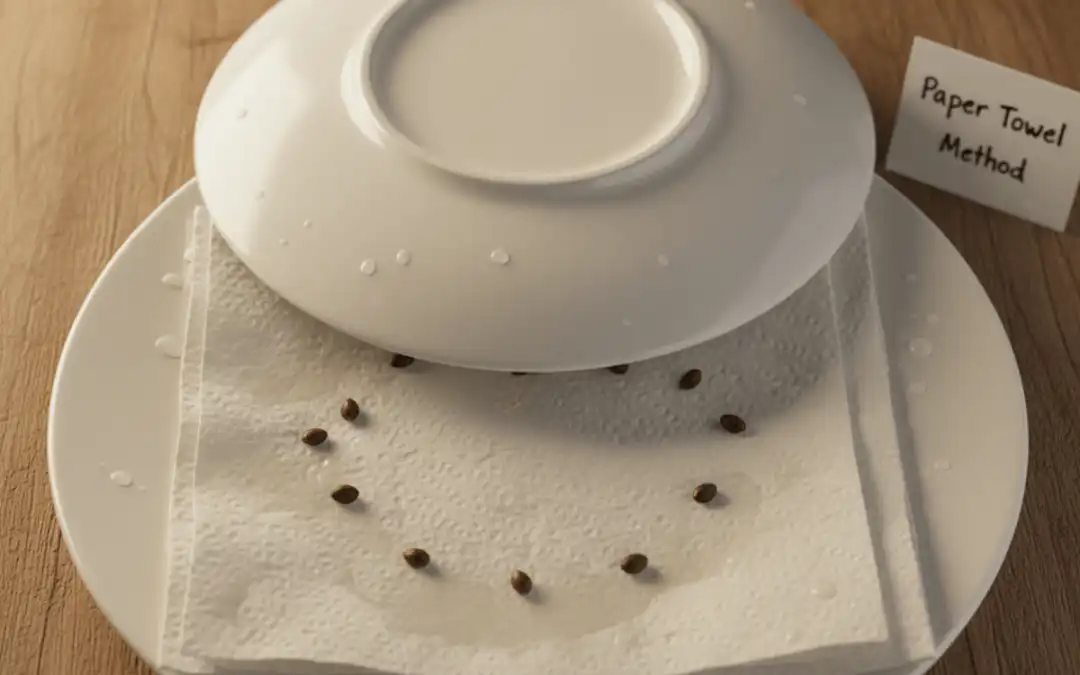
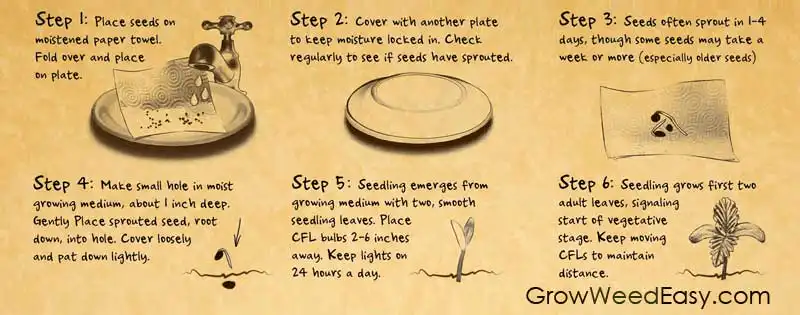
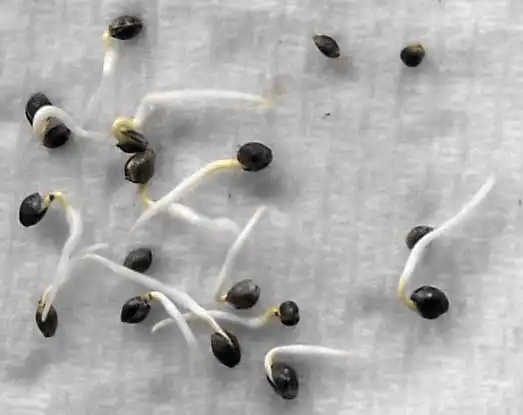
Paper towel germination method β€” the definitive viability test and Sacred Seeds’ recommended germination approach.

Autoflower vs photoperiod seeds β€” the honest comparison between formats, including where the quality gaps remain.

Cannabis genetics β€” from landrace to hybrid β€” the full genetics history that explains why strain names vary so significantly between sources.

Sacred Seeds quality guarantee β€” how we test and store every seed batch before dispatch.

Browse all cannabis seeds β€” feminised, autoflower, and photoperiod strains shipped from Australia.

References

Langa, S. et al. (2023). Seed dormancy and germination responses of cannabis landraces to various pre-treatments. South African Journal of Botany. sciencedirect.com

Langa, S. et al. (2024). Temperature Effects on Seed Germination and Seedling Biochemical Profile of Cannabis Landraces. Agronomy, MDPI. mdpi.com

Russo, E. B. (2019). The Case for the Entourage Effect and Conventional Breeding of Clinical Cannabis. Frontiers in Plant Science, 9. doi.org/10.3389/fpls.2018.01969

Clarke, R. C., & Merlin, M. D. (2016). Cannabis: Evolution and Ethnobotany. University of California Press. ucpress.edu

Sawler, J. et al. (2015). The Genetic Structure of Marijuana and Hemp. PLOS ONE, 10(8). doi.org/10.1371/journal.pone.0133292

Seeds are sold strictly as novelty collector’s items. They contain no THC or CBD. This page does not constitute medical or legal advice. By purchasing you agree to our terms and conditions. Always check local laws before germinating or cultivating cannabis.

Blue Dream Strain Review β€” Grow Guide for Australian Growers

Blue Dream Strain Review β€” Grow Guide for Australian Growers

Blue Dream is Jess’s second favourite strain β€” and she’s grown and smoked a lot of cannabis. Amnesia Haze holds the top spot, but Blue Dream sits directly behind it for a reason that’s hard to argue with: it’s the strain that delivers a genuinely functional, mood-lifting, creative experience without the edge that pure sativas can carry. Where Amnesia Haze is a commitment β€” a full-throttle sativa that demands your attention β€” Blue Dream is more forgiving, more versatile, and more useful across a wider range of situations. Morning, afternoon, social, solo. It handles all of it.

This is a complete Blue Dream strain review and grow guide β€” genetics, effects, terpene profile, full Australian grow guide with week-by-week table, outdoor timing by state, and a comparison with the strains it’s most often measured against. Both the Blue Dream feminised photoperiod and the Auto Blue Dream are in the catalogue.

Blue Dream β€” Strain Specs

Genetics Blueberry (DJ Short) Γ— Haze
Origin Santa Cruz, California β€” early 2000s
Type 60% Sativa / 40% Indica β€” Feminised Photoperiod
THC 17–24%
CBD <1%
Flowering time 9–10 weeks from 12/12 flip
Indoor yield 500–600 g/mΒ² under optimised conditions
Outdoor yield 600–900 g/plant in full season
Height 100–180 cm β€” moderate to tall with sativa stretch
Outdoor harvest (AU) North: late March β€’ Mid: early April β€’ South: mid April
Terpene profile Myrcene (dominant) β€’ Pinene β€’ Caryophyllene
Aroma Sweet blueberry, herbal, faint floral β€” clean and inviting

Blue Dream cannabis cola showing characteristic blue-green colouration, dense white trichome coverage and sativa bud structure

Blue Dream Strain Review: Genetics, Origin, and What Makes It Different

Blue Dream traces its origin to Santa Cruz, California, around 2003 β€” a period when the California medical cannabis scene was producing some of the most influential genetics of the modern era. The cross that produced Blue Dream brought together two very different parents: Blueberry and Haze.

Blueberry is DJ Short’s classic indica β€” one of the most revered breeding achievements in cannabis history. Short spent years selecting and stabilising the strain from Thai, Afghan, and Purple Thai landrace genetics, and what he produced was an indica with an unusually sweet berry terpene profile, mellow body relaxation, and striking purple phenotype expression. As a breeding parent, Blueberry contributes exactly what Blue Dream needed: the body ease, the sweet aromatic character, and the indica foundation that stops the Haze side from becoming too much.

Haze is the other parent β€” one of the most genetically influential sativas ever developed, tracing its lineage to landrace genetics from Mexico, Colombia, Thailand, and India. Haze genetics are responsible for the cerebral, energetic, creative uplift that defines Blue Dream’s effect profile. Without them it would be a pleasant indica. With them it’s something genuinely different.

The combination spread through California via Oaksterdam University, the cannabis education institution that played a central role in distributing quality genetics across the state’s medical dispensary network. From there, Blue Dream became one of the defining strains of its era β€” and two decades later it remains one of the most consistently in-demand strains globally, which is a harder achievement than most newer genetics appreciate.

🌿 Jess β€” On Blue Dream

Amnesia Haze is my all-time favourite β€” it always will be β€” but Blue Dream is the strain I probably reach for most often in practice. The reason is simple: it fits more situations. Amnesia Haze is a commitment. Blue Dream is more flexible. I can have it in the afternoon before I need to do something, or in the evening when I want to wind down, or on a morning when I want to feel genuinely good without losing the day. The blueberry flavour is distinctive and immediately recognisable. And it grows beautifully. The plants are a pleasure to work with.

Blue Dream Effects β€” What the Terpene Profile Produces

Blue Dream’s effect profile is the reason it’s lasted twenty years in a market that constantly chases novelty. The combination of Haze-derived cerebral energy and Blueberry-derived body ease is genuinely difficult to replicate β€” most strains tip too far in one direction or the other. Blue Dream stays balanced in a way that makes it actually useful rather than just impressive.

The terpene profile and what it does

Myrcene is the dominant terpene β€” earthy, herbal, and responsible for the mellow body component that stops Blue Dream from being a racy sativa. Myrcene facilitates THC crossing the blood-brain barrier, which contributes to the physical ease that sits underneath the cerebral effect. At Blue Dream’s THC range (17–24%), a high-myrcene profile produces a rounded, full experience rather than a sharp one.

Pinene is the secondary terpene and the source of the fresh, clean quality in the aroma. Pinene counteracts some of the short-term cognitive fog associated with high-myrcene strains β€” it’s part of what keeps Blue Dream on the functional, clear-headed side rather than producing the body-heavy sedation of a pure indica. It also contributes the subtle herbal freshness that sits alongside the sweet berry note.

Caryophyllene adds the faint spice in the aroma and activates CB2 receptors directly β€” contributing to the anti-inflammatory and muscle-relaxing body effect. It’s the terpene that gives Blue Dream its usefulness for physical discomfort without the full sedative load of a myrcene/linalool-dominant indica.

Effect progression

Onset (10–20 min): Clear, motivated cerebral lift. Mood elevates noticeably. Focus sharpens rather than scattering. There’s no anxious edge to the Haze influence at moderate doses β€” it’s purposeful rather than racy.

Early phase (20–60 min): The sativa and indica elements are operating simultaneously. Mentally engaged and creatively energised while physically comfortable and tension-free. This is the window where Blue Dream is genuinely functional β€” tasks, conversation, physical activity, creative work all feel enhanced rather than impaired.

Mid-to-late phase (60–120 min): The body relaxation deepens as the cerebral lift settles. At moderate doses this is still fully functional β€” a comfortable, eased state rather than sedation. At higher doses the indica side becomes more prominent and the experience moves toward relaxation rather than activity.

Duration: 2–3 hours at typical doses. Long-lasting relative to many hybrids, which contributes to its usefulness for sustained mood support or extended social situations.

🌿 Jess β€” On the Blue Dream Experience

What I love about Blue Dream is that it doesn’t demand anything from you. Amnesia Haze asks you to show up β€” you need to be ready for it. Blue Dream just lifts you. You feel better, the world feels a bit lighter, your body stops holding whatever tension it was holding, and you can do whatever you were going to do anyway. That’s rare. Most strains change what you’re doing. Blue Dream enhances it. The flavour is also genuinely beautiful β€” I don’t think there’s a strain that smells better coming out of the jar.

Growing Blue Dream Seeds β€” Complete Guide

Blue Dream is one of the more forgiving strains to grow β€” a significant reason for its enduring popularity beyond the effect profile. The Blueberry indica genetics provide resilience and structural stability while the Haze sativa influence drives vigorous growth and generous yields. It handles variation in temperature, humidity, and feeding better than most sativa-dominant genetics at this THC level, while still responding well to skilled cultivation with noticeably better results.

The honest caveat: “forgiving” doesn’t mean undemanding. Blue Dream grows large, stretches significantly in early flower, and produces dense heavy buds that need humidity management in the final weeks. Setting up correctly before the flip is more important than reactive problem-solving during flower.

Structure and training

Blue Dream grows tall β€” 100–180 cm finished height with significant stretch in early flower, typically 50–75% height increase from flip. The Haze genetics drive this stretch and it needs to be accounted for before the flip. Indoors, flip when the plant is at 40–50% of your available height. Outdoors, early training is essential to manage the structure before it becomes difficult.

Topping at week three to four of veg produces a multi-cola structure that maximises the natural yield potential. SCROG suits Blue Dream well indoors β€” the vigorous lateral branching fills a screen efficiently and the structure supports the heavy buds that develop without additional staking. LST from early veg opens the canopy and improves light penetration to lower bud sites. Defoliation in early flower β€” a moderate pass at week two and week four β€” manages the dense canopy and improves airflow through the bud sites that are most susceptible to mould in late flower.

Feeding strategy

Seedling (days 1–14): Plain pH-adjusted water or 1/4 strength maximum. EC below 0.6. Blue Dream seedlings establish quickly and don’t need pushing early.

Early veg (weeks 2–4): Build to full strength by week three. EC 1.0–1.4, nitrogen-forward. The vigorous Haze-influenced growth in veg benefits from consistent nitrogen β€” watch for glossy dark leaves as the first sign to ease back before toxicity accumulates.

Late veg (weeks 4–6): EC 1.2–1.6. Maintain nitrogen, begin adding CalMag particularly if running coco or RO water. Blue Dream is a magnesium-hungry strain β€” deficiency shows as interveinal chlorosis on mid-canopy leaves and is the most common feeding problem in this cultivar.

Early flower / stretch (weeks 1–3 of 12/12): Transition to bloom nutrients. Reduce nitrogen, build phosphorus. EC 1.4–1.8. The stretch in Blue Dream is pronounced β€” manage height actively during this phase. CalMag support continues through early flower.

Mid flower (weeks 4–7 of 12/12): Full bloom profile. EC 1.6–2.0. Potassium support from week five improves resin density and terpene expression. The myrcene and pinene profile develops strongly in this window β€” keep temperatures below 26Β°C to preserve the terpene quality that makes Blue Dream distinctive.

Late flower / pre-flush (weeks 7–9 of 12/12): Begin tapering nutrients as natural leaf yellowing starts. Reduce EC to 1.0–1.2.

Flush (final 10–14 days): Plain pH-adjusted water only. The sweet berry terpene profile of Blue Dream is particularly responsive to a thorough flush β€” properly flushed and cured Blue Dream is noticeably cleaner and more flavourful than material that wasn’t flushed.

Climate

Temperature: 22–26Β°C through veg and early flower. Drop to 20–24Β°C from week five of flower. Cool nights of 18–20Β°C in the final two weeks improve terpene expression and can trigger purple phenotype development in some plants β€” a characteristic inherited from the Blueberry parent that becomes more pronounced with temperature differentials.

Humidity: Seedling 65–70% RH. Veg 55–65% RH. Early flower 50–55% RH. Mid-to-late flower 40–50% RH, dropping to 40–45% in final two weeks. The dense buds Blue Dream produces are susceptible to botrytis if humidity climbs above 55% from week five of flower β€” airflow management and consistent RH monitoring are important.

Light: 18/6 veg, 12/12 flower. PPFD targets: 400–600 Β΅mol/mΒ²/s veg, 800–1000 Β΅mol/mΒ²/s flower. Blue Dream responds well to high light intensity in flower β€” the dense bud structure and generous trichome production both benefit from adequate PPFD.

🌿 Jess β€” On Growing Blue Dream

The main thing to know about growing Blue Dream is the stretch. If you haven’t grown a Haze-influenced strain before, the height increase from flip to mid-flower will surprise you. I’ve had plants that nearly touched the light before I got the training right. Flip earlier than you think you need to. Outdoors it’s less of an issue β€” you’ve got room β€” but indoors, account for that stretch before you flip. Once you do, the grow is genuinely satisfying. The plants are vigorous and respond well. And the smell in the final weeks of flower is extraordinary β€” the blueberry comes through very early and stays throughout.

Blue Dream Week-by-Week Grow Guide

Phase / Week What’s Happening Key Actions Watch Out For
Weeks 1–2
Seedling
Taproot establishing. First true leaves emerging. Vigorous early growth typical of Haze genetics. Plain water or 1/4 strength. 18/6 light. Humidity 65–70% RH. pH 6.0–6.5 soil. Overwatering β€” the most common early mistake. Water in a ring around the seedling. Wait until top 2 cm is dry.
Weeks 3–4
Early veg
Rapid growth. Multiple lateral branches. Structure beginning to show sativa influence β€” internodal spacing slightly longer than pure indica. Build to full strength nutrients. EC 1.0–1.2. Begin LST β€” tie main stem to open canopy. Top or FIM at week 3–4. Glossy dark leaves signal nitrogen excess. CalMag watch begins β€” early interveinal chlorosis is the first sign of Mg deficiency.
Weeks 5–6
Late veg
Vigorous canopy development. Training paying off with multiple productive bud sites. Height management critical before flip. EC 1.2–1.6. Fill SCROG screen or continue LST. Flip when plant is at 40–50% of available height β€” no later. Height β€” the stretch ahead is significant. Flipping too late is the most common Blue Dream indoor mistake.
Weeks 1–3 of flower
Stretch
50–75% height increase. Pre-flowers developing. Blueberry aroma beginning to emerge from week 2 of flower. Transition to bloom nutrients. EC 1.4–1.8. Reduce nitrogen. Light defoliation of shading fan leaves. Monitor height daily. Height management β€” keep training during stretch. Any plant getting close to lights needs immediate attention.
Weeks 4–6 of flower
Early-mid flower
Buds stacking rapidly. Sweet blueberry aroma intensifying. Heavy trichome production beginning. Height gain complete. Full bloom nutrients. EC 1.6–2.0. Potassium support from week 5. Carbon filter essential. Drop RH to 45–50%. Humidity β€” dense buds vulnerable from week 4 onward. RH above 55% raises botrytis risk significantly. Airflow is critical.
Weeks 7–8 of flower
Late flower
Buds fattening and hardening. Full blueberry-herbal aroma. Trichome production at peak. Pistils darkening. Check trichomes from day 49. Taper nutrients to EC 1.0–1.2. Drop RH to 40–45%. Cool nights 18–20Β°C for terpene expression. Harvest timing β€” milky trichomes for more cerebral effect, 10–20% amber for more balanced body effect. Check daily from week 8.
Weeks 9–10 of flower
Flush and harvest
Final ripening. Fan leaves yellowing naturally. Dense resinous colas. Some phenotypes showing purple tones with cool nights. Plain pH-adjusted water for 10–14 days. Harvest at target trichome window. Slow dry at 15–18Β°C, 55–60% RH for 10–14 days. Rushing the dry β€” Blue Dream’s blueberry terpene profile is volatile. A slow dry and 4-week minimum cure produces the full flavour.
Post-harvest
Cure
The full blueberry and herbal terpene profile develops in the jar. Fresh Blue Dream is good. Properly cured Blue Dream is exceptional. Jar at 60–65% RH. Burp daily for two weeks. 4 weeks minimum. 6 weeks ideal for full flavour expression. Opening too early. The characteristic sweet blueberry aroma that makes this strain distinctive fully develops only after a proper cure.

Indoor Growing β€” Blue Dream

  • Flowering time: 9–10 weeks from 12/12 flip
  • Yield: 500–600 g/mΒ² under optimised lighting with training
  • Container: 15–20 L β€” robust root system needs adequate space
  • Light schedule: 18/6 veg β†’ 12/12 flower
  • PPFD: 400–600 veg / 800–1000 flower
  • Height: 100–180 cm finished β€” flip at 40–50% of available height
  • Training: SCROG recommended β€” vigorous branching fills screens well. Top at week 3–4 veg. LST throughout veg.
  • Temperature: 22–26Β°C veg and early flower; cool to 20–24Β°C from week 5 flower
  • Humidity: 65–70% seedling β†’ 55–65% veg β†’ 45–50% early flower β†’ 40–45% late flower
  • CalMag: Supplement throughout β€” particularly in coco or RO water environments
  • Aroma: Carbon filtration from week 2 of flower β€” the blueberry builds early and is distinctive

Growing Blue Dream Outdoors in Australia

Blue Dream suits Australian outdoor growing well β€” the warm climate, long days, and generous light suit both the Haze sativa vigour and the indica-influenced bud development. The 9–10 week flower from flip and significant plant size mean outdoor growers need to plan for the harvest window and the space requirements before they plant.

Queensland and Northern NSW

Blue Dream thrives in the Queensland and Northern NSW climate. Plant from mid-September, target late March harvest. The long warm season suits the Haze genetics and the plants get genuinely large β€” 150–200 cm is realistic in full sun with good soil. Coastal humidity from February onward requires airflow management around the dense buds. Harvest: late March to early April.

NSW and VIC β€” Temperate

Plant late September through early October. The 9–10 week flower from flip means plants trigger naturally around mid-February and target an early to mid-April harvest β€” within the safe window before consistent autumn rains. Space is important β€” these plants need room. Training from early in the season manages structure and improves yield. Harvest: early to mid April.

Tasmania and Southern VIC

Blue Dream is workable in southern climates but the 9–10 week flower makes the timing tight. Plant October, target mid-April harvest hard deadline. In TAS particularly, the Auto Blue Dream is a more practical choice β€” the fixed 75–80 day timeline removes the harvest window anxiety entirely. For growers committed to the photoperiod version in TAS, early planting and active training to keep the plant manageable are essential. Harvest: mid April maximum.

WA and SA

The drier climate suits the dense Blue Dream bud structure β€” mould risk is significantly lower than on the east coast and the plants handle the warm dry days well. Standard timing: plant September–October, harvest early to mid April. Full sun position, adequate spacing between plants for airflow, 20–30 L containers minimum for the root system Blue Dream develops outdoors.

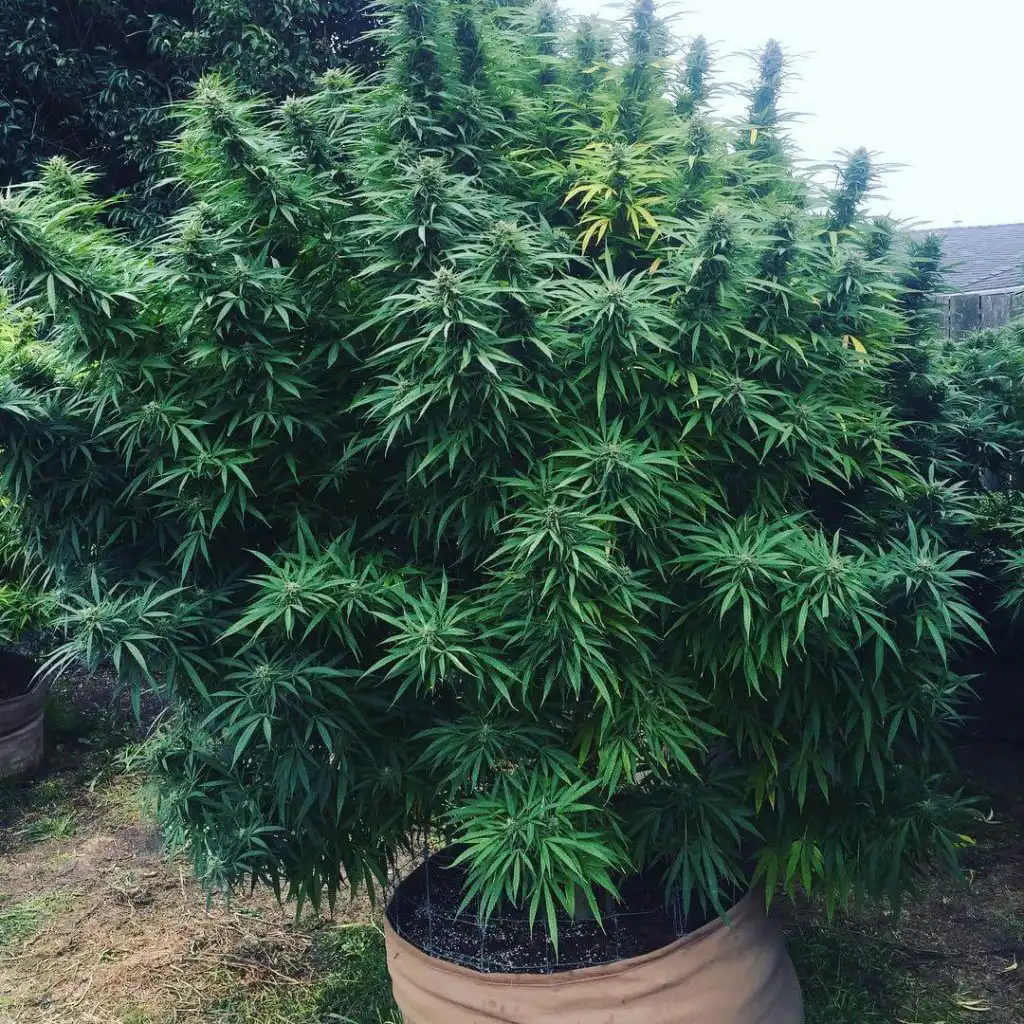
Blue Dream cannabis plant grown outdoors in a large fabric pot showing characteristic sativa height and dense multi-cola structure at harvest

Blue Dream vs Other Classic and Hybrid Strains

Strain THC Flower time How it differs from Blue Dream
Blue Dream 17–24% 9–10 weeks The reference point β€” balanced sativa/indica, sweet berry profile, functional anytime use
Amnesia Haze 20–25% 10–12 weeks More demanding sativa β€” higher THC, longer flower, less body ease, more intense cerebral effect. Jess’s number one.
Girl Scout Cookies 20–25% 9–10 weeks More indica-dominant, deeper body effect, complex Cookies terpene profile vs Blue Dream’s sweeter berry character
Gorilla Glue #4 26–28% 8–9 weeks Significantly heavier β€” more potent, more sedating, heavier resin. Not a daytime strain in the way Blue Dream is.
Northern Lights 18–22% 7–9 weeks Pure indica experience β€” faster flower, more sedating, earthy not sweet. Evening strain where Blue Dream is anytime.
Runtz 22–28% 8–9 weeks Newer genetics, more complex candy terpene profile, higher THC ceiling. Blue Dream is more consistent and versatile.

Ready to grow Blue Dream?

Feminised photoperiod and autoflowering seeds shipped from Australia. Batch-tested genetics, express delivery nationwide.

Key Takeaways β€” Blue Dream

Blueberry Γ— Haze. 17–24% THC. Myrcene, pinene, caryophyllene. 9–10 week flower. The strain that genuinely delivers on the “anytime” promise β€” cerebral uplift and physical ease operating simultaneously without either dominating. Sweet blueberry terpene profile that’s immediately recognisable and develops fully only after a proper cure. Significant stretch in flower requires height management before flip β€” flip at 40–50% of available height indoors. Dense buds need humidity management from week four of flower. Rewarding outdoor grow across all Australian climate zones; Auto Blue Dream is the better choice for Tasmania and southern Victoria where the harvest window is tightest. For the full catalogue of sativa-dominant genetics see the sativa-dominant seeds page, and for the photoperiod and auto product pages see Blue Dream feminised and Auto Blue Dream.

Blue Dream β€” Frequently Asked Questions

What are Blue Dream seeds?

Blue Dream is a sativa-dominant hybrid (60% sativa / 40% indica) bred from DJ Short’s Blueberry crossed with Haze β€” originating in Santa Cruz, California around 2003. It tests at 17–24% THC with a myrcene-dominant terpene profile producing a characteristically sweet blueberry aroma and a balanced cerebral-and-body effect. Available from Sacred Seeds as feminised photoperiod and Auto Blue Dream.

What does Blue Dream smell and taste like?

Sweet blueberry with an herbal, slightly piney undertone from the pinene, and a faint floral quality in well-grown and properly cured examples. The blueberry character from the DJ Short Blueberry parent comes through clearly and is one of the most immediately recognisable aromas in the hybrid catalogue. The full flavour develops after a minimum four-week cure β€” fresh-dried Blue Dream doesn’t fully represent the genetics.

Is Blue Dream a daytime or evening strain?

Genuinely both at appropriate doses. At moderate doses the balanced sativa/indica effect is functional β€” suitable for morning, afternoon, social situations, or creative work. At higher doses the indica side becomes more pronounced and the experience moves toward relaxation. It’s one of the few strains that earns the “anytime” label honestly. For a pure evening or sleep-focused strain, Northern Lights or Godfather OG are more appropriate.

How long does Blue Dream take to flower?

9–10 weeks from the 12/12 light flip indoors. Outdoors in Australia, plants triggered by the natural autumn light cycle harvest late March in Queensland through to mid April in southern states. Check trichomes from week eight β€” harvest at mostly milky for a more energising effect, 10–20% amber for a more balanced body effect.

Is Blue Dream easy to grow?

It’s more forgiving than most sativa-dominant genetics at this quality level β€” the Blueberry parent provides resilience and structural stability. The main challenges are height management (significant stretch requires early training and flipping at the right time), magnesium nutrition (supplement CalMag consistently), and humidity in late flower (dense buds are botrytis-susceptible above 55% RH from week four of flower). Growers who set up correctly before the flip will find it a rewarding and generous plant.

Can I grow Blue Dream outdoors in Australia?

Yes β€” Blue Dream suits Australian outdoor conditions well. In Queensland and NSW, plant from mid-September and target a late March to early April harvest. In VIC and SA, plant October and target early to mid April. In Tasmania and southern VIC, the Auto Blue Dream is a more practical choice given the shorter season. The Australian climate strain guide covers regional timing in detail.

How does Blue Dream compare to Amnesia Haze?

Amnesia Haze is a more demanding and more intense sativa β€” higher THC (20–25%), longer flower (10–12 weeks), less body ease, and a more full-throttle cerebral effect that requires more from the user. Blue Dream is more versatile and more forgiving β€” a better daytime option across a wider range of situations. Jess rates Amnesia Haze as her all-time favourite and Blue Dream as her second β€” the distinction being that Amnesia Haze is a commitment and Blue Dream is more flexible.

Is there an autoflowering version of Blue Dream?

Yes β€” Auto Blue Dream carries the same Blueberry Γ— Haze genetics in an autoflowering format, completing seed to harvest in approximately 75–80 days on a fixed timeline regardless of light schedule. Well-suited to Australian outdoor conditions where multiple runs per season are practical or where light control isn’t available.

Related Reading

Sativa-dominant cannabis seeds β€” the full range of energising and functional genetics including Blue Dream and Amnesia Haze.

Balanced hybrid cannabis seeds β€” strains that combine sativa and indica effects without either dominating.

Best cannabis strains for Australian conditions β€” regional strain selection and seasonal timing for outdoor growers across all states.

Autoflower vs photoperiod seeds β€” if you’re deciding between Blue Dream feminised and Auto Blue Dream, the format differences explained in full.

How to dry cannabis in Australia β€” the slow dry that preserves Blue Dream’s blueberry terpene profile.

Browse all cannabis seeds β€” over 50 feminised, autoflower, and photoperiod strains shipped from Australia.

Seeds are sold strictly as novelty collector’s items. They contain no THC or CBD. This page does not constitute medical or legal advice. By purchasing you agree to our terms and conditions. Always check local laws before germinating or cultivating cannabis.

The Paper Towel Method for Cannabis Seeds β€” Complete Guide

The Paper Towel Method for Cannabis Seeds β€” Complete Guide

The paper towel method is how we germinate cannabis seeds at Sacred Seeds β€” every batch, before dispatch, at 22Β°C. It’s the method we recommend to growers because it gives you something no other germination approach offers: visual confirmation that a seed has germinated before it ever contacts soil. You can see the taproot emerging, assess its health, and plant with confidence rather than hoping something is happening underground. This guide covers the paper towel method for cannabis seeds from setup through to transplanting β€” including the troubleshooting scenarios that catch people out.

Where this guide fits in the germination series

This is the deep-dive on the paper towel method. If you’re new to germination and weighing up your options, start with the complete cannabis seed germination guide β€” it covers all three methods with honest assessments. If your seeds have already failed and you need to troubleshoot, see why cannabis seeds aren’t germinating. If germination worked but your seedlings are dying in the first two weeks, the damping off and stem rot guide covers what’s happening.

Please note: we write this guide specifically for growers in the ACT where personal cultivation is permitted, and for growers in legal jurisdictions overseas. Seeds sold by Sacred Seeds Australia are sold strictly as souvenir and collectable items in accordance with Australian law.

Paper Towel Method β€” At a Glance

Ideal temperature 22–25Β°C consistent β€” heat mat recommended
Water to use Filtered, distilled, or collected rainwater at pH 6.0–6.5 β€” never tap water
Paper towel moisture Damp throughout β€” not dripping when lifted
Seed spacing 2–3 cm apart β€” room for taproots to emerge without tangling
Typical timeframe 24–72 hours for most viable seeds β€” up to 5 days for older seeds
When to plant When taproot is 0.5–1 cm long β€” don’t wait for 2 cm+
Planting depth 0.5–1 cm β€” taproot pointing down, covered lightly

Cannabis seeds ready for germination using the paper towel method β€” showing seed placement and moisture level

Why the Paper Towel Method Works for Cannabis Seeds

The paper towel method works because it delivers the three conditions a germinating cannabis seed requires β€” warmth, consistent moisture, and darkness β€” in a controlled, visible environment. Unlike direct planting in soil, you can see exactly what’s happening at every stage. That visibility is the method’s primary advantage over alternatives.

A moist paper towel maintains even moisture contact with the seed coat throughout the germination process β€” more consistent than soil, which can have dry and wet pockets depending on how evenly it was moistened. The enclosed environment of a bag or between two plates maintains humidity without requiring constant attention. And because the taproot emerges in open air rather than into soil, you can assess its health β€” length, colour, vigour β€” before committing the seed to a growing medium.

The method also works well for a wide range of seeds beyond cannabis β€” herbs, vegetables, and flowers with longer germination times all respond well to the controlled moisture and warmth environment. But for cannabis specifically, where the seeds represent a meaningful investment and germination rate matters, the paper towel method’s visibility advantage is particularly valuable.

🧠 Jason β€” Why We Use This Method

We use the paper towel method at 22Β°C to test every seed batch before it leaves us. It’s the most reliable way to confirm germination rate before seeds go out to growers. What I’ve learned from doing this consistently is that the method itself is almost foolproof when the variables are right β€” the right temperature, the right water, the right moisture level in the towel. When germination fails, it’s almost always one of those three things, not the method. The visibility is what makes it useful for testing β€” you know within 72 hours whether the seeds are performing as expected, and you can identify individual seeds that are slower or faster without disturbing the rest of the batch.

Water Quality β€” The Most Overlooked Variable in the Paper Towel Method

The water you use is not a minor detail. Australian tap water contains chlorine or chloramines (disinfectants added by municipal water authorities), fluoride, and in areas with older pipe infrastructure, trace heavy metals. These compounds interfere with the enzyme systems that initiate germination and can damage the beneficial microbiology that supports seedling development β€” all at exactly the point when the seed is most sensitive to those disruptions.

Use filtered water, collected rainwater, or distilled water. Adjust pH to 6.0–6.5 before use β€” a basic pH meter and pH adjustment solution are inexpensive and remove pH as a variable. If you’re on a chlorinated municipal supply, leaving tap water uncovered for 24 hours allows chlorine to off-gas. If you’re on a chloraminated supply β€” Sydney Water uses chloramination β€” standing water overnight does nothing, and carbon filtration is needed to remove the chloramines.

For the full explanation of what’s in Australian tap water and how it affects germination, the water quality and seed germination guide covers it in detail. The short version: use the best water you have access to, and tap water straight from the tap is the option most likely to undermine an otherwise correct germination setup.

Step-by-Step: The Paper Towel Method for Cannabis Seeds

Step-by-step paper towel germination setup showing moistened towel, seed placement and folding technique

The Paper Towel Method β€” Six Steps

Step 1 β€” Optional pre-soak (6–12 hours): For seeds with particularly hard or thick coats, a brief soak in a small cup of clean, lukewarm water (22–25Β°C) in a dark spot can help moisture penetrate the seed coat before the paper towel stage. Not required for most seeds β€” skip this step unless you’ve had seeds be slow to respond in previous grows.

Step 2 β€” Moisten the paper towel: Dampen a paper towel thoroughly with clean, pH-adjusted water. It should be moist throughout β€” damp and consistent when you hold it up. Not dripping, not just surface-damp. Squeeze out any excess water if it drips when lifted. The moisture level here is the most important variable you control directly.

Step 3 β€” Place seeds and fold: Lay seeds on one half of the paper towel with 2–3 cm of space between each one. Fold the other half over to cover them. Place the folded towel between two plates β€” creating a dome that maintains humidity β€” or inside a zip-lock bag. Both work; the plate method allows slightly more airflow, the bag maintains humidity more consistently.

Step 4 β€” Find the right location: Place the setup in a warm, dark location. A drawer, a cupboard, or on top of a seedling heat mat covered with something opaque. Target 22–25Β°C consistently. In Australia, a north-facing windowsill is the sunniest indoor position β€” but the paper towel setup needs darkness, not light, so keep it away from windows. On top of a heat mat with a consistent thermostat is the most reliable setup regardless of ambient temperature.

Step 5 β€” Monitor daily: Check the setup every 12–24 hours without disturbing it significantly. You’re looking for the white taproot emerging from the seed β€” typically within 24–72 hours for viable seeds in correct conditions. If the paper towel has dried out, remoisten lightly with clean water. If there’s condensation building up inside the bag or on the plates, crack it slightly for a few hours to allow airflow.

Step 6 β€” Plant when ready: Once the taproot is 0.5–1 cm long it’s time to plant. Don’t wait until the taproot is 2 cm+ β€” longer taproots are more fragile and more likely to be damaged during transplanting. Handle the seed by its body, not the taproot. The transplanting process is covered in detail in the next section.

🧠 Pro Tip β€” Labelling Multiple Varieties

If you’re germinating several different strains at once, divide the paper towel into clearly labelled sections using a waterproof pen before you place the seeds. Mark each section with the strain name. This sounds basic but it’s worth doing β€” germination timelines vary between strains and between individual seeds, and mixing up varieties at planting is an easy mistake that’s impossible to correct later.

Paper towel divided into labelled sections for germinating multiple cannabis seed varieties simultaneously

Transplanting Germinated Cannabis Seeds into Growing Medium

Transplanting is where most paper towel germination attempts go wrong β€” not because the method failed but because the handling at this stage damaged the taproot. The taproot emerging from a germinated cannabis seed is fragile. Any bending, breaking, or compression of it at this stage ends the plant’s development.

Prepare your growing medium before you open the paper towel. Pre-moisten the medium so it’s evenly damp throughout β€” not wet, not dry. Poke a small hole 0.5–1 cm deep in the centre of the container using a pencil or similar. Have everything ready before you handle the germinated seed.

Pick up the germinated seed by its body β€” not the taproot. Tweezers are useful here but they must be used with extreme care; gripping the taproot with tweezers is one of the most common causes of transplant damage. If you use tweezers, grip the seed coat only. Lower the seed into the hole taproot-first, pointing downward. The taproot goes into the medium, the seed body sits just below the surface. Cover lightly with growing medium β€” a thin layer, not packed down.

Do not water immediately after planting. The pre-moistened medium contains enough moisture to sustain the seedling for the first several days. Adding water on top of an already moist medium creates exactly the oversaturated conditions that lead to damping off. Wait until the surface of the medium lightens in colour slightly before the first post-planting watering.

Germinated cannabis seed being transplanted with taproot pointing down into pre-moistened growing medium

Troubleshooting Common Paper Towel Method Problems

This section covers the problems specific to the paper towel method itself. For broader germination troubleshooting β€” seeds not germinating at all, diagnosing whether it’s the seeds or the setup β€” the cannabis seeds not germinating guide covers it in full.

Seeds not germinating after 72 hours

Check the three variables in order. Temperature first β€” is the setup actually at 22–25Β°C, or are you assuming room temperature is adequate? A thermometer placed in the setup for an hour will tell you. Moisture second β€” is the paper towel still damp, or has it dried out since you last checked? It should be consistently moist throughout, not just in the centre. Water quality third β€” if you used tap water, the chlorine or chloramines may be the problem. Remoisten with filtered or distilled water and give the seeds another 24–48 hours.

Older seeds may take up to five days rather than the typical 72 hours. If seeds haven’t shown any sign of germination after seven days in correct conditions, they’re unlikely to be viable. Seeds that are pale, white, or soft when pressed between your fingers before germination are unlikely to succeed regardless of method or conditions.

Paper towel too wet β€” seeds at risk of rot

If you can see standing water in the bag or the paper towel drips significantly when lifted, it’s too wet. Open the setup, allow it to drain slightly, and reseal with less moisture. Seeds sitting in saturated conditions for extended periods are at risk of fungal infection β€” the same pathogens that cause damping off in seedlings are active in overly wet germination media. Moist and damp is correct; wet and dripping is too far.

Roots growing into the paper towel

This happens when a seed is left in the paper towel longer than necessary β€” the taproot, having nowhere else to go, begins to penetrate the paper fibres. The best fix is to not let it happen: check daily and plant when the taproot reaches 0.5–1 cm. If roots have already grown into the paper, don’t try to separate them. Cut around the embedded roots and plant the seed along with the small piece of paper β€” it will break down in the soil without harming the plant. Coffee filters are worth using as an alternative to standard paper towels β€” their tighter weave makes root embedding significantly less likely.

Helmet head β€” seed shell stuck on the emerging seedling

Helmet head occurs when the seed coat fails to separate cleanly as the seedling emerges from the growing medium. The cotyledons (first seed leaves) are trapped inside the shell, unable to open. The instinct is to pull the shell off β€” resist it. The cotyledons are attached to the inside of the shell and pulling forcefully will tear them.

Mist the shell lightly with clean water two or three times a day and leave it. In most cases the moisture softens the shell enough for it to detach on its own within 24–48 hours. If it hasn’t detached after three to four days and the seedling is clearly struggling, you can very gently attempt to loosen it with tweezers β€” but only once the shell is visibly softened by moisture, and with extreme care. A successful cotyledon stage is critical to early seedling development β€” damaging them trying to remove a stuck shell causes more harm than the shell itself.

Lack of oxygen in a sealed bag

Seeds sealed in a zip-lock bag for several days can experience reduced oxygen levels that slow or inhibit germination. If you’re using the bag method and seeds haven’t germinated within 48 hours, open the bag briefly once or twice a day to allow fresh air exchange. This is less of an issue with the plate method, which allows slight airflow around the edges of the plates.

Not sure which strain to germinate?

Answer six questions and Jess will match you to three strains based on your setup, experience, and goals.

Find Your Strain β†’

Key Takeaways β€” Paper Towel Method for Cannabis Seeds

The paper towel method is Sacred Seeds’ recommended germination approach because it provides visual confirmation of germination before the seed contacts soil. The three variables that determine success are temperature (22–25Β°C consistently β€” heat mat recommended), water quality (filtered, distilled, or rainwater at pH 6.0–6.5 β€” not tap water), and paper towel moisture level (damp throughout, not dripping). Plant when the taproot is 0.5–1 cm β€” not before, not significantly after. Handle the seed by its body not the taproot during transplanting, into pre-moistened medium at 0.5–1 cm depth, taproot pointing down. Don’t water again immediately β€” the pre-moistened medium will sustain the seedling for the first few days. For troubleshooting beyond germination β€” damping off, seedling care β€” see the damping off guide and the seedling care guide.

Paper Towel Method Cannabis Seeds β€” Frequently Asked Questions

Should I plant cannabis seeds directly in soil instead of using the paper towel method?

Direct planting into a container of growing medium works and has the advantage of not requiring the seedling to be handled during its most fragile stage. The limitation is visibility β€” you can’t confirm germination has occurred until the seedling breaks the surface, which takes longer and means any seeds that fail to germinate are only discovered after several days of waiting. For growers who want confirmation before committing seeds to a container, the paper towel method is preferable. The one situation to avoid is planting ungerminated seeds directly into outdoor garden soil β€” drainage, oxygen levels, and pathogen exposure in uncontrolled outdoor soil create conditions that make germination unreliable. The complete germination guide compares all three methods if you’re still deciding.

Can I use the paper towel method for seeds other than cannabis?

Yes β€” the paper towel method works for vegetables, herbs, and flowers, particularly those with longer germination times or hard seed coats. It’s commonly used for chilli peppers, tomatoes, and various herb seeds where pre-germination allows growers to identify viable seeds before committing growing space. The same principles apply: consistent moisture, 22–25Β°C, darkness, and clean water.

What is the ideal location for the paper towel method in Australia?

A warm, dark location with stable temperature β€” a drawer, a cupboard, or on top of a seedling heat mat. In Australia, north-facing positions get the most sun indoors (the opposite of the Northern Hemisphere), but the paper towel setup needs darkness not light, so keep it away from windows. The most reliable setup is a seedling heat mat with a thermostat set to 22–25Β°C, covered with something opaque β€” this delivers consistent temperature regardless of seasonal ambient temperature changes.

My seeds aren’t germinating β€” what could be the problem?

Check temperature first β€” is it actually 22–25Β°C, or are you assuming room temperature is adequate? Then moisture β€” has the paper towel dried out since you last checked? Then water quality β€” tap water chlorine or chloramines may be inhibiting germination. Older seeds may take up to five days rather than the typical 72 hours. If seeds show no signs of germination after seven days in correct conditions, they are unlikely to be viable. The full germination troubleshooting guide covers each cause and the exact fix.

The roots have grown into the paper towel β€” what should I do?

Cut around the embedded roots and plant the seed into growing medium along with the small piece of paper β€” it will break down in the soil without harming the plant. To avoid this in future, check seeds daily and plant when the taproot reaches 0.5–1 cm rather than allowing it to extend further. Coffee filters are worth using as an alternative to standard paper towels β€” their tighter weave significantly reduces root embedding.

How do I know when to transfer the germinated seed to soil?

When the taproot is 0.5–1 cm long. This is long enough to confirm successful germination and handle the seed safely, but short enough that the root is still rigid and undamaged. Don’t wait until the taproot is 2 cm or longer β€” longer taproots curl and tangle in the paper towel and are more easily damaged during transplanting.

Why should I use a heat mat for cannabis seed germination?

A heat mat provides consistent, gentle warmth that removes temperature as a variable β€” the most commonly underestimated factor in germination failures. Room temperature in Australian homes varies significantly with season and air conditioning, and what feels comfortable to a person (20Β°C) is below the optimal germination range for cannabis seeds. A basic seedling heat mat set to 22–25Β°C ensures the seeds are in the right temperature environment regardless of what’s happening in the rest of the room.

Related Reading

How to germinate cannabis seeds β€” the complete guide β€” all three germination methods covered with honest assessments of each. The hub article for the cluster.

Why aren’t my cannabis seeds germinating? β€” diagnostic guide for failed germination attempts. Covers temperature, water quality, seed age, and the common scenarios that cause seeds to crack but not sprout.

Water quality and seed germination β€” why Australian tap water undermines germination rates and what to use instead.

Why seedlings die β€” damping off and stem rot β€” the most common cause of seedling failure in the first two weeks after germination.

Cannabis seedling care in Australia β€” what comes after successful germination.

Sacred Seeds germination guarantee β€” how we test every seed batch before dispatch using this method.

Browse all cannabis seeds β€” feminised, autoflower, and photoperiod strains shipped from Australia.

Seeds are sold strictly as novelty collector’s items. They contain no THC or CBD. This page does not constitute medical or legal advice. By purchasing you agree to our terms and conditions. Always check local laws before germinating or cultivating cannabis.

Cannabis for Sleep β€” Strains, Science, and Harvest Timing for Australian Growers

Cannabis for Sleep β€” Strains, Science, and Harvest Timing for Australian Growers

Cannabis has been used as a sleep aid for thousands of years β€” and for most of that history, nobody called it a sleep aid. They called it winding down. The evening smoke, the end-of-day ritual, the thing that marked the transition from work to rest. The science has caught up to the practice now, and what it shows is that the relationship between cannabis and sleep is real, nuanced, and highly strain-dependent. Getting it right means understanding which cannabinoids and terpenes actually drive the sedative effect β€” and which strains in Australia deliver them reliably.

This guide covers cannabis for sleep in Australia β€” the science behind how it works, what determines whether a strain helps or hinders sleep, and Jason’s specific recommendations from the catalogue for growers and users who want the full sedative effect from their evening session.

Cannabis for Sleep β€” At a Glance

Key cannabinoid for sleep THC β€” sedative effect via CB1 activation and adenosine increase
Key terpene for sleep Myrcene β€” facilitates THC uptake, amplifies sedative effect
Best strain type Indica-dominant, high myrcene, harvested at 20–25% amber
Harvest timing matters Later harvest (more amber) = deeper sedative effect
Fastest onset Inhalation β€” 10–20 minutes
Longest duration Edibles β€” 4–8 hours, suits full-night sleep support
Avoid for sleep High-THCV sativas, high-limonene strains, early harvest material
Recommended strains (AU) Northern Lights, Godfather OG, Granddaddy Purple, Black Domina

How Cannabis Affects Sleep β€” The Science

Cannabis influences sleep through the endocannabinoid system β€” the body’s biological regulatory network that plays a central role in managing sleep-wake cycles, among many other functions. The primary mechanism is through CB1 receptor activation in the central nervous system. When THC binds to CB1 receptors, it triggers an increase in adenosine β€” a sleep-promoting neurochemical that accumulates throughout the day and drives the body’s increasing need for sleep. Simultaneously, THC suppresses the brain’s arousal systems, reducing the neurological activity that keeps you awake.

The result is an effect on sleep architecture β€” the structure of how sleep cycles through different stages across the night. THC increases time spent in NREM (non-REM) sleep, particularly the deeper slow-wave stages associated with physical restoration and memory consolidation. It reduces time spent in REM sleep β€” the lighter, dream-active stage. For most users seeking sleep support, this shift toward deeper NREM sleep is beneficial. The reduction in REM sleep has specific implications worth understanding, particularly for long-term use.

The effect is dose-dependent and tolerance-dependent in ways that matter practically. At moderate doses in occasional or low-tolerance users, the sedative effect is pronounced and well-tolerated. At higher doses or in frequent users with established tolerance, the sedative effect diminishes and sleep quality can actually worsen β€” the endocannabinoid system downregulates CB1 receptors in response to consistent overstimulation. This is the mechanism behind the common experience of long-term heavy users finding cannabis no longer helps their sleep the way it once did.

THC vs CBD for Sleep β€” What the Research Shows

THC and CBD work differently on sleep and understanding the distinction prevents a common mistake: assuming that more CBD means better sleep, or that CBD is the sleep-promoting cannabinoid.

THC

THC is the primary sleep-promoting cannabinoid. Its direct CB1 agonism drives the sedative effect through the adenosine mechanism described above. At moderate doses, THC reduces sleep onset time β€” how long it takes to fall asleep β€” and increases time in deeper NREM stages. For growers and users seeking sleep support specifically, THC content and strain type are the primary variables to focus on. The indica-dominant strains in the catalogue deliver this through Afghani-lineage genetics that combine high THC with a myrcene-dominant terpene profile that amplifies the sedative effect.

CBD

CBD’s relationship with sleep is more complex and dose-dependent. At lower doses, CBD appears to increase alertness β€” the opposite of what most sleep-seeking users want. At higher doses, CBD may promote sleep, though the mechanism is less well understood than THC’s. CBD’s most consistent sleep-related benefit in the research is in reducing anxiety and pain that disrupts sleep rather than directly promoting sleep onset. For users whose sleep problems are primarily anxiety-driven rather than physiological, a balanced THC/CBD strain may serve better than a high-THC indica. For users seeking direct sedation, high-THC indica genetics with minimal CBD are the more consistent choice.

🧠 Jason β€” On Cannabis and Sleep

Northern Lights is the strain I reach for when I want the day to genuinely be over. Not in a negative sense β€” in the sense that it marks the transition from work to rest better than almost anything else I’ve tried. The myrcene load in a well-grown NL at the later end of the harvest window is real and it does exactly what you want it to do. One session, early evening, and the body relaxes in a way that sitting on the couch without it doesn’t produce. For sleep specifically, I’ve found the harvest timing matters more than most people realise β€” the same plant harvested at ten weeks versus eight weeks produces noticeably different sedation depth.
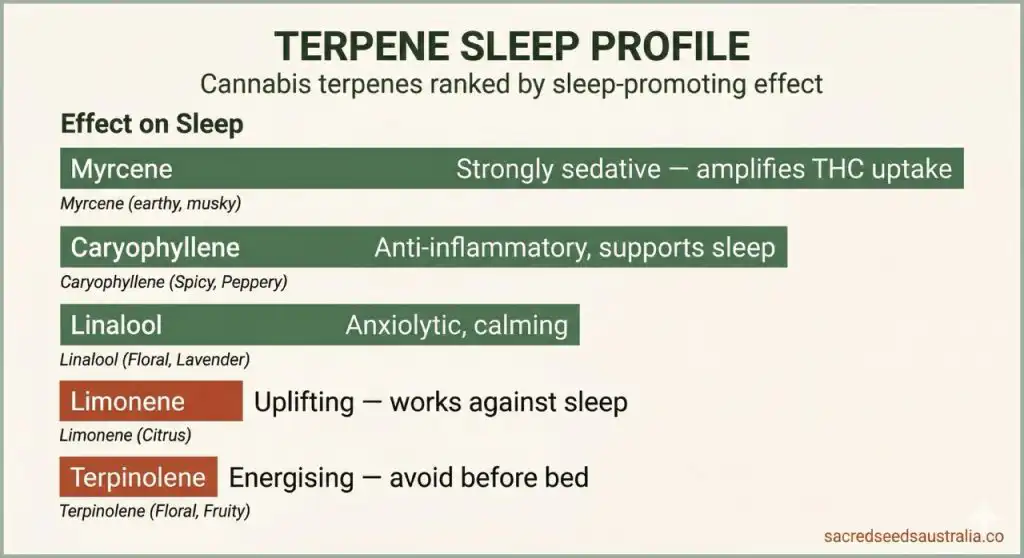
Bar chart showing cannabis terpenes ranked by sleep-promoting effect β€” myrcene and caryophyllene most sedative, terpinolene and limonene counterproductive for sleep

Why Terpenes Determine the Sedative Effect

The distinction between indica and sativa as sleep-relevant categories is real but imprecise β€” what actually determines the sedative quality of a specific strain is its terpene profile, and particularly the presence and concentration of myrcene.

Myrcene is the dominant terpene in most Afghani-lineage indica strains and is responsible for the characteristic earthy, musky aroma of strains like Northern Lights and Godfather OG. Its role in the sleep effect goes beyond aroma. Myrcene facilitates THC crossing the blood-brain barrier β€” increasing the uptake and therefore the effective potency of the THC at CB1 receptors. A strain with 18% THC and high myrcene content will produce a noticeably heavier sedative effect than a strain with 22% THC and a limonene or terpinolene-dominant profile. This is why THC percentage alone is a poor predictor of sleep quality.

The terpene profiles that support sleep and those that work against it are worth understanding explicitly.

Terpenes and Sleep β€” What Helps and What Doesn’t

Myrcene β€” the primary sleep terpene. Earthy, musky, herbal. Amplifies THC uptake and drives the sedative body effect. Dominant in Northern Lights, Godfather OG, Granddaddy Purple, Black Domina. This is the terpene to prioritise for sleep.

Caryophyllene β€” spicy, peppery. CB2 receptor agonist producing anti-inflammatory and pain-relieving effects. Supports sleep by reducing physical discomfort that disrupts it. Common in OG-lineage strains alongside myrcene. Beneficial for sleep.

Linalool β€” floral, lavender-like. Known for anxiolytic and sedative properties. Present in some indica and hybrid genetics. Beneficial for sleep, particularly where anxiety is a contributing factor.

Limonene β€” citrus. Uplifting and mood-elevating. Associated with daytime sativa effects rather than sedation. Common in Cookies-lineage and citrus-forward genetics. Works against sleep in most users.

Terpinolene β€” floral, herbaceous, slightly fruity. Associated with uplifting, energising effects in most users. Common in Jack Herer, Durban Poison. Actively counterproductive for sleep purposes.

Why Harvest Timing Changes the Sleep Effect

This is the piece of information that separates growers who use their own cannabis for sleep from buyers who rely on dispensary products β€” and it’s rarely discussed outside of growing communities.

As cannabis trichomes mature from cloudy/milky to amber, the THC content begins converting to CBN β€” cannabinol. CBN is a mildly psychoactive cannabinoid with pronounced sedative properties of its own. A harvest at 10–15% amber trichomes produces material with higher THC and a more energetic, euphoric effect even in indica strains. A harvest at 20–25% amber produces material with more CBN, deeper sedation, heavier body effect, and a more pronounced sleep-inducing quality.

For growers specifically cultivating for sleep, this means pushing the harvest to the later end of the window. On a strain like Northern Lights β€” which produces a noticeably different experience at week seven versus week nine β€” the difference between a functional evening relaxation effect and genuine sleep promotion often comes down to those two weeks and the trichome colour at harvest.
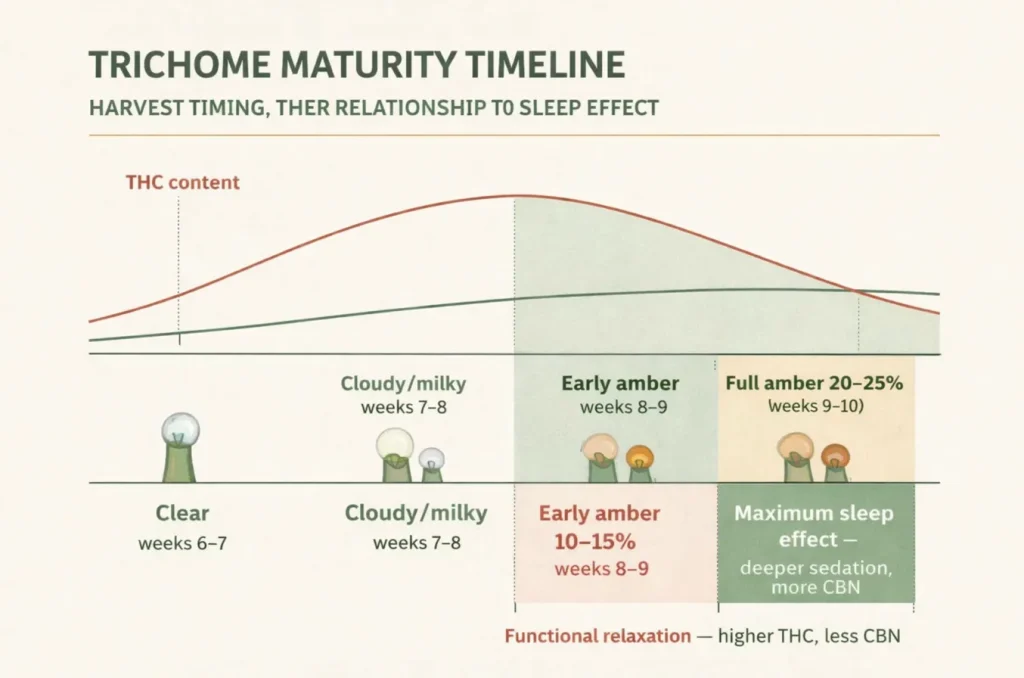
Trichome maturity timeline showing THC and CBN curves across harvest stages β€” full amber 20–25% produces maximum sleep effect through higher CBN content

🧠 Jason β€” On Harvest Timing for Sleep

I’ve run Northern Lights at eight weeks and at nine and a half weeks from the same plant. The eight-week harvest is a pleasant indica β€” good body effect, relaxing, functional. The nine-and-a-half week harvest at 20–25% amber is a different experience. The sedation is deeper, the body effect is heavier, and sleep follows much more naturally. For anyone growing specifically for sleep support, the instruction is simple: wait. Check trichomes under a loupe and don’t cut until you see a meaningful proportion of amber. The extra time is the difference between a strain that helps you relax and one that genuinely puts you to sleep.

Best Cannabis Strains for Sleep in Australia

The strains that consistently deliver for sleep share a profile: indica-dominant, Afghani lineage, myrcene-dominant terpene expression, high THC, and a growth pattern that rewards the patient late harvest. Here are Jason’s specific recommendations from the Sacred Seeds catalogue.

Northern Lights β€” the benchmark evening indica

Afghani Γ— Thai. 18–22% THC. Myrcene, caryophyllene, pinene. 7–9 week flower. Northern Lights is Jason’s personal go-to for end-of-day relaxation and sleep β€” the strain he reaches for when he wants the day to genuinely be over. The myrcene-dominant profile amplifies the THC uptake and produces deep physical sedation that builds progressively over 60–90 minutes. At the later harvest window (week nine, 20–25% amber) the sleep-promoting effect is at its strongest. Consistent, predictable, and one of the most rewarding grows in the catalogue. Also available as Auto Northern Lights for fixed-timeline grows.

Godfather OG β€” maximum sedative depth

XXX OG Γ— Alpha OG. 22–28% THC. Myrcene, caryophyllene, limonene. 8–9 week flower. The 2013 Cannabis Cup Best Indica winner for a reason. For users who need genuine heavy sedation β€” chronic pain, severe insomnia, difficulty staying asleep β€” Godfather OG operates at a different level to Northern Lights. The higher THC combined with the OG myrcene-caryophyllene profile produces a narcotic body effect that’s not suitable for anything other than an end-of-night session. More demanding grow than Northern Lights β€” temperature-sensitive in flower β€” but exceptional results for growers who can manage the environment. Also available as Auto Godfather OG.

Granddaddy Purple β€” myrcene and linalool combined

Purple Urkle Γ— Big Bud. 17–23% THC. Myrcene, caryophyllene, linalool. 8–11 week flower. Granddaddy Purple adds linalool to the myrcene foundation β€” the terpene combination associated with the most pronounced anxiolytic and sedative effects in the cannabis pharmacology literature. For users whose sleep disruption has an anxiety component, the linalool content makes GDP particularly effective. The grape and berry terpene profile is distinctive and the purple phenotype expression in cool conditions makes it one of the more visually striking grows in the catalogue.

Black Domina β€” the heaviest indica in the catalogue

Northern Lights Γ— Ortega Γ— Hash Plant Γ— Black Domina. 20–24% THC. Myrcene dominant. 8–9 week flower. 95% indica genetics. If Northern Lights is the benchmark and Godfather OG is the premium option, Black Domina is for growers who want the heaviest, most narcotic indica effect available. The four-way Afghani-lineage cross produces an almost pure indica experience β€” deep physical sedation, minimal cerebral activity, sleep follows naturally at any moderate dose. Not a social strain, not an early-evening strain. End of night, end of day.

Purple Kush β€” compact indica for Australian outdoor grows

Hindu Kush Γ— Purple Afghani. 18–22% THC. Myrcene dominant. Compact structure, excellent mould resistance, suits Australian outdoor conditions well. The Hindu Kush landrace genetics produce a reliable myrcene-dominant profile and consistent sedative effect without the temperature sensitivity of OG-lineage strains. A practical choice for outdoor Australian growers who want a sleep-focused strain that handles the variable conditions of an Australian autumn harvest.

Strains to Avoid Before Sleep

Not all cannabis helps sleep β€” and some strains actively work against it. The following profile characteristics signal a strain that will likely increase alertness rather than promote sedation.

High-THCV sativas β€” THCV acts as a CB1 antagonist, producing the opposite effect to THC at that receptor. Clear-headed, energising, appetite-suppressing. Durban Poison is the primary example. Excellent for daytime use; counterproductive for sleep.

Terpinolene-dominant strains β€” Jack Herer, Amnesia Haze, and related sativa-dominant genetics with terpinolene as a primary terpene tend toward uplifting, energising effects in most users.

Early-harvest material β€” cannabis harvested at mostly cloudy trichomes without meaningful amber content has higher THC and less CBN, producing a more energetic and cerebral effect even in indica-dominant strains. The same strain harvested early versus late produces genuinely different sleep profiles.

High-CBD dominant strains at lower doses β€” as noted in the science section, lower-dose CBD can increase alertness. High-CBD strains with minimal THC are not reliable sleep aids for most users.

Consumption Methods and Their Effect on Sleep

The method of consumption determines onset time and duration β€” both of which matter for sleep specifically in ways they don’t for general use.

Inhalation β€” fastest onset, shorter duration

Smoking or vaporising cannabis produces effects within 10–20 minutes, with peak effect around 30–60 minutes and duration of 2–3 hours at typical doses. The high bioavailability of inhaled THC β€” significantly higher than oral consumption β€” means the sedative effect is immediate and predictable. For most sleep applications, inhalation 30–60 minutes before the intended sleep time works well. The limitation is duration β€” 2–3 hours of effect may not cover a full night’s sleep, leading to early waking in some users.

Edibles β€” delayed onset, longer duration

Edibles have a delayed onset of 45–120 minutes depending on the individual’s metabolism, food consumption, and the edible’s formulation. Bioavailability is lower than inhalation β€” 4–20% of THC is absorbed versus significantly more through inhalation β€” but the duration is considerably longer, typically 4–8 hours. For users who wake during the night or who want coverage through the full sleep period, edibles timed 60–90 minutes before sleep can be more effective than inhalation. The variability in onset and effect strength makes dosing less predictable, particularly for less experienced users.

Tinctures

Sublingual tinctures sit between inhalation and edibles in onset time β€” typically 15–45 minutes depending on whether they’re held under the tongue (faster) or swallowed (slower). More predictable than edibles for most users and easier to dose consistently. A practical option for users who don’t want to inhale but need a faster and more controllable onset than edibles provide.

Risks and Considerations

Cannabis can be a genuinely effective sleep aid for many users β€” but honest guidance requires addressing the risks alongside the benefits.

Tolerance development. Regular nightly use of cannabis for sleep leads to CB1 receptor downregulation β€” the endocannabinoid system’s adaptive response to consistent stimulation. Over time this means the same dose produces less effect, requiring either dose increases (with diminishing returns) or tolerance breaks to reset sensitivity. Cannabis works best for sleep as a tool used regularly but not nightly β€” or cycled with tolerance breaks.

REM suppression and dream changes. The reduction in REM sleep associated with THC use means reduced dreaming. For most users this is either neutral or welcome β€” particularly for those with trauma-related nightmares. For some users, particularly on stopping cannabis after a period of regular use, a rebound in REM sleep can produce vivid and disturbing dreams for one to two weeks. This is a well-documented withdrawal effect that resolves with time.

Next-day effects. High doses late in the evening can produce grogginess or cognitive fog the following morning β€” particularly with edibles, where the duration extends well into the following day. Starting with lower doses and calibrating based on the morning-after experience is the practical approach.

Dependency. Some regular cannabis users report difficulty sleeping without it β€” a form of psychological dependence where the sleep routine becomes associated with cannabis use. This is real but manageable with deliberate cycling and tolerance breaks. If you’re concerned about dependency or interactions with medications you’re taking, a conversation with your GP is the right step.

Not sure which sleep strain suits your setup?

Answer six questions and Jess will match you to three strains based on your experience, space, and goals.

Find Your Strain β†’

Key Takeaways β€” Cannabis for Sleep

THC is the primary sleep-promoting cannabinoid, working through CB1 receptor activation and adenosine increase to drive sedation and shift sleep architecture toward deeper NREM stages. Myrcene is the terpene that amplifies this effect β€” making terpene profile as important as THC percentage for sleep applications. Harvest timing matters: later harvest at 20–25% amber produces more CBN and deeper sedation than early harvest material from the same plant. The best indica-dominant strains for sleep in Australia are Northern Lights (reliable, consistent, rewarding grow), Godfather OG (maximum sedative depth), Granddaddy Purple (myrcene plus linalool for anxiety-driven sleep disruption), and Black Domina (heaviest indica in the catalogue). Tolerance breaks prevent the diminishing returns of nightly use. For growers, the combination of the right genetics, the right harvest timing, and a proper cure produces material that genuinely supports sleep β€” not just relaxation.

Cannabis for Sleep Australia β€” Frequently Asked Questions

What type of cannabis is best for sleep?

Indica-dominant strains with a myrcene-dominant terpene profile and high THC β€” harvested at the later end of the trichome window (20–25% amber). Northern Lights, Godfather OG, Granddaddy Purple, and Black Domina are the consistent performers in the Sacred Seeds catalogue for sleep applications. The terpene profile and harvest timing matter as much as THC percentage.

Does cannabis help with insomnia?

Research suggests THC can reduce sleep onset time and increase time in deeper NREM sleep stages in many users. The effect is real and the mechanism is well understood β€” CB1 activation increasing adenosine and suppressing arousal systems. The limitation is tolerance development with regular nightly use, which reduces effectiveness over time. Cycling use and taking periodic tolerance breaks maintains the sleep-promoting effect better than nightly use at consistent doses.

Is indica or sativa better for sleep?

Indica-dominant strains with Afghani lineage and myrcene-dominant terpene profiles consistently outperform sativa-dominant genetics for sleep. Sativa-dominant strains β€” particularly those with terpinolene or THCV content β€” tend toward uplifting and energising effects that work against sleep for most users. The indica/sativa distinction is an imperfect shorthand; the terpene profile is the more accurate predictor.

How does harvest timing affect cannabis sleep quality?

As trichomes mature from cloudy to amber, THC converts progressively to CBN β€” a cannabinoid with its own sedative properties. Cannabis harvested at 20–25% amber trichomes contains more CBN and produces deeper, heavier sedation than the same strain harvested at 10–15% amber. For growers cultivating specifically for sleep, pushing the harvest to the later end of the window is the single most impactful variable after strain selection.

How long before bed should I use cannabis for sleep?

For inhalation: 30–60 minutes before intended sleep time, allowing the effect to build through peak and begin settling into sedation as you go to bed. For edibles: 60–90 minutes before sleep given the delayed onset, though individual variation in digestion makes this less predictable. Starting with lower doses and adjusting based on experience is the practical approach for edibles specifically.

Can cannabis cause next-day grogginess?

At higher doses, particularly with edibles that extend into the following morning, yes. The practical mitigation is dosing conservatively and timing consumption so the effect window closes before the intended wake time. Edibles taken four to six hours before waking carry more next-day effect risk than inhalation timed to a two to three hour effect window before sleep.

Does cannabis affect REM sleep?

Yes β€” THC reduces time spent in REM sleep and increases NREM sleep. For most users seeking sleep support this is either neutral or welcome. For some users, stopping cannabis after a period of regular use produces a temporary REM rebound β€” vivid or disturbing dreams for one to two weeks as the endocannabinoid system recalibrates. This resolves on its own.

Which strains should I avoid before sleep?

High-THCV sativas like Durban Poison, terpinolene-dominant genetics like Jack Herer and Amnesia Haze, and any material harvested early at mostly cloudy trichomes. These produce uplifting, alert effects that work against sleep in most users. The sativa-dominant category generally suits daytime rather than evening use.

Related Reading

Indica-dominant cannabis seeds β€” the full range of indica genetics suited to evening and sleep use.

Reading trichomes for harvest β€” how to identify the 20–25% amber window that produces the deepest sedative effect.

Cannabis terpenes β€” what they are and why they matter β€” the full terpene guide covering myrcene, caryophyllene, linalool, and how each affects the experience.

Northern Lights strain review and grow guide β€” Jason’s complete review of the benchmark sleep indica.

Browse all cannabis seeds β€” feminised, autoflower, and photoperiod strains shipped from Australia.

Seeds are sold strictly as novelty collector’s items. They contain no THC or CBD. This page does not constitute medical or legal advice. If you have concerns about sleep disorders or medication interactions, consult your GP. By purchasing you agree to our terms and conditions. Always check local laws before germinating or cultivating cannabis.