A Brief History of Marijuana Seeds

A Brief History of Marijuana Seeds

The history of marijuana seeds is the history of human civilisation in more ways than most people realise. Cannabis has been cultivated, traded, consumed, and revered for at least ten thousand years — longer than wheat, longer than rice in some regions, and across more cultures than any other plant with psychoactive properties. The seeds that growers germinate today carry genetic lineages that trace back to ancient China, the Hindu Kush mountain valleys, the plains of Central Asia, and the fields of the Kandahar region in Afghanistan.

Jason and I have spent years building Sacred Seeds around genetics that matter — strains with real lineage, real history, and real character. Some of that interest is personal. In the early 1990s, before the Taliban changed everything, we travelled through Afghanistan and spent time in the Kandahar region — one of the world’s oldest and most significant cannabis-cultivating areas. What we saw there wasn’t an industry. It was a culture. Tight-knit villages, extraordinary generosity from people who had almost nothing, and a relationship with the cannabis plant that was ancient, practical, and deeply woven into daily life. That experience changed how we think about cannabis, and it’s why the history of marijuana seeds isn’t just academic for us.

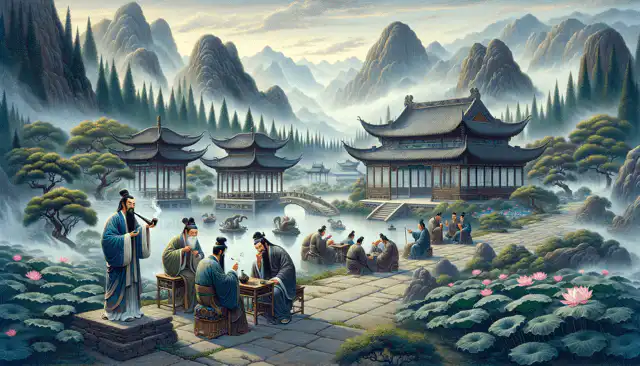
ancient china cannabis seeds

Ancient China — The Earliest Recorded Use of Cannabis Seeds

The earliest documented evidence of cannabis use comes from China, where archaeological findings suggest cultivation dating back to at least 10,000 BCE. Cannabis seeds have been found in ancient Chinese burial sites, and hemp cordage impressions have been identified on pottery from the same period — evidence that the plant was being deliberately cultivated and processed rather than simply foraged.

The most cited historical reference is the legendary Emperor Shen Nung, known as the Divine Farmer, credited with living around 2700 BCE. His pharmacopeia — the Shen Nung Ben Cao Jing — describes cannabis as a remedy for gout, rheumatism, malaria, and absent-mindedness. He recommended different preparations from the seeds, leaves, and roots for different conditions. Whether Shen Nung was a historical figure or a mythologised archetype of early Chinese medicine is debated, but the text itself is real and its references to cannabis are among the earliest written records of the plant’s medicinal use.

Beyond medicine, cannabis seeds were a food source in ancient China — consumed as grain, pressed for cooking oil, and used for lamp oil. The plant’s fibre produced textiles, rope, and paper. Cannabis was not a specialised drug plant in this context; it was an agricultural staple whose psychoactive properties were one dimension of a multifaceted relationship.

Ancient India — Spiritual Significance and the Sacred Texts

The Indian relationship with cannabis is perhaps the most spiritually significant in the ancient record. The Atharvaveda — one of the four sacred texts of Hinduism, dating to around 1500 BCE — lists cannabis as one of five sacred plants, describing it as a source of happiness, a joy-giver, and a liberator. In the Indian tradition, cannabis was not a vice or an indulgence; it was a divine gift, associated with the god Shiva, and used in religious ceremonies that continue in modified forms today.

The preparation known as bhang — made from the leaves and flowers of the cannabis plant, ground with milk, spices, and sometimes seeds — has been consumed in ritual and festive contexts in India for at least three thousand years. It is still prepared and consumed during the festival of Holi and at Shiva temples across the subcontinent.

The Ayurvedic medical texts, which form the foundational framework of traditional Indian medicine, document the use of cannabis seeds and other plant parts to treat pain, inflammation, sleep disorders, and a range of other conditions. Cannabis in the Ayurvedic tradition was understood as a powerful medicine requiring careful dosing and preparation — an understanding that reflects sophisticated pharmacological knowledge developed over centuries of observation.

The Indian subcontinent also gave the world the charas tradition — hand-rubbed live resin collected from flowering cannabis plants at altitude in the Hindu Kush and Himalayan foothills. This is one of the oldest cannabis extraction methods in existence, producing a product fundamentally different to pressed hash and requiring an intimate knowledge of plant maturity and handling that was passed between generations.

Ancient Egypt — Medicine, Ritual, and the Ebers Papyrus

The ancient Egyptian relationship with cannabis is documented in some of the oldest surviving medical texts in history. The Ebers Papyrus, dating to approximately 1550 BCE and one of the most comprehensive ancient medical documents known, contains multiple references to cannabis preparations — including a cannabis-based remedy applied for inflammation and pain relief. The text describes cannabis as shemshemet and documents its use across several medical applications.

Cannabis pollen was found in the tomb of Ramses II, one of the most powerful pharaohs in Egyptian history, who died around 1213 BCE. The presence of cannabis in royal burial contexts suggests it held significance beyond medicine — it was connected to ritual, spiritual practice, and potentially to beliefs about the afterlife. Whether it was burned as an offering, consumed by priests, or simply present as a valued commodity is debated among Egyptologists, but the archaeological evidence of its deliberate inclusion in one of history’s most significant tombs is unambiguous.

Central Asia and the Scythians — Cannabis as Ritual

The Scythians — nomadic peoples who occupied the Eurasian steppe from roughly the 9th to 4th centuries BCE — are among the most extensively documented ancient cannabis users in the archaeological record. The Greek historian Herodotus, writing in the 5th century BCE, described Scythian funeral rituals in which mourners threw cannabis seeds and plant material onto heated stones inside enclosed felt tents, inhaling the vapour and crying out in response. Herodotus wrote that they “howled with pleasure” — one of the earliest descriptions of recreational cannabis intoxication in the historical record.

Archaeological excavations of Scythian burial mounds across modern-day Russia, Kazakhstan, and Ukraine have confirmed the presence of cannabis seeds, charred plant material, and brazier equipment consistent with Herodotus’s description. These findings validate his account and establish the Scythians as one of the most significant vectors for the spread of cannabis use across Eurasia — their nomadic range covering thousands of kilometres of territory where cannabis knowledge and seeds would have been traded, gifted, and planted.

The Scythian homeland overlaps directly with the geographic origin of many of the world’s most significant cannabis landraces — including the Afghani genetics that form the backbone of modern indica breeding. The connection between Central Asian nomadic culture and the spread of cannabis genetics across the ancient world is not coincidental.

Afghanistan — Kandahar and the Hash Tradition

Of all the ancient cannabis-cultivating regions in the world, the Kandahar area of southern Afghanistan may be the most significant for understanding the genetics that dominate the modern cannabis catalogue. Afghani landrace cannabis — the compact, resinous, fast-flowering plant that became the foundational indica of Western breeding programmes — has been cultivated in this region for thousands of years. The plants that Western breeders brought to the Netherlands in the 1970s and 1980s, which formed the genetic basis of strains like Northern Lights and countless modern hybrids, came from this lineage.

The traditional hash production of the Kandahar region is pressed Afghani hash — flat, dark slabs produced by sieving dried cannabis over fine mesh screens and pressing the collected resin under heat. This is a fundamentally different tradition to the Northern Indian charas method of hand-rubbing live plants. The Afghani method produces a product that is dense, earthy, and intensely aromatic — reflecting the terpene profile of the landrace genetics from which it comes. The myrcene, caryophyllene, and pinene-dominant terpene profile of Afghani cannabis that makes strains like Northern Lights and Black Domina so distinctive in the modern catalogue is the same profile that has characterised Kandahar cannabis for millennia.

🌿 Jason & Jess — Kandahar, Early 1990s

We were in Afghanistan in the early 1990s — pre-Taliban, a period that already felt fragile but where travel was still possible in some regions. Getting to the Kandahar area was not straightforward, but we were young and curious about cannabis in a way that went beyond the recreational. We wanted to understand where the genetics came from. Where the plant actually lived before it became a catalogue entry.

What we found there stayed with us. The communities were extraordinary — close-knit villages where hospitality to strangers was a point of honour, where people who had very little would share everything. The cannabis fields were part of the landscape in a way that had no equivalent in what we’d seen in California or Amsterdam. Not hidden, not a secret industry — woven into agricultural life the way wheat fields are somewhere else.

The hash production was traditional pressed Afghani — the sieving method, not the hand-rubbing charas tradition of Northern India. We watched it being done by people who had learned from their fathers and their fathers’ fathers. The care in the process, the knowledge of the plant at different stages, the way they talked about different plants from different valleys producing different results — it was a level of botanical understanding that most Western growers would find humbling.

When we handle Afghani-lineage seeds now — Northern Lights, Black Domina, the genetics that trace back to that part of the world — we think about those villages. About the people who cultivated those landrace plants for centuries before a single Western seed bank existed. The genetics in our catalogue carry that history. It matters to us that growers know it.
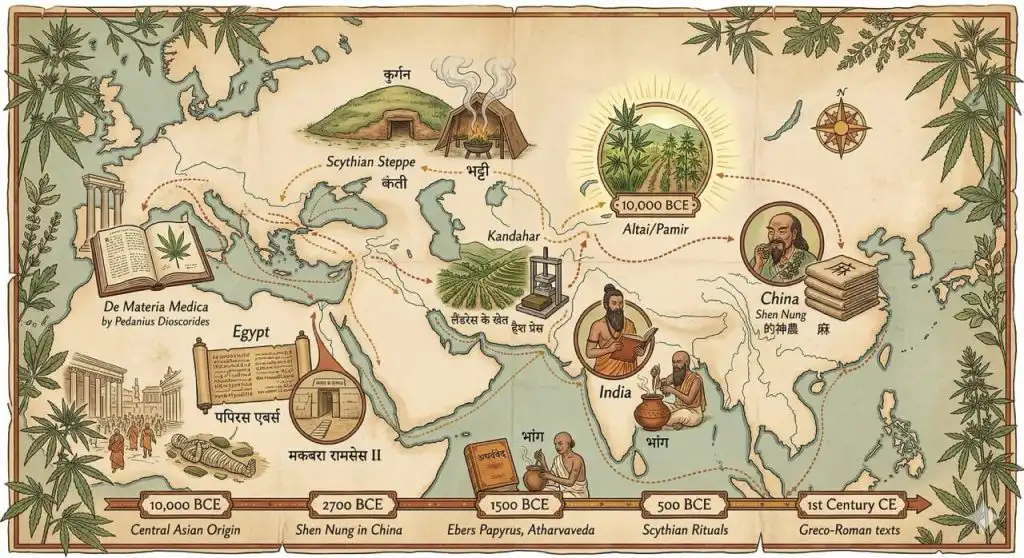
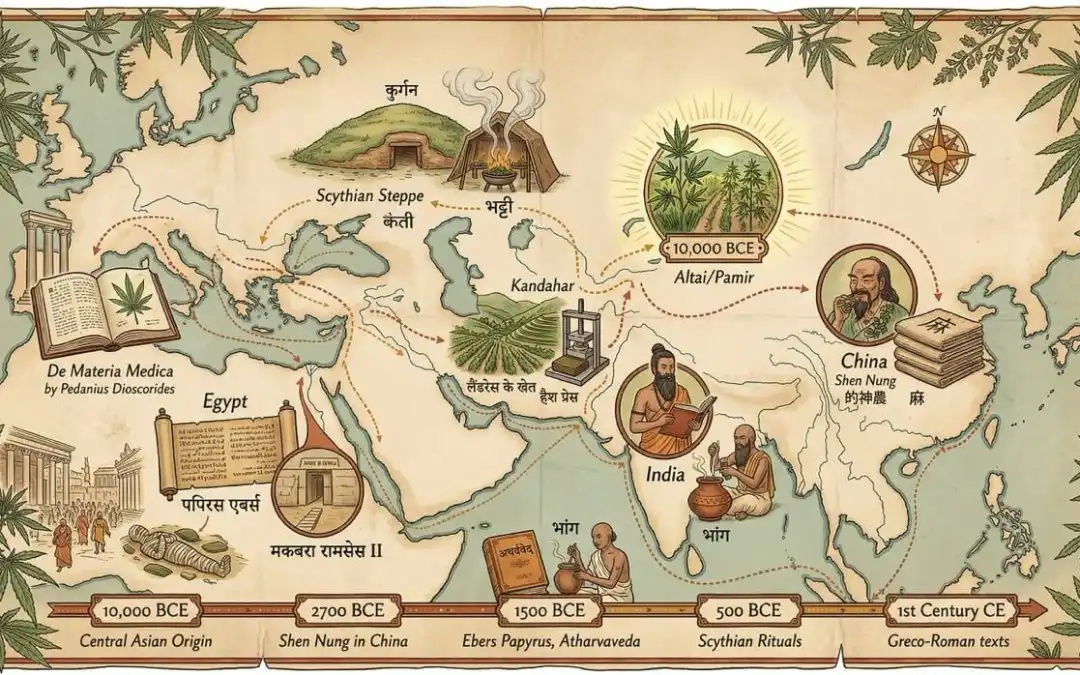
Ancient world map showing the spread of cannabis cultivation from Central Asia through China, India, Egypt, the Scythian steppe and Afghanistan along ancient trade routes

Ancient Greece and Rome — Medical Documentation

The ancient Greeks and Romans engaged with cannabis primarily through a medical lens, and their writings produced some of the most detailed early pharmacological descriptions of the plant. The Greek physician Pedanius Dioscorides, writing in the first century CE, included cannabis in his foundational medical text De Materia Medica — one of the most influential pharmaceutical references in Western history, remaining in use for over fifteen centuries after its composition. Dioscorides described cannabis as useful for treating earaches, reducing inflammation, and relieving pain. He also noted that the seeds, when consumed in large quantities, could diminish sexual function — an early observation of cannabis’s physiological effects beyond its psychoactive properties.

The Roman naturalist Pliny the Elder, writing in his encyclopaedic Natural History around 77 CE, described both the cultivation of hemp for fibre and the medicinal properties of the plant. He noted that the roots, boiled in water, could be applied to joints to relieve cramping and gout — consistent with uses documented in Chinese and Indian texts from centuries earlier, suggesting that by the Roman period, cannabis’s medicinal properties were well-established across multiple independent medical traditions.

The Greek historian Herodotus, already cited for his account of the Scythians, provides a crucial cultural link — connecting the Central Asian cannabis tradition to the Mediterranean world through his documentation of Scythian practices. His writing suggests that by the 5th century BCE, knowledge of cannabis’s psychoactive properties was not confined to any single cultural tradition but was spreading through the ancient trade networks that connected China, India, Central Asia, and the Mediterranean.

The Modern Era — Prohibition, Research, and Renaissance

The 20th century represents the most dramatic reversal in cannabis’s relationship with human culture in its recorded history. A plant that had been cultivated continuously for at least ten thousand years — used as food, fibre, medicine, and ritual substance across dozens of civilisations — was effectively criminalised across most of the world within a few decades. The United States Marijuana Tax Act of 1937 was the most significant early legislative step, followed by the inclusion of cannabis in the 1961 UN Single Convention on Narcotic Drugs, which established the global prohibition framework that most countries adopted.

The irony is that the decades of prohibition coincided with the beginning of serious scientific research into cannabis’s pharmacology. The isolation of THC by Raphael Mechoulam in 1964, and the subsequent discovery of the endocannabinoid system in the 1980s and 1990s, revealed that cannabis interacts with a biological regulatory system present in every mammal — a system that the plant’s compounds had been engaging for the entirety of its relationship with human biology.

The current period of partial legalisation and decriminalisation in various jurisdictions represents not a new development in human cannabis culture but a return to the historical norm — the criminalization of the 20th century being the anomaly in a ten-thousand-year story of cultivation and use. In Australia, the ACT permits adults to possess limited quantities of cannabis and grow up to two plants per person. Across the globe, the legal landscape continues to shift toward recognition of what ancient Chinese, Indian, Egyptian, and Central Asian cultures understood empirically: that this plant has a legitimate place in human life.

What Ancient Cannabis Means for Modern Genetics

The landrace cannabis varieties that ancient civilisations cultivated — the Afghani plants of the Kandahar valleys, the Hindu Kush varieties of the Northern Indian highlands, the Durban landraces of South Africa, the Thai sativas of Southeast Asia — are the genetic foundation of the modern cannabis catalogue. Every significant modern strain traces its lineage to one or more of these ancient regional varieties.

When breeders in the Netherlands in the 1970s and 1980s crossed Afghani landrace genetics with Northern Californian sativas, they were working with genetic material that had been shaped by thousands of years of natural selection in specific environments. The compact structure, fast flowering, and dense resin production of Afghani genetics are adaptations to the short growing seasons and high altitudes of the Hindu Kush and Kandahar regions. The terpene profile — the myrcene-dominant earthy musk that characterises Afghani-lineage strains — is the product of that same environmental selection pressure.

Understanding this history matters practically for growers. Indica-dominant strains with Afghani lineage — Northern Lights, Godfather OG, Black Domina — carry the genetic adaptations of plants that evolved to thrive in specific conditions. Their mould resistance, their fast flowering, their compact structure are not arbitrary breeding outcomes — they are ancient survival strategies encoded in the genetics.

Similarly, African landrace sativas like Durban Poison carry the genetic profile of plants that evolved in a specific climate and photoperiod — which is why they perform so well in Australian conditions that approximate the South African outdoor season. The sativa-dominant genetics in our catalogue connect back to growing traditions that predate the modern seed bank industry by centuries.

Key Takeaways — The History of Marijuana Seeds

Cannabis has been cultivated continuously for at least ten thousand years across China, India, Egypt, Central Asia, and beyond — used as food, fibre, medicine, and ritual substance long before the modern cannabis industry existed. The landrace genetics that ancient civilisations developed in specific environments — Afghani, Hindu Kush, Durban, Thai — form the genetic foundation of every significant strain in the modern catalogue. The 20th century prohibition of cannabis was a historical anomaly in a ten-thousand-year story of cultivation and use. The genetics in today’s cannabis seeds carry that entire history, and understanding it gives growers a deeper appreciation of what they’re actually working with. For Australian growers interested in strains with genuine historical lineage, the Sacred Seeds catalogue stocks Afghani-lineage indicas, African sativas, and modern hybrids that trace their genetics to these ancient cultivating traditions.

Explore strains with genuine lineage

Answer six questions and Jess will match you to three strains based on your setup, experience, and goals.

Find Your Strain →

History of Marijuana Seeds — Frequently Asked Questions

How long have humans been using cannabis seeds?

Archaeological evidence suggests cannabis cultivation dates back at least 10,000 years in China, where seeds and hemp cordage impressions have been found at ancient sites. Written records documenting cannabis’s medicinal use begin around 2700 BCE with references in ancient Chinese texts, with Indian, Egyptian, and Central Asian records following from roughly 1500–500 BCE.

Where did cannabis originate?

The most widely accepted origin is Central Asia — the Hindu Kush mountain range and surrounding areas including modern-day Afghanistan, Pakistan, and Northwestern China. From this geographic centre, cannabis spread through trade routes and human migration across Asia, the Middle East, Africa, and eventually Europe and the Americas. The genetic diversity of modern cannabis reflects thousands of years of cultivation in these distinct regional environments.

What did ancient cultures use cannabis seeds for?

Ancient cultures used cannabis seeds as a food source — ground as grain or pressed for oil — as well as in medicinal preparations documented in Chinese, Indian, and Egyptian medical texts. Seeds were also used in ritual contexts, found in burial sites from Egypt to the Scythian burial mounds of Central Asia. The plant’s fibre was used for textiles, rope, and paper across multiple ancient civilisations.

What is the history of hash production in Afghanistan?

The Kandahar region of Afghanistan has one of the oldest continuous cannabis cultivating traditions in the world. Traditional Afghani hash is produced by sieving dried cannabis plant material over fine screens to collect the resin, which is then pressed under heat into flat slabs — a method distinct from the hand-rubbing charas tradition of Northern India. This Afghani hash tradition has been practised for centuries, and the landrace genetics developed in this region form the backbone of modern indica breeding worldwide.

How did cannabis prohibition happen?

Cannabis prohibition in the modern era began primarily through US legislation — the Marijuana Tax Act of 1937 effectively criminalised the plant — and was globalised through the 1961 UN Single Convention on Narcotic Drugs. The prohibition represented a dramatic reversal of thousands of years of cannabis cultivation and use. Scientific research conducted during the prohibition period ironically produced the most significant discoveries about cannabis’s pharmacology, including the isolation of THC in 1964 and the discovery of the endocannabinoid system in the 1980s and 1990s.

How does the history of cannabis connect to modern strains?

Every significant modern cannabis strain traces its genetic lineage to ancient regional landrace varieties. Afghani landrace genetics — from the Kandahar and Hindu Kush regions — form the foundation of indica breeding and appear in strains like Northern Lights, Godfather OG, and Black Domina. African landraces from South Africa underpin sativa-dominant strains like Durban Poison. Southeast Asian genetics contributed to classic sativas. The breeders who created the modern cannabis catalogue in the 1970s and 1980s were working with genetics that had been shaped by thousands of years of natural selection in specific environments.

Is it legal to collect marijuana seeds in Australia?

Cannabis seeds are sold as novelty collector’s items in Australia. The legal status of germinating or cultivating cannabis varies by state — the ACT permits limited personal cultivation for adults; all other states prohibit cultivation. Sacred Seeds sells seeds strictly as collectibles in accordance with Australian law. Always check the specific laws in your state before germinating or cultivating.

Related Reading

Cannabis seed collecting in Australia — the philosophy and practice of building a serious genetics collection.

How to store cannabis seeds in Australia — preserving viability and genetics over the long term.

From landrace to hybrid — how cannabis genetics evolved — the breeding history from ancient landraces to modern strains.

Choosing the best cannabis strains — Sacred Seeds full guide — how to navigate the catalogue and find the right genetics for your grow.

Browse all cannabis seeds — feminised, autoflower, and photoperiod strains shipped from Australia.

Seeds are sold strictly as novelty collector’s items. They contain no THC or CBD. This page does not constitute medical or legal advice. By purchasing you agree to our terms and conditions. Always check local laws before germinating or cultivating cannabis.

Cannabis Terpenes: What They Are, Effects & Why They Matter

Cannabis Terpenes: What They Are, Effects & Why They Matter

Terpenes are the compounds responsible for why two strains with similar THC percentages can produce completely different experiences. They’re what makes Amnesia Haze smell like freshly peeled lemons and hit with a clean cerebral lift, while Godfather OG smells like earthy pine and grape and puts you on the couch. THC percentage tells you about intensity. Terpene profile tells you about character.

Understanding terpenes changes how you think about strain selection — and how you grow. This post covers what the major terpenes are, what they do, how they interact with cannabinoids, and what you can do in the grow to maximise their expression.

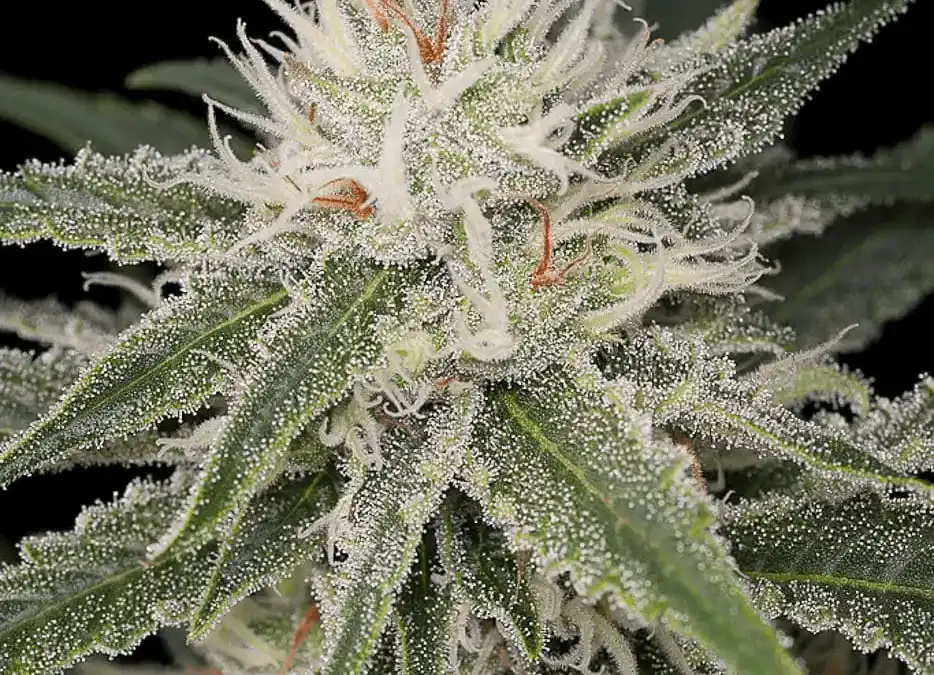
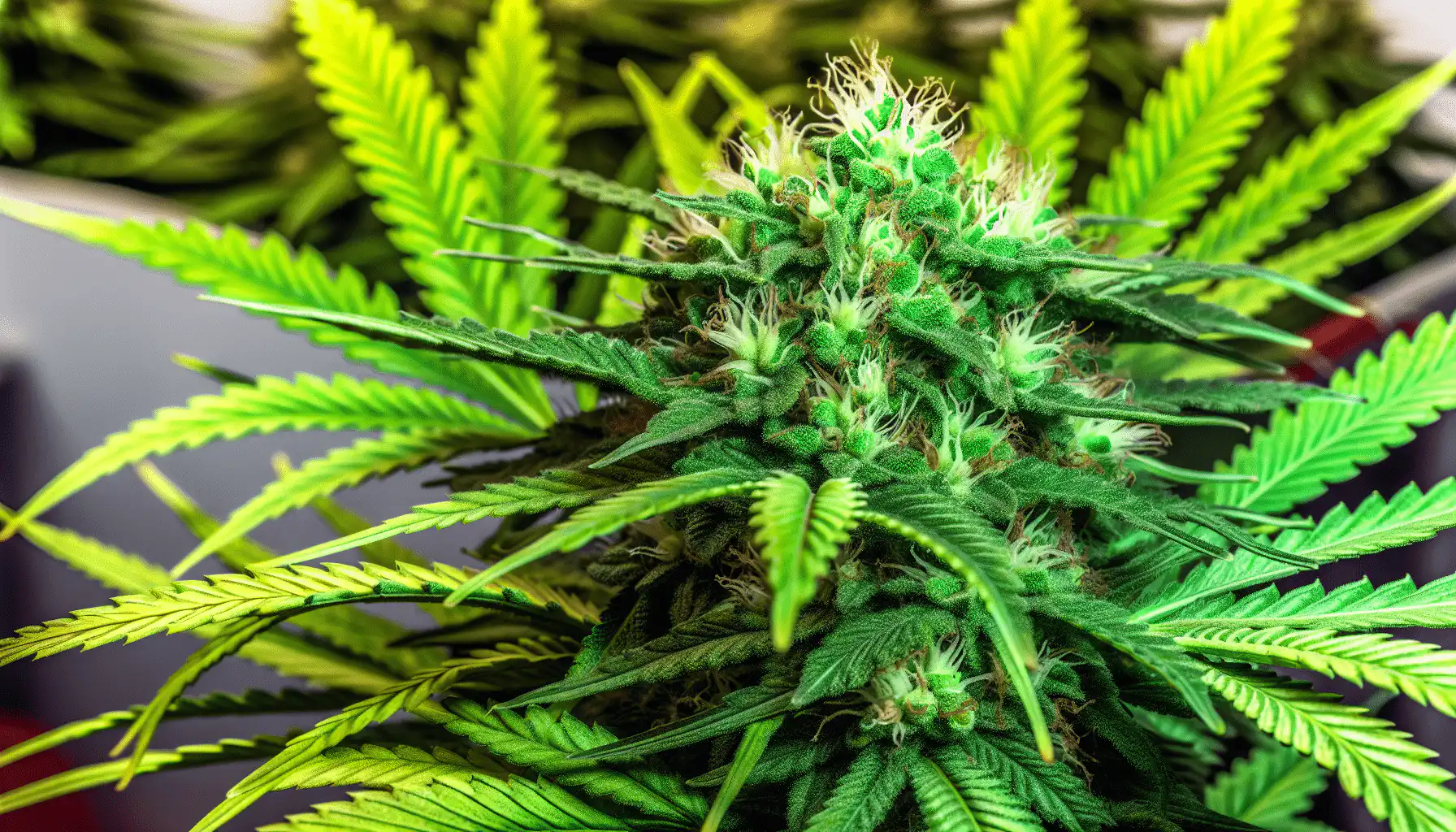
Cannabis plant showing trichomes where terpenes and cannabinoids are produced

What Are Terpenes?

Terpenes are aromatic compounds produced in the trichomes of cannabis plants — the same resin glands that produce THC and CBD. They evolved primarily as a defence mechanism: repelling predators, resisting pathogens, and attracting pollinators. The same compounds that make a plant smell distinctive to insects and animals create the flavour and aroma profiles that growers and consumers recognise in individual strains.

Cannabis produces over 150 known terpenes, though most strains are dominated by a handful. These dominant terpenes — typically two or three — define the strain’s aroma profile and, in combination with its cannabinoid content, shape the character of the effect. This is why looking at a strain’s terpene profile alongside its THC percentage gives you far more information about what it will actually produce than THC percentage alone.

Jason: The first thing I do when evaluating a strain is smell it. Not look at the THC number — smell it. A heavy myrcene profile has a characteristic earthy, musky note that tells me it’s going to be sedative and body-heavy regardless of whether it’s labelled indica or sativa. A sharp citrus note means limonene dominance and a more uplifting effect. The nose is a faster guide to what the strain does than any spec sheet.

The Major Cannabis Terpenes — What They Are and What They Do

Myrcene

Myrcene is the most abundant terpene in most commercially available cannabis strains and is responsible for the earthy, musky, slightly fruity aroma characteristic of indica-dominant genetics. It has sedative properties and — critically — facilitates THC crossing the blood-brain barrier, which is why myrcene-dominant strains tend to produce a heavier, faster-onset effect than their THC percentage alone would suggest. If a strain makes you sink into the couch, myrcene is almost certainly the dominant terpene. High in Godfather OG, Northern Lights, most Kush-lineage genetics, and the majority of indica-dominant hybrids.

Caryophyllene

Caryophyllene is the only terpene known to directly activate cannabinoid receptors — specifically CB2 receptors, which are concentrated in the immune system and peripheral tissues and are involved in inflammation and pain response. This makes it unique among terpenes: it functions partly as a cannabinoid. Strains dominant in caryophyllene tend to produce a physically relaxing effect with notable anti-inflammatory depth, without the heavy sedation of myrcene dominance. The aroma is spicy, peppery, and woody. Dominant in Gorilla Glue #4, Girl Scout Cookies, Permanent Marker, and Zkittlez.

Limonene

Limonene produces the sharp citrus aroma — lemon, orange, lime — found in many Haze genetics and sativa-dominant strains. It’s associated with mood elevation, stress reduction, and anxiolytic effects, which is why limonene-dominant strains produce the uplifting, clear-headed experience that gets attributed to “sativa” genetics. The effect distinction between a limonene-dominant and myrcene-dominant strain can be as significant as the distinction between two strains with 5% THC difference. Dominant in Amnesia Haze, Super Lemon Haze, and citrus-forward Haze crosses.

Pinene

Pinene — the dominant terpene in pine trees — produces a sharp, clean pine aroma and has a counterintuitive effect on the cannabis experience: it’s a bronchodilator and has been found to improve alertness and short-term memory retention. This matters because high THC causes temporary memory impairment through CB1 receptor activation, and pinene partially offsets this. Strains with significant pinene content alongside high THC tend to produce a more functional, clear-headed effect than strains where myrcene dominates at the same THC level. Common in Jack Herer, Blue Dream, and many landrace sativa genetics.

Linalool

Linalool is the terpene that gives lavender its characteristic aroma and is found in cannabis strains with floral, slightly spicy notes. It has calming, anxiolytic properties and is found in strains that produce a gentle, relaxed effect without strong sedation. Useful for growers whose primary use case is anxiety management — linalool-dominant strains tend to reduce THC-induced anxiety rather than amplify it. Common in some Kush crosses and strains with Afghan landrace in the lineage.

Humulene

Humulene produces an earthy, woody, slightly hoppy aroma — it’s the same terpene found in hops. It has anti-inflammatory properties and, notably, is an appetite suppressant, which explains why some high-THC strains don’t produce the strong munchies effect associated with cannabis generally. Significant in Gelato, some OG genetics, and strains with a more complex earthy-floral aroma profile.

Terpinolene

Terpinolene has a complex, multi-layered aroma — floral, herbal, pine, and citrus simultaneously — and produces an uplifting, mildly sedative effect that’s distinct from either the heavy myrcene body effect or the clean limonene lift. It’s less common as a dominant terpene but characteristic of Jack Herer and some Haze genetics. Strains where terpinolene dominates tend to be the most aromatically complex.

Different cannabis strains showing distinct terpene profiles in their structure and aroma

The Entourage Effect — Why Whole-Plant Matters

The entourage effect is the hypothesis — supported by a growing body of research — that cannabinoids and terpenes produce different effects in combination than they do in isolation. Isolated THC and whole-plant cannabis with the same THC content produce measurably different experiences, and the difference is attributed primarily to the terpene profile modifying the cannabinoid activity.

The mechanism is partly understood. Myrcene facilitates THC uptake. Caryophyllene activates CB2 receptors independently. Pinene inhibits the enzyme that breaks down acetylcholine, partially counteracting THC’s short-term memory effects. Limonene interacts with serotonin and dopamine receptors. These are not vague synergies — they’re specific biochemical interactions.

The practical implication for growers is that preserving the terpene profile of a strain matters as much as the THC percentage. A high-THC strain that’s been grown too hot, harvested early, or dried and cured poorly will have degraded terpenes — and the effect will be flatter and less nuanced than the genetics are capable of producing. The terpene profile you’re targeting is only achieved if the grow, harvest, and cure support it.

Jason: I’ve grown the same strain twice — once in a hot summer run where temperatures in flower pushed above 28°C, and once in autumn with cool nights and controlled conditions. Same genetics, same inputs, wildly different terpene expression in the final product. The hot run was potent but flat. The autumn run had the full flavour profile the genetics are capable of. Temperature in late flower is the single biggest environmental variable for terpene expression.

Terpene Profiles of Key Strains

The following profiles are for the strains we stock. Dominant terpenes are listed first — these drive the primary effect character. Secondary terpenes add depth and complexity to both the aroma and the experience.

Northern Lights — Myrcene dominant, with caryophyllene and pinene. The myrcene dominance drives the classic indica body effect — heavy, relaxing, sedative. The pinene adds a clean pine note to the earthy baseline aroma. A straightforward terpene profile that does exactly what it says.

Gorilla Glue #4 — Caryophyllene dominant, with limonene and myrcene. The caryophyllene drives a deep physical effect with anti-inflammatory depth. The limonene adds an uplifting quality that prevents the heavy sedation of pure myrcene dominance — GG4 is physically potent but more functional than a pure indica. The aroma is sour diesel with earthy and spicy notes.

Amnesia Haze — Limonene and pinene dominant, with caryophyllene. The limonene/pinene combination produces the sharp citrus aroma and the clean, energetic, cerebral effect that makes Amnesia Haze distinctive. It’s the clearest example in our range of what a limonene-dominant terpene profile does — uplifting, functional, and sustained. Jess’s pick precisely because of this profile.

White Widow — Myrcene, pinene, and caryophyllene. A balanced profile that produces the characteristic White Widow effect — an initial cerebral lift from the pinene, settling into a comfortable physical ease driven by myrcene. The combination makes it more versatile than either pure indica or pure sativa genetics.

Jack Herer — Terpinolene dominant, with caryophyllene and myrcene. Terpinolene dominance gives Jack Herer its complex, multi-layered aroma — floral, herbal, pine, and spice simultaneously. The effect is uplifting and creative without being anxious. One of the more distinctive terpene profiles in the range.

Zkittlez — Caryophyllene, humulene, and linalool. A fruity-sweet aroma profile underpinned by the earthy caryophyllene and humulene base. The linalool contributes the calming quality — Zkittlez produces a relaxed, comfortable effect without the heavy sedation of myrcene-dominant strains. The humulene also means it’s one of the less munchie-inducing strains despite solid THC content.

How to Maximise Terpene Expression in Your Grow

Terpenes are volatile compounds — they evaporate readily at elevated temperatures and degrade with light exposure, oxygen, and rough handling. The genetics set the ceiling for what a strain can produce. The grow, harvest, and cure determine how close you get to that ceiling.

Temperature in late flower is the most significant controllable variable. Terpene evaporation accelerates above 26°C, and the loss is permanent — terpenes that evaporate from buds don’t come back. Keeping the grow space below 24°C in the final two to three weeks of flower, with cool nights where possible, preserves the terpene profile and is visible in the final product. Outdoor growers in Australia who harvest in autumn — when nights cool down — consistently get better terpene expression than those harvesting in the heat of summer.

Low-stress training and adequate light penetration improve terpene density by ensuring more bud sites receive direct light, which drives trichome and terpene production. UV exposure in particular has been shown to increase trichome density — outdoor grows in high UV environments often produce more aromatic material than indoor runs, provided temperature is managed.

Flushing in the final week to ten days, a slow dry at 15–18°C and 55–60% RH, and a proper cure of four to six weeks minimum all contribute to the final terpene expression. Terpenes continue to develop in the jar during the cure — material that smells decent at harvest often smells significantly better after six weeks of proper curing. Rushing this process is the most common way to undermine an otherwise good grow.

Looking for a strain with a specific terpene profile?

Answer six questions and Jess will match you to three strains based on your setup, experience, and goals.

Find Your Strain →

Cannabis Terpenes — Frequently Asked Questions

What are terpenes in cannabis?

Terpenes are aromatic compounds produced in the trichomes of cannabis plants — the same resin glands that produce THC and CBD. They determine a strain’s aroma and flavour profile and, in combination with cannabinoids, shape the character of the effect. Over 150 terpenes have been identified in cannabis, though most strains are dominated by two or three.

Do terpenes affect how cannabis makes you feel?

Yes — and more significantly than most growers realise. Terpenes interact with cannabinoid receptors, neurotransmitters, and other biological pathways. Myrcene facilitates THC uptake and has sedative properties. Caryophyllene activates CB2 receptors directly. Limonene interacts with serotonin receptors. Pinene counteracts THC-induced short-term memory impairment. The terpene profile is a more accurate predictor of a strain’s effect character than its THC percentage.

What is the entourage effect?

The entourage effect is the hypothesis that cannabinoids and terpenes produce different — generally more nuanced and therapeutically effective — effects in combination than in isolation. Whole-plant cannabis with a complex terpene profile produces a different experience to isolated THC at the same dose. The specific mechanisms include terpenes modifying cannabinoid receptor activity, facilitating cannabinoid uptake, and producing their own independent biological effects.

Which terpene is best for sleep?

Myrcene is the most directly sedative terpene and the strongest choice for sleep. It facilitates THC crossing the blood-brain barrier, amplifying the sedative effect. Linalool also has calming properties and reduces anxiety that might otherwise interfere with sleep. Strains with high myrcene and linalool — most Kush-lineage genetics and heavy indica-dominant strains — consistently outperform other types for sleep use.

Which terpene is responsible for the citrus smell in cannabis?

Limonene. It’s the same terpene that gives lemons, limes, and oranges their characteristic scent. In cannabis it’s associated with uplifting, mood-elevating effects and reduced anxiety — strains with limonene dominance tend to produce the clear, energetic “sativa” experience. Amnesia Haze is the most pronounced example in our range.

How do I preserve terpenes during growing and curing?

Keep temperatures below 24°C in late flower — terpenes are volatile and evaporate at elevated temperatures. Dry slowly at 15–18°C and 55–60% RH for 10–14 days. Cure in sealed glass jars at 60–65% RH for a minimum of four weeks, burping daily for the first two weeks. The terpene profile continues to develop during the cure — material that’s decent at harvest is often significantly better after six weeks properly jarred.

What is the most common terpene in cannabis?

Myrcene is the most abundant terpene in most commercially available cannabis strains. It’s responsible for the earthy, musky baseline aroma characteristic of indica-dominant genetics and is the primary driver of the sedative body effect associated with that type.

Related Reading

Indica-dominant cannabis seeds — myrcene and caryophyllene-dominant genetics for body effect and sedation.

Sativa-dominant cannabis seeds — limonene and pinene-dominant genetics for uplifting, cerebral effects.

High-THC cannabis seeds — where THC ceiling and terpene profile combine for maximum effect.

Full strain selection guide — Jason’s complete breakdown of the Sacred Seeds lineup by genetics, effect, and growing characteristics.

Seeds are sold strictly as novelty collector’s items. They contain no THC or CBD. This page does not constitute medical or legal advice. By purchasing you agree to our terms and conditions. Always check local laws before germinating or cultivating cannabis.

Indica vs Sativa: What’s the Difference?

Indica vs Sativa: What’s the Difference?

The indica vs sativa distinction is one of the most widely used frameworks in cannabis — and one of the least accurate. The idea that indica means sedating body high and sativa means energising cerebral high is a useful shorthand that the industry has largely moved past, because it doesn’t map reliably onto what strains actually do. Understanding why leads to much better strain selection decisions.

This post covers the real differences between indica and sativa as plant types, why the indica/sativa effect model breaks down, what actually drives a strain’s effects, and how to use that knowledge when choosing genetics.

Indica and Sativa as Plant Types — What’s Actually Different

The indica/sativa distinction is botanically real at the morphology level. Cannabis indica originated in the Hindu Kush mountain range — Afghanistan, Pakistan, northern India — and evolved in a harsh, high-altitude, short-season environment. The plants are compact and bushy, with broad dark leaves, dense bud structure, and a relatively fast flowering time. That fast flowering is an adaptation to a short growing season, not a coincidence.

Cannabis sativa originated in equatorial regions — Southeast Asia, Central America, parts of Africa — where the growing season is long and the climate warm and humid year-round. Sativa plants grew tall to compete for light, developed narrow leaves, and evolved long flowering cycles because there was no environmental pressure to finish quickly. The airy, open bud structure that makes sativas less prone to mould in humid conditions is another adaptation to the climate they evolved in.

These morphological differences are real and they matter for growers. Indica-dominant genetics suit small indoor grows and short outdoor seasons. Indica-dominant strains finish faster, stay compact, and produce dense buds. Sativa-dominant genetics need space, time, and warmth — they’re not practical for small tents or cool short-season climates, but they thrive outdoors in Queensland and Northern NSW where the season accommodates the timeline.

Where the indica/sativa model falls apart is when it’s applied to effects.

Why “Indica = Body, Sativa = Head” Isn’t Reliable

The reason the effect model breaks down is that virtually no commercially available cannabis is a true landrace indica or sativa anymore. The strains available from any seed bank — including ours — are the product of decades of deliberate crossbreeding between indica and sativa genetics. A strain labelled “indica-dominant” may be 70% indica by genetics but carry a terpene profile that produces effects closer to what you’d expect from a sativa, or vice versa. The label tells you about plant structure and flowering time more reliably than it tells you about effects.

The more accurate predictor of a strain’s effects is its chemical profile — specifically, the combination of cannabinoids and terpenes it produces.

Jason: I’ve grown indica-dominant strains that produce a surprisingly cerebral, functional high — and I’ve grown sativa-dominant strains that put people on the couch. The label is useful for planning your grow space and timing your outdoor season. It’s not a reliable guide to what the smoke will feel like. For that you need to look at the terpene profile.

What Actually Drives Effects — Terpenes and Cannabinoids

THC is the primary psychoactive cannabinoid — it binds to CB1 receptors in the brain and central nervous system and produces the intoxicating effect. CBD is non-intoxicating and modulates the effects of THC when both are present, generally softening the psychoactive intensity and contributing its own therapeutic properties. The ratio of THC to CBD matters, but it’s not the whole picture.

Terpenes — the aromatic compounds that give each strain its distinctive smell — have a more significant influence on the character of the effect than most growers realise. They’re not just flavour compounds. Several major terpenes interact directly with the endocannabinoid system and with neurotransmitter pathways, shaping the quality of the high in ways that THC percentage alone doesn’t capture.

Myrcene is the most common terpene in cannabis and is found at high levels in most indica-dominant strains. It has sedative properties and facilitates THC crossing the blood-brain barrier, which is why myrcene-dominant strains tend to produce the heavy, couch-lock effect people associate with indicas. The effect isn’t from the indica genetics per se — it’s from the myrcene.

Caryophyllene is the only terpene that directly activates cannabinoid receptors — specifically CB2 receptors, which are involved in inflammation and pain response. Strains with dominant caryophyllene tend to produce a more physically relaxing effect with notable anti-inflammatory properties. Girl Scout Cookies and Gorilla Glue #4 are both caryophyllene-dominant — which is part of why they hit the way they do despite being different genetics.

Limonene is associated with mood elevation and anxiety reduction. Strains with high limonene — many Haze genetics, Amnesia Haze in particular — produce the uplifting, clear-headed effect that gets attributed to “sativa” genetics. Again, it’s the terpene driving the character of the high, not the botanical classification.

Linalool has calming, anxiolytic properties. Pinene improves alertness and memory retention and counteracts some of the cognitive fog associated with high-THC use. Humulene suppresses appetite — which is why some strains don’t produce the munchies despite high THC.

Jason: When I’m recommending a strain to someone, the first question is always what effect they’re after. A grower chasing therapeutic sedation and pain relief needs myrcene and caryophyllene dominance — something like Godfather OG or Northern Lights. Someone who wants to stay functional needs a strain where limonene or pinene is prominent enough to counteract the myrcene. THC percentage is almost a secondary consideration once you understand what the terpenes are doing.

Key Terpenes and What They Do

Myrcene — Sedative, facilitates THC uptake. Dominant in most indica-dominant strains. Drives the heavy body effect. High in Godfather OG, Northern Lights, most Kush genetics.

Caryophyllene — Anti-inflammatory, activates CB2 receptors. Physical relaxation without heavy sedation. Dominant in Gorilla Glue #4, Girl Scout Cookies, Permanent Marker.

Limonene — Mood elevation, anxiety reduction. The terpene behind uplifting “sativa” effects. Prominent in citrus-forward strains, many Haze genetics.

Linalool — Calming, anxiolytic. Reduces anxiety associated with high-THC use. Common in Lavender and some Kush crosses.

Pinene — Alertness, memory retention. Counteracts THC-induced cognitive fog. Common in strains with a sharp pine aroma.

Humulene — Appetite suppression, anti-inflammatory. Found in Gelato, some OG genetics. Explains why some high-THC strains don’t trigger strong munchies.

Hybrids — What the Label Actually Means

Almost everything in the modern cannabis catalogue is a hybrid. The question isn’t whether a strain is a hybrid — it’s what the indica/sativa ratio means in practical terms for growing and for effects.

An indica-dominant hybrid like Gorilla Glue #4 will have the compact, manageable structure and the relatively fast flowering time of indica genetics, but its caryophyllene and myrcene terpene profile drives a deep physical effect that’s more complex than a simple classification suggests. Girl Scout Cookies is technically indica-dominant but the Durban Poison sativa genetics in the lineage give it a euphoric, sociable opening phase that a pure indica wouldn’t produce — then the body relaxation follows.

On the sativa-dominant side, Amnesia Haze is the clearest example of genuine sativa expression — long flowering time, tall structure, sharp lemon terpene profile driven by limonene, and a cerebral effect that lasts. It’s not the easiest strain to manage but the effect is genuinely distinctive and can’t be replicated with a faster-finishing indica-dominant hybrid.

Balanced hybrids are the most practical choice for growers who want a manageable plant that doesn’t sacrifice the complexity of effect. The 50/50 indica/sativa genetics typically means medium height, medium flowering time, and an effect that combines the body relaxation of indica dominance with the mental lift of sativa influence.

What This Means for Australian Growers

For outdoor Australian growers, the morphological differences between indica and sativa are more practically relevant than the effect differences. Queensland and Northern NSW growers have the season length to run sativa-dominant genetics properly — the long flowering window that makes Amnesia Haze impractical in Victoria is manageable in subtropical climates. The open bud structure of sativa-dominant strains is also an advantage in coastal climates where humidity through February and March can cause problems for dense indica buds.

In Victoria, SA, and Tasmania, indica-dominant genetics and fast version strains are the practical choice outdoors. The season doesn’t accommodate 10–11 week sativa flowering times, and the risk of autumn rain hitting dense indica buds is already real enough without adding weeks to the timeline. Fast version genetics — photoperiod strains with a Ruderalis cross that shortens flowering by one to three weeks — are worth considering here specifically.

For indoor growers, the indica/sativa distinction matters mainly for canopy management and grow space. Sativa-dominant strains stretch significantly in early flower — 50–100% height increase is common — which makes them impractical in low-ceiling tents without aggressive training. Indica-dominant genetics stay compact and are generally easier to manage in a fixed indoor space.

The full Australian climate strain guide covers regional strain selection in more detail.

Not sure whether indica or sativa suits your grow?

Answer six questions and Jess will match you to three strains based on your setup, experience, and goals.

Find Your Strain →

Indica vs Sativa — Frequently Asked Questions

Is indica or sativa better for sleep?

High-myrcene, indica-dominant strains are the strongest choice for sleep. Myrcene is sedative and facilitates THC uptake, which is why indica-dominant genetics with a myrcene-dominant terpene profile — Godfather OG, Northern Lights, Master Kush — consistently outperform sativa-dominant strains for sleep. The indica/sativa label is a reasonable proxy here, but the terpene profile is the more reliable predictor than the botanical classification.

Is sativa stronger than indica?

Not inherently. THC percentage varies across both types and is determined by genetics and growing conditions, not by whether a strain is indica or sativa dominant. Sativa-dominant strains tend to produce a more cerebral, stimulating effect because of their terpene profiles — typically higher limonene — rather than because they contain more THC. Some of the highest-THC strains in our range are indica-dominant.

What’s the difference between indica and sativa plants to grow?

Indica-dominant plants are shorter, bushier, faster-flowering, and more compact — suited to small indoor spaces and short outdoor seasons. Sativa-dominant plants stretch significantly, take longer to flower (often 10–12 weeks from flip), and need space and warmth. For most Australian indoor growers and for outdoor growers in the southern states, indica-dominant or balanced hybrid genetics are more practical than sativa-dominant strains.

What are hybrid strains?

Virtually all modern cannabis strains are hybrids — crosses between indica and sativa genetics bred for specific combinations of structure, yield, flowering time, and chemical profile. An indica-dominant hybrid will typically have the compact structure and faster finish of indica genetics with terpene complexity introduced by the sativa lineage. The indica/sativa ratio in a hybrid is most useful as a guide to growing behaviour rather than as a precise predictor of effects.

Does the indica/sativa distinction still matter?

For growing decisions — yes, it’s still a useful starting point. Indica-dominant genetics for compact spaces and short seasons, sativa-dominant for long warm outdoor seasons and growers who want the specific sativa effect profile. For predicting effects — less so. The terpene profile is a more accurate guide to what a strain will feel like than the indica/sativa label, and the two don’t always correlate the way the traditional model suggests.

What terpenes should I look for in a strain I want to grow?

It depends on the effect you’re after. For sedation and pain relief, look for myrcene and caryophyllene dominance. For uplifting, functional effects, look for limonene and pinene. For anxiety reduction without heavy sedation, linalool. The terpene profiles of specific strains are listed on each product page — this is more useful information than the indica/sativa classification for understanding what a strain will actually produce.

Related Reading

Browse indica-dominant cannabis seeds — compact, fast-flowering genetics suited to small spaces and short seasons.

Browse sativa-dominant cannabis seeds — longer-flowering genetics for warm climates and growers chasing the distinctive sativa effect profile.

Browse balanced hybrid cannabis seeds — the practical middle ground for most growing situations.

Best cannabis strains for Australian climates — regional strain selection for outdoor growers across all Australian states.

Autoflower vs photoperiod seeds — the other major format distinction worth understanding before choosing genetics.

Seeds are sold strictly as novelty collector’s items. They contain no THC or CBD. This page does not constitute medical or legal advice. By purchasing you agree to our terms and conditions. Always check local laws before germinating or cultivating cannabis.
{
“@context”: “https://schema.org”,
“@type”: “FAQPage”,
“mainEntity”: [
{
“@type”: “Question”,
“name”: “Is indica or sativa better for sleep?”,
“acceptedAnswer”: {
“@type”: “Answer”,
“text”: “High-myrcene, indica-dominant strains are the strongest choice for sleep. Myrcene is sedative and facilitates THC uptake — indica-dominant genetics with a myrcene-dominant terpene profile consistently outperform sativa-dominant strains for sleep.”
}
},
{
“@type”: “Question”,
“name”: “Is sativa stronger than indica?”,
“acceptedAnswer”: {
“@type”: “Answer”,
“text”: “Not inherently. THC percentage varies across both types and is determined by genetics and growing conditions, not botanical classification. Sativa-dominant strains tend to produce a more cerebral effect because of their terpene profiles — typically higher limonene — rather than because they contain more THC.”
}
},
{
“@type”: “Question”,
“name”: “What’s the difference between indica and sativa plants to grow?”,
“acceptedAnswer”: {
“@type”: “Answer”,
“text”: “Indica-dominant plants are shorter, bushier, faster-flowering, and more compact — suited to small indoor spaces and short outdoor seasons. Sativa-dominant plants stretch significantly, take longer to flower (often 10–12 weeks from flip), and need space and warmth.”
}
},
{
“@type”: “Question”,
“name”: “What are hybrid strains?”,
“acceptedAnswer”: {
“@type”: “Answer”,
“text”: “Virtually all modern cannabis strains are hybrids — crosses between indica and sativa genetics. The indica/sativa ratio in a hybrid is most useful as a guide to growing behaviour — compact vs tall, fast vs slow — rather than as a precise predictor of effects.”
}
},
{
“@type”: “Question”,
“name”: “Does the indica/sativa distinction still matter?”,
“acceptedAnswer”: {
“@type”: “Answer”,
“text”: “For growing decisions yes — indica-dominant for compact spaces and short seasons, sativa-dominant for long warm outdoor seasons. For predicting effects, the terpene profile is more accurate than the indica/sativa label, and the two don’t always correlate the way the traditional model suggests.”
}
},
{
“@type”: “Question”,
“name”: “What terpenes should I look for in a strain I want to grow?”,
“acceptedAnswer”: {
“@type”: “Answer”,
“text”: “For sedation and pain relief, look for myrcene and caryophyllene dominance. For uplifting functional effects, look for limonene and pinene. For anxiety reduction without heavy sedation, linalool. Terpene profiles are listed on each product page.”
}
}
]
}

Cannabis in Australia: Laws and future Scenarios

Cannabis in Australia: Laws and future Scenarios

Cannabis seeds occupy a specific legal position in Australia that’s worth understanding before you buy. This post covers what that position is, how Sacred Seeds operates within it, and what you need to know about the legal landscape before making decisions about your collection.

This is general information only — not legal advice. Laws change and vary significantly by state and territory. If you need advice specific to your situation, speak to a lawyer. See our terms and conditions for full details on how Sacred Seeds operates.

Cannabis Seeds as Collectible Items

Cannabis seeds sold as collectible or novelty items — which is the basis on which Sacred Seeds and other Australian seed retailers operate — are a distinct legal category from seeds purchased with the intention of cultivation. The seeds themselves contain no THC or CBD. They are not a controlled substance in that form.

Sacred Seeds sells seeds strictly on this basis. Every order is placed with the understanding that seeds are acquired as collector’s items, consistent with Australian law. Our full strain collection is available on that basis — feminised photoperiod, autoflowering, and fast version genetics from breeders in Amsterdam and California, shipped from within Australia.

The legal risk associated with germinating or cultivating from collected seeds is real and varies by jurisdiction. The line between possessing seeds as a collectible and possessing seeds with intent to cultivate is a matter of circumstance and interpretation, not a bright legal distinction.

The Federal Framework

At the federal level, medicinal cannabis has been legal in Australia since 2016, when the Narcotic Drugs Act was amended to permit licensed cultivation and production for medicinal and scientific purposes. Patients can access medicinal cannabis through a doctor’s prescription via the Therapeutic Goods Administration’s Special Access Scheme or Authorised Prescriber pathway.

Recreational cannabis remains illegal federally. What happens if you’re caught with cannabis for personal use depends almost entirely on which state or territory you’re in — each has its own legislation, penalties, and diversion or cautioning schemes. The federal framework sets the floor; state law determines what’s enforced on the ground.

The ACT — Australia’s One Meaningful Exception

The Australian Capital Territory has the most permissive personal use framework in the country. Adults in the ACT can possess up to 50 grams of dried cannabis and cultivate up to two plants per person — to a maximum of four per household — without criminal prosecution. This is a decriminalisation arrangement rather than full legalisation, and it exists in tension with federal law which still technically prohibits cultivation. Supply, sale, and use in public places remain offences.

Every other state and territory treats cultivation as a criminal offence regardless of scale, with penalties ranging from fines to imprisonment depending on quantity and jurisdiction. Most have cautioning or diversion schemes for minor first-time personal possession, but these reduce penalties rather than remove criminal liability.

Check Your State Laws

Cannabis laws in Australia change regularly and vary significantly between jurisdictions. What applies in the ACT does not apply in NSW. Before making any decisions about cultivation or personal use, verify the current laws in your specific state or territory.

The relevant sources are your state or territory government’s health or justice department websites, or a lawyer who practises in this area. Sacred Seeds does not provide legal advice and this post is not a substitute for it.

Looking to add to your collection?

Answer six questions and Jess will match you to three strains based on your setup, experience, and goals.

Find Your Strain →

Cannabis Seeds and Australian Law — Frequently Asked Questions

Is it legal to buy cannabis seeds in Australia?

Cannabis seeds are sold legally in Australia as collectible novelty items. Sacred Seeds operates on this basis — seeds contain no THC or CBD. Germinating or cultivating those seeds is subject to the laws of your state or territory, which you should verify before proceeding.

Is medicinal cannabis legal in Australia?

Yes — medicinal cannabis has been accessible federally since 2016 through a doctor’s prescription via the TGA’s Special Access Scheme or Authorised Prescriber pathway. Access requirements vary slightly by state but the federal framework applies nationwide.

Which state has the most permissive cannabis laws in Australia?

The ACT allows adults to possess up to 50 grams of dried cannabis and cultivate up to two plants per person without criminal prosecution. No other state or territory has a comparable personal cultivation threshold. All other jurisdictions treat cultivation as a criminal offence.

Are cannabis seeds the same as cannabis for legal purposes?

Seeds sold as collectible items are not the same legal category as cannabis for use or cultivation — they contain no THC or CBD. However, the legal position depends on intent and circumstance. If your intent is cultivation, understand the laws in your jurisdiction before proceeding.

Do cannabis laws differ between Australian states?

Significantly. The ACT has a decriminalisation framework for personal possession and home cultivation. Every other state has its own mix of criminal penalties, diversion schemes, and cautioning programmes for minor possession. Always check current legislation in your specific jurisdiction.

Related Reading

Browse cannabis seeds in Australia — over 50 feminised, autoflower, and photoperiod strains sold as collector’s items, shipped from Australia in 3–6 days.

How to store cannabis seeds in Australia — maintaining seed viability in Australian conditions.

This article is provided for general informational purposes only and does not constitute legal advice. Cannabis laws in Australia change frequently — always verify current legislation in your state or territory and seek legal advice for your specific circumstances. Sacred Seeds sells cannabis seeds strictly as novelty collector’s items containing no THC or CBD. By purchasing you agree to our terms and conditions.

Australian Cannabis Seeds: The Philosophy and Practice of Seed Collecting

Australian Cannabis Seeds: The Philosophy and Practice of Seed Collecting

Cannabis seed collecting in Australia sits at the intersection of botany, genetics, and a quiet form of resistance. The practice has grown well beyond acquiring interesting strains — serious collectors are preserving genetics that exist nowhere else, maintaining varieties that commercial breeding programmes have moved on from, and building personal seed banks that will outlast any single season’s grow.

Jason and Jess have been collecting alongside growing for years. The seed collecting philosophy at Sacred Seeds isn’t separate from the retail operation — it’s the reason it exists. The strains we stock are the strains we’d collect ourselves.

Why Collect Cannabis Seeds?

The straightforward answer is genetic preservation. Cannabis has undergone more deliberate selective breeding in the last thirty years than almost any other plant — driven first by prohibition (selecting for potency and concealment), then by legalisation (selecting for yield and commercial consistency), and now by the dominance of a handful of flavour-of-the-month genetics that cycle through the market every eighteen months. The result is that genuinely distinctive varieties — particularly older landraces and the classic Dutch and Californian genetics that defined the first wave of modern cannabis — are increasingly hard to find in their original form.

A seed collector’s role in this is practical, not sentimental. Seeds stored correctly hold their viability for five to eight years or longer. A collection maintained properly is a living archive — genetics that can be grown, selected, and passed on rather than lost to the relentless churn of commercial breeding trends. Every classic strain that disappears from catalogues represents a gene pool that may never be recovered from commercial sources.

Jason: I spent years collecting seeds before I started growing seriously. The two practices inform each other — the more you grow, the more you understand what you’re trying to preserve, and the more you collect, the more you have to work with when you find a phenotype worth keeping.

Decentralised Seed Storage and Why It Matters

The dominant model for seed preservation is institutional — government-funded seed vaults, corporate breeding collections, university gene banks. The Svalbard Global Seed Vault is the most famous example. These institutions do important work, but they have a fundamental structural problem: centralisation. When one institution holds the only remaining stock of a variety, the survival of that variety depends entirely on the continued operation, funding, and priorities of that institution. Cannabis genetics are particularly vulnerable to this — they’ve been deliberately excluded from most formal preservation programmes due to their legal status, meaning the institutional safety net that protects food crops simply doesn’t apply.

Decentralised seed storage is the practical alternative. When hundreds of individual collectors each hold a portion of the genetic diversity — different strains, different phenotypes, stored across different locations and climates — no single point of failure can wipe out the whole. A flood, a fire, a funding cut, a policy change: any of these can destroy a centralised collection. They can’t destroy a distributed one.

This is the philosophy Jason and Jess built Sacred Seeds around. Keeping cannabis genetics out of centralised corporate or pharmaceutical control isn’t an abstract political position — it’s a practical argument about resilience. The more individual Australian growers maintain their own seed collections, the less dependent the broader cannabis genetics ecosystem is on commercial catalogues that rotate based on what’s trending rather than what’s worth preserving.

Jason: The irony of the current market is that legalisation in many jurisdictions has accelerated the homogenisation of cannabis genetics rather than slowing it. Commercial operations need consistency, scalability, and shelf appeal. Classic genetics that don’t tick those boxes get quietly dropped. The only places they survive are in the hands of collectors who understood their value before the market moved on.

What’s Worth Collecting

Not every strain warrants a permanent place in a collection. The genetics most worth preserving are those with characteristics unlikely to survive commercial selection pressure — unusual terpene profiles, landrace genetics with regional adaptation built over generations, heritage varieties with documented lineage, and phenotypically interesting specimens that express traits the parent strain is known for.

In practical terms for Australian collectors, the strains worth prioritising are the ones that suit local growing conditions and that are becoming harder to source in genuine form. Older indica-dominant genetics like Northern Lights and classic Dutch hybrids represent decades of selection that produced genuinely stable, consistent genetics — the kind of stability that takes generations of careful breeding to achieve and can be lost quickly if the source material isn’t maintained. On the sativa side, landrace-adjacent genetics like Durban Poison and Amnesia Haze carry regional characteristics that modern hybrids have largely bred out in pursuit of shorter flowering times and higher yield.

For collectors interested in the current generation of American genetics — Gorilla Glue #4, Permanent Marker, the various Cookies descendants — the argument is different but still valid. These genetics are popular now, which means they’ll be widely available now. The time to preserve them is before that popularity fades and commercial breeders move on to the next generation.

Building a Seed Collection — Practical Starting Points

Start with what you’d actually grow. A collection built around genetics you have a practical relationship with is more useful than one assembled for completeness. If you grow indica-dominant strains, collect those well before branching out.

Prioritise stable, documented genetics. Feminised seeds from established breeders give you a known starting point. The lineage is documented, the phenotypic expression is understood, and the genetics are reproducible.

Store correctly from the start. Viability lost through poor storage can’t be recovered. Airtight container, silica gel sachet, back of the fridge, labelled with strain and date. Full storage guide here.

Rotate and grow. A seed collection isn’t a museum — it’s a living resource. Growing from stored seeds periodically lets you verify viability, select for desirable phenotypes, and refresh your stock with seeds from plants you’ve observed directly.

Label everything. Strain name, breeder, date acquired, and any notes on phenotype or performance. Future you will regret every unlabelled pack.

Seed Collecting in the Australian Context

Australia presents specific challenges and specific opportunities for seed collectors. The challenges are legal — cultivation laws vary significantly by state and territory, and collectors operate in a complicated grey area that makes open community building difficult compared to jurisdictions where home cultivation is decriminalised or legal.

The opportunity is climatic. Australia’s range of growing conditions — from the tropical north to the cool southern states — means that seeds selected and grown over multiple generations in Australian conditions develop local adaptation that imported genetics simply don’t have. A collector in coastal Queensland who has been selecting from Amnesia Haze plants over several seasons may have phenotypes with mould resistance genuinely suited to that climate. That’s genetic information that exists nowhere else and has real value.

The storage challenge in Australia is humidity — particularly on the east coast. Seeds that would keep for years in a European climate can degrade significantly faster in a coastal Australian environment without proper containment. Silica gel in an airtight container isn’t optional here, it’s the baseline. The full storage guide covers the specifics for Australian conditions.

Looking to add to your collection?

Answer six questions and Jess will match you to three strains based on your setup, experience, and goals.

Find Your Strain →

Cannabis Seed Collecting in Australia — Frequently Asked Questions

Is it legal to collect cannabis seeds in Australia?

Cannabis seeds are sold and possessed in Australia as collectible items. The legal position varies by state and territory — germination and cultivation laws differ significantly across jurisdictions. Sacred Seeds sells seeds strictly as novelty collector’s items in accordance with Australian law. Always check your local laws before germinating or cultivating.

How long do collected cannabis seeds remain viable?

Seeds stored correctly — below 4°C, below 15% RH, in an airtight container in darkness — can remain viable for five to eight years or longer. In Australian coastal climates where ambient humidity is high, proper containment with silica gel sachets is essential. The full breakdown is in our cannabis seed storage guide.

What strains are most worth collecting and preserving?

Genetics with the highest preservation value are those facing commercial selection pressure — older landrace varieties, classic Dutch and Californian genetics with documented lineage, and strains with unusual terpene profiles or regional adaptation. Practically, collect genetics you have a direct relationship with through growing, and prioritise strains that are becoming harder to source in genuine form.

What is decentralised seed storage?

Decentralised seed storage distributes preservation responsibility across many individual collectors rather than relying on a single institution or seed bank. The practical benefit is resilience — no single point of failure can wipe out a distributed collection. For cannabis specifically, which has been excluded from most formal institutional preservation programmes due to its legal status, decentralised home collections represent the primary means by which genetic diversity is maintained.

How should I store seeds I’ve collected?

Airtight container with a silica gel sachet, kept at 4°C or below in complete darkness. Label with strain name, date, and source before sealing. In coastal Australian climates, the silica gel is non-negotiable — ambient humidity will degrade seeds in a poorly sealed container far faster than you’d expect. Full details in the seed storage guide.

Where can I buy quality cannabis seeds to start a collection in Australia?

Our full strain collection covers feminised photoperiod, autoflowering, and fast version genetics — over 50 strains sourced through direct breeder relationships in Amsterdam and California. All shipped from within Australia in 3–6 days, batch-tested for germination before dispatch.

Related Reading

How to Store Cannabis Seeds in Australia — temperature, humidity, containers, and handling for Australian conditions. The practical companion to this article.

Autoflower vs Photoperiod Seeds — understanding the format differences is useful context when deciding which genetics are worth collecting and preserving long-term.

Best Cannabis Strains for Australian Climates — regional strain selection, relevant for collectors thinking about which genetics have practical value in their specific growing conditions.

Browse all cannabis seeds — over 50 feminised, autoflower, and photoperiod strains. Shipped from Australia in 3–6 days.

Seeds are sold strictly as novelty collector’s items. They contain no THC or CBD. This page does not constitute medical or legal advice. By purchasing you agree to our terms and conditions. Always check local laws before germinating or cultivating cannabis.