The Family Tree of Modern Cannabis: How Today’s Most Famous Strains Are Connected
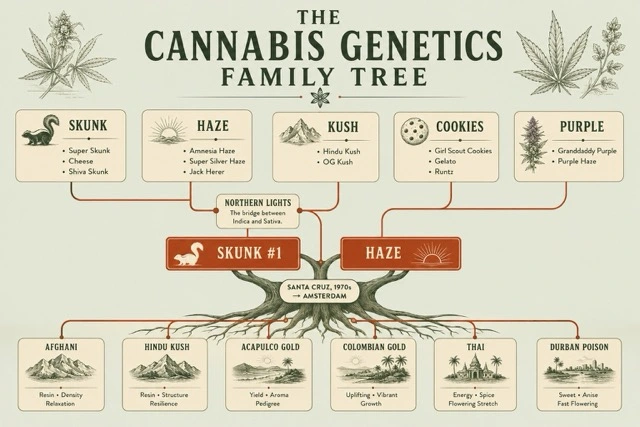
The cannabis genetics family tree is smaller than it looks. The hundreds of strain names in any modern catalogue trace back to a surprisingly short list of ancestors, and once you can see those connections, the whole map of classic cannabis makes sense.
Walk through a seed catalogue today and the number of names feels endless. New crosses, new hype, new flavours every season. But almost all of them are branches of the same tree, and the trunk was built in the space of a few decades from a handful of landrace plants and a small number of breeders who knew what to do with them. This guide is the map. It explains where the classic cannabis strains came from, how the major families relate to one another, and why so many strains that seem unrelated are actually close cousins. It is the hub our individual strain reviews branch off from, so wherever a strain is mentioned, you can follow the link to the full story.
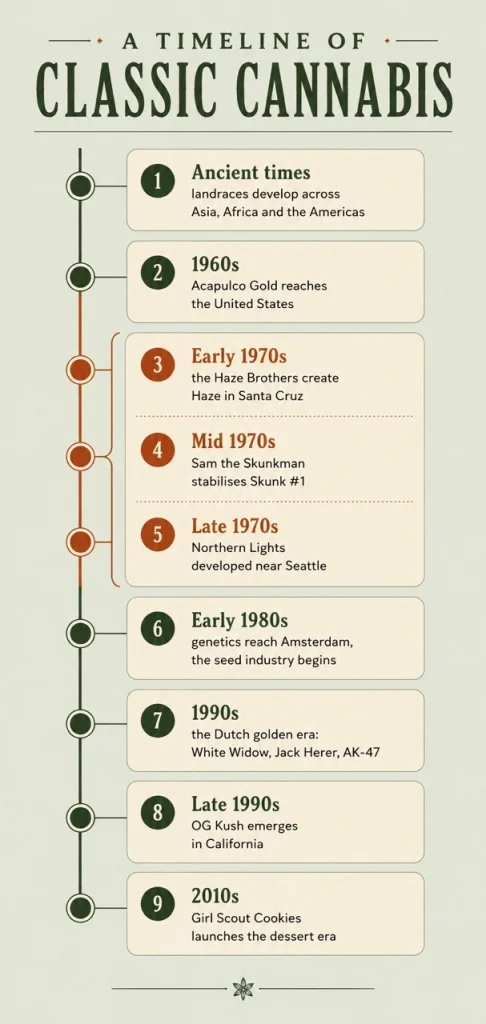
A Timeline of Classic Cannabis
The family tree shows how strains relate. A timeline shows when it all happened, and the two together are the clearest way to hold the whole story in your head. The remarkable thing is how compressed it is: most of what defines modern cannabis was created in about fifty years.
The Roots: The Landrace Foundations
Every classic strain begins with a landrace. A landrace is a cannabis population that developed over generations in one part of the world, shaped by its local climate rather than by a breeder, until it became stable and distinct. Before the modern strain existed, cannabis was identified by where it came from, not by a name on a packet: Afghan, Thai, Mexican, Colombian, South African. These regional populations are the roots of the whole tree, and a small number of them did most of the work.
Afghani is the source of nearly everything indica. It came from the dry mountain valleys of Afghanistan and Pakistan, where the plants grew short, dense and heavily resinous, finished fast, and produced the earthy, hashy character that defines the indica side of the family. When you meet a strain that is compact, quick and heavy, Afghani genetics are usually behind it. The Hindu Kush landrace comes from the same region and carries the same qualities.
Acapulco Gold is the most famous Mexican sativa, a golden-hued landrace from the Guerrero mountains that became a byword for top-grade cannabis in the 1960s. It brought yield, aroma and a clear, energetic high, and it turns up as a parent in some of the most important early hybrids. Its full story is worth reading on its own, and our Acapulco Gold review covers it.
Colombian Gold, a South American sativa, contributed clarity and a bright, uplifting character to the early crosses, and sits alongside Acapulco Gold in the foundation of the Skunk and Haze lines. Thai landraces brought the soaring, cerebral, long-flowering sativa quality that became the backbone of the Haze family. And Durban Poison, a pure sativa from the South African coast, is unusual for finishing fast in a cool climate and for its high THCV content, which is why it ended up in the Cookies family decades later. Our Durban Poison review and our guide to THCV in cannabis both go deeper.
These landraces are the raw material. On their own they were magnificent but impractical, often tall, slow and inconsistent. The story of classic cannabis is the story of what happened when a few breeders started combining them on purpose. For the fuller picture of how wild populations became the strains we grow now, our explainer on cannabis seed genetics from landrace to hybrid sits right alongside this guide.
The Santa Cruz Moment
A great deal of the modern family tree can be traced back to one place and time: Santa Cruz, California, in the 1970s. Breeding projects there, running in overlapping circles, took the world’s landraces and turned them into some of the first stable, reproducible hybrids.
The first produced Haze. A pair of growers remembered as the Haze Brothers worked through successive seasons crossing imported sativa landraces, Mexican with Colombian, then that cross with Thai, selecting for a soaring, cerebral, electric high. The result flowered for an extraordinarily long time and grew enormous, but nothing else offered that kind of clear sativa energy, and it became the foundation of an entire family.
The second produced Skunk #1. A breeder named David Watson, known as Sam the Skunkman, working with a collective, crossed Afghani with Colombian Gold and Acapulco Gold and, crucially, stabilised it so the seeds came true. The accounts of exactly how the Santa Cruz breeders and their genetics overlapped differ in the detail, but the widely told version is that Watson came into possession of the Haze genetics as well as his own Skunk line. That matters, because a few years later both Skunk and Haze would travel to Amsterdam together, which is why the two families are so deeply intertwined at the top of the tree.
The Three Pillars: Skunk, Haze and Northern Lights
If the landraces are the roots, three cultivars are the pillars that everything else was built on. By the late 1980s, Dutch breeders themselves described the trade as resting on three plants, three genetic directions, and almost everything from that era is some combination of them.
Skunk #1 changed what breeding could do. Before it, planting cannabis seed was a lottery: every plant came out different, and there was little you could rely on from one seed to the next. Skunk #1 is widely credited as one of the first hybrids bred to be genuinely true-breeding, meaning a packet of seeds produced a uniform, predictable crop. That innovation turned cannabis growing from folklore into something closer to a craft, and it became the template for combining distant landraces into one coherent plant. Its direct descendants include Super Skunk, Cheese and Shiva Skunk.
Haze was the opposite kind of plant: pure sativa energy, soaring and cerebral, but wild, enormous and slow to flower. Its history is really the history of taming it, and it took the other two pillars to do that. On its own it was too much plant for most growers, but crossed and controlled it became the source of the entire modern sativa scene.
Northern Lights is the third pillar, and it is arguably as influential as either of the others, even though it is often treated as a supporting character. Developed from Afghani genetics near Seattle in the late 1970s by a grower remembered only as “The Indian,” it was the first time the pure Afghani landrace itself had been refined into something a breeder could reliably build from, rather than used as one parent in a cross. It brought heavy resin, fast flowering and a compact, stable structure, and once it reached Amsterdam it became one of the most-used breeding parents in history. Neville’s Haze, Super Silver Haze, Shiva Skunk and Jack Herer all depend on it. When Haze needed structure and speed, Northern Lights supplied it, which is why so many later strains descend through Northern Lights specifically. Our Northern Lights review tells its full story.
Three Plants, Three Directions
Skunk brought balance and stability. Haze brought soaring sativa energy. Northern Lights brought heavy, fast, resinous indica structure. Almost everything the Dutch seed trade built in its defining era was some combination of those three, which is the single most useful thing to remember when you read any classic lineage.
The Amsterdam Pivot
The genetics were born in California, but the industry was built in the Netherlands. In the early 1980s the American genetics reached Amsterdam, where the cannabis culture had coffeeshops and growers but no broad access to stable, high-quality breeding lines. The American material filled that gap exactly.
The figure who turned that into an industry was Nevil Schoenmakers, an Australian-born breeder who founded The Seed Bank in 1984 and effectively invented the commercial mail-order seed business. Working from what became known as the Cannabis Castle, he acquired premier Californian varieties including Original Haze and Skunk #1 from Watson, refined and crossed them, and put them in a catalogue that growers around the world could order from. Suddenly a strain was no longer whatever happened to be in a bag of imported flower. It was a named, repeatable product with a known lineage, and cannabis breeding went global. High Times called him the King of Cannabis in 1985.
But Amsterdam was never one breeder. It became the centre of a whole ecosystem. Nevil sold The Seed Bank to Sensi Seeds in 1991, the house that carried Northern Lights, Jack Herer and Black Domina to the world. He went on to co-found Greenhouse Seeds with Arjan Roskam, the house behind a long run of Cannabis Cup winners. Serious Seeds produced AK-47 and Chronic, both carrying Northern Lights and Skunk. Dutch Passion pioneered feminised seed technology and preserved classics like White Widow and Blueberry. And Nevil later co-founded Mr Nice Seedbank with Shantibaba, keeping the authentic old-school Haze and Northern Lights lines alive. It was this cluster of houses, not any single person, that turned a handful of American cuttings into the global seed industry.
The Five Families
Most classic cannabis strains fall into one of five families. The families overlap, since breeders constantly crossed between them, but each has a clear character and a clear origin. Understanding the five is most of what you need to read any lineage on the cannabis genetics family tree.
| Family | Founding genetics | Typical traits | Famous descendants |
|---|---|---|---|
| Skunk | Afghani x Colombian Gold x Acapulco Gold | Balanced, reliable, fast, loud sweet-sour aroma | Super Skunk, Cheese, Shiva Skunk |
| Haze | Mexican x Colombian x Thai landraces | Soaring, cerebral, energetic, long-flowering | Amnesia Haze, Super Silver Haze, Jack Herer |
| Kush | Hindu Kush landrace; OG Kush (disputed) | Heavy, earthy, resinous, fuel-forward | OG Kush, Bubba Kush, Purple Kush |
| Cookies | OG Kush x Durban Poison | Sweet, dessert-like, dense, frosty, potent | Gelato, Wedding Cake, Runtz |
| Purple | Purple Thai; Granddaddy Purple line | Grape and berry notes, anthocyanin colour | Purple Haze, Granddaddy Purple, Purple Kush |
Skunk
The Skunk family descends from Skunk #1: balanced, reliable, fast, with the loud, pungent, sweet-and-sour aroma that gave the whole category its name. This is the family that proved hybrids could be stable, and its genetics anchor countless other strains. Super Skunk, Cheese and Shiva Skunk are the direct line, but the Skunk influence reaches far beyond strains that carry the name.
Haze
The Haze family descends from the Santa Cruz sativa landrace cross: soaring, cerebral, energetic, long-flowering. On its own Haze was too wild to grow easily, so its history is really the history of taming it, mostly by crossing it with Northern Lights and Skunk to add structure and speed. Amnesia Haze, Super Silver Haze, Jack Herer and Kali Mist all sit here, and the family reaches into modern hybrids like Blue Dream and Moby Dick, a Haze crossed with White Widow.
Kush
Kush is the family most often misunderstood, because the word means two different things. The original Hindu Kush is a real landrace from the Afghan and Pakistani mountains, a pure, resinous, heavy indica. The modern OG Kush is something else entirely: a 1990s California hybrid whose exact parentage is genuinely disputed, most often described as Chemdawg crossed with a Hindu Kush, sometimes with Thai in the mix. What is certain is that OG Kush became the backbone of West Coast cannabis and a parent to a huge share of modern strains, including the entire Cookies family. When a strain name ends in Kush, it is worth knowing which Kush is meant: the ancient landrace or the modern Californian hybrid that borrowed its name.
Cookies
The Cookies family is the most recent of the five and the bridge to the modern era. It begins with Girl Scout Cookies, created by the Cookie Fam collective in the San Francisco Bay Area around 2010, from OG Kush crossed with Durban Poison. That pairing of a heavy, fuel-forward Kush hybrid with a bright, sweet African sativa produced something new: dense, frosty, sweet and dessert-like, and it kicked off the entire flavour-driven era of cannabis that followed. Gelato, Wedding Cake, Sunset Sherbet and Runtz are all Cookies descendants. Our Girl Scout Cookies review traces where it began and what came after.
Purple
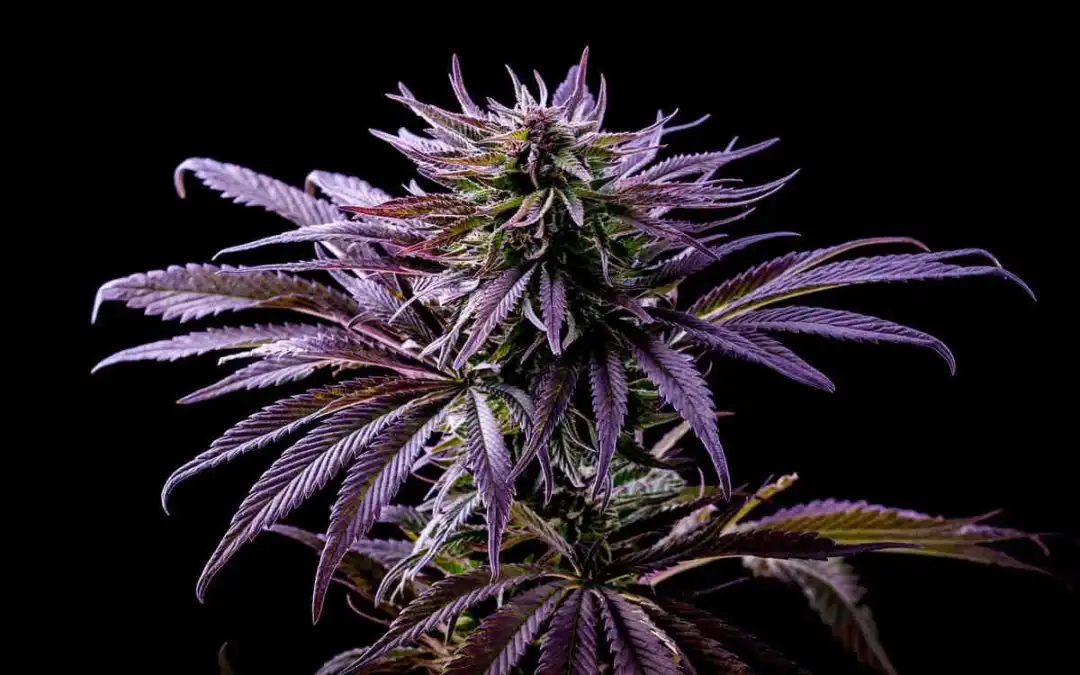
The Purple family is defined by looks as much as lineage, and it has two distinct sources. The old-school purple strains, like Purple Thai and the Purple Haze it fed into, got their colour from landrace genetics rich in anthocyanin, the same pigment that colours blueberries. The modern purple strains, led by Granddaddy Purple, were bred specifically for that grape-forward colour and sweetness. The purple colour itself is largely cosmetic, brought out by cool temperatures in late flower rather than being a sign of extra potency, and it appears across other families too, including certain Northern Lights and Cookies plants. Our guide to purple cannabis strains explains what actually causes it.
How the Classics Connect on the Cannabis Genetics Family Tree
Once the five families are clear, the connections between individual classics start to appear, and many of them are surprising. Strains that seem unrelated on a shelf are often close cousins.
Consider how much runs back to those Santa Cruz projects and the three pillars. Jack Herer combines all three building blocks, Haze, Skunk and Northern Lights, in a single plant. Shiva Skunk is a Northern Lights and Skunk #1 cross that ties the two oldest families together directly. AK-47, one of the most awarded strains of the 1990s, is a blend of Colombian, Mexican, Thai and Afghani genetics that reads like a summary of the landrace roots themselves.
White Widow deserves its own place here, because it became a breeding cornerstone in its own right. Created in the Netherlands in the mid-1990s, it crossed a Brazilian sativa landrace with a resin-heavy South Indian indica, and the result was a plant so coated in white trichomes that it looked frosted. That extreme resin production is why it dominated the Dutch coffeeshop era and why breeders reached for it again and again: it passed its frost and potency to its offspring reliably. It is a reminder that landraces kept feeding the tree well after the first hybrids, and that the Dutch scene was still producing foundational genetics into the 1990s. Its descendants include Moby Dick, a White Widow and Haze cross, and our White Widow review tells the full story.
The newer classics connect back just as clearly. Girl Scout Cookies exists because OG Kush met Durban Poison, which means a modern dessert strain has a pure African landrace as one of its grandparents. Gorilla Glue, one of the defining high-resin hybrids of the 2010s, carries Chem, Sour Diesel and Chocolate Diesel genetics that trace back through the same diesel and Kush lines that produced OG Kush. Follow almost any modern strain back far enough and you arrive at the same small set of landraces and the same handful of hybrids.
The Breeding Bottleneck
This is the single idea worth taking away from the whole story. Modern cannabis has thousands of names but comparatively little foundational genetic diversity, because so much breeding traces back to the same small pool of elite parents.
Think about what that means. A few landraces at the roots. Two or three hybrids at the trunk. A handful of breeders in one city who stabilised them. Everything since has been recombination of that narrow base, which is why strains that look completely different on a menu so often share a grandparent. The catalogue is astonishingly wide, but the genetic foundation it grows from is narrow, and most new strains are new arrangements of old material rather than genuinely new genetics.
This is not a criticism. That elite pool became elite for good reasons: those parents were potent, stable and reliable, which is exactly what you want to breed from. But it explains a lot about modern cannabis, including why chasing the newest name so often means buying a close relative of something you already know, and why the classics remain worth understanding. They are not old news. They are the base layer everything else is built on.
Why the Family Tree Makes You a Better Selector
All of this is history, but it has a practical payoff. Lineage is the single most reliable predictor of how a strain will behave, which makes the family tree a genuinely useful tool when you are choosing what to grow or smoke, not just an interesting story.
Lineage predicts growth habit: an Afghani or Kush-heavy strain will tend to grow short and bushy, while a Haze-heavy one will stretch tall and need room. It predicts flowering time: Skunk and Northern Lights genetics finish fast, Haze genetics finish slowly, and a cross usually lands between its parents. It predicts terpene profile and flavour: Skunk in the lineage suggests a sour, pungent funk, Kush suggests earth and fuel, Cookies suggests sweet dessert notes. It predicts effect: indica-heavy families lean relaxing and physical, Haze and sativa families lean cerebral and energetic. And it predicts breeding behaviour: stable, inbred lines like Skunk #1 and Northern Lights pass their traits reliably, which is why they were used as parents so often, while an unstable cross can throw wildly different plants.
So when you read that a new strain is, say, a Cookies crossed with a Haze, you already know a great deal before you have grown it: expect real height, a longer flower, a sweet-yet-complex profile, and a balanced-to-uplifting effect. Reading lineage is a skill, and the family tree is how you learn it.
An Honest Note on Lineage
Anyone who spends time with cannabis genetics quickly runs into a problem: a great deal of the lineage is disputed, and some of it is simply unknowable. This is worth being upfront about, because plenty of sources state contested genetics as settled fact.
The reason is history. For most of the period when these strains were created, cannabis breeding was illegal and underground. There were no formal records, no registration, no archives. Genetics moved through friendships and private exchanges, strains were passed as clones rather than seeds, and the same name was often applied to different plants by different people. OG Kush is the classic example: its parentage has never been definitively confirmed, and even the meaning of its name is contested. Girl Scout Cookies is another, with the Cookie Fam keeping the exact lineage semi-private for years. Even the better-documented stories come with competing accounts: who exactly stabilised Northern Lights, how Sam the Skunkman came to hold the Haze genetics, and whether Skunk #1 was truly the first stable hybrid or one of several, are all points where careful sources disagree.
None of this makes the tree less real. The broad shape is well established, and the major relationships are clear. But the honest position is to describe the widely accepted lineage while being straight about what is certain and what is not, rather than inventing precision that does not exist. When we say a strain is “most often described as” a particular cross, that phrasing is doing real work. It is the difference between reporting the genetics and pretending to a certainty the historical record does not support.
Key Takeaways
It starts with landraces. Afghani, Acapulco Gold, Colombian Gold, Thai, Hindu Kush and Durban Poison are the roots of the cannabis genetics family tree, each contributing a distinct character to everything that followed.
Three pillars built the trunk. Skunk #1, Haze and Northern Lights are the cultivars almost every classic descends from, and most Dutch-era strains are some combination of the three.
Amsterdam built the industry. Nevil Schoenmakers and a cluster of houses, Sensi, Greenhouse, Serious, Dutch Passion and Mr Nice, turned the American genetics into the global seed trade.
Five families, one narrow base. Skunk, Haze, Kush, Cookies and Purple cover the classics, and the breeding bottleneck means thousands of modern names share a small pool of elite parents.
Lineage predicts behaviour. Reading the family tree tells you a strain’s likely height, flowering time, flavour and effect before you grow it, which is what makes it a practical tool and not just a history lesson.
Explore the Family Tree
This guide is the hub, and every strain in it has its own full story. The map below shows how the branches connect, and each link follows the lineage upward from the roots.
Afghani (landrace) → Northern Lights → Black Domina
Acapulco Gold (landrace) → Acapulco Gold review → Skunk #1 → Cheese
Thai + Colombian (landraces) → Haze → Jack Herer · Amnesia Haze · Kali Mist · Blue Dream
Brazilian + South Indian (landraces) → White Widow → Moby Dick
Hindu Kush (landrace) → OG Kush → Girl Scout Cookies → Gorilla Glue era
To understand the character behind the genetics, our guides to cannabis terpenes, sativa versus indica and landrace-to-hybrid genetics explain the traits that run through the families.
Cannabis Genetics: Frequently Asked Questions
What is a cannabis genetics family tree?
It is a map of how cannabis strains descend from one another, tracing modern cultivars back through their parent strains to the original landrace populations. Because almost all classic cannabis strains share a small number of ancestors, the tree shows how strains that look unrelated on a menu are often close cousins.
What is a landrace strain?
A landrace is a cannabis population that developed over generations in one region, shaped by local climate rather than by a breeder, until it became stable and distinct. Afghani, Hindu Kush, Thai, Colombian Gold, Acapulco Gold and Durban Poison are the landraces that founded most modern genetics. Our explainer on cannabis seed genetics from landrace to hybrid covers how they became the strains we grow now.
What are the main cannabis strain families?
Five families cover most classic cannabis strains: Skunk, Haze, Kush, Cookies and Purple. They overlap constantly, since breeders crossed between them, but each has a distinct character and origin. Knowing which family a strain belongs to tells you a great deal about how it will grow and what it will produce.
Why is Skunk #1 so important in cannabis history?
Skunk #1 is widely credited as one of the first hybrids bred to be genuinely true-breeding, meaning a packet of seeds produced a uniform, predictable crop rather than a lottery of different plants. That turned cannabis growing from folklore into something closer to a craft, and it became the template for combining distant landraces into one coherent plant. Its descendants include Super Skunk, Cheese and Shiva Skunk.
What are the three pillars of modern cannabis?
Skunk #1, Haze and Northern Lights. Skunk brought balance and stability, Haze brought soaring sativa energy, and Northern Lights brought heavy, fast, resinous indica structure. Almost everything the Dutch seed trade built in its defining era is some combination of those three.
Is OG Kush really Chemdawg crossed with Hindu Kush?
That is the most commonly repeated account, but it has never been definitively confirmed. OG Kush emerged in 1990s California when breeding was underground and undocumented, and even the meaning of its name is contested. Anyone stating its parentage as settled fact is overstating what the historical record supports.
What is the difference between Hindu Kush and OG Kush?
They are entirely different things that share a word. Hindu Kush is a genuine landrace from the Afghan and Pakistani mountains, a pure, resinous, heavy indica. OG Kush is a 1990s Californian hybrid of disputed parentage that borrowed the name and went on to become the backbone of West Coast cannabis. When a strain name ends in Kush, it is worth knowing which one is meant.
Where did Girl Scout Cookies come from?
Girl Scout Cookies was created by the Cookie Fam collective in the San Francisco Bay Area around 2010, from OG Kush crossed with Durban Poison, though the collective kept the exact lineage semi-private for years. It launched the entire dessert era of cannabis, and Gelato, Wedding Cake, Sunset Sherbet and Runtz are all its descendants. Our Girl Scout Cookies review traces the full story.
Who was Nevil Schoenmakers?
An Australian-born breeder who founded The Seed Bank in 1984 and effectively invented the commercial mail-order cannabis seed business. Working from what became known as the Cannabis Castle, he refined the Californian genetics that reached Amsterdam and put them in a catalogue growers worldwide could order from. High Times called him the King of Cannabis in 1985.
What is the cannabis breeding bottleneck?
It is the idea that modern cannabis has thousands of names but comparatively little foundational genetic diversity, because so much breeding traces back to the same small pool of elite parents. A few landraces at the roots, two or three hybrids at the trunk, and a handful of breeders who stabilised them account for the ancestry of most of what is sold today.
Why is so much cannabis lineage disputed?
Because for most of the period when these strains were created, cannabis breeding was illegal and underground. There were no formal records or archives, genetics moved through private exchanges, strains were passed as clones rather than seeds, and the same name was often applied to different plants by different people. The broad shape of the family tree is well established, but specific parentage is often genuinely unconfirmed.
How does knowing a strain’s lineage help me choose one?
Lineage is the most reliable predictor of how a strain behaves. It indicates growth habit, flowering time, terpene profile and effect: Kush and Afghani genetics grow short and fast and lean relaxing, Haze genetics grow tall and slow and lean energetic. If you want a practical shortlist, our guide to the best classic cannabis strains to grow in Australia applies exactly this thinking.
The Same Roots, Still Growing
It is tempting to see today’s exotics as a clean break from all this. Permanent Marker, RS11, Cap Junky, Jealousy and the countless names arriving every season can feel like a new era with new rules. But they are not. They grow from the same roots. Trace any of them back and you find Cookies and Kush, and behind those, OG Kush and Durban and Afghani, and behind those, the same landraces and the same few pillars that built everything else.
That is the real value of knowing the classics. Understanding the family tree is not nostalgia, it is how you understand modern cannabis, because the modern catalogue is the same tree still growing. When you are ready to grow a piece of that history yourself, browse the full range of cannabis seeds Australia.
Sacred Seeds Australia sells cannabis seeds strictly as souvenirs and for genetic preservation, in accordance with local laws. In Australia it is illegal to germinate cannabis seeds unless you are in the ACT or hold a specific licence. Nothing in this article is medical advice.