Best Cannabis Strains for Australian Climate: Complete 2026 Guide

Best Cannabis Strains for Australian Climate: Complete 2026 Guide

This guide is for outdoor collectors. If you’re growing indoors with controlled environments, climate doesn’t matter, since you can grow any strain. But outdoors? Australia throws everything at you.

From Far North Queensland’s stifling 90% humidity and monsoon rains, to Perth’s relentless 45°C summer days with months of drought, to Tasmania’s short growing season that ends with March frosts. Getting outdoor strain selection wrong means watching months of work rot from bud mould, shrivel from heat stress, or get killed by early cold snaps.

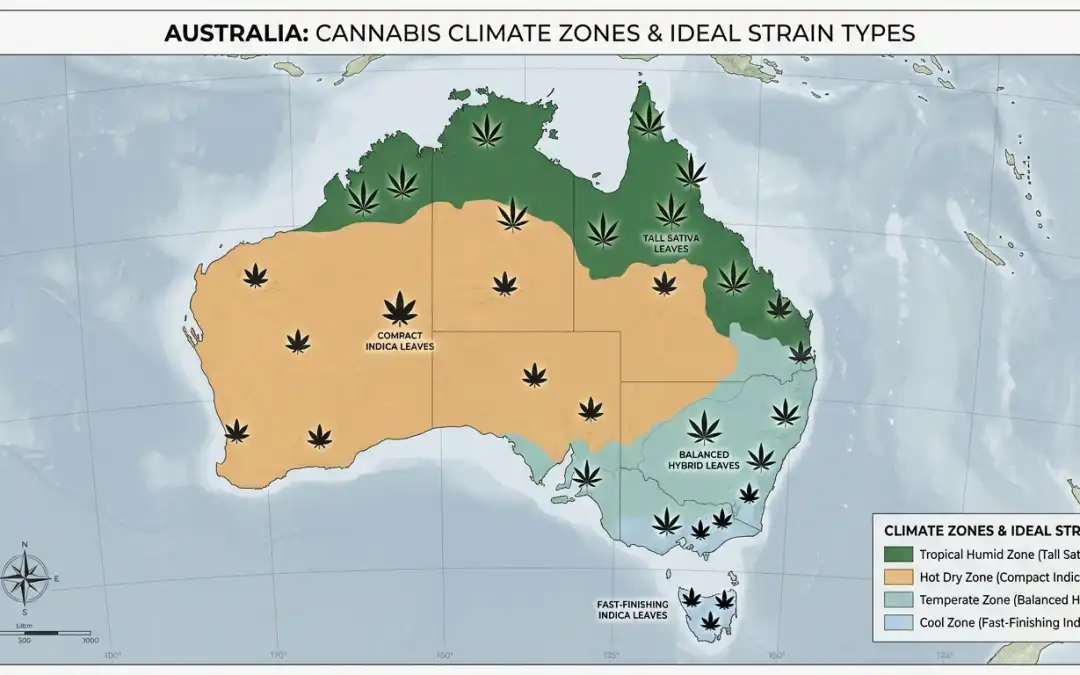
This guide covers over 40 strains from our range, each matched to specific Australian outdoor climate zones. Whether you’re battling tropical humidity, desert heat, unpredictable coastal weather, or racing against frost, you’ll find genetics that actually survive and thrive in your outdoor conditions.

Australian cannabis climate zones map showing recommended strain types for Queensland, NSW, Victoria, Tasmania, South Australia and Western Australia


Why Australia Isn’t One Climate

Most strain advice you’ll read online was written for the northern hemisphere, where a country is usually one growing region with a bit of variation at the edges. Australia does not work like that. A grower in Cairns and a grower in Hobart are not doing the same activity in different weather. They are solving completely different problems, and a strain that solves one will fail at the other.

The distance is the easy part to grasp. Darwin sits closer to the equator than Havana. Hobart sits at the same latitude as Barcelona. Between them you have wet tropics, dry tropics, subtropics, Mediterranean, temperate, and cool temperate, and every one of those has a different relationship between when a plant wants to finish and what the sky is doing at the time.

What that means practically is that the question “what’s the best strain to grow outdoors in Australia” has no answer. There is only the best strain for your specific finish window, and everything below is about working out what yours is.

The One Variable That Decides Everything: Your Rain Date

Growers new to outdoor work tend to fixate on heat. Will it get too hot, will it get cold enough at night, what’s my average summer temperature. Those matter at the margins, but they are almost never what loses a crop in this country.

What loses crops is moisture arriving while the buds are still on the plant. Dense flowers plus sustained humidity plus poor airflow equals botrytis, and botrytis can take a cola from perfect to compost inside three days. Heat stress stunts a plant. Cold slows it. Rot ends it.

So the single most useful thing you can know before you choose a strain is roughly when your area gets consistently wet in autumn, and then count backwards. A strain that finishes two weeks before your rain typically arrives is a strain you will probably harvest. A strain that finishes two weeks after it is a strain you will probably be cutting down early and disappointed with. That relationship, between flowering length and rain date, decides more outcomes than genetics quality ever will.

It also explains a pattern that confuses people: why a strain can be perfect in Perth and a disaster in Coffs Harbour at the same latitude. Perth’s autumn is dry. The Northern Rivers autumn is not. Same sun, same length of season, completely different answer. Jason’s guide to growing cannabis outdoors in Australia works through the planting calendar and the regional harvest deadlines that come out of this, and it’s the companion piece to everything below.

The Trade-Off Every Outdoor Grower Is Actually Making

Once you understand the rain date, the real decision becomes obvious, and it is not which strain is best. It is how much risk you are willing to carry for extra weight.

Longer-flowering genetics generally produce more. They have more time to stack, more time to build resin, and more time to develop the terpene complexity that makes a plant worth growing rather than just worth harvesting. They also spend that extra time exposed. Every additional week in flower is another week of weather you do not control.

Shorter-flowering genetics give up some of that ceiling and buy you certainty in exchange. You take less off the plant, and you take it off cleanly, in dry weather, at the moment you chose rather than the moment the forecast forced.

Neither is the right answer in the abstract. In Queensland, where the season is long and the autumn is forgiving, running a twelve-week plant is a reasonable bet. In Tasmania it is not a bet, it is a donation. The growers who consistently do well outdoors in this country are not the ones with the best genetics. They are the ones who matched the flowering window to their own weather and then stopped being greedy about it.

🧠 Jason: The Mistake I See Every Autumn

Every year around March I get the same message. Plant looks incredible, trichomes aren’t there yet, and there’s a week of rain coming. What do I do. And by the time someone is asking that question the decision has already been made for them months earlier, when they picked a strain that finishes later than their weather allows.

If you take one thing from this page, take this: choose your strain backwards from your rain, not forwards from your wishlist. Work out when your area reliably turns wet, subtract the flowering time, and that tells you your latest safe planting date and your longest safe flower. Then pick from what fits. It is a less exciting way to choose a strain and it is the reason some people harvest every year and others tell you the weather beat them again.

Your Microclimate Beats Your State

The tables below sort by region because that is the only practical way to organise it, but state lines are a rough instrument and you should treat them as a starting point rather than a verdict.

The Adelaide Hills and the Adelaide plains are forty minutes apart and are not the same growing environment. The Hills are cooler and wetter and behave more like temperate Victoria. Perth and Margaret River are both Western Australia, and one is Mediterranean while the other is genuinely wet in autumn. The Sydney basin holds warm sheltered pockets and cold damp gullies within the same suburb.

Elevation, aspect, and shelter all move you around inside your zone. A north-facing slope with morning sun and afternoon shelter can gain you a fortnight over a low, still, south-facing yard in the same postcode. Cold air pools in hollows, so the bottom of a gully frosts before the slope above it. A wall or a fence that holds heat overnight changes what your plant experiences regardless of what the regional average says.

The practical version: find the table row that matches your region, then adjust for what you can see out your own window. If you are damper, cooler, or more shaded than your region’s description, treat yourself as the zone south of you. If you are drier, warmer, and better exposed, you have more room than the table gives you.

What To Do If You’re On The Boundary

Plenty of growers sit right on the edge, where the strain they want finishes just slightly later than the weather comfortably allows. There are four honest ways out of that, and only one of them is giving up on the strain.

Run a fast version. These finish meaningfully quicker than the standard photoperiod while keeping the same genetics behind them, which is often exactly the buffer a marginal season needs. Our guide to fast version cannabis seeds explains how they differ from both photoperiods and autos, and the fast version range is where to browse.

Switch to an autoflower. Autos run on a fixed clock from germination and ignore day length entirely, which takes the seasonal calendar out of the decision. You give up some yield ceiling and you get certainty, plus the option of multiple runs in a season. Our autoflower versus photoperiod comparison covers the trade-off properly, and the autoflower range has the options.

Plant earlier and accept a smaller plant. Getting in the ground a few weeks sooner shortens your veg and costs you size, but it moves the whole finish window forward into safer weather. A smaller plant you actually harvest beats a bigger one you lose.

Cover it. A greenhouse, a poly tunnel, or even a temporary rain cover over the canopy for the final fortnight changes the calculation more than most growers expect. You are not trying to control the climate, only to keep water off dense flowers during the window where water is the enemy.

What Actually Makes Genetics Climate-Resilient

Strain descriptions throw around “mould resistant” and “hardy” without explaining what produces those traits, which makes them impossible to judge. Three things actually do the work.

Bud structure. This matters more than any other single factor in a humid finish. Open, airy flower structure lets moisture move through and dry out. Dense, tightly packed colas hold it against the plant, and that trapped moisture is where rot starts. Landrace sativas tend to be open. Modern high-yield indica-dominant hybrids tend to be dense. That structural difference is why Durban Poison handles a wet Northern Rivers autumn better than plants with twice its bag appeal.

Where the genetics evolved. A landrace carries its home climate in it. Afghani-descended genetics were selected in dry mountains and handle heat and low humidity well. South African and Mexican landraces evolved under intense sun with a dry finish. Dutch-bred hybrids were optimised for cool, short northern European seasons, which is why several of them hold up in Tasmania where warmer-climate genetics stall.

Flowering length. The least glamorous factor and the most decisive. A nine-week plant simply has fewer opportunities to meet bad weather than a fourteen-week plant. Much of what gets marketed as resilience is really just a shorter exposure window, and that is worth knowing when you’re comparing two strains that both claim to be tough.

Yield sits slightly apart from those three. The heaviest producers in the range, Moby Dick being the clearest example, tend to want dry heat and plenty of room rather than resilience in the usual sense. Give it Perth or the Adelaide plains and full sun and it will out-produce anything else on the list. Put the same plant in a humid coastal autumn and the size that makes it impressive becomes the thing that works against it.

Using the Tables Below

What follows is the strain-by-strain breakdown by climate zone. Read it with the framework above in mind rather than as a shopping list, because the right choice is the one that fits your finish window, your microclimate, and how much risk you want to carry.

If you want the sativa side of this in more depth, Jason’s guide to the best sativa strains by Australian region goes state by state on the longer-flowering genetics specifically, where the timing question bites hardest. If this is your first outdoor season, the most forgiving strains for Australian growers is the better place to start. And when it comes time to call the harvest, our guide to reading the whole plant at harvest covers the judgement that a rain forecast forces on you, alongside the amber trichomes guide for what you’re seeing under the loupe.

One last thing worth saying plainly: humidity brings pests as well as rot, and the two often arrive together in a wet autumn. Our organic pest control guide covers identification and treatment without reaching for anything harsh, and getting the cure right afterwards is what turns a crop you saved into one you’re glad you grew.

Quick Reference: Match Your Climate to the Right Strain

Your Climate Key Challenge Best Strains
🥵 Hot & Humid
QLD, NT
Mould, bud rot Amnesia Haze, Durban Poison, Moby Dick
☀️ Hot & Dry
WA, SA
Heat stress, drought Black Domina, Blue Dream, White Widow
🌦️ Temperate
NSW, VIC coast
Variable weather Gorilla Glue, Runtz, Gorilla Zkittlez, Bruce Banner
🥶 Cool/Short
TAS, High Country
Frost, short summer Northern Lights, Purple Kush, Granddaddy Purple, Any Autoflower

Hot & Humid Climates (Queensland, Northern Territory)

The problem: High humidity (70-90%) causes bud rot. Dense indica buds will fail.

The solution: Sativa-dominant strains with open, airy bud structure for airflow.

Top Picks

Strain Why It Works Mould Resist Flower Time
Amnesia Haze Legendary Sativa, extreme airflow 9/10 10-11 weeks
Durban Poison South African landrace, coastal humidity genetics 9/10 8-9 weeks
Moby Dick 75% Sativa, massive with natural spacing 8/10 9-11 weeks
Jack Herer Fast Sativa hybrid, semi-airy buds 7/10 8-10 weeks
Pineapple Express Sativa-dom, handles humidity well 7/10 8-9 weeks

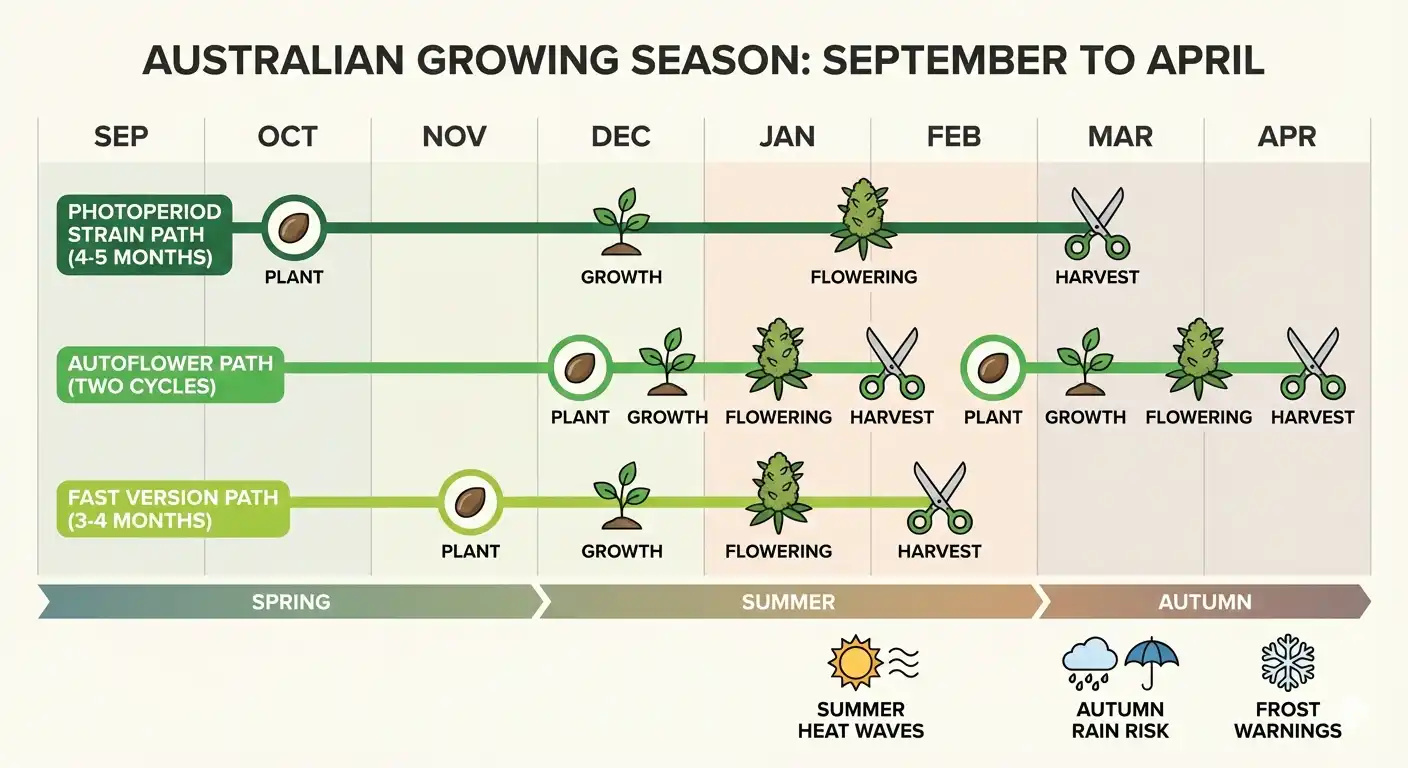
Pro tip: In Far North QLD, harvest before November wet season. Plant July-August for October harvest. Autoflower versions finish even faster (9-11 weeks total).
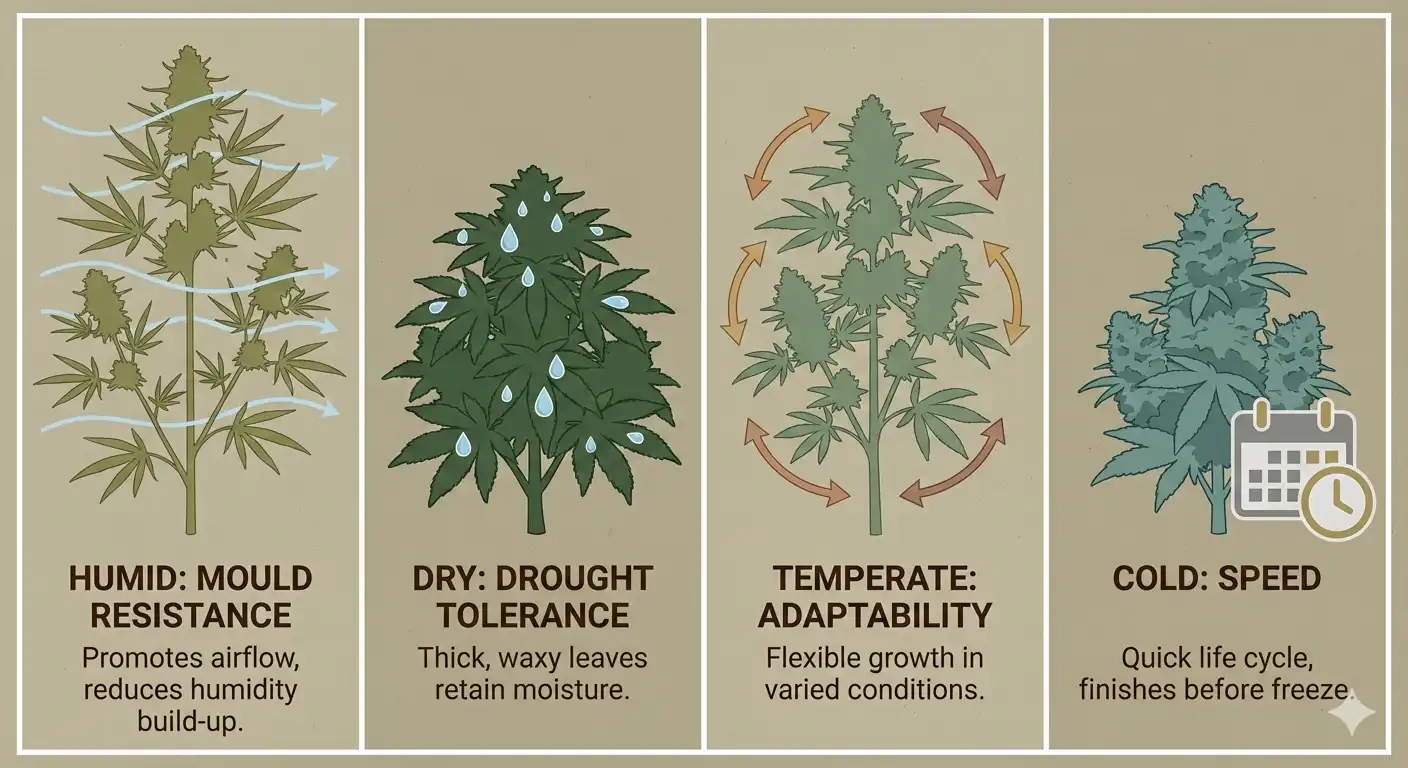


Comparison of cannabis plant structures for different Australian climates showing Sativa, Indica, hybrid and fast-flowering characteristics

Top Picks

Strain Why It Works Adaptability Flower Time
Gorilla Glue Extremely robust 50/50, handles everything 10/10 8-9 weeks
Runtz Trending balanced hybrid, climate adaptable 9/10 8-9 weeks
Gorilla Zkittlez Indica-dom, fast finish, sweet terps 8/10 8-9 weeks
Bruce Banner Sativa-dom with fast finish for a Sativa 8/10 8-10 weeks
Godfather OG Legendary potency, surprisingly resilient 8/10 8-9 weeks
Australian cannabis growing season timeline comparing photoperiod, autoflower and fast version flowering times from spring to autumn

Frequently Asked Questions

What are the best trending strains for Australian conditions?

Runtz, Gorilla Zkittlez, and Gelato (Fast version) all handle Australian conditions well while offering modern genetics that collectors want.

What’s the most mould-resistant strain?

Durban Poison and Amnesia Haze are consistently rated highest (9/10) by Queensland/NT collectors.

What’s the most underrated strain for Australian conditions?

Black Domina. It’s a 95% Indica with elite drought tolerance, fast finish (7-8 weeks), and works across multiple climates.

Can I grow Sativas in Melbourne or Hobart?

Melbourne: Yes—choose fast Sativa hybrids under 10 weeks (Jack Herer, Blue Dream, Bruce Banner).
Hobart: Risky. Pure Sativas take 12-14 weeks. Use Auto Amnesia Haze for Sativa effects with Tasmania timing.

Should I choose photoperiod, autoflower, or fast version?

Photoperiods: Maximum control and yields (need 4+ months good weather)
Autoflowers: Short seasons, simplicity, multiple crops per year
Fast Versions: Photoperiod quality with 1-2 weeks faster finish (best for marginal climates)

How do I protect plants during extreme heat?

Use 30-50% shade cloth (12pm-4pm), water early morning, mulch heavily (10cm), and use large pots (45-60L minimum). Plant heat-tolerant strains: Blue Dream, White Widow, Black Domina.

What strains work across multiple climates?

These “all-rounders” adapt to varied conditions: Blue Dream, Gorilla Glue, Northern Lights, White Widow.

Does pot size matter in hot climates?

Absolutely. Larger pots provide more water reservoir and better insulation. Minimum 30L, better 45-60L. Fabric pots are best for hot climates—they allow root air-pruning and temperature regulation.


Final Thoughts

Strain selection is the most important factor for Australian outdoor success. Match genetics to your specific challenge:

  • QLD collectors: Prioritize mould resistance (Amnesia Haze, Durban Poison, Moby Dick)
  • WA/SA collectors: Prioritize heat/drought tolerance (Black Domina, White Widow, Blue Dream)
  • TAS collectors: Prioritize speed (Northern Lights, Black Domina, any autoflower)
  • NSW/VIC collectors: Prioritize adaptability and fast finish (Gorilla Glue, Runtz, Gorilla Zkittlez)

Browse our complete cannabis seed collection

Need help choosing? Contact our growing support team for personalized recommendations.


Disclaimer: This guide is for educational purposes. Sacred Seeds sells cannabis seeds as collectible souvenirs. Germination and cultivation may not be legal in your jurisdiction. Always check local laws.
 

The Best Purple Cannabis Strains in Australia

The Best Purple Cannabis Strains in Australia

The best purple cannabis strains earn their reputation on far more than the colour. The deep violet is the draw, but behind it sits genuinely special genetics, a relaxed and fruity character, and some of the best bag appeal you can grow. This guide runs through the purple cannabis strains we rate most for Australian growers, then gets into the science of why these plants turn purple and what that colour really does and does not mean.

One thing to get straight up front: the colour does not make a strain stronger. It is a signpost. It points to specific genetics and to the sweet, relaxed experience purple weed is loved for, which is exactly what we look for when we choose strains for the collection at Sacred Seeds Australia.

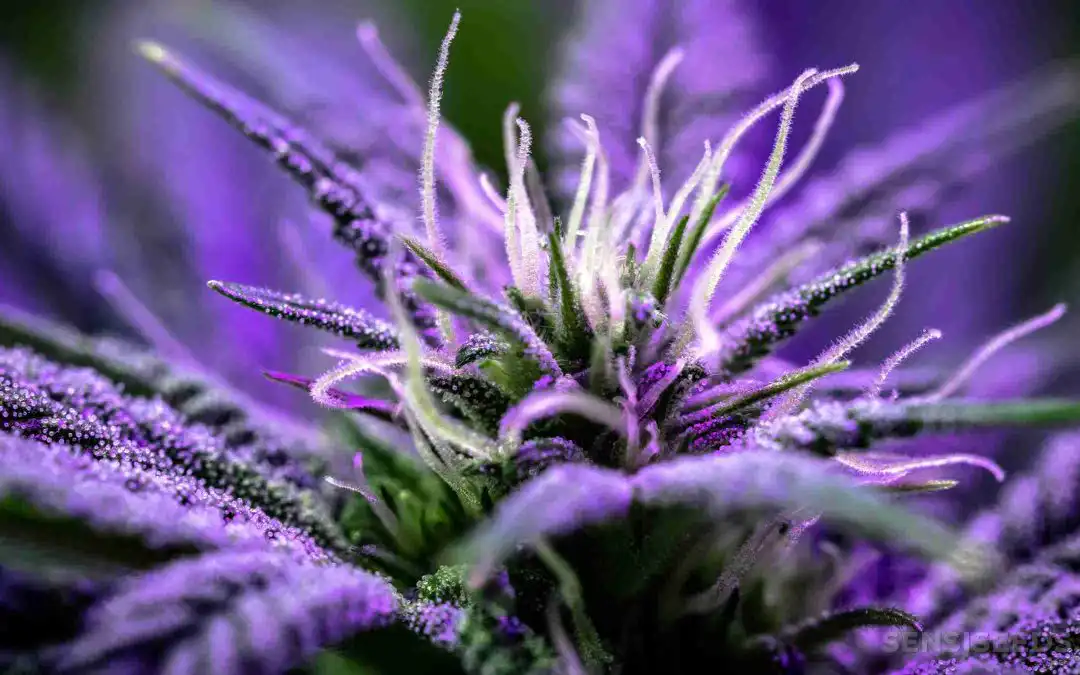
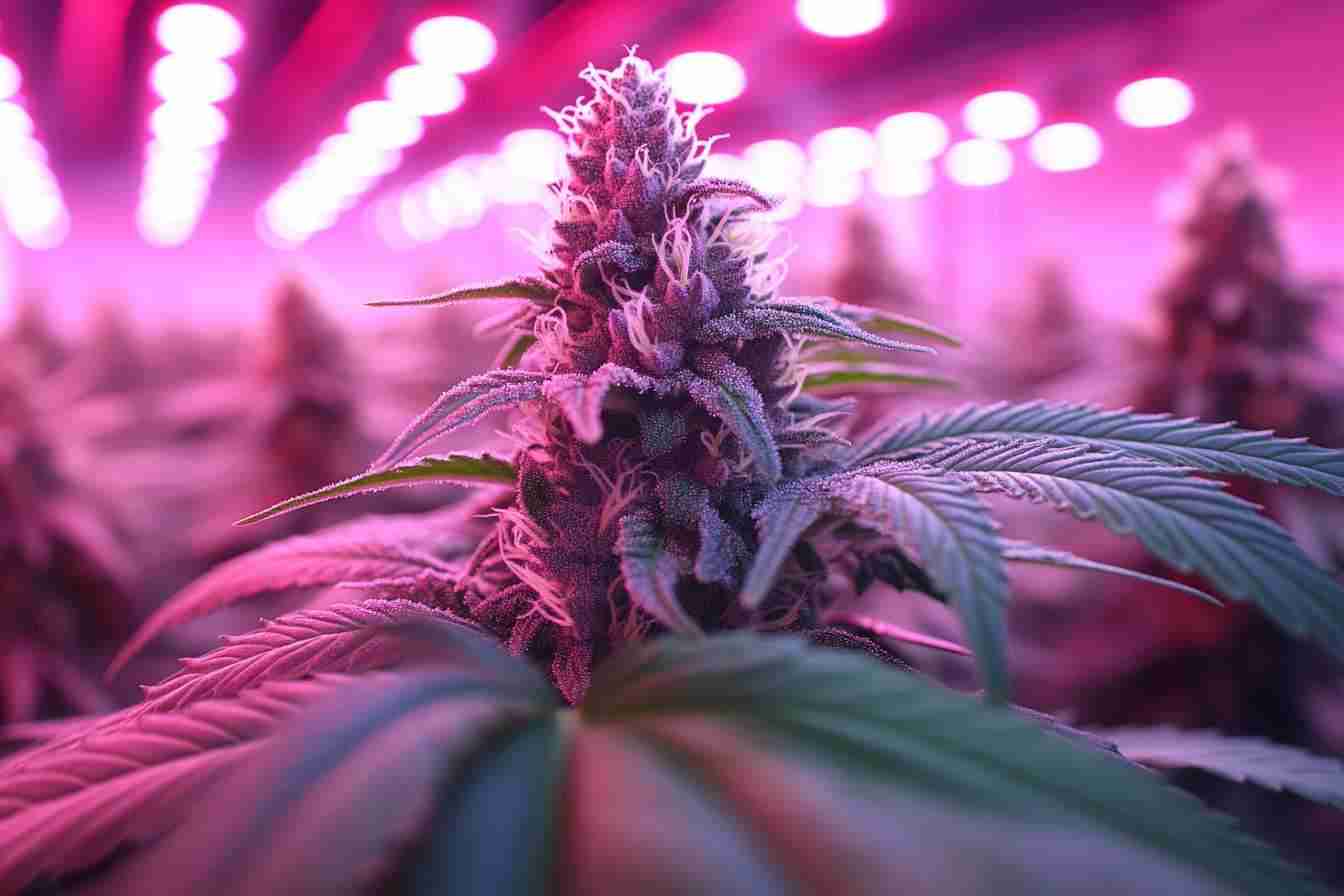
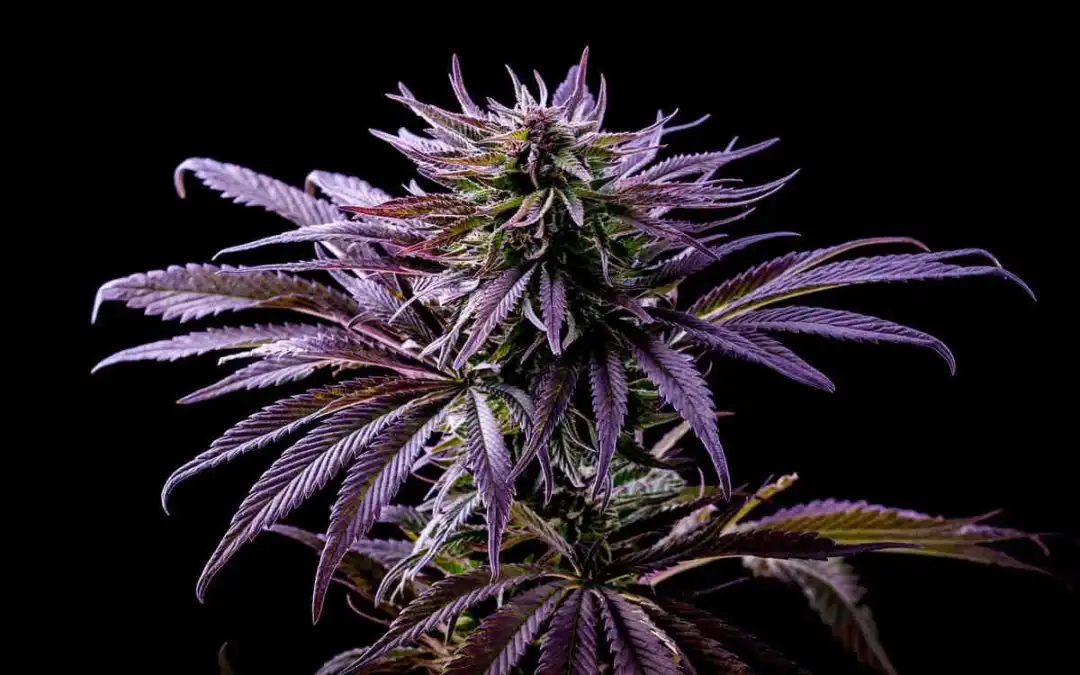
purple cannabis plant full flower sacred seeds australia

The Best Purple Cannabis Strains to Grow in Australia

These are the purple cannabis strains we keep coming back to, the ones that back up the colour with the genetics, flavour and effect to match.

Granddaddy Purple

Granddaddy Purple, or GDP, is the most famous purple strain in the world and the one that put purple buds on the map. It was created in 2003 by breeder Ken Estes, who crossed Purple Urkle with Big Bud to produce a high-yielding, indica-dominant hybrid with a powerful body high and an unmistakable grape Kool-Aid aroma. Before GDP, purple buds were a rarity. After it, they became an icon, and it is still the benchmark every other purple strain is measured against. If you grow only one purple strain, make it this one. Our full breakdown of why Granddaddy Purple goes purple covers the Purple Urkle heritage and what Estes was actually breeding for, and the same genetics are available as an autoflower version on a fixed timeline.

Purple Kush

Purple Kush is a West Coast classic and a pure indica, born from crossing Hindu Kush with a Purple Afghani. I’m a sativa person almost all of the time, so it means something when I say Purple Kush is one of the very few indicas I will happily reach for. It is famous for a deeply relaxing, sedative character and an earthy, sweet kush flavour that is every bit as legendary as the high, and its deep purple hue has earned it a place on more than one all-time-great kush list.

Purple Glam Kush

If you came here looking for Purple Glam Kush, here is the lay of the land. It is a close cousin of Purple Kush, sharing that same deeply purple, kush-heavy, grape-and-berry character, and we have since folded it into our Purple Kush line. So if Purple Glam Kush is the look and the effect you are after, Purple Kush is the one to grow, available as feminised photoperiod or as a faster, more compact autoflower. Same gorgeous colour, same heavy and relaxed body high, same easy grow.

What Anthocyanins Actually Do

The pigments behind the purple are called anthocyanins, and they belong to the flavonoid family. They are the very same compounds that turn blueberries blue, grapes deep red and eggplant violet, and every cannabis plant carries the machinery to make them. In most plants the green pigment chlorophyll is so dominant that it masks everything underneath. As a plant matures and its chlorophyll fades late in flower, the anthocyanins that were there all along finally get their moment, and the buds, leaves and sometimes even the stems shift toward those deep violet shades.

Cool nights are the usual trigger. Letting the temperature drop a few degrees during the dark period late in flower slows chlorophyll production and lets the colour come through more strongly, which is why purple tends to deepen as autumn cool sets in across much of Australia. A gentle drop is all you want, never a freeze. Timing a late-season finish to catch those nights is covered in our guide to growing cannabis outdoors in Australia. It is also worth knowing that plenty of strains not named for the colour will throw violet in cool conditions, including some phenotypes of Girl Scout Cookies and Godfather OG.

So do anthocyanins actually do anything? In the plant, yes. They are antioxidant pigments that serve a genuine protective role. For you, the person smoking it, the honest answer is not much. They are present in only tiny amounts in cannabis, smoking degrades them anyway, and there is no good evidence that a purple bud is any stronger, or any better for you, than a green one. The sensible way to think about the colour is that it is beautiful and a reliable sign of specific genetics, but cosmetic in itself. The potency and the character of the high come from the cannabinoids and terpenes, not the pigment.

Do Purple Cannabis Strains Share a Flavour or Terpene Profile?

This is the question that trips a lot of people up. Colour and aroma are controlled by different genetics, and the anthocyanins themselves do not create flavour, so strictly speaking there is no causal link between purple and any particular terpene. The colour does not make a strain taste of grape.

And yet, in practice, purple cannabis strains really do share a family resemblance. They lean fruity, often toward sweet berry and grape, and they frequently carry noticeable linalool, the soft floral terpene you also find in lavender, alongside the earthy myrcene that runs through so many relaxing indicas and a peppery touch of caryophyllene. Our cannabis terpenes guide explains how each of those shapes what you taste and feel. The reason is breeding rather than pigment. Growers have spent decades selecting plants that are both deeply coloured and great tasting, so the two traits have ended up travelling together. The grape note in Granddaddy Purple, for example, comes from its terpenes, not its colour, but because GDP was bred for both at once, they arrive in the same plant. Purple is not a flavour guarantee, then, but it is a fair bet on a fruity, relaxed profile.

Not All Purple Strains Put You to Sleep

It is a common mistake to assume all purple weed will knock you out. Many of the famous purple cannabis strains, Granddaddy Purple and Purple Kush among them, are indica-dominant and deeply relaxing, but that is not the whole story. There are sativa-dominant purples too. The legendary Purple Haze is the classic example, a cross of Haze and Purple Thai known for an energetic, creative, almost psychedelic high. The colour does not lock in the effect, so there really is a purple strain for every mood.

You Will Not Get Purple Buds Without the Right Genetics

For all the tricks growers use, the single most important factor is the DNA. You cannot force a plant to turn purple if it does not have the genetic predisposition, and no amount of cold or clever feeding will make a green strain show violet buds. This is the point the Granddaddy Purple strain review makes in detail: what set GDP apart in 2003 was not that it could turn purple, but that it did so predictably. That is why sourcing authentic seeds matters so much with purple varieties. At Sacred Seeds Australia we work with top breeders for genuine genetics, and our feminised and autoflower selections are chosen carefully, so you are always starting with the real deal. You can browse the full range of cannabis seeds Australia to see everything we stock, and if you are not sure which one suits your setup, our strain finder is a quick way to narrow it down.

Key Takeaways

Start with the proven names. Granddaddy Purple and Purple Kush are the purple cannabis strains we rate most, the icon and the pure-indica classic. Purple Glam Kush now sits within our Purple Kush line, so that is where to head if it is what you are after.

The colour is a signpost, not a power-up. Anthocyanins are cosmetic in cannabis. A purple bud is not stronger or healthier than a green one, the effect comes from cannabinoids and terpenes.

Genetics come first, temperature second. A plant will only turn purple if it carries the code for it. Cooler autumn nights late in flower can then deepen the colour, but they cannot create it.

Purple is a fair bet on fruity flavour. There is no causal link between colour and terpenes, but decades of breeding for both means purple strains often share sweet berry and grape notes, with linalool and myrcene common.

Frequently Asked Questions

What are the best purple cannabis strains?

Three names come up most. Granddaddy Purple is the most famous and the benchmark for the whole category, and Purple Kush is the pure-indica classic with deep relaxation and sweet kush flavour. Purple Glam Kush is a close relative of Purple Kush that we now carry within our Purple Kush line, so that is the one to choose if Purple Glam Kush is the look and effect you want.

Is purple weed stronger or better for you?

No. The colour comes from anthocyanin pigments, which are cosmetic in cannabis. They are present in only tiny amounts, smoking degrades them, and there is no good evidence a purple bud is more potent or any better for you than a green one. Potency and effect come from the cannabinoids and terpenes, not the colour.

Are all purple strains indicas?

No, but many of the most famous ones are indica-dominant, and that relaxed character is part of the classic purple profile. There are sativa-leaning and balanced purples too, like the energetic Purple Haze, so the colour on its own does not lock in the effect. If the terms themselves are new to you, our guide to the indica and sativa distinction is a useful starting point, or you can browse the indica-dominant range directly.

Does the purple colour affect the taste of the buds?

Not directly. The anthocyanins that colour the plant do not create its aroma. The reason purple strains so often taste of sweet berry or grape is that breeders have long selected for colour and fruity flavour together, and many carry the floral terpene linalool alongside the earthy myrcene found in so many indicas.

What makes a cannabis plant turn purple?

Genetics first. A strain must carry the predisposition to produce high levels of anthocyanin pigments. In those strains, as chlorophyll fades late in flower the purple shows through, and cooler night temperatures during the dark period can deepen it further by slowing chlorophyll production. For a worked example, see how GDP’s colour genetics work.

Do purple strains grow well in Australia?

Very well, and the climate actually helps. Cooler autumn nights toward the end of flowering are exactly the trigger that deepens purple colouration, so many purple cannabis strains finish here with their best colour. Choose genetics suited to your region and keep airflow up around dense buds in a humid finish. Our Australian climate strain guide breaks the country down state by state.

Do purple strains give good yields?

Yes, many are high-yielding varieties. Breeders know growers want both good looks and a heavy harvest, which is exactly why Granddaddy Purple was bred with Big Bud, a famous high-yielding strain, to produce large yields of dense, resinous purple buds.

What are the legal rules for growing purple seeds in Australia?

The rules are the same as for all cannabis seeds. In Australia it is illegal to germinate or grow cannabis plants unless you are in the ACT or hold a specific licence, so all seeds, purple ones included, are sold as adult souvenirs. Our overview of cannabis laws in Australia covers how this varies by state. Always be aware of your local laws.

Sacred Seeds Australia sells cannabis seeds strictly as souvenirs and for genetic preservation, in accordance with local laws. Nothing in this article is medical advice.

🧑‍🎓 Need helping choosing what to buy? Have a read of this strain guide.

🧑‍🎓 Learn here how we test our seeds and the best way to store seeds.  

Discover the Best Wholesale Cannabis Seeds for Your Growing Needs

Discover the Best Wholesale Cannabis Seeds for Your Growing Needs

Tired of buying one seed pack at a time?
There’s a smarter, more cost-effective way to build your collection or stock your shelves.
Let’s talk about buying your cannabis seeds in bulk.


How Smart Buyers Get Wholesale Cannabis Seeds

The cannabis seed market is booming.
According to a 2025 report by Cognitive Market Research, the global market is projected to surpass $2.25 billion, with wholesale cannabis seeds making up a huge share.

For serious growers and retailers, buying in bulk is the logical next step — securing a consistent supply of premium genetics at a far better price.
At Sacred Seeds Australia, we offer flexible options for buying bulk cannabis seeds — from small bundle deals to large-scale wholesale orders.


Key Takeaways

🌿 It’s a Smart Business Move

Buying bulk marijuana seeds drastically lowers your cost per seed.
That means better profit margins for resellers, or a more affordable way to achieve a large, uniform harvest.

🌿 Consistency Is Everything

For any serious operation, uniformity matters.
Bulk cannabis seeds ensure your plants share the same genetics, characteristics, and potency across every crop.

🌿 You Don’t Need to Be a Big Shot

“Bulk” doesn’t always mean thousands of seeds.
Smart options like seed bundles give you wholesale pricing on packs as small as 20 seeds.

🌿 Your Supplier Is a Partner

A trustworthy supplier is everything.
Look for stable genetics, high germination rates, and secure shipping — all essential for long-term success.

Wholesale Cannabis Seeds

🌿 The Main Reasons to Buy in Bulk

The most obvious reason is the cost saving.

Buying bulk seeds offers a significant price advantage over single-pack purchases. According to OG Distribution, it leads to better profit margins for those who sell seeds. For a grower, it just means you save a lot of money on your setup costs for production.

But the real advantage for a grower is consistency.

When you’re growing multiple plants, you want a uniform crop that behaves predictably. Sourcing bulk seeds of the same strain from a trusted source of original genetics provides your plants with the same growth patterns and final quality. You avoid the lottery of using a random mix of seeds.


🌱 What the Pros Do Before Buying in Bulk


🔍 First, They Often Do a Small Test Run

Instead of committing to a huge bulk order of a single strain, they might purchase a smaller bundle with a mix of different cannabis strains they are interested in. This allows them to run a real-world test on the genetics.

They check the germination rate, watch how the plants grow, and assess the final quality and yield of the harvest for themselves. Only after they have personally verified the viability and characteristics of the strains do they commit to a large purchase.

🤝 Second, They Build a Relationship with Their Seed Bank

They don’t just treat them like a faceless website. They communicate with them, ask questions, and become a valued long-term customer. The approach leads to better service, bigger discounts, and sometimes even exclusive access to new cannabis genetics before they hit the general market.

Smart buyers play the long game. They don’t just find a cheap price online and order a thousand seeds blindly. They do their homework to protect their investment and get the absolute best quality.


🌾 Try Out Sacred Seeds’ Bundle

Thinking about wholesale doesn’t mean you have to order hundreds of seeds at once. A great way to get bulk discounts without the massive commitment is with a seed bundle. It’s a perfect middle ground.

At Sacred Seeds Australia, for example, we have pre-made bundles like the Medicinal Indica Mix or the High THC Mix. They are 20-seed packs that give you a variety of carefully selected strains with a 20% discount.

We also have a “Mix & Match” deal. You just choose any four 5-seed packs you like, and you get the same 20% off at checkout. It’s a flexible way to get a special price on a collection of different cannabis strains.

For those who want to test sample up to 5 different strais before making a bigger order, we have introduced Mystery Mix bundles, in photo or auto, or a blend of both. 


🌍 What to Look For in a Wholesale Supplier

First, they should be able to prove their genetics are stable and come from respected breeders. Consistency is the most important factor in the bulk market.

Next, look for a commitment to quality. Industry surveys show that many wholesale suppliers will guarantee germination rates of 90% or higher. Sacred Seeds offers a qualoity guarantee which works in the same way: customers of theirs know they are well looked after, in a responsible way. 


🇦🇺 Why a Local Partner is a Better Choice for You

When you’re investing in bulk seeds, you need a partner who understands the Australian market. Sacred Seeds Australia takes pride in helping growers and collectors scale up.

We offer everything from our flexible 20-seed bundles to larger wholesale inquiries. Because we’re a local Aussie business, our customers get fast, discreet shipping, and you never have to worry about customs hassles. We provide access to a wide selection of the world’s best feminized and autoflowering seeds, right here in Australia.

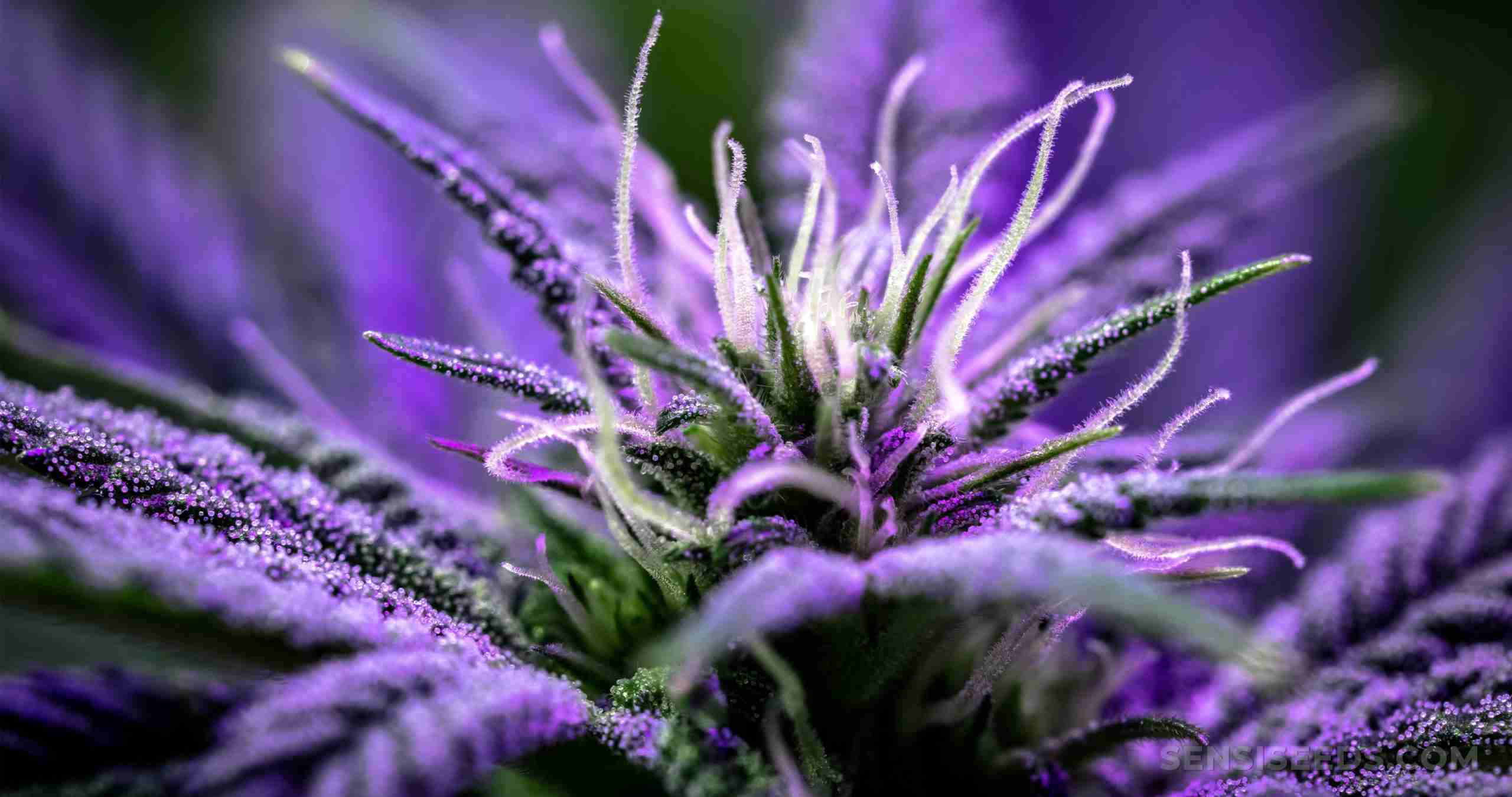
Wholesale Cannabis Seeds- close up purple flower

💬 Frequently Asked Questions (FAQs)

❓ What is the minimum order for wholesale cannabis seeds?

It varies a lot between seed banks. For our own program, our discounted bundles start at just 20 seeds, and you can contact us for more info on larger wholesale prices.


📦 How are bulk seeds packaged for shipping and storage?

Proper packaging is vital. Bulk seeds should be sent in secure, crush-proof packaging to protect them during shipping.
For long-term storage, they need to be kept in a cool, dark, and dry place with a stable temperature to maintain their viability.


🌏 Do you ship wholesale orders worldwide?

Our main focus is on serving our Australian customers with fast local shipping.
However, for international inquiries about whether we ship worldwide to your specific country, please contact us directly to discuss the legal options.


🌸 Are feminized seeds the only option for bulk sale?

No, but they are the most popular. Feminized seeds are in high demand because they guarantee female plants, simplifying the growing process by eliminating male plants.
Sacred Seeds offers only feminized seeds.


🌿 What if I have a special request for a particular strain?

If you’re after a specific strain for a large bulk order that you don’t see on our page, it’s always worth getting in touch.
Since we work with many different breeders, we may be able to source specific cannabis genetics upon request.


⚡ What’s the main advantage of autoflowering seeds for a large harvest?

Autoflowering seeds are excellent for production because they have a fixed, fast lifecycle.
They begin to flower automatically after a few weeks, allowing commercial growers to plan for predictable, quick harvest cycles both indoors and outdoors.

🧑‍🎓 Need helping choosing what to buy? Have a read of this strain guide.

🧑‍🎓 Learn here how we test our seeds and the best way to store seeds.  

Top Cannabis Seeds 2025

Top Cannabis Seeds 2025

You look around online, and it feels like there are a million different cannabis strains. Every season, there’s a new hype strain everyone is talking about. So, what’s actually worth your time to grow in 2025?

🌿 Top Cannabis Seeds 2025

There’s always something new and interesting for cannabis lovers, but a few strains have a staying power that’s hard to ignore. They’re the ones built on legendary genetics — the strains that deliver on their promise of potency, flavour, or a massive harvest.

This list is a look at some of the top cannabis seeds 2025 has to offer, broken down by what they do best. At Sacred Seeds Australia, we make it our business to stock these kinds of top-tier feminized seeds because solid genetics are the only thing that really matters.


✨ Key Takeaways

  • The Classics Are Still on Top. You’ll see names like Northern Lights on this list for a reason. Their genetics are stable, reliable, and they just work.
  • New School Flavour Is a Big Deal. Modern strains like Runtz are pushing the boundaries of what cannabis can taste like, with super-sweet, candy-like terpene profiles. Growers chasing something beyond the standard cookie-and-fuel profiles should look at our Zkittlez strain review — the terpene profile alone sets it apart from everything else on this list.
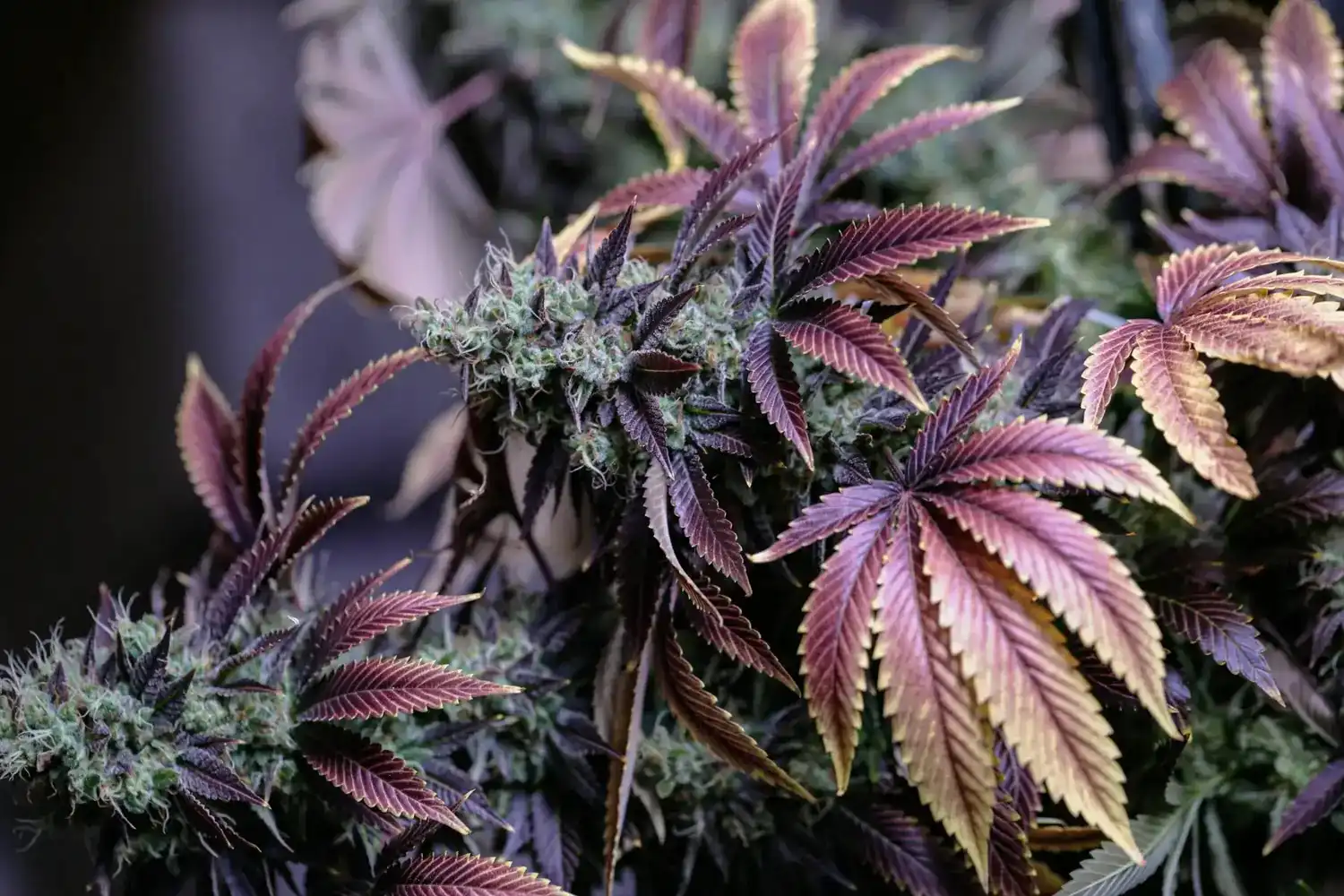
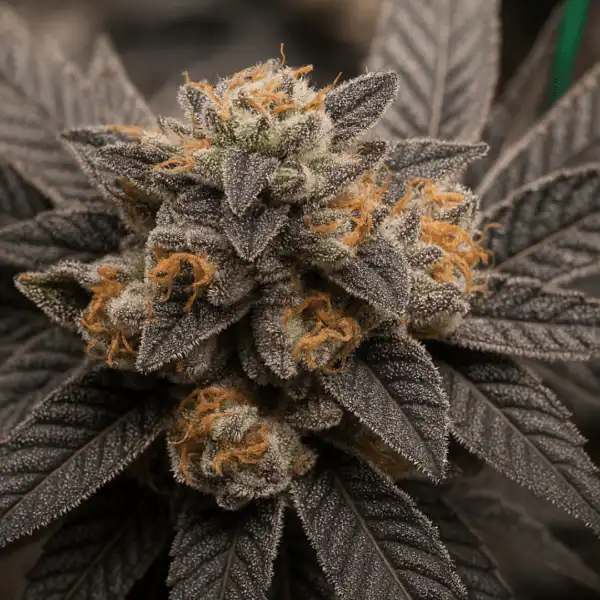
Close-up of frosty cannabis flower under lights premium feminized seeds 2025

🌿 For an Easy, Forgiving Grow

If you’re new to growing cannabis, you want a strain that won’t punish you for small mistakes. These are tough, resilient plants that are famous for being beginner-friendly.

1. Northern Lights

Northern Lights is a pure Indica that has been a favourite for decades. It’s incredibly tough, with strong natural resistance to pests and mould. With a fast flowering time and dense, resin-coated buds, this strain delivers calming, reliable results. It’s about as dependable as a plant gets.

2. Blue Dream

A legendary hybrid from California, Blue Dream is known for its balanced effects — a creative lift from its Sativa side and smooth body relaxation from its Indica heritage. Growers love it because it’s easy to manage and produces generous yields of sweet, berry-flavoured buds.

3. Granddaddy Purple

Granddaddy Purple is another classic Indica that’s perfect for beginners. It grows into a short, stocky plant that’s easy to handle in an indoor setup. Famous for its vibrant purple hues and rich grape-and-berry flavour, it rewards new growers with a beautiful, relaxing harvest.


🌾 For a Truly Massive Harvest

If your main goal is to get the biggest yield possible, these strains are for you. They’re famous for producing huge amounts of high-quality flower.

4. Moby Dick

Moby Dick is a beast of a plant. A cross between White Widow and Haze, this Sativa-dominant hybrid gets absolutely huge — especially outdoors. Expect massive yields of dense buds with a strong citrus-and-pine flavour profile.

5. Gorilla Glue

Gorilla Glue is world-famous for its heavy resin production. Its buds are so sticky they can literally jam up your scissors. That thick coating of resin means incredibly dense, weighty buds and fantastic yields at harvest time.


🍬 For Those Who Care Most About Flavour

If you’re all about unique and delicious terpene profiles, these strains are worth exploring. They’ve been bred specifically for their incredible flavours and aromas.

6. Runtz

Runtz is a modern hype strain that truly lives up to its name. A cross between Zkittlez and Gelato, Runtz is loved for its incredibly sweet, candy-like flavour. There are now many popular variations, including Purple Runtz and others.

7. Durban Poison

Durban Poison is a pure Sativa landrace from South Africa. It’s loved for its complex sweet–spicy–anise flavour and famously clear-headed, energetic high that sparks creativity and focus.

8. Amnesia Haze

A true Amsterdam legend, Amnesia Haze is a powerful Sativa-dominant strain with a bright lemon-citrus flavour and earthy undertones. The uplifting, energetic high is ideal for creativity. It’s slightly more challenging to grow due to its longer flowering time, but the payoff is exceptional for Sativa lovers.

top cannabis seeds 2025

🌿 For Growers Chasing Maximum Potency

For some people, it’s all about the highest potency available. The strains below have been specifically bred to produce extremely high levels of THC.

9. Godfather OG

Often called “The Don of all OGs”, Godfather OG is an incredibly potent Indica strain. With THC levels that have been recorded at over 30%, it delivers a very powerful, sedating high that is definitely not for beginners.

10. Permanent Marker

Permanent Marker is a newer strain that has quickly become known for its extreme potency. It’s a complex hybrid with a unique chemical and floral flavour. Its high THC content produces a strong and lasting euphoric feeling.


🌱 Feminized vs. Autoflower: What’s the Difference?

The ‘feminized vs. autoflower’ question is simpler than it sounds. First, know that all our seeds are feminized, which means they all produce female plants.

The only real difference is how they start to flower.

Photoperiod feminized seeds need you to change the light cycle to make buds. Autoflowering feminized seeds are on an internal clock and will automatically switch on their own after a few weeks, no matter the amount of light.


🌾 Where to Find Real, Quality Genetics

A strain is only as good as the stability of its parents, and only a good seed bank can guarantee that quality.

That’s why finding a source that’s passionate about preserving these legendary genetics is so important. At Sacred Seeds Australia, we make it our mission to give our customers access to genuine, high-quality cannabis seeds from the breeders who made these strains famous in the first place.


❓ FAQs

What is a ‘landrace’ strain?

A landrace is a pure, original cannabis strain that has grown in a specific part of the world for centuries. They are the ancient parents of all modern hybrid strains. Durban Poison, for example, is a pure Sativa from the port city of Durban in South Africa.

How does a strain like White Widow stay popular for so long?

Legendary strains like White Widow have stayed at the top because their genetics are incredibly stable. They consistently grow well, produce a great harvest of frosty buds, and have balanced effects that a huge range of people enjoy.

Are there ‘top strains’ for people who want high CBD instead of THC?

Absolutely. While many lists focus on high-THC for recreational use, there’s a whole category of excellent strains for growers seeking high CBD content instead.

If I want the fastest results, should I always choose an autoflowering strain?

For the absolute quickest seed-to-harvest timeline, yes. Autoflowering strains are perfect for anyone on a growing journey who wants fast results-  often ready in as little as 9–10 weeks from germination.

What happens if I’m growing weed seeds and one turns out to be a male plant?

If you spot male plants (they grow pollen sacs, not buds), remove them immediately. Their pollen will cause your female plants to produce seeds instead of potent flowers. Using feminized seeds is the best way to avoid this issue.

🧑‍🎓 Need helping choosing what to buy? Have a read of this strain guide.

🧑‍🎓 Learn here how we test our seeds. 

🧑‍🎓 Check out this strain guide for Runtz seeds


Top Indica Weed Seeds for Your Thriving Cannabis Garden

Top Indica Weed Seeds for Your Thriving Cannabis Garden

You’ve probably heard the old saying, “Indica puts you in-da-couch.” It’s a simple way to remember its relaxing reputation. But there’s a lot more to this type of cannabis than just a body high. If your priority is strong, body-focused effects that stick, then you’re looking for indica weed seeds.

A Grower’s Guide to Indica Weed Seeds

Most people who look to buy indica seeds are chasing that heavy, relaxing body high. And that’s ok. It’s what the classic indica strains are known for. But the really interesting bit is why they have that effect.

We’ll get into all of that here, from the plant’s tough shape to the science behind its super-sticky resin.

Those are the traits that define Indica, and knowing them is your key to finding a great strain.

Key Takeaways

  • Short and Strong. Indica plants are typically short, bushy, and tough, with wide, dark green leaves. They’re built to be resilient.
  • Faster Finishes. A huge advantage for growers is that Indica strains have shorter flowering times than their sativa counterparts, leading to quicker harvests.
  • The “Body High.” The classic Indica effect is a relaxing, full-body sensation. It’s often used to help with stress, anxiety, and chronic pain.
  • They’re Resin Factories. Indica strains naturally produce more sticky resin than sativa strains. Resin is filled with THC and terpenes that create potent, relaxing effects.

.

permanent marker indica weed seed

What Do Indica Plants Look Like?

You can often spot an Indica plant just by its shape. Unlike tall, lanky sativa plants, Cannabis Indica produces short, dense, and bushy plants with thick stems and characteristic broad leaves.

According to CBD Alchemy, the traits are the result of the plant’s evolution in the cold, dry, and harsh mountain regions of places like Afghanistan, Pakistan, and the Hindu Kush. They are tough, compact plants built for survival, which is a great trait for growers.

So, Where Would You Find The Best Indica Seeds in Australia?

It’s best to go with a trusted source that works with top breeders.

That’s our focus at Sacred Seeds Australia. We offer a curated, extensive selection of proven Indica cannabis seeds and Indica-dominant strains, including legendary names like Northern Lights, Granddaddy Purple, Master Grand Kush, and modern heavy hitters like Godfather OG, Runtz, and Permanent Marker.

We provide fast, discreet shipping nationwide. You’ll get your seeds without the long wait or customs risks.

What to Know Before Growing Indica Weed Seeds

Here’s what to keep in mind when growing an Indica strain:

  • Great for Small Spaces: Their compact, bushy size makes them a perfect fit for tents or smaller grow rooms where height is an issue.

  • Enjoy Quicker Harvests: With a fast flowering time of only 45-60 days, you get to the finish line sooner than with most Sativas.

Indica seeds are very popular among Australian growers for a few practical reasons.

First, their shorter flowering times (often just 45 to 60 days) mean they are well-suited to climates with a shorter warm season if you are growing outdoors. For those growing indoors, that means you can achieve quicker harvests. Also, the plants work fine in small spaces because they are naturally short and compact.

However, their famously dense buds are a double-edged sword. You need to make sure you have good airflow around the plants to prevent moisture from getting trapped and causing issues like mold.

Effects Users Should Expect from Indica

The high resin content and unique terpene profile of Indica cannabis lead to its famous relaxing effects.

The feeling is often described as a heavy, pleasant body sensation, great for melting away tension.

A report on WebMD highlights that because of its strong effects, people often use Indica strains to help with:

  • Anxiety and stress reduction

  • Easing muscle spasms and chronic pain

  • Insomnia and sleep issues

The Big Difference: Why Indicas Are So Sticky

Have you ever noticed how Indica buds are often super dense and frosty with crystals? That’s resin.

A 2023 report in the Trade Cannabis Industry Journal explains that heavy resin production was a defense mechanism. It protected the plant’s flowers from the harsh mountain sun and cold.

As a result, Indica strains produce, on average, 20-30% more resin than sativa strains, according to Zamnesia.

That sticky resin is where all the good stuff is: the cannabinoids like THC and the terpenes that are responsible for the strain’s aroma and effects. More resin often means more potency and more flavour. And that’s what makes Indica Weed Seeds so popular.

Enjoy Indica Responsibly

Indica strains are a classic for a reason, and they deserve a place in any serious collection. Just remember to respect the hobby by respecting the law.

Germination is illegal in most of Australia, and that’s why at Sacred Seeds Australia, all our seeds are sold strictly as adult souvenirs for your collection. Stay informed and collect responsibly.

indica weed seed fan leaves

FAQs

What does ‘indica dominant’ mean?

It means the strain is a hybrid, but its genetics are mostly Indica, so it will show more Indica characteristics. It’ll likely be a shorter plant with relaxing and body-focused effects, but it might have some subtle traits from its sativa side.

What do indica strains taste like?

You’ll often find they have a sweet, fruity taste, like the famous Blueberry strain, or a deep, earthy aroma with hints of pine or hash.

Will an indica always make me sleepy?

While Indica strains are known for their sedative effects, the experience isn’t the same for everyone. Some people find that a lower dose can be pleasantly relaxing without being sleep-inducing. However, if you’re looking for a strain to use during the daytime, a sativa or a sativa-dominant hybrid might be a better choice.

Are indica seeds a good choice for beginners?

Yes, because they are easier to manage in an indoor grow space compared to the often large and stretchy sativa varieties. Their tough nature, compact size, and faster flowering time make them more forgiving for new growers.

Is there a famous indica autoflower strain?

Yes, Northern Lights Auto is one of the most famous and beloved Indica autoflowers. It combines the legendary relaxing effects and ease-of-growth of Northern Lights with the speed and simplicity of an autoflowering strain.

Do I need to prune an indica plant?

Because Indica plants grow so bushy with large, broad leaves, it’s often a good idea to do some light pruning. Removing some of the larger fan leaves that are shading lower bud sites can improve light penetration and good airflow, leading to better buds and bigger high yields.

🧑‍🎓 Need helping choosing what to buy? Have a read of this strain guide.

🧑‍🎓 Learn here how we test our seeds. 

🧑‍🎓 Check out this strain guide for Runtz seeds


How to Germinate Cannabis Seeds — The Complete Australian Guide

How to Germinate Cannabis Seeds — The Complete Australian Guide

People make germinating cannabis seeds sound like delicate surgery, and it isn’t. You don’t need a laboratory or special equipment. You need to give a seed what it has been waiting for: warmth, moisture and darkness. That is the whole mechanism. Every germination method is just a different way of delivering those three conditions, and once you understand that, the choice between methods becomes a lot less mysterious.

This guide covers the full journey from choosing a seed through to the end of the first week, at which point you have an established seedling and the job changes. It covers how to germinate cannabis seeds using the paper towel method we use and recommend, two alternatives with an honest assessment of each, and then what happens next: planting into medium, the first watering, introducing light, and getting through the first seven days without losing the plant.

Cannabis Seed Germination at a Glance

Recommended method Paper towel, for visible confirmation before soil contact
Ideal temperature 22 to 25 °C, consistent. A heat mat is the most reliable way to hold it
Water to use Filtered, distilled or collected rainwater at pH 6.0 to 6.5, never tap
Typical timeframe 24 to 120 hours. Most viable seeds show a taproot within 48 to 72
Planting depth 0.5 to 1 cm, taproot pointing down, covered lightly
Light during germination None. Darkness encourages the taproot to emerge and anchor
How we test at Sacred Seeds Paper towel at 22 °C, every batch before dispatch

The sections below run in the order you will actually need them, so you can work straight down the page from the moment you choose a seed to the moment the first true leaves open.

Stage 1: Choosing a Seed

Good technique will not rescue a bad seed. A seed with compromised viability, whether from age, poor storage or physical damage, does not have the stored energy to complete germination no matter how carefully you manage temperature and moisture. The genetics inside the shell determine what is possible before you start.

Healthy, viable cannabis seeds are firm and hard when pressed between your fingers, and they do not compress. They are typically dark, brown or grey-brown or striped, with a slight waxy sheen on the surface. Seeds that are pale green, white, very small or soft under pressure are unlikely to germinate. Size variation within a batch is normal, and larger seeds do not germinate faster or grow more vigorously than smaller ones from the same genetics.

Age matters as much as appearance. Seeds stored badly lose viability noticeably after two to three years, and even well-stored seeds show declining rates past five. If you are working from an older stash, the guide to how long cannabis seeds last sets out realistic expectations, and the seed storage guide for Australian conditions covers keeping the next batch viable.

Choosing the right type for your setup

Beyond viability, there are three decisions worth making before you germinate anything, because they are much harder to change later.

The first is feminised or regular. Feminised seeds produce female plants, which is what almost every grower wants, and they remove the need to identify and remove males partway through the grow. The second is autoflower or photoperiod. An autoflowering plant runs to a fixed timeline and finishes fast, which suits short seasons and small spaces, but the fixed clock means there is no recovery window if something goes wrong early. A photoperiod plant is slower and more forgiving, and for a first grow that forgiveness is worth more than speed.

The third is climate fit, and in Australia it is the one people skip. A dense indica bred for an arid mountain climate behaves very differently through a humid Queensland autumn than it does in Tasmania. Our guide to the best strains for the Australian climate works through the regional picture, and the beginner strain guide narrows it further if this is your first run.

If you would rather answer a few questions than read three guides, the strain finder matches you to three options based on your setup and experience, and the full cannabis seeds Australia catalogue is there when you have decided.

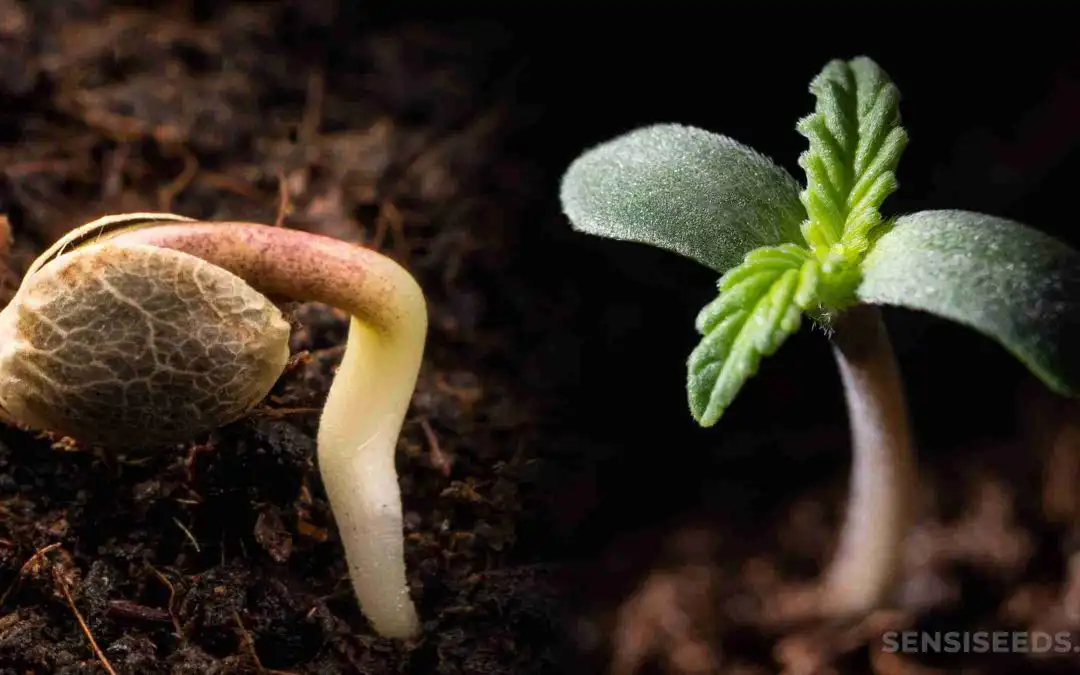
How To Germinate Weed Seeds CLOSEUP SEEDLING

Seed quality beats technique

We batch-test every seed line we stock using the paper towel method at 22 °C before dispatch. The germination guarantee page explains how that testing works. Starting from genetics that have been tested and confirmed viable is the single most useful thing you can do before germination begins, because everything after this point is damage limitation on a decision you already made.

The Three Things Every Cannabis Seed Needs

Before getting into methods it helps to understand what is actually happening, because every method is just delivering the same three conditions in a slightly different way.

A cannabis seed in dormancy is a complete plant in suspended animation, waiting for environmental signals that tell it conditions are safe. The signals it is waiting for are warmth, moisture and darkness.

Warmth signals that winter has passed. Cannabis seeds germinate most reliably at 22 to 25 °C. Below 18 °C the process slows badly and pathogen risk climbs, because the seed is developing slowly while the environment has more time to work against it. Above 28 °C the enzymes involved become heat-stressed. Consistency matters more than hitting an exact number inside that range, and fluctuation does more damage than sitting a degree or two outside it. A seedling heat mat under the setup is the most reliable way to hold temperature regardless of what the room is doing.

Moisture is the trigger that starts everything. Water penetrates the seed coat, activates the enzyme systems that convert stored nutrients into usable energy, and initiates the cell division that produces the taproot. The level needs to be steady: not so wet that the seed drowns or turns vulnerable to fungal infection, not so dry that the process stalls. Moist, not soaked, is the target.

Darkness encourages the emerging taproot to grow downward and anchor rather than reacting to light. A germinating seed has no use for light. That comes later, once the seedling has emerged and needs to photosynthesise.

Jason on germination basics

We test every batch we stock using the paper towel method at 22 °C before it goes out. What I have learned from doing that across hundreds of batches is that failures almost always come down to one of two things: the seed was not viable, or the conditions were not right. Temperature is the most commonly underestimated variable. People assume room temperature is adequate and it often isn’t, particularly through an Australian winter or in an air-conditioned room. A heat mat is a cheap fix that removes temperature as a variable entirely. After that it is water quality and patience.

Why Water Quality Matters

The water you germinate in is not a minor detail. Australian tap water contains chlorine or chloramines, fluoride, and in older pipe infrastructure some trace heavy metals. These interfere with the enzyme systems driving germination and damage the beneficial microbiology in a seed-starting medium at exactly the point the seed is most sensitive to it.

Use filtered water, collected rainwater or distilled water, pH adjusted to 6.0 to 6.5. On a chlorinated municipal supply, leaving tap water uncovered for 24 hours lets the chlorine off-gas. On a chloraminated supply, and Sydney Water is the common Australian example, standing it overnight achieves nothing, because chloramines need carbon filtration to remove.

For the full detail on what is in Australian tap water and how it affects germination, the water quality and seed germination guide covers it properly. The short version: use the best water you have access to, and untreated tap water is the worst option available to most growers.

Stage 2, Method 1: The Paper Towel Method

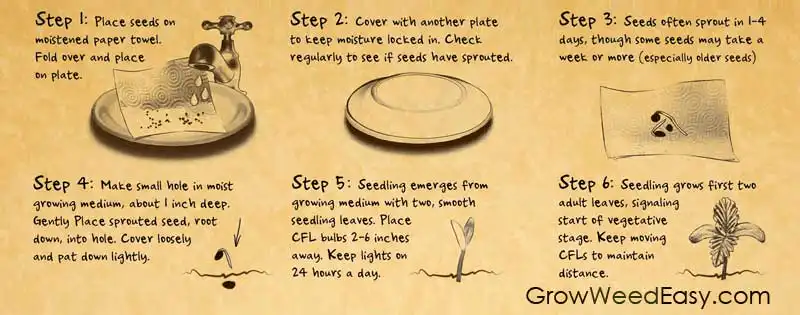
The paper towel method is what we use to batch-test every seed line before dispatch, and it is what we recommend to growers for one reason above the others: you can visually confirm germination before the seed ever touches soil. That visibility means you know a seed has germinated before you commit it to a pot, and it lets you catch a temperature or moisture problem while there is still time to fix it.

The setup is simple. Moisten a paper towel with clean, pH-adjusted water so it is damp throughout but not dripping. Place your seeds on one half with enough space that emerging taproots will not tangle, then fold the other half over. Put the folded towel between two plates or inside a zip-lock bag to hold humidity steady, and place it somewhere warm and dark: a drawer, a cupboard, or on a heat mat under something opaque.

Check every 12 to 24 hours. You are looking for the white taproot emerging, which typically appears within 24 to 72 hours for a viable seed in the right conditions, though some take up to five days. Once the taproot reaches 0.5 to 1 cm the seed is ready to plant. Handle it by the seed body and never by the taproot, which is fragile enough that bending or breaking it at this stage ends the plant.


paper towel method- simple diagram

Paper towel method, step by step

Step 1. Moisten a paper towel with clean, pH-adjusted water at 6.0 to 6.5. Damp throughout, not dripping when lifted.

Step 2. Place seeds on one half with 2 to 3 cm spacing. Fold the towel over to cover them.

Step 3. Put the folded towel between two plates or in a zip-lock bag, somewhere warm at 22 to 25 °C and dark.

Step 4. Check every 12 to 24 hours without disturbing the setup. Remoisten lightly if the towel has dried.

Step 5. Once the taproot reaches 0.5 to 1 cm, plant taproot-down in pre-moistened medium at 0.5 to 1 cm depth.

Step 6. Cover lightly. Do not water again immediately, because the pre-moistened medium will sustain the seedling for the first few days.

For the complete version with troubleshooting for every common problem, see the dedicated paper towel germination guide.

Method 2: Water Soaking

Soaking means placing seeds in a glass of clean, lukewarm water at 22 to 25 °C in a dark, warm spot for 24 to 48 hours. The seed absorbs water directly, which softens the coat and triggers germination. Seeds sinking as they saturate is a positive sign, and a small crack in the shell with an emerging taproot means it is ready to plant.

The real use case is seeds with particularly hard or thick coats that have been slow to respond to the paper towel. Direct water contact ensures full saturation where a damp towel might take longer. For most seeds from quality genetics the paper towel method is both sufficient and preferable, because soaking leaves no margin for error on timing. A seed left in water after the taproot emerges will drown. If you use this method, check every 12 hours from the 24-hour mark and plant the moment the taproot appears.

Never soak in tap water. The seed sits in direct, extended contact with whatever is in it, so any chlorine, chloramines or heavy metals are working on the seed for the entire soak. Distilled or filtered only.

Method 3: Direct Planting

Direct planting is what it sounds like, placing a seed straight into moist growing medium with no separate germination step. It is how cannabis seeds sprout in nature and it works. The advantage is that the seedling is never handled or transferred during its most fragile stage, because it germinates and establishes its root system in the medium it will grow in.

Pre-moisten the medium thoroughly so it is evenly damp throughout, poke a hole 0.5 to 1 cm deep in the centre of the container, and place the seed in. With an ungerminated seed any orientation is fine, since the taproot will orient itself downward. Cover lightly, and optionally cover the container with plastic wrap to create a humidity dome for the first few days.

The limitation is visibility. You cannot confirm germination until the seedling breaks the surface, so any seed that fails is only discovered after several days of waiting. With reliable genetics and a settled setup that is a minor cost. For a first grow, or for anyone already troubleshooting germination problems, the paper towel method’s visibility is worth the extra step.

Stage 3: Planting Into Medium

This is the moment most beginners get wrong, and the mistakes are all in the same direction: too deep, too big, too rich.

Too deep is the most common. Half a centimetre to one centimetre is the whole range. The seedling is running on the energy stored inside the seed and nothing else until the cotyledons open and start photosynthesising, so every extra centimetre of medium it has to push through is drawn from a fixed and small fuel tank. Plant at two or three centimetres and a viable seed can simply run out of energy before it reaches the surface.

Too big is the next one. A germinated seed does not go into a twenty litre pot. A small container, a party cup with drainage holes or a small nursery pot, gives the root system a volume of medium it can actually colonise, which means the medium dries at a sensible rate. In a large pot the tiny root system cannot use the surrounding moisture, the medium stays wet for far too long, and you get the conditions that damping off thrives in. The container sizing guide covers what to start in and when to move up.

Too rich is the quiet one. Seedlings need almost nothing in the way of nutrients for the first two weeks, and a hot pre-fertilised potting mix will burn them before they have leaves to show it. A light seed-raising mix, or coco, or a gently amended soil is what you want. The guide to soil for cannabis seedlings in Australia covers the specifics of what to use and what to avoid.

Practically: pre-moisten the medium so it is evenly damp before the seed goes anywhere near it, make the hole with a pencil or your finger, place the germinated seed taproot-down, and cover lightly without compacting. Do not press the medium down over the top.


Cannabis seed planting depth diagram showing correct 1 cm depth compared with planting too deep 

Stage 4: The First Watering

The counterintuitive part is that if you pre-moistened the medium properly, the first watering is not on planting day. It is three to five days later.

Overwatering kills more seedlings than anything else, and it does not look like overwatering while it is happening. It looks like drooping, which reads as thirst, which prompts more water. The root system at this stage is a taproot a centimetre or two long with a few fine laterals. It cannot drink meaningfully, and saturated medium starves it of oxygen while creating exactly the conditions fungal pathogens want.

When you do water, water in a ring around the seedling rather than at the stem. Roots grow toward moisture, so a ring encourages outward development and gets the root system spreading rather than sitting in a wet column directly under the crown. Keep the volume small, enough to dampen the surrounding medium and no more, and let the surface dry slightly between waterings. Lifting the container is the most reliable gauge you have, since the weight difference between damp and dry is obvious once you have felt it twice.

Use the same clean, pH-adjusted water you germinated in. The seedling is no less sensitive now than the seed was.

Stage 5: The First Light

Light goes on when the seedling breaks the surface, not before. Until then the seed is working in darkness by design.

Once it emerges it needs 12 to 16 hours of light a day if you are indoors. A seedling under insufficient light stretches, producing a long thin stem reaching for a source that is too far away or too weak, and a stretched seedling is structurally fragile and much more vulnerable to damping off and physical damage. If the stem between the medium and the cotyledons is getting long and pale, the light is too far away or not strong enough.

The opposite error is less common but real. Too much intensity too close will bleach and stress a seedling that has barely any leaf area to work with. Under LED, start further back than you think and close the distance over the first week as the plant shows it can handle it. A gentle, generous light period beats an intense short one at this stage.

Outdoors the equivalent mistake is putting a fresh seedling straight into full Australian summer sun. Start it somewhere with bright indirect light or morning sun only, and harden it off over several days. The outdoor growing guide for Australia covers timing and placement in more detail.

Stage 6: The First Week

Knowing what normal looks like is most of the battle here, because almost every first-week intervention makes things worse and the temptation to intervene is strongest when you don’t know what you are looking at.

Days one to three. Nothing visible above the surface, or a bent stem pushing up. This is the phase where people dig the seed up to check on it, which ends the plant. Leave it alone.

Days two to four. The seedling breaks the surface and the cotyledons open, the two smooth rounded leaves that came packed inside the seed. They are not true leaves and they will yellow and drop later, which is normal and not a deficiency. Occasionally the seed shell comes up still attached, which growers call helmet head. Mist it lightly and leave it, because it usually falls away within a day or two once softened.

Days four to seven. The first true leaves appear, single-bladed at first, then the familiar serrated shape. Growth looks slow above the surface because the plant is investing in roots. That is exactly what you want.

Through all of it, hold humidity around 70 to 80 percent for the first few days and ease it down to 60 to 65 percent as the cotyledons open fully. Keep temperature steady in the low twenties. Do not feed. A seedling in a decent medium has everything it needs for the first two weeks, and the most common cause of first-week damage after overwatering is a well-meaning early feed. The guide to when to start feeding seedlings sets out the actual trigger to watch for, which is the third node rather than a date on a calendar.

Two things to watch for. If a seedling collapses at the base with a pinched, darkened stem, that is damping off, and the damping off and stem rot guide covers prevention, since treatment after the fact rarely works. If leaves yellow in a pattern that is not the cotyledons fading, the yellowing leaves guide will help you separate a real problem from a normal one.


Cannabis seedling first week timeline showing germination through to first true leaves

Stage 7: Where to Go From Here

At the end of the first week you have an established seedling with true leaves and a working root system, and the job changes. The germination questions are behind you and the seedling questions begin: feeding schedules, transplant timing, training, and the transition into vegetative growth.

The cannabis seedling care guide picks up exactly where this one finishes and carries you through to early vegetative growth. When the roots fill that first small container, the transplanting guide covers moving up a pot size without checking the plant’s growth. If you are running an autoflower, the week by week autoflower guide maps the whole fixed timeline from here to harvest.

Everything from this point rewards patience more than intervention, which is the same lesson the first week teaches.

Key takeaways

Every germination method delivers the same three conditions: warmth at 22 to 25 °C, steady moisture, and darkness. The paper towel method is our recommendation because it confirms germination visually before the seed touches soil.

Use clean, pH-adjusted water at 6.0 to 6.5, whether filtered, rainwater or distilled. Australian tap water contains chlorine, chloramines and fluoride that work against germination.

Plant shallow at 0.5 to 1 cm, in a small container, in a light medium. Too deep, too big and too rich are the three planting errors that cost most beginners their first seedling.

Do not water on planting day if the medium was pre-moistened, do not feed in the first fortnight, and do not dig the seed up to check on it. The first week rewards leaving things alone.

How to Germinate Cannabis Seeds: Frequently Asked Questions

What is the best way to germinate cannabis seeds?

The paper towel method is the most reliable for most growers. It gives you consistent temperature and moisture control and lets you confirm germination visually before the seed contacts soil. Place seeds between moist paper towels, hold 22 to 25 °C in the dark, and check every 12 to 24 hours. It is also what we use to batch-test every line before dispatch. The paper towel method guide has the full step-by-step.

How long does it take for cannabis seeds to germinate?

Most viable seeds in correct conditions show a taproot within 24 to 72 hours. Older seeds and those with hard coats can take up to five days. If nothing has happened after seven days in good conditions the seed is unlikely to be viable. Do not give up at 24 hours. If yours are not germinating despite correct conditions, the germination troubleshooting guide works through the causes.

Can I use tap water to germinate cannabis seeds?

Australian tap water contains chlorine or chloramines, fluoride, and in older infrastructure some trace heavy metals, all of which interfere with germination. Use filtered, collected rainwater or distilled at pH 6.0 to 6.5. On a chlorinated supply, standing tap water uncovered for 24 hours off-gasses the chlorine. On a chloraminated supply such as Sydney Water, standing it does nothing and you need carbon filtration. The water quality guide covers it in full.

What temperature is best for germinating cannabis seeds?

22 to 25 °C, held consistently. Below 18 °C germination slows and pathogen risk rises. Above 28 °C the enzyme systems involved get heat-stressed. A seedling heat mat is the most reliable and inexpensive way to hold that range regardless of ambient temperature, which matters through an Australian winter or in an air-conditioned room where the air is cooler than it feels.

How deep should I plant a germinated seed?

Half a centimetre to one centimetre, taproot pointing down, covered lightly without compacting. Deeper is the most common beginner error. The seedling runs purely on energy stored in the seed until the cotyledons open, so every extra centimetre it has to push through comes out of a small fixed supply. Planting at two or three centimetres can exhaust a perfectly viable seed before it reaches the surface.

What should I plant my seedling into?

A small container with drainage, a party cup or small nursery pot, filled with a light seed-raising mix, coco, or gently amended soil. Avoid hot pre-fertilised potting mixes, which will burn a seedling before it has leaves to show the damage. The seedling medium guide covers the options, and the container sizing guide covers when to move up.

When should I water for the first time?

If you pre-moistened the medium before planting, three to five days after, not on planting day. Water in a ring around the seedling rather than at the stem, keep the volume small, and let the surface dry slightly between waterings. Overwatering is the leading killer of seedlings and it presents as drooping, which is easily mistaken for thirst.

When do I turn the light on?

When the seedling breaks the surface, not before. Then 12 to 16 hours a day. Too little light produces a stretched, fragile stem, and too much intensity too close will stress a plant with almost no leaf area. Under LED, start further back than feels right and close the distance across the first week.

Should I feed my seedling in the first week?

No. A seedling in a decent medium has everything it needs for roughly the first fortnight, and early feeding is one of the most common causes of first-week damage. The feeding guide explains the trigger to watch for, which is the third node rather than a set number of days.

What if my cannabis seeds are old?

Older seeds germinate at lower rates. Viability drops noticeably after two to three years without proper storage and declines even in good storage past five. Light scarification, gently rubbing the coat on fine sandpaper to thin it, can help moisture penetrate. Soaking is also worth trying for hard-coated older seeds. The seed longevity guide sets out what to expect by age.

My seedling came up with the shell stuck on it. What should I do?

That is helmet head, where the seed coat has not separated cleanly. Leave it alone and mist it lightly with clean water to soften the shell. It usually falls off on its own within 24 to 48 hours. Pulling it off manually frequently decapitates the seedling, because the cotyledons inside are attached to the shell and tear if forced before the coat has softened.

Do I need a heat mat?

Not strictly, but it is worth having. A heat mat provides consistent gentle warmth and removes temperature as a variable, which is the most commonly underestimated factor in germination failure. In Australia it matters most through the cooler months or in air-conditioned rooms, where ambient temperature sits well below 22 °C without feeling cold.

What do healthy cannabis seeds look like?

Firm and hard, not compressing when pressed between your fingers. Typically dark, brown or grey or striped brown and tan, with a slight waxy sheen. Pale green, white, very small or soft seeds are unlikely to germinate. Size variation inside a batch is normal, and larger seeds do not germinate faster or grow more vigorously than smaller ones from the same genetics.

Should I start with feminised or autoflower seeds?

For a first grow, feminised photoperiod seeds are the more forgiving choice, because a photoperiod plant has a recovery window if something goes wrong early while an autoflower runs to a fixed clock. The autoflower versus photoperiod comparison works through the tradeoffs, and the beginner strain guide narrows down which genetics suit a first run.

What happens after the first week?

You have an established seedling and the job shifts to seedling care: feeding, transplant timing, and the move into vegetative growth. The seedling care guide picks up precisely where this guide ends.

Related Reading

Paper towel germination method, the full step-by-step with troubleshooting for every common problem.

Water quality and seed germination, why Australian tap water undermines germination rates and what to use instead.

Why aren’t my cannabis seeds germinating, a diagnostic guide for failed attempts covering temperature, water, seed age and the seeds that crack but never sprout.

Cannabis seedling care in Australia, the complete guide to the fortnight after germination.

Why seedlings die: damping off and stem rot, the most common cause of failure in the first two weeks and how to prevent it.

Sacred Seeds germination guarantee, how we test every batch before dispatch.

Browse the full range, feminised, autoflower and photoperiod genetics shipped from within Australia.

Seeds are sold strictly as novelty collector’s items. They contain no THC or CBD. This page does not constitute medical or legal advice. By purchasing you agree to our terms and conditions. Always check the laws that apply where you live before germinating or cultivating.