Damping off kills more cannabis seedlings than bad genetics ever will — and almost every case is preventable. I’ve had growers contact us convinced they received dead seeds, only to describe a germination setup that was almost perfectly designed to cause damping off: wet medium, no airflow, tap water, cold temperatures, seeds planted too deep. The seeds were fine. The environment killed them.
Stem rot and cannabis damping off are fungal and water mould diseases that attack seedlings at their most vulnerable — the two-week window between germination and the point where the plant has developed enough root mass and stem thickness to resist infection. Getting through that window successfully comes down to environmental management, not genetics. This guide covers what causes it, how to identify it before it’s too late, and the prevention strategies that work reliably in Australian growing conditions.
Cannabis Damping Off — At a Glance
| Primary cause | Overwatering — wet medium is the single most common trigger |
| Pathogens responsible | Pythium spp., Rhizoctonia spp., Fusarium spp. |
| First visible symptom | Stem pinching and discolouration at soil level |
| Ideal temperature | 21–27°C — consistent, not fluctuating |
| Ideal humidity | 70–80% early seedling; reduce to 60–65% once cotyledons open |
| Critical window | Germination through to day 14 — highest vulnerability period |
| Water at soil level | In a ring around the seedling — never directly at the stem |
| Treatable once visible? | Rarely — prevention is the only reliable strategy |
In this guide:

What Damping Off and Stem Rot Actually Are
Damping off and stem rot are related but distinct conditions. Understanding the difference matters because they have overlapping causes and identical prevention strategies — but slightly different presentations.
Damping off is caused by a group of soil-borne pathogens — primarily water moulds and fungi in the Pythium, Rhizoctonia, and Fusarium genera. These pathogens are present in most growing environments at low levels and cause no problems when conditions are right. The problems begin when the environment tips in their favour: saturated medium, poor airflow, inadequate drainage, or cold temperatures that slow the seedling’s development while the pathogen continues to reproduce. Once conditions favour the pathogen, it colonises the seedling’s stem at the soil line — the thinnest, most vulnerable point — and the plant collapses.
Stem rot is essentially the same process by a different name, sometimes used specifically when the fungal infection is visibly localised to the stem tissue rather than the root system. In practice, the two conditions look similar, have the same environmental causes, and respond to the same prevention and treatment approaches. The distinction matters less than the management.
What both conditions share is timing: they overwhelmingly affect seedlings in the first two weeks from germination, before the stem has lignified enough to resist infection and before the root system is extensive enough to handle moisture variation. After day 14 the risk drops significantly. Before day 14 — particularly in the first week — the seedling is genuinely fragile in a way that experienced growers sometimes forget.
🧠 Jason — On Blaming Genetics
The call I dread is the one where someone tells me their seedlings all died in the first week and they think we sent them bad seeds. In three years of running Sacred Seeds, I’ve had exactly two batches with genuine germination problems that were attributable to the seeds themselves. Every other case of early seedling death that’s come back to us has been environmental — and damping off from overwatering is far and away the most common. When all your seedlings die at the same stage, at the same point in the stem, that’s not genetics. That’s the environment. The seeds did their job. Something in the setup killed what came out of them.
How to Identify Cannabis Damping Off — Symptoms by Stage
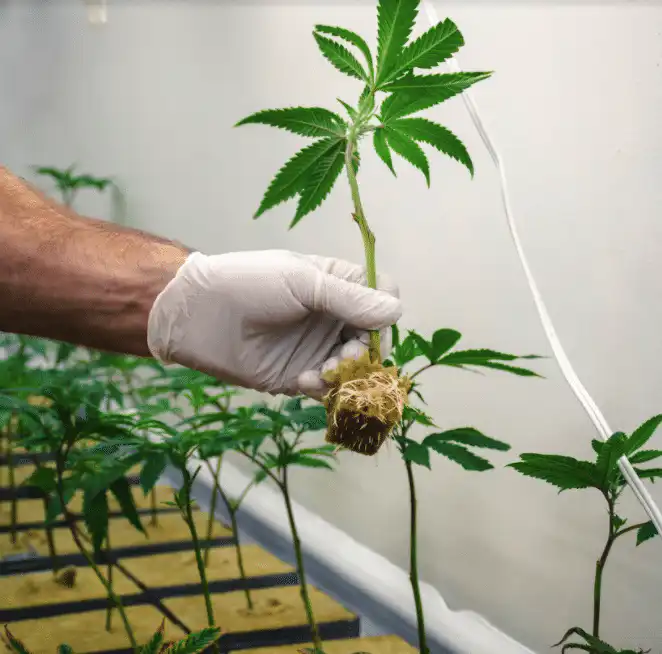
Damping off moves quickly — a seedling that looks stressed in the morning can be collapsed by evening. Catching it at the earliest stage gives you the best chance of intervening before the entire batch is affected.
Pre-emergence damping off is the invisible version — seeds germinate, the radicle begins to develop, and then the pathogen attacks the stem before it breaks the surface. The seed never emerges. This is often misread as a germination failure and attributed to seed quality. If seeds have germinated in the paper towel test but fail to emerge after transplanting into medium, damping off at or below the surface is a likely explanation.
Early post-emergence is where the symptoms become visible. The stem develops a pinched, water-soaked appearance at soil level — a narrowing of the stem that makes the seedling look like it’s being strangled at the base. The cotyledons (the first seed leaves) may appear healthy while the stem below is already compromised. This is the window where intervention has any chance of working.
Collapse follows quickly from the pinching stage. The stem can no longer support the seedling’s weight and the plant tips over — the characteristic “floppy seedling” presentation. At this stage the infection is almost certainly fatal. The stem is soft, discoloured brown to grey, and the root tissue if examined will show stunted, grey-brown, or absent development.
Secondary signs in high-humidity conditions include fluffy white cobweb-like mycelial growth on or around infected tissue — the visible presence of the fungal pathogen. This is most common with Pythium in very wet, humid setups and is a reliable confirmation of damping off rather than mechanical damage or other causes.
Damping Off Symptom Checklist
Early warning signs — act now: Stem narrowing at soil level. Water-soaked appearance at the base. Cotyledons wilting despite moist medium. Seedling leaning without mechanical cause.
Advanced symptoms — likely fatal: Seedling collapsed or unable to support itself. Stem soft and discoloured brown to grey at soil line. Roots stunted, grey-brown, or absent when checked. White mycelial growth visible on or around stem base.
Pre-emergence — invisible but suspected when: Seeds germinated in paper towel test but failed to emerge from medium. Multiple seeds from the same batch fail to emerge at the same stage. Medium was wet at planting and remained wet during the emergence window.
What Causes Cannabis Damping Off in Australia
The pathogens responsible for cannabis damping off are opportunistic — they’re present in most growing environments and only cause problems when conditions favour them over the seedling. Understanding what shifts conditions in the pathogen’s favour is the key to prevention.
Overwatering is the primary cause — by a significant margin. Saturated medium deprives the root zone of oxygen, stresses the seedling’s development, and creates the anaerobic, high-moisture conditions that Pythium and other water moulds require to proliferate. A seedling in correctly moist medium — moist enough to sustain development, dry enough that the surface is slightly dry between waterings — is dramatically less vulnerable than one sitting in saturated growing media. This is the single most important variable to manage and the most commonly mismanaged one.
Poor drainage compounds overwatering — medium that doesn’t allow water to drain freely keeps the root zone wet long after watering. Containers without adequate drainage holes, medium compacted to the point of poor drainage, or growing mixes without sufficient aeration (perlite, coco coir) all extend the wet period after watering. In an Australian summer setup where the ambient humidity is already elevated, poor drainage in the container means the medium may never fully dry between waterings.
Inadequate airflow allows humidity to build around the seedling’s stem — the exact microclimate that favours pathogen growth. A humidity dome without ventilation can maintain conditions ideal for damping off even if the medium moisture level is correct. Gentle airflow — even just cracking the humidity dome — makes a measurable difference.
Cold medium temperature slows the seedling’s development while the pathogen continues to reproduce at its normal rate, widening the window of vulnerability. Medium temperatures below 18°C significantly increase damping off risk. In Australian autumn and winter grows, or in setups without bottom heat, medium temperature is often lower than ambient air temperature — a seedling heat mat under the tray addresses this directly.
Contaminated growing media or equipment introduce the pathogens directly. Reused pots and trays that weren’t sterilised between grows, garden soil used as a seedling medium, or growing mixes that were stored open and exposed to moisture all carry elevated pathogen loads. Fresh, high-quality seedling mix in sterilised containers starts the seedling with the lowest possible pathogen pressure.
Planting depth affects how much stem tissue is exposed to the saturated zone around the medium surface. Seeds planted deeper than 1 cm from the surface force the emerging seedling to push through more wet medium with more stem tissue at risk. Germinated seeds placed at 0.5–1 cm depth with the radicle pointing down minimises this exposure.
How Damping Off Pathogens Spread
Understanding the transmission routes explains why good sanitation is as important as correct watering technique — and why a single infected plant in a tray can rapidly become a lost batch.
Pythium, Rhizoctonia, and Fusarium persist in soil and plant debris and can be introduced into a clean seedling setup through previously used pots and trays that weren’t sterilised, airborne spores (particularly Fusarium, which spreads through air movement), fungus gnats whose larvae carry and spread pathogens through the medium as they move, contaminated hands and tools that have contacted infected soil, and irrigation water that has splashed from infected medium to healthy plants.
Once introduced, these pathogens move through shared irrigation water and by growing directly through the growing medium — which is why a single collapsed seedling in a tray represents a real risk to neighbouring plants. Remove affected seedlings immediately and isolate healthy ones if possible once damping off is confirmed in a multi-seedling setup.
Fungus gnats deserve specific mention in the Australian context. The warm, humid conditions of Australian summers create ideal conditions for fungus gnat populations, and their larvae are a meaningful vector for damping off pathogens in continuously wet medium. Sticky yellow traps above the growing area and allowing the medium surface to dry between waterings both address fungus gnat risk alongside the damping off prevention they’re already doing.
Prevention — The Only Reliable Strategy Against Cannabis Damping Off
By the time damping off is visible, the seedling is almost always past saving. Prevention is not a secondary consideration — it’s the only reliable approach. These are the strategies that consistently make the difference.
Growing medium selection and preparation
Use a purpose-made seedling mix or create one from organic potting soil, sterilised coco coir, and 10–20% perlite for drainage and aeration. Avoid garden soil entirely — it carries pathogen loads that make damping off almost inevitable in seedlings. Pre-moisten the medium before use so it’s evenly damp but not wet — it should clump slightly when squeezed but not drip. Starting with correctly moistened medium means the first watering can be delayed until the seedling genuinely needs it, rather than the medium requiring water immediately after planting.
Equipment sterilisation
Soak all reused pots, trays, and tools in a 10% bleach solution (one part bleach to nine parts water) for 30 minutes, rinse thoroughly, and allow to fully dry before use. For growing medium that needs sterilisation — coco coir, or potting mix being reused — a 1:9 hydrogen peroxide and water solution soaked through and fully drained is effective. Heat sterilisation (spreading medium on a baking tray at 82°C for 30 minutes) works for soil-based mixes. The point is not sterility for its own sake — it’s reducing the pathogen load the seedling starts with.
Watering technique
Water in a ring around the seedling, not directly at the stem. The root system grows outward from the seed and the watering ring encourages roots to grow toward the moisture. Direct stem watering saturates the most vulnerable tissue. Use clean water at room temperature — cold water (below 18°C) slows root development and increases infection risk. For the best water for cannabis germination, filtered or collected rainwater at pH 6.0–6.5 is significantly better than unfiltered tap water. Allow the surface of the medium to dry slightly between waterings — not bone dry, but not continuously wet.
Temperature and airflow
Maintain medium temperature at 21–27°C consistently. A seedling heat mat with a thermostat under the tray is the most reliable way to achieve this regardless of ambient temperature. Keep ambient humidity at 70–80% during the first few days after emergence, then reduce to 60–65% as the cotyledons open and the seedling begins to develop. A humidity dome is useful early — but it needs ventilation. A slightly cracked dome, or one with ventilation holes, maintains humidity while allowing enough airflow to prevent the stagnant, humid microclimate that favours damping off pathogens.
Planting depth
Germinated seeds should be planted no deeper than 1 cm from the surface, with the radicle pointing downward. Deeper planting increases the length of stem tissue exposed to the wet zone around the medium surface and forces the seedling to develop through more medium before reaching light — prolonging the period of maximum vulnerability without benefit.
Lighting
Adequate light from emergence is important not just for photosynthesis but because light-deprived seedlings develop elongated, weak stems — less structural resistance to the pinching effect of damping off infection. Twelve to sixteen hours of proper grow light or strong fluorescent at the correct distance. Seedlings reaching toward a distant or weak light source are more vulnerable than those developing compact, robust stems under correct lighting.
🧠 Jason — The Watering Mistake That Kills Most Seedlings
Most damping off cases I see come down to one thing: the medium was never allowed to dry between waterings. People start with pre-moistened mix, plant the seed, then water again the next day because they’re anxious about the seedling drying out. And then again the day after. The medium never gets a chance to develop the moisture differential that drives root growth outward, and the stem sits in wet medium continuously through the most vulnerable period of its life. In a correctly set up germination environment — humidity dome with ventilation, heat mat, 22–24°C — the medium you moistened before planting will sustain the seedling for three to five days without additional watering. Wait for the surface to lighten in colour slightly before you add more water. That surface drying is the seedling telling you it’s ready.
Treatment Options When You Catch It Early
To be direct about this: if a seedling has visibly collapsed — stem soft, plant tipped over — it’s gone. There is no reliable recovery from advanced damping off. The treatment options below address very early-stage infection, where the stem is showing stress signs but the plant hasn’t yet collapsed. They are management tools, not cures.
Improve airflow immediately. Remove or fully open the humidity dome. Add a gentle fan if you don’t already have one. Reducing the humidity at the stem surface is the most impactful immediate step — it slows the pathogen’s spread even if it doesn’t reverse existing infection.
Allow the medium to dry. Stop watering and let the medium surface dry to the point where the top centimetre is dry to the touch. This removes the moisture the pathogen requires to continue spreading. Do not let the medium dry completely — the seedling still needs moisture — but a drying cycle after early symptom detection is the right response.
Neem oil solution applied as a drench around (not at) the stem base has antifungal and antibacterial properties. Mix to manufacturer’s recommended dilution. Effective against Pythium and Fusarium at early stages. Apply once and monitor — repeated applications at seedling stage can cause phytotoxicity.
Cinnamon powder applied lightly around the stem base has natural antifungal properties from its cinnamaldehyde content. A light dusting on the medium surface around the stem — not on the stem itself — creates a hostile environment for the pathogen without stressing the seedling.
Chamomile tea spray (cooled, diluted 1:1 with clean water) contains antifungal compounds and is gentle enough for seedling-stage application. Less reliable than neem but non-toxic and worth trying if neem isn’t available.
If early intervention doesn’t halt visible progression within 24 hours, remove the affected seedling and isolate remaining healthy seedlings. The priority becomes protecting the rest of the batch, not saving a seedling that’s already past the point where recovery is realistic.
What Healthy Cannabis Seedlings Look Like

Knowing what to look for in a healthy seedling is as useful as knowing the damping off symptoms — it calibrates the baseline you’re aiming for and helps distinguish normal development from early stress signals.
A healthy cannabis seedling at day three to five has a robust, straight stem that holds the cotyledons (the first round seed leaves) level and steady without leaning or drooping. The stem is green or very slightly purple at the base — not discoloured, not pinched, not soft. The cotyledons are symmetrical, vibrant green, and horizontal — catching light effectively.
By day seven to ten the first true leaves — the serrated cannabis leaves — are developing from the growing tip. The stem is visibly thickening. The seedling is actively growing rather than just holding position. Root tips may be visible at drainage holes in smaller containers, indicating the root system is developing normally.
By day fourteen the plant is transitioning out of the highest-risk window. The stem has begun to lignify — developing the structural rigidity that makes it naturally more resistant to damping off infection. From this point, standard cannabis seedling care protocols apply and the acute damping off risk is significantly reduced.
Not sure which strain suits your setup?
Answer six questions and Jess will match you to three strains based on your experience, space, and goals.
Key Takeaways — Cannabis Damping Off
Cannabis damping off and stem rot are caused by Pythium, Rhizoctonia, and Fusarium pathogens that attack seedlings in the first two weeks from germination — the window before the stem has lignified enough to resist infection. Overwatering is the primary cause in almost every case: saturated medium creates the anaerobic, high-moisture conditions these pathogens require. Prevention is the only reliable strategy — by the time a seedling has visibly collapsed it cannot be saved. The prevention framework is straightforward: correctly moistened medium (not wet), clean water at pH 6.0–6.5, containers with adequate drainage, airflow through the growing area, medium temperature at 21–27°C, and planting depth no greater than 1 cm. Sterilise all equipment between grows. Allow the medium surface to dry slightly between waterings — this is the single most impactful habit change most growers can make. For the full germination setup see the paper towel germination guide, and for what comes after successful germination see the cannabis seedling care guide.
Cannabis Damping Off — Frequently Asked Questions
What is cannabis damping off?
Damping off is a disease of cannabis seedlings caused by soil-borne fungal and water mould pathogens — primarily Pythium, Rhizoctonia, and Fusarium species. It attacks seedlings at soil level, pinching and rotting the stem tissue during the first two weeks from germination when the plant is most vulnerable. It’s almost always an environmental problem rather than a genetics problem — the same seeds in a correctly managed setup will germinate and thrive.
What causes damping off in cannabis seedlings?
Overwatering is the primary cause in the vast majority of cases — saturated medium creates the conditions Pythium and other water moulds require to proliferate. Poor drainage, inadequate airflow, cold medium temperatures, contaminated growing equipment, and planting seeds too deep all contribute. In Australian growing conditions, high ambient humidity in summer setups with poor ventilation is a significant compounding factor.
How do I know if my seedling has damping off?
The first visible sign is stem pinching and a water-soaked discolouration at soil level — a narrowing of the stem that makes the plant look strangled at the base. This progresses to the seedling leaning and eventually collapsing, unable to support its own weight. In humid conditions, white fluffy mycelial growth may be visible around the base. Pre-emergence damping off is invisible — seeds that germinated successfully but never broke the surface are the indication.
Can damping off be treated?
Very early stage infection can sometimes be slowed with improved airflow, reduced watering, and fungicide applications like diluted neem oil or cinnamon powder around the stem base. A collapsed seedling cannot be saved. Prevention is the only reliable strategy — the treatment options are damage limitation rather than cure.
How do I prevent damping off in my cannabis seedlings?
Use fresh, high-quality seedling mix in sterilised containers with adequate drainage holes. Pre-moisten the medium before planting and resist watering again until the surface lightens in colour. Water in a ring around the seedling rather than at the stem. Maintain medium temperature at 21–27°C with a heat mat. Provide airflow through the growing area — a slightly cracked humidity dome rather than fully sealed. Use clean filtered water at pH 6.0–6.5 rather than tap water.
How long are cannabis seedlings vulnerable to damping off?
The highest-risk window is germination through to approximately day 14. During this period the stem is thin, unlignified, and most susceptible to fungal infection at soil level. After day 14 the stem begins to develop structural rigidity and the risk drops significantly. By the time the plant has four to six true leaves it’s essentially past the damping off risk window entirely.
Does bad genetics cause damping off?
No. Damping off is an environmental disease caused by specific pathogens in specific conditions. Genetics plays no role. If your seedlings are dying from damping off it means the growing environment favoured the pathogens over the seedling — not that the seeds were poor quality. The same seeds in a correctly managed setup will germinate successfully.
What is the difference between damping off and stem rot?
In practice, the terms describe the same process — fungal infection of the seedling stem at soil level leading to collapse. Damping off is sometimes used specifically for pre-emergence failure or very early post-emergence collapse, while stem rot describes the visible rotting of stem tissue in slightly more developed seedlings. The causes, prevention strategies, and treatment approaches are identical for both.
Related Reading
Cannabis seedling care in Australia — the complete guide to the seedling stage from emergence through to early veg, including watering, lighting, and feeding.
Water quality for cannabis germination — why Australian tap water undermines germination rates and the practical fixes that work.
Paper towel germination method — Sacred Seeds’ complete step-by-step germination guide.
How to germinate cannabis seeds — all germination methods covered with troubleshooting for common problems.
Browse all cannabis seeds — feminised, autoflower, and photoperiod strains shipped from Australia.
Seeds are sold strictly as novelty collector’s items. They contain no THC or CBD. This page does not constitute medical or legal advice. By purchasing you agree to our terms and conditions. Always check local laws before germinating or cultivating cannabis.