🌿 White Widow Seeds: Key Info
| 🏷️ Breeder |
Green House Seed Co. / Shantibaba, Amsterdam, 1994 |
| 🧬 Genetics |
Brazilian sativa landrace × South Indian (Kerala) indica |
| 🍬 Also Known As |
WW, White, The Widow |
| 🌱 Type |
Feminised Photoperiod
60% Sativa / 40% Indica hybrid |
| 🔥 THC / 💧 CBD |
THC ~18–25% • CBD <1% |
| ⏱ Flowering Time |
8–9 weeks from the 12/12 flip, plus veg time |
| 🌾 Yield (Guide) |
Indoor: up to 600 g/m² • Outdoor: up to 650 g/plant |
| 📏 Height |
Medium (80–120 cm), compact, bushy, resin-heavy structure |
| 🌿 Flavour & Aroma |
Floral, pine, earthy, with peppery spice undertones |
| 🧪 Terpene Profile |
Myrcene (dominant) • Caryophyllene • Pinene |
| 🌤 Outdoor Harvest (AU) |
North: mid to late April • Mid: late April to early May • South: early May |
| 🌱 Experience |
Accessible to intermediate (forgiving landrace genetics, longer finish) |
| 📦 Handling |
Batch-tested at ~22 °C (paper towel method). Stored cold/dry prior to dispatch. Learn how we test seeds here. |
| ⚠️ Legal Notice |
Sold strictly as souvenirs/collectibles in accordance with local laws. |
🏆 Winner, 1995 High Times Cannabis Cup. White Widow took the Cup the year after release and became the benchmark for trichome production, with three decades of continuous global cultivation behind it since.
🌿 White Widow Seeds: Brazilian Sativa × South Indian Indica, the Original Frosted Hybrid
White Widow seeds carry the Brazilian sativa and South Indian indica genetics that Green House Seed Co. and Shantibaba introduced in 1994: the extreme white trichome coverage that named the strain, a floral-pine terpene profile, and the clear-headed-then-settled effect that made White Widow the benchmark of Amsterdam coffee shop culture for three decades.
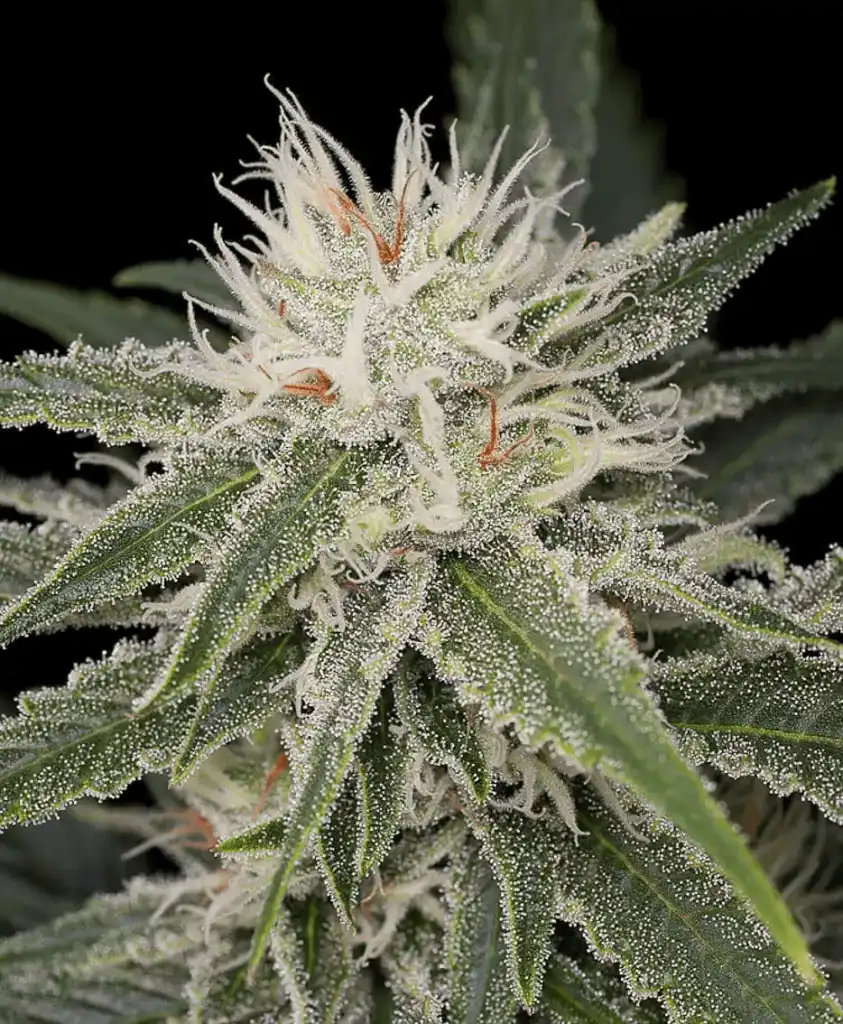
The genetics trace to two landrace sources: a Brazilian sativa mother (often identified as the old-school Manga Rosa landrace) and a resin-heavy South Indian indica father sourced from a farm in the mountains of Kerala, selectively bred for trichome production over generations, and our piece on cannabis genetics from landrace to modern hybrid traces how crosses like this reshaped the whole catalogue. The cross produced the white crystal-coated buds that gave the strain its name, and a 60% sativa, 40% indica balance that neither parent could deliver alone. It won the High Times Cannabis Cup in 1995 and became one of the most recognised and widely grown strains in the world. A detail worth knowing for Australian growers: breeder Shantibaba (Scott Blakey) is Australian, so the most influential hybrid of the 1990s has Australian roots at its core. For the full contested origin story, the breeding legacy, and the strains it spawned, see our White Widow strain review.
What White Widow seeds do well:
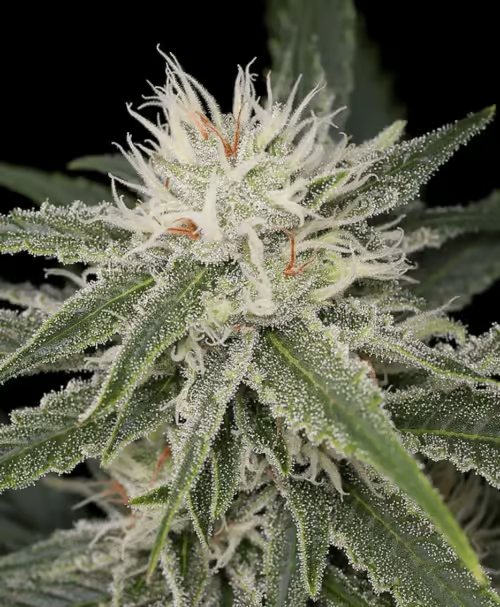
- Exceptional trichome coverage: the Kerala resin genetics produce the white crystal coating that defines the strain at harvest, one of the most visually striking of any classic hybrid and genuinely above average for resin density
- A 60/40 sativa-leaning balance: the Brazilian sativa drives clear-headed euphoria and social energy, the South Indian indica contributes body ease and depth, and neither overwhelms the other at moderate doses, one of the most versatile effect profiles in the classic catalogue
- A floral-pine-earthy terpene profile: myrcene-dominant with pinene brightness and caryophyllene spice, more herbal and complex than diesel or candy-forward genetics
- Robust and adaptable: the Brazilian and South Indian landrace genetics bring genuine resilience across growing environments, more forgiving than OG or Cookies-derived genetics at equivalent potency
- A 30-year proven track record: White Widow seeds are worth growing not because they are new, but because the genetics have held up in continuous cultivation since 1994
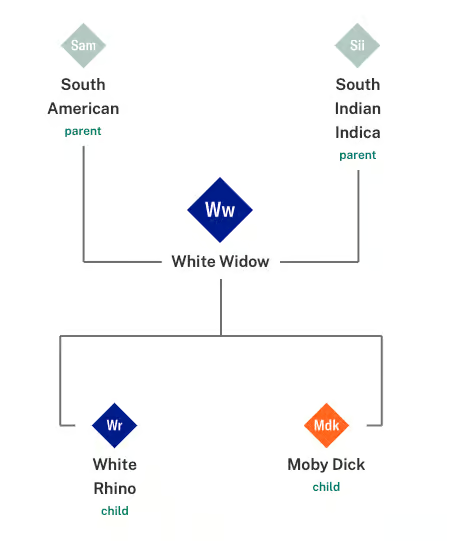
White Widow's influence runs a long way past its own sales. It sits behind White Rhino, White Russian, Blue Widow and Black Widow, and one of its most successful children is in this catalogue. Moby Dick, its biggest-yielding child, crossed the Brazilian sativa side with Haze and pushed the result into serious size and yield territory, while keeping the resin density the Kerala parent contributed here.
White Widow Lineage
Brazilian Sativa
Landrace (Manga Rosa)
×
South Indian Indica
Kerala, resin-selected
↓
White Widow
Green House / Shantibaba, 1994
↓
Progenitor of an entire family:
Moby Dick, White Rhino, White Russian, Blue Widow, and Black Widow.
↻ Looking for a different format? Auto White Widow runs the same Brazilian and South Indian genetics on a fixed 63 to 70 day timeline, compact at 60 to 100 cm, with no light flip and the option of multiple outdoor cycles per season. If you are undecided, our
autoflower versus photoperiod comparison sets out the trade-off.
🌿 White Widow Seeds Effects and Experience
Onset (5–15 minutes): fast and clear-headed. The Brazilian sativa genetics drive an uplifting, euphoric lift, mood brightens, conversation flows, creativity engages. Warm and pleasant rather than sharp or racy, with a clean alert quality from the pinene. One of the more sociable, functional onsets in the classic catalogue.
Early phase (15–45 minutes): the cerebral character at its most active. Creative focus, social energy, physical lightness. The South Indian indica begins contributing gentle ease underneath the clarity, warmth building without competing with the mental engagement. The floral-pine flavour is most present here.
Mid-phase (45–90 minutes): the 60/40 balance expressing fully. Mental engagement settles into comfortable contentment while physical ease deepens and muscle tension releases gradually. Still functional at typical doses, this is the window White Widow is best known for, alert and comfortable at once.
Late-phase (90+ minutes): physical ease becomes the primary sensation as the myrcene and caryophyllene express, appetite increases, and the effect drifts toward a settled wind-down. Still more functional than a pure indica at this stage. In the evening or at higher doses, sleep is a natural outcome.
Duration: 2 to 3 hours at typical doses, a gradual, comfortable taper without a sharp comedown.
Potency note: at 18 to 25% THC in a sativa-leaning hybrid, White Widow is meaningfully potent without sitting at the extreme end of the catalogue, and the myrcene base can make it feel stronger than the number suggests. The balance reads as comfortable and functional at moderate doses, but it is still a potent strain, so allow 15 minutes before assessing.
Flavour: floral and pine on the inhale, a fresh, herbal, slightly sweet quality from the pinene and myrcene, with earthy depth and a peppery caryophyllene spice on the exhale. Subtle and complex rather than loud. The full profile develops with a proper 3 to 4 week cure, since fresh-dried White Widow underrepresents the genetics, so assess at four weeks in the jar.
🌿 Terpene Profile
A myrcene-dominant profile in a register distinct from the candy and diesel genetics that dominate the modern catalogue:
- Myrcene (dominant): the earthy, herbal foundation, and the base of the body side of the effect
- Caryophyllene: the peppery spice on the exhale, the same compound that gives black pepper and cloves their bite
- Pinene: the fresh pine note that lifts the myrcene earthiness and keeps the profile from being one-dimensional
For how these compounds shape flavour and effect, see our cannabis terpenes guide. How much the 60/40 split actually predicts is covered in our piece on sativa versus indica. White Widow sits in our hybrid range, leaning sativa, and at the top of its range touches our high-THC range.
🌱 Growing White Widow Seeds in Australia
(Strictly for ACT residents with a licence or those overseas where cultivation is legal. Our overview of cannabis laws in Australia sets out how each state treats it.)
Experience level: accessible to intermediate. The Brazilian and South Indian landrace genetics make White Widow seeds more forgiving than OG or Cookies-derived genetics at equivalent potency, which is why it earns a place in our roundup of the most forgiving strains for Australian growers. The main things to manage are the 12/12 flip timing and the longer flowering window (8 to 9 weeks, longer than most indica-dominant photoperiods), while height stays compact and manageable throughout. For the early weeks, our cannabis seedling care guide covers getting a plant established well.
Veg phase: grow under 18/6 until the plant is the size you want to flower. 4 to 6 weeks suits most indoor setups. The medium, compact structure fills out evenly without aggressive training, though topping from week 3 to 4 and LST from early veg improve canopy evenness, and White Widow responds well to SCROG given the bushy branching.
Height and structure: compact at 80 to 120 cm with minimal flowering stretch. The South Indian indica keeps the plant manageable without the sativa stretch of Bruce Banner or Sour Diesel genetics, and the bushy, resinous structure is one of the more practically manageable photoperiods in the catalogue. That makes it a genuine option where headroom is tight, and our guide to growing cannabis in small spaces covers the screen work.
Trichome development: the white crystal coating builds from flower week 5 to 6, and by harvest the buds are densely coated, the visual indicator the strain is named for. That density adds some inner-canopy humidity risk in late flower, though less than Gorilla Glue or Runtz genetics.
Flowering: flip to 12/12 at the desired size for 8 to 9 weeks of flower. The South Indian indica produces a longer finish than most indica-dominant photoperiods, so do not expect the 7 to 8 week finish of OG or Afghan genetics. Check trichomes from week 7 and harvest at 15 to 20% amber for the balanced White Widow effect (a later 20 to 30% amber harvest shifts toward more body depth). Our amber trichomes guide covers reading them, and our guide to reading the whole plant at harvest covers the signals beyond trichome colour.
Common issues: harvesting too early (the white coating looks done from week 6 to 7, but the full trichome density and terpene complexity develop in the final weeks, so check trichomes, not appearance), and rushing the cure (the subtle floral-pine profile develops significantly in the jar, so assess at four weeks, and our complete guide to curing cannabis covers the process).
🏠 Indoor Growing
- Veg time: 4 to 6 weeks under 18/6
- Flower time: 8 to 9 weeks from the 12/12 flip
- Yield: up to 600 g/m² with quality lighting and canopy training
- Container: 15 to 20 L
- Height: 80 to 120 cm, compact and manageable, so a standard 150 cm tent is adequate
- Training: SCROG, or topping plus LST, since the compact bushy structure fills a screen evenly
- Trichome management: the white coating from week 5 to 6 is genuine, so keep humidity below 45% from flower week 5 and maintain inner-canopy airflow
- Aroma: floral and pine from flower week 4 to 5, more subtle than diesel or candy genetics, but carbon filtration is still recommended
🌿 Outdoor Growing (Australia)
- Planting: October to November for a full Australian summer veg. Jason's outdoor growing guide covers the season calendar and regional harvest deadlines
- Harvest: mid to late April in Queensland and northern NSW, late April to early May in central NSW, Victoria, and SA, and early May in the southern states and Tasmania
- Yield: up to 650 g/plant with a full summer veg, good sun, and 15 to 20 L containers
- Height: 100 to 140 cm over a full season, compact by photoperiod standards, so stake from week 4 of flower
- Site: full sun preferred. The Brazilian and South Indian landrace genetics handle Australian summer heat well, and the Dutch breeding gives unusually good cold tolerance for cooler southern finishes. Our Australian climate strain guide breaks this down by region
- Humidity: the April to May finish is later than fast-version genetics, so in humid coastal regions favour open, well-ventilated positions and monitor dense bud sites in the final weeks, though the Brazilian parent gives better mould tolerance than most dense-budding hybrids
- Aroma: floral and pine, more discreet outdoors than diesel or skunk genetics
🧪 White Widow Seeds EC and Feeding Guide: Soil and Coco
White Widow seeds are moderate feeders, and the Brazilian and South Indian landrace genetics add robustness that makes them more tolerant of minor feeding inconsistencies than OG or Cookies-derived genetics. Build EC conservatively through seedling and adjust on plant response, and our nutrient deficiency guide covers reading the leaves when something slips. The floral-pine myrcene and pinene profile benefits from conservative nitrogen in late flower and a proper flush, and the longer flowering window means more feeding cycles through peak flower, so monitor runoff EC through flower weeks 5 to 8.
All EC values assume quality base nutrients. Australian tap water typically runs 0.2 to 0.5 EC, so factor that into your target and measure after mixing.
📊 EC and pH Target Table: Soil vs Coco
| Phase |
Soil EC |
Coco EC |
Soil pH |
Coco pH |
Notes |
Seedling
Weeks 1–2 |
0.4–0.6 |
0.5–0.8 |
6.2–6.5 |
5.8–6.0 |
Plain water in week 1. Landrace robustness is more forgiving than OG or Cookies genetics, but still start conservative. |
Early veg
Weeks 3–5 |
0.8–1.2 |
1.0–1.4 |
6.0–6.5 |
5.8–6.2 |
Nitrogen-forward, built on plant response. The compact structure does not need pushing past what the plant shows it can take. |
Late veg
Weeks 5–8 |
1.2–1.6 |
1.4–1.8 |
6.0–6.5 |
5.8–6.2 |
Maintain nitrogen. SCROG filling. Flip when the plant is at the desired size. |
Early flower
Flower weeks 1–4 |
1.2–1.6 |
1.4–1.8 |
6.0–6.5 |
5.8–6.2 |
Reduce nitrogen, increase P and K. Minimal stretch. K support from flower week 2. Floral-pine aroma beginning to build. |
Peak flower
Flower weeks 4–7 |
1.4–1.8 |
1.6–2.0 |
6.0–6.5 |
5.8–6.2 |
High P and K, nitrogen low. Trichome coating building from week 5 to 6. Monitor runoff EC, since the longer flower window accumulates more salt than shorter-finishing photoperiods. |
Late flower
Flower weeks 7–9 |
1.0–1.4 |
1.2–1.6 |
6.0–6.5 |
5.8–6.2 |
Taper EC down. Check trichomes from flower week 7. The coating and terpenes are still developing, so do not rush. Target 15 to 20% amber. |
Flush
Final 10–14 days |
0.0–0.4 |
0.0–0.5 |
6.2 |
5.8–6.0 |
Flush until runoff EC drops below 0.5. The floral-pine profile is noticeably cleaner after a proper flush, and the longer flower window means more accumulated salt to clear. |
💡 Feeding Key Principles
- Landrace robustness, more forgiving than OG or Cookies genetics: build EC on plant response and adjust confidently, since minor inconsistencies are tolerated better than with sensitive modern genetics
- Back off nitrogen from flower week 4 to 5: the floral-pine myrcene and pinene profile benefits from lower nitrogen in the second half of the longer flower window
- Monitor runoff EC through the longer flower period: more feeding cycles means more potential salt accumulation, so check runoff through flower weeks 5 to 8 and flush with 2× pot volume if runoff EC exceeds feed-in by 0.4 or more
- The flush and cure finish the profile: a 10 to 14 day flush until runoff drops below 0.5, then 3 to 4 weeks in sealed jars, since the floral-pine-earthy complexity develops during cure. Our drying guide and curing guide cover the process
🗓️ White Widow Seeds Week-by-Week Grow Timeline
| Phase |
What's Happening |
Key Actions |
Watch Out For |
Veg
Weeks 1–6 |
Compact, bushy growth from the landrace genetics, even and manageable without aggressive stretch. Responds well to topping and LST |
Top at node 4 to 5. Begin SCROG or LST. 18/6. EC 0.8 to 1.6 (soil). Flip when at the desired size |
No major structural concerns, one of the more manageable photoperiods. Get the canopy right before the flip |
Early flower
Flower weeks 1–4 |
Minimal stretch. Dense bud sites establishing evenly. Floral-pine aroma from week 3 to 4 |
Transition to bloom. Reduce N. EC 1.2 to 1.6. K support from week 2. Carbon filter from week 4 |
Early patience. Expecting a 7 to 8 week finish leads to early harvest, since development continues through week 9 |
Peak flower
Flower weeks 4–7 |
Dense bud development. The white crystal coating building visibly from week 5 to 6, the strain's defining trait. Aroma intensifying |
Peak EC 1.4 to 1.8, nitrogen low. Drop RH to 45 to 50% from week 5. Active inner-canopy airflow. Monitor runoff EC |
Salt accumulation from the extended feeding window. Check runoff EC and flush if it exceeds feed-in by 0.4 or more |
Late flower
Flower weeks 7–9 |
Full white crystal coverage. Aroma at peak. Trichomes transitioning to amber. The genuine harvest window approaching |
Check trichomes from week 7. Drop RH to 40 to 45%. Begin the flush at 10 to 15% amber. Target 15 to 20% amber. Slow dry at 15 to 18 °C |
Harvesting on appearance. The week-6 frost suggests readiness before the cannabinoids finish, so check trichomes, not looks |
| Cure |
The full floral-pine-earthy complexity develops in the jar. At 4 weeks the profile is fully expressed |
Jar at 60 to 65% RH. Burp daily for 2 weeks, then seal. 3 weeks minimum, 4 for full complexity |
Assessing at 1 week. The floral character develops during cure, so assess at 4 weeks |
🧠 Jason's Tip: Growing White Widow
The growing notes above cover the mechanics. What they do not explain is why a strain from 1994 still earns a slot in a tent when there is a new drop every month. The answer is predictability. Run a pack of White Widow and the plants come up close to identical: same structure, same finish, same profile, with almost none of the phenotype lottery you get from recent hybrid lines. Thirty years of continuous cultivation has sanded off the variation. That is worth more than a couple of THC points to anyone running a screen or a small tent, where one outlier plant wrecks the canopy plan.
Second thing, and most people waste it: do not bin the trim. The Kerala parent was selected for resin over generations, and White Widow puts out more usable trichome on the sugar leaf than almost anything else in the catalogue. Trim into a bag, freeze it as you go, and you will have enough for a decent run of dry sift or bubble by the time the jars are ready. I get more hash off one White Widow plant than off three of most other strains, and it costs nothing but a bit of discipline at the trimming table.
The Australian observation worth passing on: the Dutch breeding gave this thing better cold tolerance than its landrace parents suggest. Most of what finishes in late April sulks once the nights drop, and White Widow largely does not. I have run it through a cool Victorian finish where the night temperatures were sitting under 10 °C and it kept packing weight when a Haze alongside it had stalled. If you are south and you want a photoperiod that will not quit on you in the last fortnight, this is a sensible pick.
⚖️ White Widow Feminised Seeds vs Auto White Widow: Which Format Suits You
| Feature |
White Widow Photo
(this page) |
Auto White Widow |
| Type |
Photoperiod |
Autoflower |
| Timeline |
8–9 weeks flower plus veg |
63–70 days fixed |
| Indoor yield |
Up to 600 g/m² |
Up to 450 g/m² |
| Outdoor yield |
Up to 650 g/plant |
Moderate per plant |
| THC |
~18–25% |
~18–20% |
| Height |
80–120 cm |
60–100 cm |
| Light schedule |
18/6 veg, 12/12 flower |
Any, no flip required |
| Outdoor cycles |
1 per season |
3–4 per season |
| Best for |
Maximum yield, full terpene expression, photoperiod control |
A fixed timeline, multiple cycles, simplicity |
Choose White Widow feminised seeds for maximum yield, the full 18 to 25% potency, and the complete floral-pine terpene expression. Choose the Auto White Widow for a fixed 63 to 70 day timeline, multiple outdoor cycles per season, and compact height without a light flip.
🎯 Is White Widow Feminised Right for Your Grow?
✅ White Widow Feminised is the right choice if:
- You want the 60/40 sativa-leaning Brazilian and South Indian effect, cerebral euphoria with genuine body support, at full photoperiod terpene and resin expression
- The floral-pine-earthy profile is a deliberate choice, something distinct from the candy and diesel genetics that dominate the modern catalogue
- Maximum yield per cycle matters, up to 600 g/m² indoor and 650 g/plant outdoor, well above the auto
- You want forgiving landrace genetics that tolerate minor feeding and environmental slips
- You can manage the 8 to 9 week flower window and resist harvesting on appearance rather than trichome timing
❌ Consider the alternatives if:
- A fixed timeline with no light flip suits you better, where the Auto White Widow runs 63 to 70 days on any schedule
- Multiple short outdoor cycles matter more than a single large April to May harvest
- Maximum potency is the brief, where Fat Bastard or Gorilla Glue sit at the top of the THC range
- Yield above all is the brief, where Moby Dick takes these same White Widow genetics and crosses them with Haze for a bigger plant again
- You want a faster outdoor finish, where the fast-version range finishes in March rather than White Widow's April to May window
Still comparing options? Our full strain lineup guide covers the range, or browse the balanced hybrid range, the feminised photoperiod range, or the complete cannabis seeds catalogue.
🌟 White Widow Customer Experiences
Paraphrased from verified customer reviews and grower communications.
⭐⭐⭐⭐⭐ "A real creativity strain, energised, focused, and clear, perfect for art or long conversations. The kind of strain I keep coming back to when I want something reliable and genuinely pleasant." Indoor grower, Australia
⭐⭐⭐⭐⭐ "Instant cerebral buzz, great for social situations, talkative and uplifted with a piney sweetness on the exhale. Classic genetics that still hold up against anything in the modern catalogue." Indoor grower, Australia
❓ Frequently Asked Questions: White Widow Seeds
What are White Widow seeds?
White Widow seeds are a feminised photoperiod strain bred from a Brazilian sativa landrace and a resin-heavy South Indian (Kerala) indica, developed by Shantibaba and Green House Seed Co. in Amsterdam in 1994. The Brazilian sativa drives clear cerebral euphoria and the South Indian indica brings resin density and body depth, producing a 60% sativa, 40% indica hybrid that won the 1995 High Times Cannabis Cup and stayed in global cultivation for three decades. For the full origin and breeding legacy, see our White Widow strain review.
What is the effect profile of the White Widow strain?
A 60/40 sativa-leaning hybrid effect. The onset is fast and cerebral, euphoric, social, and creative, from the Brazilian sativa, and the South Indian indica builds physical ease underneath the clarity without early sedation. At moderate doses the balance is genuine and sustained for 60 to 90 minutes before the body depth becomes more primary, while higher doses lean more relaxing. One of the more versatile profiles in the classic catalogue, working across daytime to evening depending on dose and setting.
How long do White Widow seeds take to flower?
8 to 9 weeks from the 12/12 flip, plus veg time. The South Indian Kerala indica produces a longer finish than most indica-dominant photoperiods. Check trichomes from flower week 7, since the white crystal coating looks convincingly mature from week 6 to 7 but the full terpene and cannabinoid development continues through week 9. Harvest at 15 to 20% amber, not on the appearance of the coating.
What yields can I expect from White Widow seeds?
Up to 600 g/m² indoors with quality lighting, canopy training (SCROG or topping plus LST), and a consistent environment. Outdoors, up to 650 g/plant with an October to November planting, 15 to 20 L containers, and good sun. Australian outdoor harvest falls mid to late April through early May, later than the fast-version genetics but with the full photoperiod terpene and resin expression.
What strains come from White Widow?
White Widow is one of the most-used parents in modern breeding. Its direct crosses include Moby Dick (with Haze), White Rhino, White Russian (with AK-47), Blue Widow (with Blueberry), and Black Widow, which is the original line renamed after Shantibaba moved his genetics to Mr. Nice Seedbank. Moby Dick is the one you can grow from this catalogue, and it took the Brazilian sativa side and pushed it toward serious size and yield. Our Moby Dick strain review covers how that cross behaves in an Australian season, and Moby Dick feminised seeds are in stock.
How do the White Widow feminised seeds compare to the auto?
Same Brazilian and South Indian genetics and the same balanced effect, with a difference in timeline, yield, and management. The photoperiod (this page) produces up to 600 g/m² indoor and 650 g/plant outdoor with full veg control, at the cost of a 12/12 flip and the 8 to 9 week window. The Auto White Widow runs 63 to 70 days on any light schedule with simpler management and multiple outdoor cycles per season. For maximum yield and the fullest expression of the genetics, the photoperiod is the right choice.
What makes White Widow's terpene profile distinctive?
The myrcene-dominant floral and earthy base, with pinene freshness and caryophyllene spice, sits in a register distinct from most of the modern catalogue. It is not a loud candy or diesel profile, it is more herbal, floral, and subtly complex, and it develops most fully with a proper 3 to 4 week cure. Fresh-dried White Widow smells pleasant, but the full floral-pine-earthy character needs the cure to express, and the subtle outdoor aroma is a practical advantage, more discreet than most of the catalogue.
Are White Widow seeds good for hash and concentrates?
Exceptionally so. The resin quality and quantity, from Kerala indica genetics selectively bred for trichome production, make White Widow one of the best in the catalogue for hash and concentrate work. Dry sift, rosin, and bubble hash all produce strong results from properly grown and cured material.
Do you ship White Widow seeds across Australia?
Yes, with fast domestic shipping and discreet packaging, and most orders arrive within a few business days. All seeds are batch-tested and stored in optimal conditions before dispatch.


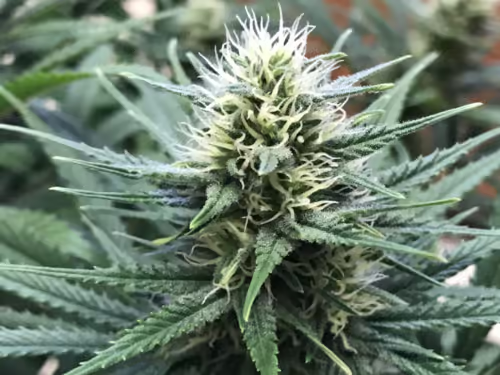








Seedling coming on strong..
Will be back for sure to increase my seed bank.
Thanks to the team at Sacred seeds..
Sacred Seeds are by far the best supplier out there and delivery is super fast, they’re also great to deal with, they always reply to queries promptly as well!
awesome buds recommend it highly
Super fast delivery and hassle free transaction.
All look fat and healthy and I’ll put them in in a few months.
Finally a place where you can buy seeds easily in Aust.
Very happy
Very good growing and flowering plant. Huge nugs