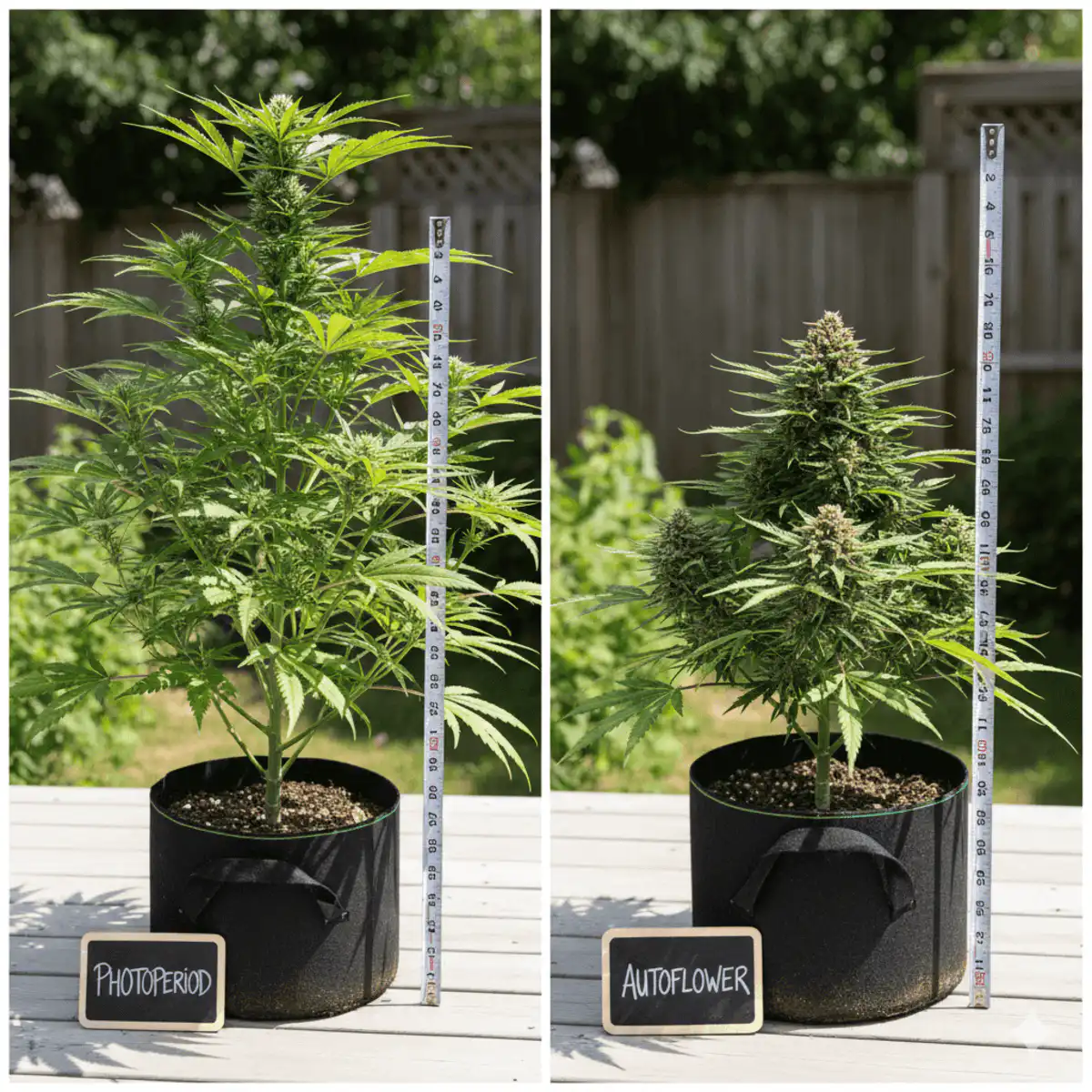
If you are standing right at the start of your first grow, the choice between autoflower and feminised seeds can feel like the first locked door. The words sound technical, every forum has a loud opinion, and it is genuinely hard to tell what actually matters and what is noise. I have grown hundreds of both over the years, so let me make this simple. By the end of this you will know which one suits you and, just as importantly, why.
The short version: autoflowers flower on a fixed clock, about three to four weeks after they sprout, no matter what you do with the lights. Feminised photoperiod plants wait, and only begin flowering when you give them longer nights. Autos are faster, smaller and ask less of you on lighting. Feminised plants grow bigger, yield more and forgive your mistakes, but they take longer and you manage the light yourself. Neither is better than the other. They are built for different jobs.
A Quick Word on the Names
Before anything else, let us clear up the words, because they trip up nearly everyone at the start.
There are two completely separate things going on, and people muddle them constantly. The first is the plant’s sex. A feminised seed is simply one bred to grow into a female plant, and females are the ones that produce the buds you are after. The alternative is a regular seed, which can come up either male or female. Every single seed we sell at Sacred Seeds Australia is feminised, so you never have to learn to spot and remove males. That part is handled for you.
The second thing is how the plant decides when to flower, and this is the real choice in front of you. Here there are two types: autoflowering and photoperiod. Because everything in our range is already feminised, we label the two by the part that actually differs. The autoflowering ones we call autos, and the photoperiod ones we just call feminised. So when this guide says feminised, it means feminised photoperiod seeds. Do not let that wording throw you, because both types are in fact feminised. The only difference that matters from here on is the flowering trigger, and that is what the rest of this guide is about.
The One Real Difference: How the Plant Decides to Flower
A cannabis plant grows in two stages. First it puts on leaves and stems and gets bigger, which growers call the vegetative stage. Then at some point it switches over to making the buds, which is the flowering stage. The whole autoflower-versus-feminised question comes down to a single thing: what flips that switch.
Feminised photoperiod plants flower in response to light, or more precisely, to darkness. Out in nature they read the lengthening nights of late summer as the sign that autumn is coming, and that is their cue to start flowering before the cold sets in. Indoors, you play the part of the seasons. You keep them under long days, usually eighteen hours of light to six of dark, written as 18/6, for as long as you want them to keep growing. When you are ready for buds, you change the timer to twelve hours of light and twelve of dark, 12/12, and that longer night tells the plant that autumn has arrived. Until you make that change, a photoperiod plant will happily keep growing leaves for months.
Autoflowers ignore all of that. They flower on age alone. Roughly three to four weeks after the seedling pops up, the plant begins flowering on its own, and no light schedule will stop it, start it or speed it along. You can run the lights at 18/6 the whole way through and never touch the timer once. That is the headline convenience of an auto, and it is worth knowing where the trick came from.
That single genetic difference, light-triggered versus age-triggered, is the root of every other difference between the two types. Everything below flows from it.
Where Autoflowers Got Their Trick
The auto-flowering ability is not something breeders dreamed up from scratch. They borrowed it from a wild, scrappy cousin of the cannabis plant called Cannabis ruderalis.
While the indica and sativa plants we prize evolved nearer the equator, where the day length barely changes through the year, ruderalis grew up somewhere far less forgiving: Siberia, northern Russia, the steppes of Central Asia. Summers there are short and harsh. A plant that sat around waiting for the nights to draw in before flowering would freeze solid before it ever set seed. So ruderalis solved the problem another way. It evolved to flower on a built-in clock, a few weeks after sprouting, regardless of the light, so it could race through its entire life before the first frost.
The catch was that wild ruderalis is small, weak and barely worth smoking. The breakthrough, back in the 1970s and 80s, came when breeders realised they could cross that tough little survivor with elite indica and sativa genetics, then select over many generations to keep the automatic flowering while breeding the potency, flavour and yield back in. The early results in the 2000s were honestly mediocre, often only eight to twelve per cent THC. Modern autos are a different animal. Good ones from serious breeders now land comfortably in the low twenties for THC and finish the whole job in around ten weeks.
It is a genuinely clever piece of work when you stop to think about it. Every Gorilla Glue autoflower seed is carrying ancient cold-climate survival genes wrapped around the terpenes of a modern West Coast heavyweight, and it all breeds true. Decades of patient work sit inside something the size of a grain of rice.
What You Get With an Autoflower
Autos are built around speed and simplicity. From seed to harvest you are usually looking at eight to twelve weeks, the plants stay small, often sixty to a hundred centimetres, and you never have to fiddle with the light timer. Outdoors across much of Australia you can plant them through spring, summer and into autumn and pull more than one harvest in a single season, which a photoperiod simply cannot do.
What I want you to understand, though, is that simple is not the same as forgiving, and a lot of advice online blurs those two words together. An auto runs on a fixed clock. If something goes wrong early, you overwater it, you shock it transplanting, you cook it under a light hung too close, the plant does not wait around for you to fix it. It flowers on schedule anyway, at whatever size it happened to reach, and you harvest a disappointment. There is no pause button. For the same reason, heavy training is risky, because the plant has no spare time to recover from the stress you put it under. You essentially get one clean run at it.
You also cannot really clone an auto. A clone carries the age of the plant it was cut from, so an auto clone just flowers almost straight away as a tiny runt. If preserving a plant you have fallen in love with matters to you, that is a job for a photoperiod.
What You Get With a Feminised (Photoperiod) Plant
Feminised photoperiod plants are the traditional choice, and they trade speed for control and size. Because you decide when to flip the lights to 12/12, you decide how big the plant gets. Want something small for a cupboard? Flip it after a couple of weeks of growth. Want a monster? Let it grow for eight weeks first. Yields per plant are far larger too, often a hundred to three hundred grams or more, against an auto’s thirty to eighty.
The quiet advantage, and the one I think matters most for someone still learning, is that photoperiods forgive you. Because the plant only flowers when you tell it to, time is on your side. If a young plant gets stressed or sick, you simply keep it in the growth stage for longer and let it bounce back before you flip. That recovery window is the whole difference between a ruined auto and a photoperiod that shrugs off a rough fortnight. They also clone perfectly and take every training technique in the book, from topping to mainlining to a full SCROG, because you can always hand them more time.
The price you pay is patience and a little responsibility. The whole run takes three to five months, and you have to manage the light switch yourself. Forget to change that timer and the plant just keeps growing leaves and never sets a single bud.
Side by Side
| What matters | Autoflower | Feminised (photoperiod) |
|---|---|---|
| Time to harvest | 8 to 12 weeks, start to finish | 3 to 5 months (you control the length) |
| Plant size | Compact, 60 to 100cm | 100 to 200cm or more, your choice |
| Yield per plant | 30 to 80g typical | 100 to 300g or more possible |
| Light schedule | Any schedule works, no changes needed | 18/6 to grow, then switch to 12/12 to flower |
| Forgiveness of mistakes | Low. The fixed clock punishes early errors | High. Extend the growth stage to recover |
| Training | Limited, no time to recover from stress | Excellent, takes topping, mainlining, SCROG |
| Cloning | Not practical | Easy and reliable |
| Outdoors in Australia | Several harvests across one season | One harvest, follows the natural seasons |
So Which Should You Actually Choose?
Here is where I part ways with the standard advice. You will read everywhere that autoflowers are the beginner’s seed. That is half right, and the half it gets wrong can cost you a whole grow, so let me give it to you straight.
Autos do remove one of the things new growers find hardest, which is the light schedule. There is no flip to get wrong, no timer to forget, no stray light leak quietly ruining your flower. In that narrow sense they are simpler. But because of that fixed clock, an auto is the least forgiving plant in the shop when it comes to actual mistakes. A photoperiod hands you a recovery window for nearly everything an auto punishes you for. So whether “easiest for beginners” is true depends entirely on which kind of mistake you are more likely to make.
Lean toward autos if you want a harvest fast, you are short on space or growing on a balcony, you want the simplest possible lighting, or you want several smaller outdoor harvests across one season. Just go in knowing you need to treat that seedling gently, because there is no second chance.
Lean toward feminised photoperiods if you want the biggest yield, you want to control the size of the plant, you would like room to make a mistake and recover from it, or you want to clone and train. The cost is time and remembering to manage the lights.
My honest take after years of growing both: if you can handle one change of the light timer and you want the most room to learn without wrecking a grow, a forgiving feminised photoperiod makes a fantastic first plant. If you are tight on space or time and you will commit to babying the seedling through its first fortnight, an auto will get you to harvest sooner. Plenty of growers, me included, end up running both, autos for a quick turnaround and photoperiods for the main crop. There is no wrong answer here, only the one that fits your space and your patience.
Still weighing it up? Our 10 best beginner strains guide points you to specific autos and feminised photoperiods that are kind to first-timers, and you can browse the whole range of cannabis seeds Australia to see what is on offer. You can also go straight to our autoflower or feminised photoperiod collections.
Key Takeaways
The only real difference is the flowering trigger. Autos flower on age, feminised photoperiods flower when you shorten their daily light. Everything else follows from that.
Both types are feminised. Every seed we sell grows into a bud-producing female. In our shop, “auto” and “feminised” are just shorthand for autoflowering and photoperiod.
Autos are fast and simple, but not forgiving. Quick, compact and easy on lighting, yet the fixed clock punishes early mistakes and rules out cloning and heavy training.
Feminised photoperiods reward patience. They take longer and need a light change, but they yield far more, forgive your errors and let you clone and train freely.
“Beginner-friendly” is the wrong lens. Pick the type whose tradeoff fits your space, your time and how much room you want to make and fix mistakes.
Frequently Asked Questions
Are autoflowers less potent than feminised photoperiods?
No, modern autoflowers can match photoperiod potency. The early autos of the 2000s were weaker, but today’s genetics from serious breeders regularly test in the low twenties for THC or higher. The main difference is the size of the harvest, not the strength of it. A top-shelf auto delivers the same quality as a photoperiod in a smaller, faster package.
Can you clone an autoflower?
Technically yes, but in practice no. An autoflower clone keeps the age of the plant it was cut from, so it flowers almost immediately with hardly any growth behind it, leaving you with a tiny plant and a negligible yield. Photoperiods clone perfectly because you can hold them in the growth stage for as long as you like. If preserving genetics matters to you, a photoperiod is the only practical option.
Do autoflowers need 24 hours of light?
No. Some growers run them around the clock, but most run 18/6 or 20/4 for the whole grow. Autos will flower under any schedule, but a daily dark period still helps them grow well, and 18/6 is the sweet spot: plenty of light for strong growth without stressing the plant or running up the power bill for no reason.
Which yields more, an autoflower or a feminised plant?
A feminised photoperiod yields far more per plant, typically a hundred to three hundred grams or more against thirty to eighty for an auto. That said, autos finish so much faster that you can run two or three cycles in the time one photoperiod takes, so in a small space autos can produce more total over a year despite the smaller individual harvests.
Can you grow autoflowers outdoors in Australia?
Yes, and they do very well here. Unlike photoperiods, which follow the seasonal light and give you a single harvest a year, autos can go in across spring, summer and into autumn for multiple harvests. In warmer parts of the country you can manage three or four auto runs in a season, and their smaller size and faster finish make them less conspicuous.
What happens if you put an autoflower on a 12/12 light cycle?
It will still flower, because an auto flowers on age no matter what, but the yield suffers because the plant is getting far less total light through its life. You gain nothing by doing it. Keep autos on 18/6 or 20/4 throughout and let them have the light.
Are feminised seeds autoflower or photoperiod?
They can be either. “Feminised” only tells you about sex: the seed grows into a female plant. “Autoflower” and “photoperiod” describe how the plant flowers. You can have feminised autos, feminised photoperiods, regular autos or regular photoperiods. Because every seed we sell is already feminised, we use “feminised” in the shop as shorthand for the photoperiod type and “auto” for the autoflowering type, but rest assured both of ours are feminised.
Can you switch an autoflower to 12/12 mid-grow?
You can, but there is no benefit and it only costs you yield. Autos do not need a light change to flower, they do it on their own, so switching to 12/12 simply hands the plant less light energy and leaves you with a smaller result. Keep an auto on 18/6 or 20/4 from start to finish.
Sacred Seeds Australia sells cannabis seeds strictly as souvenirs and for genetic preservation, in accordance with local laws. In Australia it is illegal to germinate cannabis seeds unless you are in the ACT or hold a specific licence. Always be aware of your local laws.