The Acapulco Gold strain is the most famous cannabis ever grown, and almost nobody alive has smoked the real thing.
That sounds like a line, but it is the plain truth, and it is the most interesting thing about this plant. Acapulco Gold was not bred in anyone’s grow room. It grew wild in the mountains above the Mexican coast, and by the 1960s its name had become American shorthand for the best cannabis money could buy, so famous it ended up in the Oxford English Dictionary.
Then, over about a decade, it effectively vanished. What happened to it involves a US government herbicide programme, a bitter irony about the colour it was named for, and one of the most consequential breeding projects in cannabis history.
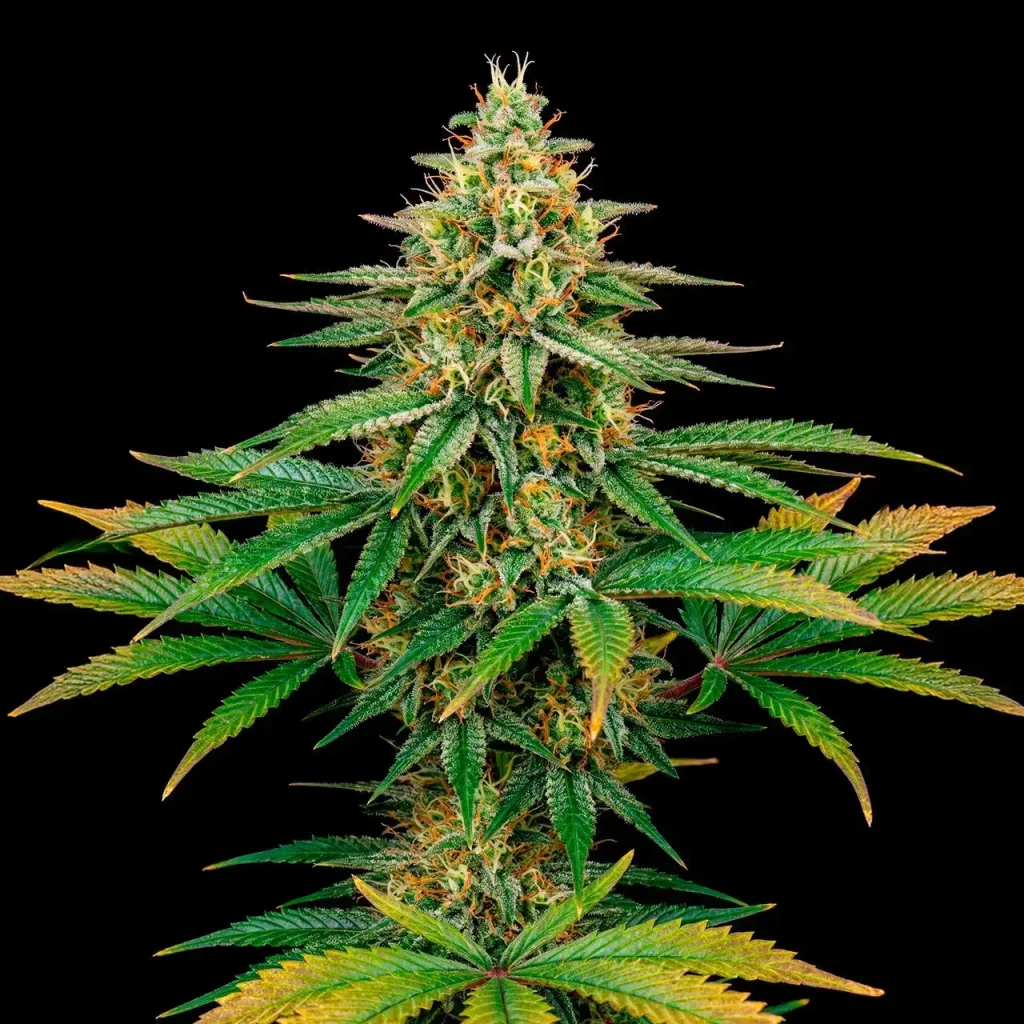
I have grown a lot of heritage genetics, and this is the one with the biggest story attached. Here is where it came from, what actually happened to it, why what you can buy today is not the wild original, and where it fits if you are growing in Australia. This is a strain review, so the full grow detail, the yields, the feeding and the Australian harvest timing all live on the Acapulco Gold feminised seeds page.
The Legend of the Golden Herb
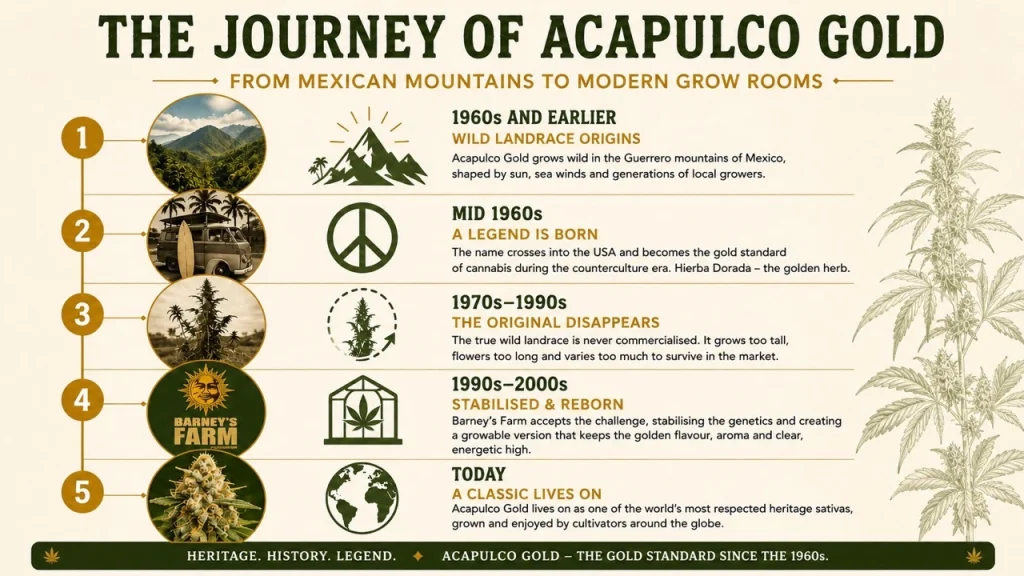
Acapulco Gold came out of the Guerrero mountains, in the hills behind the resort city of Acapulco on Mexico’s Pacific coast. Nobody bred it in the modern sense. It developed over generations in a hot, tropical, coastal climate, shaped by fierce sun, a long growing season and the hands of local farmers who selected what did well. It is usually described as around 80% sativa, with some accounts pointing to an old cross with a Nepalese indica somewhere back in the line.
The name came from the colour. Mature flowers took on a warm brownish-gold, and locals called the region’s cannabis hierba dorada, golden herb. What actually caused it is worth knowing, because it is central to everything that follows. The gold is chlorophyll breaking down slowly under intense sun, then the flowers being aged and dried in the Pacific winds coming off the ocean. Gary Tovar, who smuggled the stuff in quantity in that era and knew it as well as anyone, put the colour down to exactly that wind-drying. It was terroir, in other words: the specific place, the specific sun, the specific air.
By the mid-1960s the name had crossed the border and become a byword in the United States for the highest grade available, the benchmark everything else got measured against. Very few strains have ever earned their own Oxford English Dictionary entry, and this is one of them. Decades later it still turns up on every list of the greatest strains of all time. When people talk about heritage sativas, this is the top of the tree, and our history of marijuana seeds sets out how plants like this travelled the world long before anyone was breeding them deliberately.
The Strain That Helped Build Modern Cannabis
Acapulco Gold is not just a museum piece. It is one of the foundations that everything else is standing on, and the story of how is more specific than most people realise.
In 1970s California, a loose underground collective in the hills around Santa Cruz set about doing something that barely existed at the time: breeding cannabis properly, with real selection over multiple generations, to produce a plant that came true from seed. The collective was called Sacred Seeds, no relation to this shop despite the name, and the breeder at the centre of it was David Watson, known to everyone as Sam the Skunkman. Before their work, growers planted seed and got a lottery. Consistency was not a thing.
The starting point was an Afghani indica crossed with Colombian Gold, a cross that already showed promise but was not stable. Around 1975, Acapulco Gold was folded into that line, and that is the move that made it work. The Afghani brought structure, resin and a short flowering time. The Colombian brought clarity and complexity. Acapulco Gold brought the yield, pulled the flowering time down further and sharpened the aromatics. The result was Skunk #1, one of the first genuinely true-breeding cannabis hybrids, and the first seeds were selling in Santa Cruz by 1976.
Then the story turns. Reagan-era enforcement caught up with them, the collective was raided in 1982, and Watson eventually left for the Netherlands carrying the genetics with him. What arrived in Amsterdam went on to become the backbone of the entire Dutch seed industry, and Skunk lineage now sits somewhere in the family tree of an enormous share of the strains grown today. Super Skunk, Cheese, countless Haze crosses, on and on. So when you grow Acapulco Gold, you are not just growing an old sativa. You are growing one of the three plants that modern cannabis breeding was built out of, and our piece on cannabis genetics from landrace to modern hybrid traces that whole journey.
How the Gold Was Poisoned
Here is the chapter that gets left out of almost every write-up of this strain, and it is the reason the real thing is gone.
In 1975, the Mexican government began an aggressive campaign to wipe out its cannabis and poppy crops, and the United States backed it heavily, supplying helicopters and somewhere in the order of 13 to 15 million dollars a year. The aircraft sprayed the fields with paraquat, a viciously toxic herbicide. The plan was to kill the crop where it grew.
What actually happened was uglier. Mexican farmers, watching their livelihood dying in the field, went out and harvested the sprayed plants immediately, before the herbicide could finish the job, and shipped them anyway. By the late 1970s, estimates put somewhere between 20 and 30 per cent of Mexican cannabis entering the United States as paraquat-contaminated.
And now the part that makes this a story about Acapulco Gold specifically. Paraquat turned the plants a yellowish gold. Smokers looking at contaminated Mexican weed saw golden buds and thought they had got hold of the good stuff, the legendary Acapulco Gold. Demand for the poisoned product went up, because the poison happened to counterfeit the exact visual signature that had made the strain famous. The one thing that marked out the best cannabis in the world had become the marker of contaminated weed. In 1978 the US Secretary of Health, Education and Welfare confirmed that heavy smokers of tainted cannabis risked serious lung damage, NORML sued to stop US funding of the spraying, and the whole programme became a scandal.
The knock-on effect reshaped cannabis permanently. Between the eradication campaign and the paraquat panic, the Mexican import trade collapsed, and American smokers stopped trusting anything that came up from the south. Growers responded by doing it themselves, and the domestic sinsemilla scene in California took off in earnest. The modern cannabis industry, in a real sense, grew out of the ashes of the Mexican trade. Acapulco Gold’s death was the thing that lit the fire.
Why You Cannot Buy the Wild Original
So the honest position, which I would rather give you than a marketing line. Three things killed the original, and they stack.
The first is that it was already being diluted before the spraying started. Demand in the States was enormous, and by 1975 New York Magazine was reporting that the strain’s potency had already been watered down by overplanting to chase that demand. The legend was being eroded from the inside.
The second is the eradication campaign and everything that followed. The fields went, the trade collapsed, and the growers who had maintained those genetics for generations largely stopped.
The third is the one no breeder can fix. Acapulco Gold was a product of its place. The blazing Acapulco sun, the long season, the Pacific winds that dried and aged the flowers into that gold. Take the same genetics somewhere else and you get a very good sativa, but you do not get 1974 in the Guerrero mountains, because you cannot ship a climate. Even growers who had genuine seed found that grown elsewhere it never quite hit the same heights.
On top of all that, the wild plant was never a commercial proposition anyway. Left as nature made it, it grew enormous and lanky, took a long time to flower, and varied plant to plant. It was magnificent in its own valley and completely impractical as a seed product. So when you see Acapulco Gold offered anywhere today, it is not the untouched wild plant, because that plant could not survive contact with a modern market even if the fields still existed.
What you can buy is the closest thing to it that has ever been commercially available, and that took real work from a serious breeder. Barney’s Farm, the long-running Amsterdam house, took the landrace and stabilised it: taming the towering height and the marathon flowering into something a grower can actually finish, while holding onto what made the name, the golden tones, the toffee-and-coffee profile and the clear, energetic high. Their version took Best Sativa at the 2010 High Times Cannabis Cup in Amsterdam, a modern nod to one of the oldest names in the game. That is the genetics behind our Acapulco Gold seeds. Not a modern hybrid wearing a famous name, but a faithful, growable rebuild of the real thing.
Why I Rate What Barney’s Did Here
Preserving a landrace and making it growable are two different jobs, and most attempts lose the plot on one or the other. You either end up with an untouchable wild plant nobody can finish, or a stabilised version that has had all the character bred out of it in the name of yield.
This one keeps the toffee-coffee-pine, keeps the clear golden high, and still comes down to a workable height and a nine to ten week flower. That is the hard balance to strike, and given the original fields are gone and have been for forty years, a faithful rebuild is not a compromise. It is the only way this plant exists at all.
The High: Clear, Golden and Daytime
Acapulco Gold is the classic energetic sativa, and it is a proper daytime strain. The lift is fast and clean, a bright, clear-headed rush that sharpens focus and pulls you toward doing something rather than sinking into the couch. Ideas come easily, conversation flows, and there is a genuine creative pull to it.
What sets it apart from a lot of pure sativas is that it stays clear instead of tipping into the racy, scattered edge, with just enough body warmth from the small indica side to keep it grounded. This is the quality that built the reputation in the first place. In an era when most imported cannabis was harsh and unpredictable, a clean, bright, functional high was genuinely remarkable, and it is why the name stuck for sixty years. At roughly 20 to 23% THC with almost no CBD to soften it, this is genuinely potent and it builds faster than you might expect, so keep it for the morning and the middle of the day. The energy in it is the last thing you want near bedtime.
What to Expect
A sativa-dominant landrace at around 80/20, testing 20 to 23% THC. A fast, clear, creative head lift with real energy and no couch-lock, grounded by a light body warmth. Firmly a daytime strain for creative work, activity and getting things done. Old-school toffee, coffee and pine on the flavour. Genuinely potent, so go easy if your tolerance is not up there.
Flavour: Toffee, Coffee and Pine
The flavour is where Acapulco Gold shows its age in the best possible way. This is an old-school profile, nothing like the sweet candy and gas of the modern hybrids. You get burnt toffee and roasted coffee on the nose, sweet pine underneath, and a peppery citrus edge on the exhale. It is complex and savoury-sweet rather than fruity, and it is one of the more distinctive flavours in the whole landrace world.
The chemistry behind it is led by caryophyllene, the peppery terpene you also find in black pepper, with earthy myrcene, bright limonene and fresh pinene filling it out. That pinene is part of why the high reads so clear, and our cannabis terpenes guide covers how those compounds shape both flavour and effect. Properly cured, it is smooth and the complexity really comes forward, so it rewards patience in the jar more than most. Our complete guide to curing cannabis is worth reading before you rush this one, because a fast dry flattens the toffee and pine that make it worth growing.

Where the Acapulco Gold Strain Fits in Australia
This is the part that decides whether Acapulco Gold is right for you, and it comes straight from its heritage. It evolved on a hot, sunny, tropical coast with a long season, and it wants exactly that. Give it those conditions and it performs outdoors like few sativas can. Fight your climate with it and you will be disappointed. So here is the honest regional picture.
The warm north is where it belongs. Queensland, Northern New South Wales and the warmer pockets of Western Australia give it the heat, the sun and the season length it evolved for, and the tropical north will finish it earlier again. This is as close as Australia gets to a Guerrero summer, and in those regions a full-season plant gets big and productive with the character coming through the way the name promises.
The cool, wet south is the poor fit outdoors, and I would rather say so than sell you a plant that will struggle. Acapulco Gold flowers late, and in cooler southern climates that late finish runs headlong into autumn rain and dropping temperatures at exactly the point where the long colas are heaviest and most vulnerable to rot. Beyond the rot risk, the plant simply never gets the sustained warmth it was built for, and a warm-climate sativa grown cold is a shadow of itself. If you are down south and you still want to grow it, bring it indoors where you control the climate completely rather than trying to force it outdoors.
Indoors, anywhere in the country, it is a different conversation, because you are supplying the climate yourself. Give it strong light and the vertical room a tall sativa needs and where you live stops mattering. If your space is tight, our guide to growing cannabis in small spaces covers the training that makes a stretchy sativa workable under a low ceiling. The full grow detail, the height management, the feeding and the harvest timing all sit on the Acapulco Gold seeds page.
Because the whole regional question turns on the timing of the finish, it is worth reading this alongside Jason’s guide to growing cannabis outdoors in Australia, which sets out the planting calendar and the regional harvest deadlines that decide whether a late-flowering sativa comes in clean. For where this sits among the rest of the sativas, the region-by-region sativa guide compares it directly with the others in the range, and the broader guide to the best cannabis strains for the Australian climate covers indicas and hybrids by region too.
One thing worth setting expectations on: the full golden expression is a terroir effect, tied to that Acapulco sun and sea air. Grown here you will get warm gold and amber tones coming through in the pistils and leaf, especially with cool nights late in flower, but the drenched-in-gold look of 1974 Guerrero is not something any seed can promise you anywhere else on earth. The genetics, the flavour and the high all carry through. The postcard does not.
Who It Suits
Acapulco Gold suits growers in warm, sunny regions who can give a tall sativa the heat and season it wants, or anyone growing indoors with proper climate control. It is for people who want true heritage landrace genetics with real history behind them, a clear and energetic daytime high with no couch-lock, and a distinctive old-school flavour over modern candy profiles. It is not the pick if you want a compact, quick, low-effort grow, a heavy sedative evening strain, or a forgiving first plant in a cool, wet climate.
Still weighing it up? Our strain finder takes six quick questions and points you to three strains that fit your setup, your climate and the effect you are after.
Key Takeaways
The most famous name in cannabis. The Acapulco Gold strain is a Mexican sativa landrace from the Guerrero mountains, a byword for top-grade cannabis since the 1960s and one of the very few strains with its own Oxford English Dictionary entry.
The gold was terroir. That colour came from chlorophyll breaking down under fierce Mexican sun and the flowers drying in Pacific winds, which is why the full golden expression cannot be exported anywhere.
It built modern cannabis. Folded into Skunk #1 around 1975 by David Watson’s Santa Cruz collective, it contributed yield, faster flowering and aroma to one of the first true-breeding hybrids, and its genetics run through a huge share of strains grown today.
The original is genuinely gone. Overplanting diluted it, then a US-funded paraquat eradication campaign from 1975 destroyed the trade, with the herbicide turning plants gold and counterfeiting the strain’s own signature.
This is the closest you can buy. Barney’s Farm’s Cup-winning stabilised version keeps the character while taming the height and flowering time. A roughly 80/20 sativa at 20 to 23% THC, clear and creative with toffee, coffee and pine.
A warm-climate plant. It thrives outdoors in Queensland, Northern NSW and warm WA, and is best kept indoors in cool, wet southern regions. Available as Acapulco Gold feminised seeds.
Frequently Asked Questions
What is the Acapulco Gold strain?
Acapulco Gold is a Mexican sativa landrace from the Guerrero mountains above Acapulco, and one of the most famous cannabis strains in history. It is known for its golden-hued buds, a distinctive burnt-toffee-and-coffee flavour, and a clear, energetic, creative high. It reached the United States in the 1960s as a byword for the highest grade of cannabis available, earned an Oxford English Dictionary entry, and is still named among the greatest strains of all time.
Why is it called Acapulco Gold?
The name comes from the warm golden-brown colour the mature buds and pistils take on, which local growers called hierba dorada, golden herb. It develops as chlorophyll slowly breaks down under intense sun, and from the flowers being aged and dried in the Pacific winds coming off the ocean. It is a product of that specific place, which is why the most vivid golden expression is climate-dependent and looks more subdued grown anywhere else.
Is this the real landrace or a hybrid?
It is a faithful, stabilised version of the real landrace rather than the untouched wild plant. The true wild Acapulco Gold was never commercially viable, since it grew huge, flowered for a very long time and varied plant to plant, and the fields that produced it were destroyed decades ago. Barney’s Farm stabilised the genetics into a growable feminised plant that keeps the landrace character, the golden tones, the flavour and the clear high, while taming the height and flowering time. It is as close to the original as you can realistically buy.
What happened to the original Acapulco Gold?
Three things, stacked. Enormous American demand led to overplanting that had already diluted its potency by the mid-1970s. Then from 1975 a Mexican eradication campaign, funded and equipped by the United States, sprayed the fields with the herbicide paraquat and collapsed the trade. Finally, the genetics that survived could never fully reproduce the original anywhere else, because so much of what made it special was the Acapulco climate itself.
What was paraquat weed?
In the late 1970s, as much as 20 to 30 per cent of the Mexican cannabis entering the United States was contaminated with paraquat, a toxic herbicide sprayed on the fields from US-supplied helicopters. Farmers harvested sprayed plants early and shipped them anyway. The bitter irony for this strain is that paraquat turned the plants yellowish gold, so contaminated cannabis was widely mistaken for genuine top-shelf Acapulco Gold, which actually pushed demand for it up. In 1978 US health authorities confirmed the risk of serious lung damage to heavy smokers of tainted cannabis, and the programme became a major scandal.
Is Acapulco Gold a parent of Skunk #1?
Yes, and it is one of the most important contributions any landrace has made. Around 1975 a Santa Cruz breeding collective, confusingly also called Sacred Seeds but no relation to this shop, led by David Watson, better known as Sam the Skunkman, folded Acapulco Gold into an existing Afghani and Colombian Gold cross. Acapulco Gold brought the yield, shortened the flowering time and sharpened the aroma, and the result was Skunk #1, one of the first true-breeding cannabis hybrids. Skunk genetics now run through an enormous share of the strains grown today, including Super Skunk.
What are the effects like?
A clear-headed, energetic, creative sativa high with a light body warmth and, importantly, no couch-lock. It leans toward mental energy rather than physical sedation, which makes it a daytime strain suited to creative work, activity and social settings. Peak effects run around one to two hours with a clean taper and no harsh comedown.
How potent is it?
Around 20 to 23% THC with under 1% CBD. That is genuinely potent, and with little CBD to soften it the effect arrives cleanly and quickly, so newer users should start with a draw or two and wait rather than assuming a landrace will be mild.
What does it taste and smell like?
Distinctive and old-school: burnt toffee and roasted coffee on the nose with sweet pine underneath and a peppery citrus edge on the exhale. The caryophyllene-led profile, with myrcene, limonene and pinene behind it, gives it a savoury-sweet complexity that modern candy and diesel hybrids do not have. Our terpenes guide explains what each of those compounds contributes.
Will my buds actually turn gold?
Partly. You should see warm gold and amber tones come through in the pistils and leaf as it ripens, and cool nights late in flower will bring them out more strongly. But the full drenched-in-gold look of the Mexican original was a terroir effect, produced by that specific sun and the sea air the flowers were dried in, so no seed can promise it anywhere else. The genetics, the flavour and the high all carry through regardless.
Is Acapulco Gold indica or sativa?
Strongly sativa, at roughly 80% sativa to 20% indica. Some accounts trace the small indica portion to an old cross with a Nepalese indica somewhere back in the line. The effect reflects the sativa dominance almost entirely: energetic, cerebral and clear, with only a light body warmth to ground it. Our piece on sativa versus indica covers how much that framework actually holds up.
Where does it grow best in Australia?
In warm, sunny regions. Queensland, Northern NSW and the warmer parts of WA suit it best outdoors, since it wants heat, strong sun and a long season. Cooler or wetter southern regions are a poor fit outdoors, because its late finish runs into autumn rain when the long colas are at their most vulnerable, so in those areas it is far better grown indoors with climate control. Our Australian climate strain guide breaks it down by region.
Is Acapulco Gold worth growing today?
If you want a clear, energetic daytime sativa with a flavour nothing modern replicates, yes. It is also one of the few strains where you are growing a genuine piece of cannabis history rather than a name. What you should not expect is the 1974 Guerrero experience, because that plant, that place and that moment are gone. What you get is the closest thing anyone can offer, and it is a very good sativa on its own terms.
How does it compare to other landrace sativas?
Among the classic landraces, Acapulco Gold pairs a genuinely fast flowering time with the most distinctive flavour, since the toffee-coffee-pine profile sets it apart from the spicy anise of Durban Poison and the sweeter tropical landraces like Colombian Gold. All of them want warmth, but Acapulco Gold and Durban Poison are the more practical to finish in an Australian season.
Sacred Seeds Australia sells cannabis seeds strictly as souvenirs and for genetic preservation, in accordance with local laws. In Australia it is illegal to germinate cannabis seeds unless you are in the ACT or hold a specific licence, and our overview of cannabis laws in Australia sets out how each jurisdiction treats it. Nothing in this article is medical advice.
Related reading: browse the full range of cannabis seeds Australia, our sativa-dominant range, the Durban Poison review for another heritage landrace sativa, the region-by-region sativa guide, and the guide to the best cannabis strains for the Australian climate.