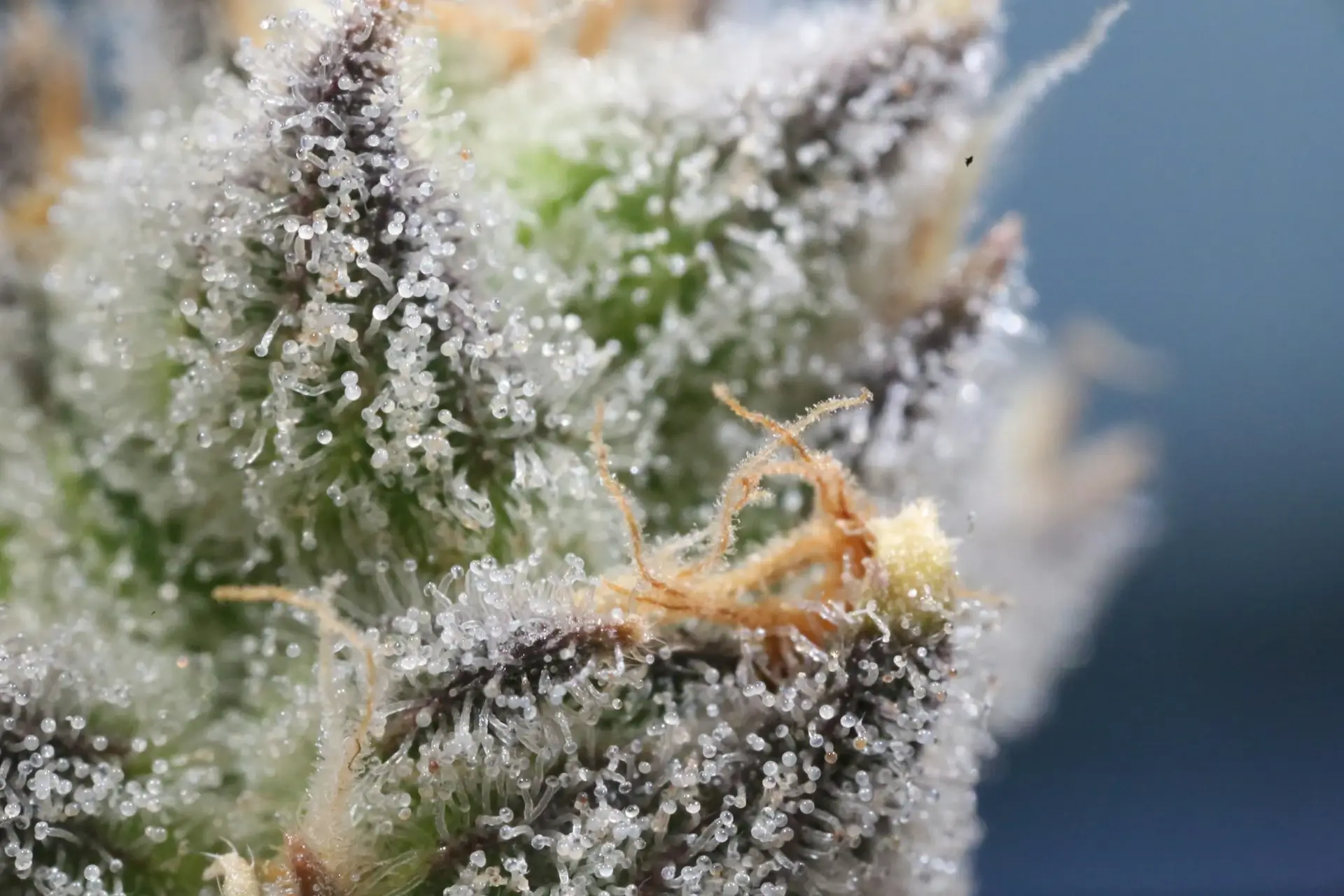
There’s a moment that happens the first time you see the White Widow strain in late flower. You open the tent, or you walk up to the plant outdoors, and the buds stop you. Not because of size, since the yields are good but not outrageous. Not because of structure, since the plant grows well but isn’t the most dramatic thing you’ll ever cultivate. What stops you is the frost. The trichome coverage on White Widow at week 8 is one of the most visually striking things in cannabis. Buds that look like someone dusted them with icing sugar, every surface coated in crystalline resin that catches light from any angle. I’ve been growing this strain for years and that moment still lands.
That frost is where the name comes from. The thick white blanket of trichomes that covers the buds in late flower, so dense it obscures the green underneath, combined with the potency that hits fast and hard, the way a black widow spider’s venom does. Both interpretations of the name hold. The buds look white. And the high bites.
White Widow is one of the most important strains in cannabis history. Not just because it won the 1995 High Times Cannabis Cup. Not just because it became the defining strain of the Amsterdam coffee shop scene for a decade. But because the genetics that produced it, a Brazilian sativa landrace crossed with a resin-heavy South Indian indica from Kerala, created a breeding foundation that spawned some of the most influential hybrids of the past thirty years. Moby Dick, White Russian, White Rhino, Blue Widow and Black Widow all trace back to this cross. Understanding White Widow is understanding where a significant portion of modern cannabis genetics came from.
If you’re considering White Widow feminised seeds or the Auto White Widow, read on for the full story, then head to the product pages for the complete grow guide, EC targets, and week-by-week timeline. You can browse the wider range of cannabis seeds Australia from there too.
🧬 Origin Story: The Most Contested History in Cannabis
Most famous strains have a clean origin story. White Widow doesn’t. Its history is genuinely disputed, and the dispute itself is interesting enough to be worth understanding.
The most widely accepted account attributes White Widow to Shantibaba, the breeder’s alias of Scott Blakey, an Australian breeder who was working at Green House Seeds in Amsterdam in the early 1990s alongside Arjan Roskam. According to this account, Shantibaba had spent years travelling through Central and South Asia collecting cannabis genetics from small family farms, the kind of seed-hunting our history of marijuana seeds traces across the whole modern catalogue. On one trip, a local farmer in the mountains of Kerala, India, directed him to a unique hybrid that had been selectively bred for resin production over generations. Shantibaba left India with seeds from that farm. Back in the Netherlands, he crossed the Kerala genetics, used as the male, with a Brazilian sativa landrace female, rumoured to be a variety called Manga Rosa. The result, after years of selection and stabilisation, was White Widow. Green House Seeds released it in 1994.
The strain won the 1995 Cannabis Cup. What happened next is part of the origin story too. Shantibaba eventually split from Green House Seeds, founding Mr Nice Seed Bank with Howard Marks. To distinguish his original genetics from the versions being sold by other banks under the White Widow name, he renamed the strain Black Widow. If you want the original Shantibaba lineage, the actual 1995 Cannabis Cup genetics, you’re looking for Black Widow at Mr Nice Seeds, not White Widow from Green House.
The second origin story credits a Dutch grower named Ingemar De Sjamaan, a low-profile cultivator focused on creating hardy strains adapted to harsh European conditions. De Sjamaan claims his own White Widow genetics are separate from Shantibaba’s creation and has never fully disclosed his lineage. The two accounts have never been definitively resolved.
What’s not disputed: the Australian connection in White Widow’s creation is real. Shantibaba is Australian. The genetics he sourced and the breeding work he did in Amsterdam produced one of the most influential cannabis strains of all time. For Australian growers, that’s worth knowing.
White Widow’s Breeding Legacy: The Strains It Made Possible
White Widow’s genetic influence extends well beyond its own reputation. The Brazilian sativa and South Indian indica combination produced a breeding foundation with exceptional resin genetics, hybrid vigour, and structural robustness, qualities that translate powerfully into crosses. Almost any hybrid involving White Widow genetics tends to inherit the heavy trichome coverage and balanced effect profile the original is famous for.
The direct offspring include Moby Dick (White Widow crossed with Haze, which took the Brazilian sativa side and pushed it toward serious size and yield), White Rhino (White Widow with an unknown indica, heavier and more sedating with exceptional resin), White Russian (White Widow with AK-47, one of the most celebrated hybrids of the late 1990s), Blue Widow (White Widow with Blueberry, the blue terpene profile over White Widow’s resin structure), and Black Widow (Shantibaba’s original renamed genetics, sold through Mr Nice Seeds).
White Widow sits at a junction point in cannabis genetics history. Before it, resin production of this quality and density was uncommon. After it, it became an expectation. The South Indian indica genetics that Shantibaba brought back from Kerala have influenced a much wider network of hybrids through three decades of subsequent breeding, a shift our piece on cannabis genetics from landrace to modern hybrid traces in full. Growing White Widow is growing a piece of that history.
🧬 White Widow Genetics: What Each Parent Contributes
White Widow is a 60% sativa, 40% indica hybrid. The split matters because it explains the effect profile precisely: predominantly cerebral with meaningful physical support, neither extreme. How far that framework actually holds up is covered in our piece on sativa versus indica.
Brazilian sativa landrace (Manga Rosa): The cerebral engine. Brazilian sativa landraces are known for uplifting, euphoric, socially stimulating effects, clear-headed elevation rather than heavy psychedelic expansion. This component is responsible for White Widow’s mood-lifting character, the open branching structure that responds well to training, and, perhaps surprisingly, its mould resistance. Brazil’s humid coastal growing conditions selected for plants that could handle moisture.
South Indian indica (Kerala): The resin factory. The Kerala genetics Shantibaba sourced had been selectively bred for resin production over generations, which is why the trichome coverage on White Widow is categorically different from most cannabis of the same era. These genetics contribute the physical body effect, the structural density of the buds, the earthy-spice base of the terpene profile, and the robustness that makes White Widow one of the more forgiving strains to grow, which is why it earns a place in our roundup of the most forgiving strains for Australian growers. The indica component also shortens the flowering window. A pure Brazilian sativa would run 14 to 16 weeks. White Widow finishes in 8 to 9.
The combination produced something that surprised the Amsterdam breeding community in 1994, not because either parent was unknown, but because the specific cross created a level of resin production and effect balance that hadn’t been achieved before. The 1995 Cannabis Cup win reflected genuine novelty.
White Widow’s Terpene Profile: Old School, Clean, and Underrated
White Widow is myrcene-dominant, earthy and herbal, with a subtle warmth that sits as the foundation of the aroma. Caryophyllene contributes the spicy, peppery note that becomes more prominent on the exhale, the same compound that gives black pepper and cloves their bite. Pinene adds the fresh pine element, clean and forest-forward, that lifts the myrcene earthiness and prevents the profile from being one-dimensional. Our cannabis terpenes guide covers how each of those compounds shapes flavour and effect.
Open a jar of properly cured White Widow and the first thing you smell is earth and pine. Not sweet, not fruity, not chemical. It smells like cannabis used to smell before the industry optimised everything for candy terpene profiles. This is the aroma that Dutch coffee shops became famous for in the 1990s.
The practical implication of myrcene dominance: these terpenes are more stable post-harvest than the volatile terpinolene profile of Jack Herer or the limonene of Amnesia Haze. White Widow’s terpene profile survives a wider range of drying and curing conditions without the dramatic degradation that costs those strains their defining character. More forgiving here than most, but a slow dry and a proper 4 to 6 week cure still significantly improves depth and complexity, and our complete guide to curing cannabis covers how to get there.
For growers who’ve been running candy-terp modern genetics and want to understand what the 1990s Amsterdam scene was built on, White Widow’s terpene profile is the answer. Not better or worse than limonene-dominant strains, but genuinely different in character and effect quality.
🌿 White Widow Effects: What to Actually Expect
THC range: 18 to 25%. CBD: 0.1 to 0.3%.
Onset (5 to 15 minutes): Fast and noticeable. The Brazilian sativa genetics produce a clean, rapid mood shift, a euphoric burst that arrives within minutes. Not the slow creep of a pure indica. White Widow was famous in Dutch coffee shops for catching tourists off guard because it looked manageable and hit fast. The myrcene base modulates what would otherwise be a purely cerebral onset, so there’s warmth alongside the clarity from the very beginning.
Early phase (15 to 45 minutes): The cerebral character establishes fully. Mood elevation, social energy, mild creative stimulation, functional and clean. The 60% sativa genetics produce directed energy rather than expansive psychedelic character. Conversation flows more easily, focus arrives without edginess, and the mood lift is sustained rather than spiking and dropping.
Mid-phase (45 to 90 minutes): The Kerala indica genetics contribute meaningfully. A physical ease settles alongside the still-active cerebral effect, muscle relaxation without sedation, body comfort without couch-lock. At typical doses this is one of the most genuinely balanced effect profiles in cannabis. The 60/40 split isn’t marketing, it’s an accurate description of how the high feels. Not predominantly sativa, not predominantly indica. Both present, both contributing, neither dominating.
Late phase (90 to 150 minutes): The indica component becomes more present. Cerebral energy softens, appetite increases noticeably, mild drowsiness develops. No notable crash, since the comedown is gradual and mood remains elevated through the end.
Duration: 2 to 3 hours at moderate doses. The indica genetics limit the duration relative to pure sativa expressions, which actually works in White Widow’s favour for functional daytime use.
One honest note on potency: at 18 to 25% THC with a myrcene-led terpene profile, White Widow hits harder than many growers expect from looking at the numbers. The heavy myrcene base tends to make it feel weightier than the THC percentage alone suggests, so give it fifteen minutes before deciding you need more.
🌏 The Australian Angle: Why White Widow Suits This Country
White Widow’s outdoor performance in Australia is genuinely strong across more of the country than most comparable strains. The Dutch-bred genetics were specifically selected to perform in a continental European climate, cooler temperatures, moderate humidity, less intense sun than the landrace parents evolved in. That adaptation translates directly to Australian conditions, including states where other hybrids struggle in autumn.
The 8 to 9 week flowering window means outdoor plants finish in late March to mid-April across most of Australia, comfortably within the dry autumn window before conditions deteriorate. In Victoria and southern SA, White Widow finishes comfortably in late April, a window where Haze-dominant genetics are already under cold stress. It’s one of the few strains where Tasmanian and cold southern Victorian growers have a genuinely viable outdoor option. Jason’s guide to growing cannabis outdoors in Australia sets out the planting calendar and the regional harvest deadlines that decide whether a crop comes in clean, and the Australian climate strain guide covers how the rest of the catalogue compares region by region.
The mould resistance from the Brazilian sativa parent is also meaningful in Australia’s more humid coastal regions. Queensland and northern NSW growers running dense-budding strains in autumn conditions find White Widow significantly more tolerant than most comparable photoperiods, though tolerance is not immunity and our organic pest control guide covers what to watch for in a wet finish.

🌿 Five Things Most Growers Don’t Know About White Widow
1. It was bred by an Australian. Shantibaba, or Scott Blakey, is Australian. He was working in Amsterdam at Green House Seeds when he developed the cross, but the genetic collecting work that produced the South Indian indica parent involved extensive travel through Asia. The most influential strain of the 1990s has Australian DNA at its core.
2. The original genetics are now sold as Black Widow. After Shantibaba left Green House Seeds and founded Mr Nice Seed Bank with Howard Marks, he renamed his genetics Black Widow to distinguish them from the White Widow name being used commercially by other banks. The actual 1995 Cannabis Cup genetics are sold as Black Widow at Mr Nice Seeds today.
3. The frost timing is biologically distinct from most strains. White Widow’s trichome heads form earlier and more visibly than in most strains. Growers have observed frost development from week 4 to 5 of flower that is more visually advanced than many strains show at week 7. This is a characteristic of the Kerala indica genetics selectively bred for resin production over generations. The trichome formation timeline is accelerated relative to cannabinoid maturation, which is precisely why the plant looks done before it is. Our amber trichomes guide explains what you are actually reading under the loupe.
4. It’s the progenitor of an entire strain family. Moby Dick, White Russian, White Rhino, Blue Widow, Black Widow, White Chocolope and numerous other White family strains all trace their lineage back to this cross. The consistency with which White Widow genetics pass on heavy trichome coverage and balanced effects to offspring made it one of the most used breeding strains of the past three decades. Moby Dick is the one you can grow from our catalogue, and it is the biggest yielder of the family.
5. It handles cold better than its reputation suggests. The Dutch breeding programme optimised White Widow for continental European temperatures, cooler nights, shorter seasons, less intense sun. The result is a strain that tolerates temperature variation down to 13 to 14°C without significant quality impact. Most cannabis genetics become stressed below 18°C. White Widow keeps performing in conditions where most of the catalogue doesn’t.
Ready to Grow White Widow?
The complete grow guide, with EC targets for soil and coco, the week-by-week timeline, training approaches, harvest timing, the Australian regional calendar and Jason’s tip, is on the product pages.
White Widow Feminised Seeds → | Auto White Widow Feminised Seeds →
Still deciding whether it fits your setup? The strain finder takes six questions and comes back with three honest picks. Here is the short version of everything above.
Key Takeaways
An Australian built it. Shantibaba, or Scott Blakey, crossed a Brazilian sativa landrace with a resin-selected South Indian indica from Kerala and released it through Green House Seeds in 1994. It won the Cannabis Cup the following year.
The origin is genuinely contested. A second account credits Dutch grower Ingemar De Sjamaan, and the two have never been resolved. The original Shantibaba line is now sold as Black Widow through Mr Nice Seeds.
The frost lies to you. Trichome heads form far earlier than the cannabinoids mature, so the plant looks finished around week 7 and is not. Harvest on trichome colour at 15 to 20% amber, not on appearance.
It founded a family. Moby Dick, White Russian, White Rhino, Blue Widow and Black Widow all descend from this cross, and Moby Dick is the one in our range.
It suits more of Australia than most. The Dutch cold tolerance and the Brazilian mould resistance together make it viable from Queensland to Tasmania. Available as White Widow feminised seeds and Auto White Widow.
❓ Frequently Asked Questions: White Widow Strain
What is the White Widow strain?
White Widow is a 60% sativa, 40% indica hybrid created in Amsterdam in 1994 by crossing a Brazilian sativa landrace with a resin-heavy South Indian indica from Kerala. Bred by Australian breeder Shantibaba at Green House Seeds, it won the 1995 High Times Cannabis Cup and became the defining strain of the Amsterdam coffee shop scene for a decade. It’s known for exceptional trichome production, a balanced cerebral-and-body effect profile, and robust genetics that perform well across a wide range of growing conditions.
What does White Widow smell and taste like?
Myrcene-dominant, so earthy, herbal and grounded, with a fresh pine element from pinene and a spicy pepper note on the exhale from caryophyllene. Clean and classic rather than sweet or fruity. Properly cured White Widow smells like what Dutch coffee shops became famous for in the 1990s. The terpene profile is more stable post-harvest than terpinolene or limonene-dominant strains, but a 4 to 6 week cure still significantly deepens the earthy-pine complexity.
Is White Widow good for outdoor growing in Australia?
Yes, and notably good across more Australian states than most comparable strains. The Dutch-bred genetics handle cooler temperatures better than most hybrids, which means White Widow finishes acceptably in cooler southern states where Haze-dominant genetics would struggle. In Queensland, NSW, WA and SA the growing conditions are excellent. Even in Victoria and Tasmania, the cold tolerance makes outdoor growing more viable than with most other comparable strains. The outdoor growing guide sets out the regional harvest deadlines behind that.
Why does White Widow look ready to harvest before it actually is?
The Kerala indica genetics produce trichome heads that form earlier and more visibly than in most strains. By week 7 of flower the buds look extraordinary and fully frosted. But the cannabinoid content inside those trichomes continues maturing through weeks 8 to 9, and bud weight stacks significantly in the final 10 to 14 days. Use a loupe, check mid-canopy trichomes, and harvest at 15 to 20% amber. Growers who harvest at week 7 based on visual appearance consistently miss a meaningful share of potential yield. Our amber trichomes guide and our guide to reading the whole plant at harvest both cover the call.
Is White Widow good for making hash and concentrates?
Exceptionally so. The resin quality and quantity White Widow produces, from Kerala indica genetics selectively bred for trichome production, makes it one of the best strains in the catalogue for hash and concentrate work. Dry sift, rosin and bubble hash all produce excellent results from properly grown and cured White Widow.
Who bred White Widow?
Shantibaba, the breeder’s alias of Scott Blakey, an Australian breeder working at Green House Seeds in Amsterdam in the early 1990s. He sourced the South Indian indica parent from a farming family in Kerala, India, and crossed it with a Brazilian sativa landrace. After leaving Green House Seeds, he renamed his original genetics Black Widow, now sold through Mr Nice Seed Bank.
What strains come from White Widow?
White Widow is one of the most-used parents in modern breeding. Its direct crosses include Moby Dick (with Haze), White Rhino, White Russian (with AK-47), Blue Widow (with Blueberry) and Black Widow, the original line renamed after Shantibaba moved to Mr Nice Seed Bank. Moby Dick is the one you can grow from this catalogue, and it took the Brazilian sativa side and pushed it toward serious size and yield. Moby Dick feminised seeds are in stock.
Where can I buy White Widow seeds in Australia?
Sacred Seeds Australia stocks both White Widow feminised seeds and Auto White Widow feminised seeds with express Australian shipping and batch-tested seed quality. Both are sold strictly as novelty collector’s items in accordance with local laws.
Sacred Seeds Australia sells cannabis seeds strictly as souvenirs and for genetic preservation, in accordance with local laws. In Australia it is illegal to germinate cannabis seeds unless you are in the ACT or hold a specific licence, and our overview of cannabis laws in Australia sets out how each jurisdiction treats it. Nothing in this article is medical advice.
Related reading: the Moby Dick review for White Widow’s biggest-yielding child, our guide to cannabis genetics from landrace to hybrid, the complete guide to curing cannabis, the full balanced hybrid range, and the wider catalogue of cannabis seeds Australia.