If modern cannabis has a single ancestor, the Skunk #1 strain is it. Nearly every strain you have ever smoked owes something to this one plant.
That is not marketing. It is the plain history of the plant. Skunk #1 was the first cannabis hybrid ever bred to come true from seed, the strain that turned growing from a lottery into something reliable, and the genetic backbone that most of what followed was built on. It is also, fittingly, the strain our whole catalogue is named in tribute to. This review covers where it really came from, why it changed everything, what to expect from it, and how it grows in Australia. The full grow detail, the feeding and the harvest timing all live on the product pages, where Skunk #1 comes in two formats: the feminised photoperiod and the autoflower.

The Original Skunk: Where It Began
To understand what Skunk #1 did, you have to remember what came before it. For most of cannabis history there was no such thing as a strain in the way we mean it now. Cannabis was identified by where it came from: Afghan, Thai, Colombian, Mexican, Lebanese. Each of those was a landrace, a broad regional population shaped over generations by its own climate and growers, and genetically all over the place. Plant a handful of seeds from imported Colombian and you might get something extraordinary, or plants that stretched out of control, finished too late, or looked nothing like each other. Skunk #1 is one of the plants that helped turn cannabis from a set of places into a set of strains, and that shift is the reason it matters.
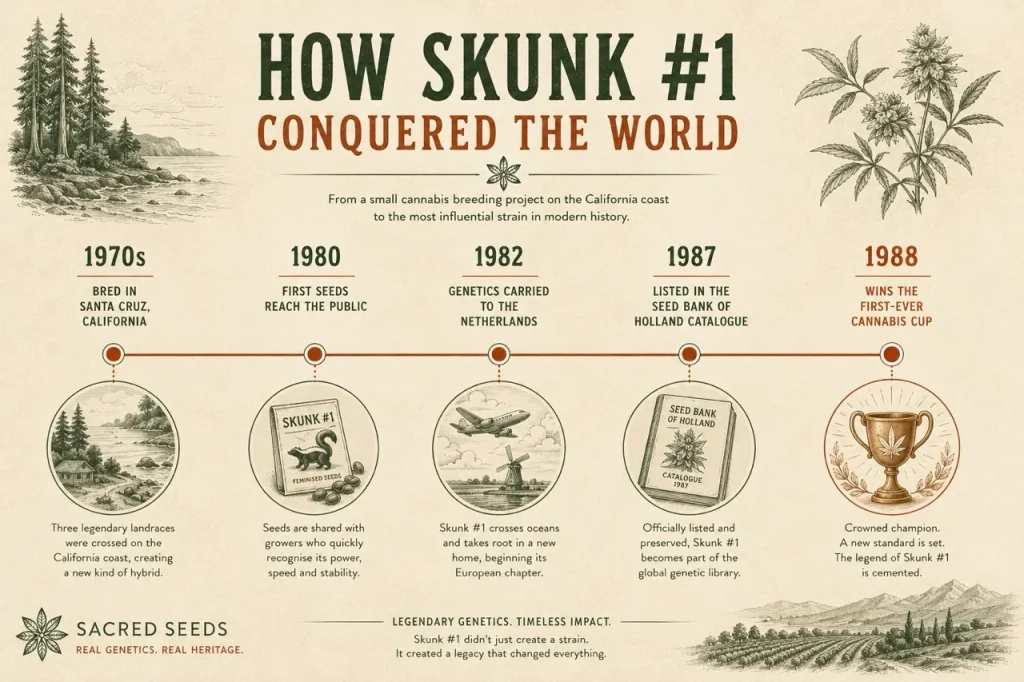
The Skunk #1 strain was born in Santa Cruz, California, in the 1970s, from the work of a breeder named David Watson, better known by his alias Sam the Skunkman. At a time when almost nobody was breeding cannabis with any real rigour, Watson and the collective of growers he worked with set out to do something genuinely new: take landrace genetics from opposite corners of the world and cross them into one stable, reliable, potent plant.
The cross they landed on was a polyhybrid of three landraces from three continents. An Afghani indica brought resin, density and a short, fast flowering time. Colombian Gold, a South American sativa, brought clarity and an uplifting lift. And Acapulco Gold, the legendary Mexican sativa, brought yield, aroma and pedigree. The result was (Afghani × Colombian Gold) × Acapulco Gold, and it balanced indica and sativa in a way nothing before it had managed. If you want the full story of one of those parents, our Acapulco Gold review traces exactly what it contributed to this cross, and our guide to cannabis seed genetics from landrace to hybrid explains how a cross like this becomes a stable strain.
There is one thing about this history we want to be completely straight about, because the name invites the question. The collective Watson bred under was called Sacred Seeds. That 1970s Santa Cruz collective is no relation to this shop. We took our name in tribute to them and to that era of proper, patient breeding, because it is the standard we hold ourselves to, but we are not them and we would never pretend to be. When we say Skunk #1 is the strain our catalogue is named for, that is what we mean: a nod to the people who did the foundational work, not a claim to their legacy.

The Strain That Ended the Lottery
To understand why Skunk #1 matters so much, you have to understand what growing cannabis was like before it. You planted seed and you got a lottery. Every plant came out different, some tall, some short, some potent, some weak, some male, and there was very little you could rely on from one seed to the next. Breeding, in the sense we mean it now, barely existed.
Skunk #1 was the answer to that. Watson and his collective did not just make a nice cross, they stabilised it, working through generation after generation of selective breeding until the plant reproduced its own traits faithfully from seed. That made it the first true-breeding cannabis hybrid, the first strain where a packet of seeds gave you a uniform, predictable, reliable crop. That sounds modest. It was revolutionary. It is the single innovation that turned cannabis growing from folklore into something closer to a craft, and every stabilised strain since has followed the road Skunk #1 built.
On top of that, it was potent for its day, it was fast, and it was genuinely easy to grow. Reliable, strong and forgiving, all at once, from seed. Nothing else offered that, and word travelled fast.
🏆 Winner, the first High Times Cannabis Cup, 1988. Skunk #1 took the very first Cannabis Cup in Amsterdam, beating the Super Sativa Seed Club, the Seedbank of Holland and Sensi Seeds. The win cemented its reputation and its genetics spread to seed banks worldwide.
How Skunk Conquered Holland
By 1980 Skunk #1 seed was reaching the public in California, and it had become the most reliable hybrid in the state’s underground grow scene. Then the story took the turn that made it global. Watson was arrested in Santa Cruz, and in 1982 he left for the Netherlands, carrying with him a reported 250,000 seeds, Skunk #1 among them.
What happened next reshaped cannabis for good. In Amsterdam, Watson connected with the pioneers of the early Dutch scene and the strain found a second home. Dutch breeders seized on it, because a plant that was resilient, fast and consistent was exactly what the emerging indoor growing movement needed. The genetics reached figures like Nevil Schoenmakers, the founder of The Seed Bank of Holland, who listed Skunk #1 in his 1987 catalogue and put it in front of an international mail-order audience for the first time. That is the same Nevil whose story runs through our Northern Lights review. Skunk #1 became a foundation of the Dutch movement, and the Amsterdam seed houses that received the genetics in the 1980s, Sensi Seeds among them, preserved and proliferated it. They still sell Skunk #1 to this day, and the version behind our seeds carries that same Dutch-preserved heritage. Sam the Skunkman, who passed away in 2025, left the entire modern seed industry standing on the foundation he laid.
The Effect: The Benchmark Hybrid High
Here is where honesty matters more than hype. Skunk #1 is not a modern THC monster, and it was never trying to be. It tests around 15 to 19% THC, which is moderate by today’s inflated standards, and that is exactly the point of it. What Skunk #1 offers is balance, and it is the balance that every hybrid since has been measured against.
The high comes on with a gentle, happy, uplifting lift from the sativa side, clear-headed and social rather than racy, and then settles into a warm, relaxed body ease from the Afghani backbone. It is the definition of a balanced hybrid, a roughly 65% indica, 35% sativa plant that leaves you elevated and comfortable at the same time without pinning you to the couch or sending your head spinning. It is versatile, it is approachable, and it is genuinely enjoyable in a way that raw potency does not guarantee. For a lot of experienced smokers, this reliable, well-rounded character is why they keep a Skunk in the rotation long after they have chased every high-THC headline.
What to Expect
A balanced hybrid, roughly 65% indica to 35% sativa, at an honest 15 to 19% THC. A gentle, happy, uplifting lift settling into a warm, relaxed body ease. Elevated and comfortable at once, versatile and approachable rather than overpowering. The classic earthy, sweet-and-sour skunk aroma with citrus and a hoppy edge. The strain every hybrid since is measured against.
Flavour and Aroma: The Original Skunk
This is the strain that put the word skunk into the cannabis vocabulary, and the aroma is exactly what you would hope. It is loud, pungent and unmistakable: earthy and musky at the base, with a sweet-and-sour tang over the top, a thread of citrus, and an almost hoppy, rubbery edge that is pure old-school. When people say a strain is skunky, this is the plant that defined the term, and it fills a room the moment the jar opens.
Underneath the aroma, the terpene profile is led by myrcene, the earthy, musky terpene that anchors so many relaxing indicas, with caryophyllene adding a peppery kick, limonene bringing the citrus lift, and linalool and pinene rounding it out with soft floral and fresh sharp notes. It is a complex, savoury profile rather than a sweet dessert one, and for a lot of growers that classic funk is the whole appeal.
One honest note, because it is part of the strain’s character. Skunk #1 has been kept by many different breeders over nearly fifty years, and the aroma genuinely varies from one preserved line to the next. Some phenotypes lean sweet, fruity or citrus-forward, others push hard into the acrid, animal pungency the name is famous for. That is not a fault, it is what happens to a living line that different people have selected in different directions over decades. It also means there is no single official Skunk smell, and a little variation between plants is authentic to the strain rather than a sign something is off.
Growing Skunk #1 in Australia
Part of what made Skunk #1 conquer the world is that it is genuinely easy to grow, and that has not changed. In its feminised photoperiod form it is one of the rare heritage strains where beginner-friendly is an honest description rather than a marketing line. It tolerates mistakes, shrugs off the kind of stress and feeding errors that would set back a fussier plant, and it does not stretch or herm at the first sign of trouble. Like Northern Lights, it is a plant a first-timer can actually succeed with, which is a real reason to choose it. The autoflower shares the same hardiness, but its fixed clock leaves no room to recover from an early setback, so it asks for slightly more care despite being simpler to run.
It is also fast and adaptable. Flowering finishes in around seven to eight weeks, quick for a plant with this much sativa in it, and it stays a manageable height, roughly a metre indoors and up to two metres outdoors as a big full-season plant. The genetics are hardy and carry good resistance to pests and mould, which is worth a great deal in an Australian context.
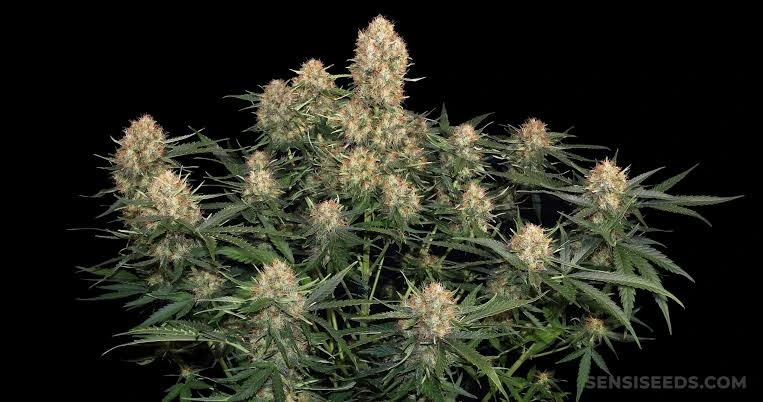
In structure it grows the way its mixed ancestry suggests: a strong central stem with sturdy lateral branches and moderate spacing between nodes, holding up dense, resin-heavy flowers without needing much training to stay upright. The leaves sit broad to intermediate, showing both the Afghan and the tropical sides of the family. It is a balanced, sensible plant that suits a range of growing styles rather than demanding one particular setup.
Skunk #1 comes in two formats, and the choice is genuinely down to how you like to grow. The feminised photoperiod gives you full control: you decide when to flip, you can keep it in veg to grow it bigger or train it, and it is the one to take if you want the largest plants and the biggest yields. The autoflower runs on its own clock instead, flowering on age regardless of light, which makes it faster start to finish, more compact, and the simpler option if you want a hands-off grow, a discreet setup, or more than one run in a season. Same genetics and the same character either way. It is only the growing experience that changes.
On climate, Skunk #1 is far more adaptable than the pure landraces it came from. It thrives indoors anywhere, and outdoors it does well through a normal warm Australian summer across most of the country, not just the tropical north. Its mould resistance makes it a sensible choice in more humid regions where a denser, less resilient strain would struggle in late flower. It is, in short, a genuine all-rounder, which is exactly why it became the backbone strain it is. The full feeding schedule, the training detail and the regional harvest timing all sit on the Skunk #1 seeds page, and our Australian climate strain guide shows where it fits against other genetics.
The Family Tree: Skunk’s Legacy
To grow Skunk #1 is to grow the root of the tree. Its genetics are estimated to sit behind a huge share of the strains grown today, and its direct children read like a roll call of modern classics. Super Skunk, which we also stock, is Skunk #1 crossed back with Afghani for a punchier, more indica-leaning version of the original. Shiva Skunk is Skunk #1 crossed with Northern Lights #5, a heavier, more resinous cross that became a classic in its own right. Cheese is a famous Skunk #1 phenotype, preserved as a clone for its extreme pungency, that grew into a whole family of its own. The Skunk line, and a long line of hybrids well beyond it, traces back to this plant.
That is the real reason Skunk #1 anchors our range and gives our name its meaning. A strain does not become historically important by being the strongest. It becomes important by passing its best traits down the generations reliably, which is exactly what breeders still respect Skunk #1 for. A catalogue built on real genetics and proven strains does not hold together without the strain that proved the whole idea was possible. Everything else is, in a sense, a descendant. This is where it started.
Who It Suits
Skunk #1 suits growers who want a genuinely easy, forgiving, fast plant that still carries real history, first-timers included, and it suits smokers who want a balanced, versatile, approachable high rather than a raw-potency knockout. It is for anyone who values the classic loud skunk aroma and a reliable all-rounder that grows almost anywhere in Australia. It is not the pick if you are chasing the highest possible THC number or the sweet candy flavours of the modern hybrids, though it is worth remembering those hybrids largely descend from this one.
Not sure Skunk #1 is the right fit? Our strain finder takes six quick questions and matches you to three strains based on your setup, your experience and the effect you are after.
Key Takeaways
The foundation strain. The Skunk #1 strain was the first true-breeding cannabis hybrid, bred by David Watson and the Sacred Seeds collective in 1970s California from Afghani, Colombian Gold and Acapulco Gold.
It ended the lottery. By coming true from seed, it turned growing from guesswork into something reliable, and it is the genetic backbone behind a huge share of modern strains.
A Cup-winning legend. It won the first High Times Cannabis Cup in 1988, then became a cornerstone of the Dutch seed industry through Sensi and others.
Balance over brute force. A roughly 65/35 indica-leaning hybrid at an honest 15 to 19% THC, uplifting then relaxed, with the original loud skunk aroma. The benchmark every hybrid is measured against.
Genuinely easy and adaptable. Forgiving, fast and mould-resistant, and it grows well across most of Australia indoors or out. In its feminised photoperiod form it is one of the rare heritage strains a beginner can genuinely succeed with, and it also comes as a faster, more compact autoflower.
Frequently Asked Questions
What is the Skunk #1 strain?
Skunk #1 is a balanced, indica-leaning hybrid and the first cannabis strain ever bred to come true from seed. Created in 1970s California, it is a three-landrace polyhybrid of Afghani, Colombian Gold and Acapulco Gold, famous for its loud skunky aroma, its reliable balanced high, and its role as the genetic backbone of a huge share of modern strains. It is also known as Skunk No. 1, Skunk One, or simply the original Skunk.
Who created Skunk #1?
It was created by the breeder David Watson, better known as Sam the Skunkman, working with a Santa Cruz collective in 1970s California. Watson later brought the genetics to the Netherlands in 1982, where Dutch seed houses including Sensi Seeds preserved and proliferated the line. Watson passed away in 2025, leaving the modern seed industry built on his work.
What strains is Skunk #1 made from?
It is a polyhybrid of three landraces from three continents: an Afghani indica for resin, density and fast flowering, Colombian Gold for an uplifting, clear sativa lift, and Acapulco Gold, the famous Mexican sativa, for yield and aroma. The cross is usually written as (Afghani × Colombian Gold) × Acapulco Gold.
Why is Skunk #1 so important?
Because it was the first true-breeding cannabis hybrid. Before it, growing from seed was a lottery of wildly different plants. Skunk #1 reproduced its traits reliably from seed, which turned breeding from folklore into a craft and made consistent, predictable crops possible. Most stabilised strains that came after it were built on the path it opened, and its genetics sit behind a large share of what is grown today.
Did Skunk #1 win the Cannabis Cup?
Yes. It won the very first High Times Cannabis Cup, held in Amsterdam in 1988, beating entries from the Super Sativa Seed Club, the Seedbank of Holland and Sensi Seeds. The win cemented its reputation and helped spread its genetics to seed banks around the world.
Is Skunk #1 indica or sativa?
It is a balanced hybrid that leans indica, roughly 65% indica to 35% sativa. The effect reflects that balance: an uplifting sativa lift up front settling into a relaxed indica body ease, without heavy sedation or a racy head.
How strong is Skunk #1?
It tests around 15 to 19% THC, which is moderate by modern standards, and that is by design. Skunk #1 is about balance and reliability rather than raw potency, and many experienced smokers prefer that well-rounded, approachable character to a higher number that overwhelms.
What does Skunk #1 smell and taste like?
It is the strain that defined the word skunk. The aroma is loud and pungent, earthy and musky with a sweet-and-sour tang, a thread of citrus, and a hoppy, almost rubbery edge. The terpene profile is led by myrcene, with caryophyllene, limonene, linalool and pinene behind it, giving a savoury, complex character rather than a sweet one.
Is Skunk #1 easy to grow?
The feminised photoperiod is, genuinely. It tolerates mistakes, resists pests and mould, and does not stretch or herm easily, which makes it one of the rare heritage strains a complete beginner can succeed with. It is fast too, finishing flower in around seven to eight weeks. The autoflower is just as hardy but runs on a fixed clock with no room to recover from a setback, so it rewards a little more planning even though it is simpler to run.
How long does Skunk #1 take to flower?
Around seven to eight weeks, or 49 to 56 days, which is fast for a plant carrying this much sativa. That quick, reliable finish is part of why it became a favourite of the early indoor growing scene.
Should I get the photoperiod or the autoflower?
Both carry the same genetics and the same character, so it comes down to how you want to grow. The feminised photoperiod gives you full control over size and timing, since you choose when to flip it into flower, and it is the pick for the largest plants and the biggest yields. The autoflower flowers on age rather than light, which makes it faster, more compact, and simpler to run, and it suits a hands-off grow, a discreet space, or fitting more than one crop into a season.
Does Skunk #1 grow well in Australia?
Very well. It is far more adaptable than the pure landraces it descends from, thriving indoors anywhere and outdoors through a normal warm Australian summer across most of the country. Its mould resistance makes it a sensible choice in humid regions where denser strains struggle in late flower.
What strains come from Skunk #1?
A great many. Its direct children include Super Skunk, which crosses it back with Afghani, Shiva Skunk, a heavier cross with Northern Lights #5, and Cheese, a famous Skunk #1 phenotype that became its own strain. Beyond those, Skunk genetics run through a huge share of modern hybrids, which is why it is called the backbone of modern cannabis.
Is today’s Skunk #1 the same as the original?
Not in every respect, and that is worth understanding rather than glossing over. Any seed line kept for close to fifty years passes through different breeders and different selection choices, so several legitimate versions of Skunk #1 exist, some leaning sweeter, some more tropical, some more heavily Afghani. That does not make one real and the others fake. Living genetics have histories rather than fixed specifications, so the honest question is not just whether a line is the original, but who preserved it and what they selected for along the way. The version behind our seeds carries the Dutch-preserved heritage that traces back to Watson’s line.
Is Skunk #1 the same as Super Skunk?
No, though they are closely related. Super Skunk is Skunk #1 crossed back with Afghani, which pushes it more indica-dominant, with a heavier body effect and an even stronger aroma. Skunk #1 is the more balanced original, while Super Skunk is the punchier, more relaxing descendant.
Why is it called Skunk?
For its aroma. The strain produces a pungent, musky, sweet-and-sour smell so distinctive that it gave the entire category its name. When people describe any strain as skunky, they are describing a quality that traces directly back to this plant.
Sacred Seeds Australia sells cannabis seeds strictly as souvenirs and for genetic preservation, in accordance with local laws. In Australia it is illegal to germinate cannabis seeds unless you are in the ACT or hold a specific licence. Nothing in this article is medical advice.
Related reading: browse the full range of cannabis seeds Australia, our feminised photoperiod range, the Acapulco Gold review for one of its landrace parents, and the guide to the best cannabis strains for the Australian climate.