The first time Ken Estes saw it, a friend held a bright light over the bag and the room changed. The buds were so dense they’d compressed into each other — you could roll the pound out of the bag like a bowling ball. When he pulled a bud loose, it separated like velcro. The smell was overwhelming. Purple everywhere. “I know what I got,” he said. “I’ve got this. This is it. This is to me just like the Grand Poobah.” He high-fived his friend Charlie and said the words out loud for the first time: Grand Daddy Purple.
This was 2003. The genetics had been preserved for eighteen years by a Native American tribe in the mountains of Northern California — a cut they called Purple Medicine that none of the commercial growers around at the time had managed to replicate or access. Estes had come to the tribe through a community of friends in Humboldt County, had helped a family in the tribe keep their home through a difficult period, and the cut came to him as a gesture of trust. He recognised immediately what he had. He changed his entire operation to run it.
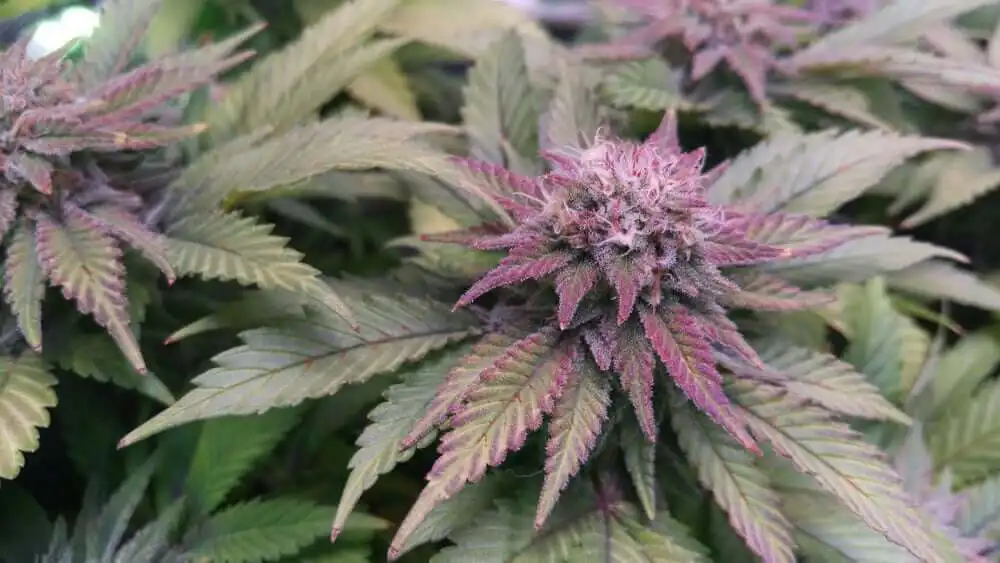
The story behind Granddaddy Purple matters because it’s the reason the strain is what it is. This wasn’t a planned breeding programme designed to hit market trends. It was the preservation of something rare. Ken Estes had been paralysed from the waist down years earlier in a motorcycle accident — cannabis gave him back his quality of life when nothing else did, and he’d spent years as a disabled cannabis activist by the time the Purple Medicine cut came to him. GDP was his contribution to giving back what cannabis had given him.
I’ve got my own version of that connection with this strain. A few years back I broke my leg badly in a bike accident and tore through the soft tissue in my lower back trying to right myself before I went down. Six months of recovery. The pain through the worst of it was the kind that makes you understand why people get desperate. Granddaddy Purple was the strain I leaned on most through that period. Not for the obvious reason — not because it knocked me out — but because it didn’t. GDP let me get through the day with the pain at a manageable level while leaving enough sharpness to actually be present, to read, to talk with Jess, to function. The myrcene and linalool combination is doing real work that most heavy indicas don’t manage. You feel relief without losing yourself. I understand why Estes spent the rest of his life championing this strain. I know exactly what he was preserving.
Two decades after Estes first put it in front of the California medical market, GDP remains the benchmark purple strain. The deep violet colouration, the grape and berry terpene profile, the heavy body effect that doesn’t erase you — all of it consistent, all of it distinctive, and none of it fully replicated by the dozens of strains its genetics spawned. This article is the strain story — the Estes history, the contested genetics, the anthocyanin science, and why Australia’s climate suits it particularly well. For full grow detail — week-by-week timeline, EC targets, training, harvest timing — head to the Granddaddy Purple product page or Auto Granddaddy Purple.
🧬 Granddaddy Purple Genetics — The Contested Origin
There are two accounts of GDP’s genetic lineage and they’ve never been definitively resolved, which is fitting for a strain whose origin involves an eighteen-year-old preserved cut from a Native American tribe.
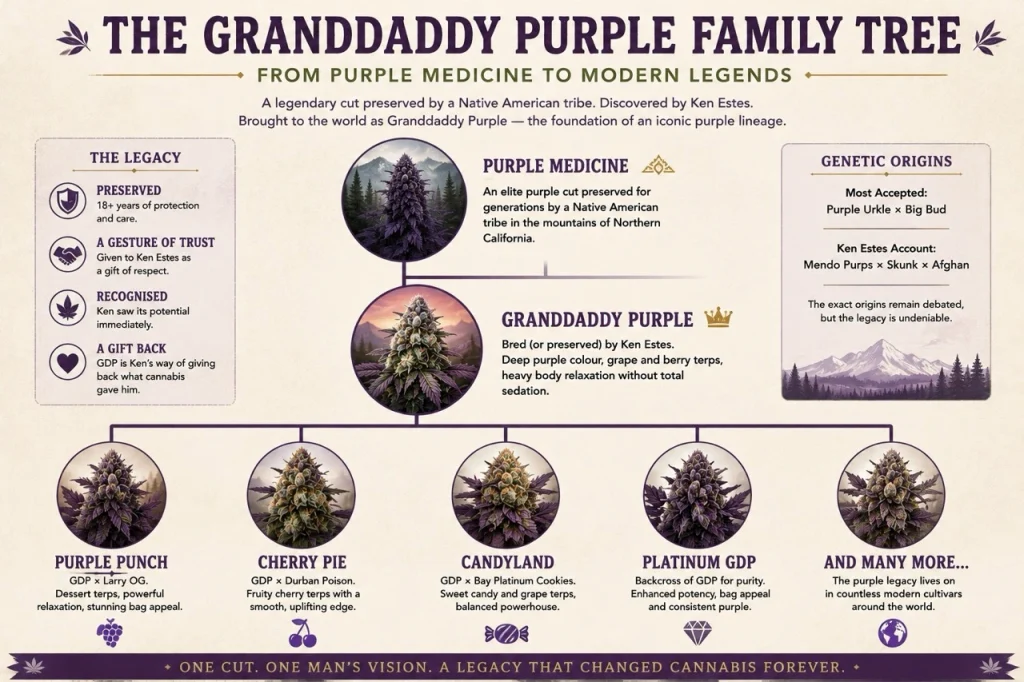
The most widely accepted version: Purple Urkle × Big Bud. Purple Urkle is a California indica of uncertain origin — likely a clone-only Mendocino Purps phenotype — known for intense grape and berry flavour, naturally high anthocyanin production producing vivid purple colouration, and deeply sedating effects. Big Bud is an Amsterdam-bred indica developed by Sensi Seeds specifically for yield — massive dense flower development that made it one of the most commercially productive strains in European seed bank history. The cross combines Purple Urkle’s visual spectacle and flavour profile with Big Bud’s structural density and yield capacity. This is the lineage most growers and seed banks attribute to GDP, and it’s the one that makes logical sense given the strain’s characteristics.
Ken Estes himself cited a different lineage: Mendo Purps × Skunk × Afghan. Some cannabis historians believe Estes didn’t breed the strain himself but rather preserved and commercialised it — that the genetics he received from the tribe already existed as a stabilised cross, and that the Purple Urkle × Big Bud attribution came later as a retroactive attempt to explain something that predated those names. Several of the more thorough breeder research teams have noted that it’s generally accepted Estes didn’t actually breed the strain but instead helped commercialise it.
What’s not disputed: whatever the precise genetic origin, Ken Estes was the person who recognised it, preserved it, ran it through a commercial operation, and put it in front of the California medical cannabis market. The characteristics — deep purple colouration from high anthocyanin production, grape-and-berry myrcene-dominant terpene profile, heavy indica effect, above-average yield for a purple strain — are consistent across every account. The strain works. The name stuck. The genetics defined a category.
GDP’s Breeding Legacy — The Strains It Made Possible
Granddaddy Purple’s genetics have been used in more significant offspring crosses than almost any other strain of its era. The purple colouration, the grape terpene profile, and the dense resin production all transfer reliably to crosses — which made GDP invaluable as a breeding parent through the 2000s and into the modern era.
Purple Punch (GDP × Larry OG) — dense purple flowers, sweet berry flavour, knockout indica effect. Now one of the most popular indica strains worldwide. Cherry Pie (GDP × Durban Poison) — tart cherry aroma, purple-tinged buds, the strain that bridged the GDP era and the Cookies era. Platinum GDP (GDP × Platinum Cookies) — GDP’s visual identity with added Cookies resin. Candyland (GDP × Bay Platinum Cookies) — Ken Estes’ own daytime-friendly GDP cross, bred deliberately for mould resistance and cerebral effects.
If you’ve smoked anything purple in the last decade, you’ve almost certainly smoked something with GDP genetics in its lineage. Estes’ contribution to the modern cannabis catalogue is enormous, and most consumers don’t realise how much of what they’re enjoying traces back to that one cut from the Northern Californian mountains.
🔬 The Science of Purple — Why GDP Turns the Colour It Does
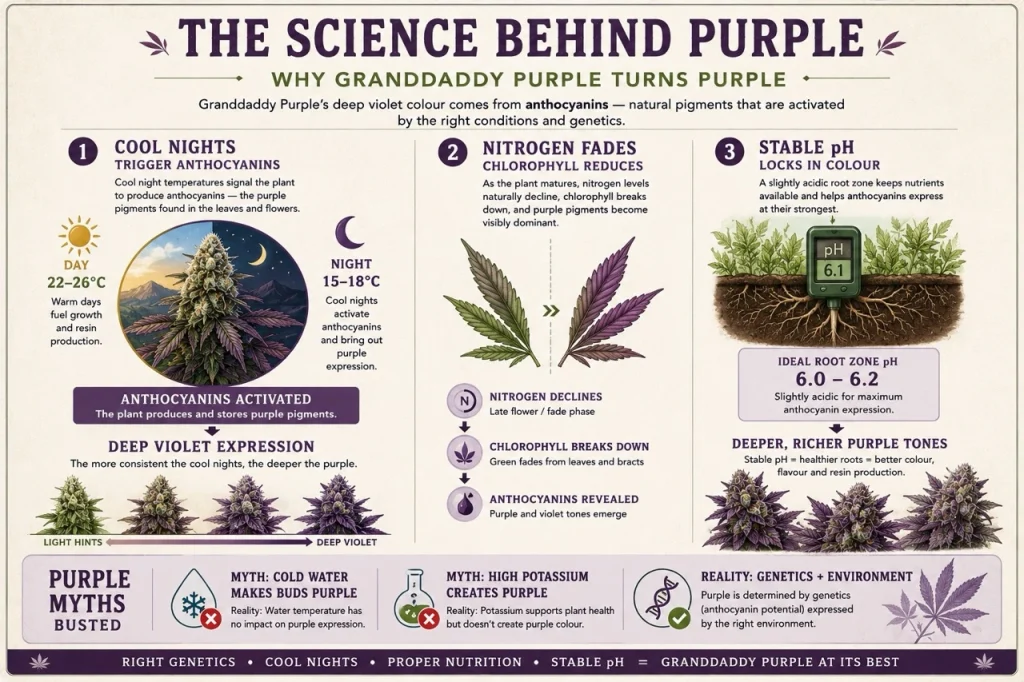
Most growers who’ve heard anything about purple cannabis have heard wrong information. The two myths that won’t die: cold water in the final weeks turns plants purple, and high potassium feed produces purple expression. Both are wrong. The actual mechanism is anthocyanin chemistry, and it’s worth understanding because it tells you what you can and can’t influence.
Anthocyanins are pigment compounds produced by many plants — they’re what makes blueberries blue, red cabbage red, and Purple Medicine genetics purple. In cannabis, anthocyanin production is genetic potential rather than guaranteed expression. A plant can carry the genes for high anthocyanin production and still finish entirely green if the conditions don’t trigger expression. GDP carries those genes strongly. The expression is unusually reliable compared with most “purple” strains, but even GDP can finish green under the wrong conditions.
Three environmental levers actually drive anthocyanin expression in a plant that carries the genetics for it.
Temperature differential. The most significant lever. Cool nights — specifically nights at 15–18°C while days remain at normal flowering temperatures of 22–26°C — trigger anthocyanin production as the plant’s biochemistry shifts under cool stress. The differential is what matters, not the absolute temperature. A plant grown at constant 18°C day and night won’t purple up. The same plant exposed to 23°C days and 16°C nights will. From week seven of flower onward is the window where the trigger has the most effect on the visible result.
Nitrogen withdrawal. Chlorophyll — the green pigment — masks anthocyanin expression. As long as the plant is producing chlorophyll at full intensity, the underlying purple stays hidden under the green. Pulling nitrogen earlier than usual through the back end of flower allows chlorophyll to break down naturally and reveals the anthocyanin colour underneath. This is why properly flushed GDP often shows more dramatic purple than the same genetics fed heavy nitrogen through to harvest.
pH stability in the final weeks. Anthocyanin compounds shift colour based on pH — they trend toward red/pink in acidic conditions and toward blue/violet in more alkaline conditions. Holding root zone pH at 6.0–6.2 in the final weeks of flower produces the deepest violet expression. pH drift toward 6.8 or higher in the final weeks tends to produce more red and pink expression, which is genetically the same compound just expressing differently.
🌍 Granddaddy Purple — Five Things Most Growers Don’t Know
The strain has been on the market more than two decades now, and grower communities have built up a body of practical knowledge about it that doesn’t make it into seed bank descriptions.
1. The name was coined in real time. “Grand Daddy Purple” wasn’t focus-grouped or marketed into existence. Ken Estes said the words out loud the first time he saw the genetics, high-fiving his friend Charlie. He was thinking of the Grand Poobah — the figurehead, the patriarch — and the purple in front of him. The name stuck because it described what the strain felt like as much as what it looked like.
2. The genetics were preserved by a Native American tribe for eighteen years. Before Estes ever saw the cut, the Purple Medicine genetics had been kept alive by a tribal community in the mountains of Northern California — passed within the community, never released commercially. The fact that GDP exists in modern catalogues at all is the result of that community’s willingness to share something they’d held privately for nearly two decades.
3. The colour expression is unusually genetic-loaded. Most “purple” strains rely heavily on environmental triggers to express colour. GDP is the opposite — the anthocyanin genetics are loaded enough that the colour expresses noticeably under a wider range of conditions than most purple genetics manage. You still need cool nights for the dramatic expression, but GDP gives you something even when the conditions are imperfect, where most purple strains finish entirely green.
4. The myrcene-linalool combination is what makes it useful for pain. GDP’s terpene profile pairs myrcene (the dominant relaxing terpene in cannabis, common to most heavy indicas) with significant linalool — the terpene most associated with lavender’s calming, anxiolytic properties. Linalool is rare at meaningful concentrations in cannabis, and the combination with myrcene produces an effect profile that’s specifically useful for anxiety-driven pain rather than just sedation. This is why GDP became the strain of choice for medical cannabis patients in California in the 2000s and why Estes himself stayed loyal to it.
5. It’s a sleep strain that doesn’t actually knock most people out. Read GDP’s reputation and you’d expect a heavy sedative that puts you down within an hour. The reality is more subtle. GDP produces deep relaxation and pain relief without the cognitive shutdown of pure couchlock indicas. Most consumers describe it as the strain that lets them function through the day under conditions that would otherwise be unmanageable, with sleep available when wanted rather than imposed. That distinction is part of why it became the medical cannabis benchmark.

🧠 Granddaddy Purple Effects — What to Actually Expect
Onset (10–20 minutes): Slower than the high-myrcene profile might suggest. The first signal is physical rather than cerebral — a noticeable softening of muscle tension, a sense that the body is settling. Cerebrally, the effect is gentle and warm rather than racing — mood lifts mildly without the bright euphoric peak of more limonene-driven strains. At medical doses, pain signal reduction is the most noticeable change in the first twenty minutes.
Early phase (20–45 minutes): Body relaxation deepens. The myrcene and linalool combination produces sustained physical ease that’s distinctly different from indica couchlock — your body relaxes, but you remain functional. Anxiety reduces noticeably, which is the linalool contribution. Conversation flows easily. Reading, music, slow tasks all work fine. This is the window most experienced GDP users find the most useful.
Mid-phase (45–120 minutes): The deeper indica character settles in. Physical relaxation reaches its peak, appetite increases reliably, and the desire for stillness becomes more present. Sleep is available now if you want it but isn’t forced — you can stay up and remain comfortable, or wind down and drift off easily. Pain management remains effective through this window. The cerebral effect is mellow, present, contented.
Late phase (120–180+ minutes): Gradual fade. Physical effects persist longer than cerebral ones. No notable crash — the comedown is smooth, sleep follows naturally, and morning-after effects are minimal compared with heavier sedative strains. Many users find GDP doesn’t disrupt their next-day functioning the way heavier indicas can.
Potency note: 17–23% THC depending on phenotype and grow, which is moderate by modern standards but produces effects that punch above the percentage. The terpene profile — particularly the linalool contribution — does work that pure THC content doesn’t reflect. New consumers should approach with respect for the body effect rather than the cerebral hit.
Granddaddy Purple Flavour Profile — Grape, Berry, Lavender Sweetness
Open a jar of properly cured GDP and the room knows about it. The dominant note is sweet grape — concentrated, almost candied, with the kind of intensity that translates straight to the palate without losing definition. Beneath the grape sits darker berry character — blackberry, blueberry — and a subtle lavender note that comes from the linalool content and gives the profile a depth most fruit-forward strains miss. The combination is unmistakable. Anyone who’s had real GDP recognises it immediately.
On the inhale: sweet, fruity, with the grape leading and the floral lavender note layered underneath. On the exhale: deeper berry character with a slightly earthy finish from the underlying indica genetics. The smoke is smoother than the dense bud structure suggests — properly cured GDP doesn’t hit the throat hard the way some high-resin indicas can.
The cure matters significantly with this strain. Six weeks minimum, eight weeks ideally. Fresh-harvested GDP reads as one-dimensional grape-sweet without the linalool depth that makes the strain distinctive — the floral note develops in the jar over time. A proper cure is where the full GDP character actually shows up.
🌏 The Australian Angle — Why Our Autumn Suits GDP Better Than Most
Australia is one of the better climates in the world for outdoor GDP, and the reason is the autumn temperature differential most of the country gets automatically. The cool-night/warm-day pattern that triggers anthocyanin expression — exactly what GDP needs to express its visual character fully — happens naturally across most of southern Australia from late March through April. Plants finishing in that window get the colour expression as a free side effect of being in the right place at the right time. Indoor growers have to engineer that temperature differential deliberately. Most Australian outdoor growers get it for nothing.
Victoria, Tasmania, southern New South Wales, the ACT, and the South Australian Adelaide Hills produce the most dramatic GDP colour expression in the country. April night temperatures dropping into the 12–16°C range while days remain at 18–22°C are precisely the conditions that drive deep violet expression. Plants grown in these regions during a normal autumn finish with colour that indoor growers struggle to match even with deliberate temperature programming. The Adelaide Hills and the Melbourne hinterland in particular produce some of the most striking outdoor GDP in Australia.
Queensland and Northern NSW will still produce purple expression, but the warmer autumns mean the colour develops less intensely than further south. Compensate by choosing the latest possible harvest window your climate allows — the more time the plants have under cooling night temperatures, the more colour develops. Inland regions away from coastal warmth tend to produce better expression than coastal sites at the same latitude.
Western Australia is the variable case. Perth and the wheatbelt’s dry autumns suit GDP’s bud structure well, but the milder night temperatures don’t trigger colour expression as reliably as the southern states. The southwest corner — Margaret River, Albany — gets cooler nights and produces stronger colour expression than the rest of the state.
Ready to Grow Granddaddy Purple?
The complete grow guide — week-by-week timeline, EC targets, training approach, climate management, and harvest timing — is on the product pages.
Granddaddy Purple Feminised Seeds → | Auto Granddaddy Purple Feminised Seeds →
❓ Frequently Asked Questions — Granddaddy Purple
What is Granddaddy Purple?
Granddaddy Purple — GDP — is an indica-dominant feminised cannabis strain commercialised by Ken Estes in California in 2003 from genetics preserved for eighteen years by a Native American tribe in Northern California. The most widely accepted lineage is Purple Urkle × Big Bud, though Estes himself cited Mendo Purps × Skunk × Afghan. THC range is 17–23% with a myrcene and linalool dominant terpene profile producing grape, berry, and floral lavender flavour. It’s the benchmark purple strain in modern cannabis and the parent of dozens of significant offspring crosses including Purple Punch, Cherry Pie, and Platinum GDP.
Where does Granddaddy Purple come from?
Ken Estes named and commercialised the strain in 2003 in California. The genetics had been preserved for eighteen years before that by a Native American tribe in the mountains of Northern California, who called the cut “Purple Medicine.” Estes received the cut as a gesture of trust after helping a family in the tribe through a difficult period. He recognised what he had immediately and built his entire operation around running it. Cannabis historians generally credit Estes with preserving and commercialising the strain rather than originally breeding it.
Why is Granddaddy Purple actually purple?
Anthocyanins — pigment compounds the plant produces under specific conditions. GDP carries unusually loaded anthocyanin genetics, but expression depends on three environmental triggers: cool night temperatures (15–18°C while days remain at 22–26°C from week seven of flower onward), nitrogen withdrawal in late flower (chlorophyll masks the underlying purple), and stable root zone pH at 6.0–6.2 in the final weeks. The cold-water and high-potassium myths circulating online are wrong. The actual mechanism is temperature-driven biochemistry, and Australia’s autumns trigger it automatically across most of the country.
What does Granddaddy Purple smell and taste like?
Sweet grape leading the profile, with darker berry character (blackberry, blueberry) underneath and a distinctive lavender note from the linalool content. The combination is unmistakable to anyone who’s had real GDP. The flavour develops significantly over the cure — fresh-harvested material reads as one-dimensional grape sweetness without the floral depth. Six weeks minimum in glass for the full character to express. Eight weeks is meaningfully better.
What are the effects of Granddaddy Purple?
Deep physical relaxation paired with sustained mental functionality — distinctly different from couchlock indicas that erase cognitive function. The myrcene and linalool combination produces pain relief and anxiety reduction without forcing sedation. Many medical cannabis users prefer GDP specifically because it lets them function through the day under conditions that would otherwise be unmanageable, with sleep available when wanted rather than imposed. The cerebral effect is gentle, warm, contented rather than euphoric or racing.
Is Granddaddy Purple good for outdoor growing in Australia?
Yes — Australia is one of the better outdoor GDP climates in the world. The cool-night autumn pattern across most of southern Australia (Victoria, Tasmania, southern NSW, ACT, Adelaide Hills) triggers anthocyanin expression automatically without any intervention. April night temperatures of 12–16°C with daytime warmth produce some of the most dramatic outdoor GDP colour expression anywhere. Queensland and Northern NSW will produce purple but less intensely. WA varies by region — the southwest corner gets stronger colour than Perth and the wheatbelt.
How does Granddaddy Purple compare to the auto version?
Auto Granddaddy Purple delivers the same genetic foundation on a fixed 70–80 day timeline with no light flip required. The trade-offs are slightly lower THC, reduced terpene intensity, and smaller yield per cycle. The auto is a strong choice when the photoperiod timeline isn’t workable, particularly for southern Australian growers running multiple cycles per season. For the full GDP character — the dramatic colour, the deep linalool development, the medical-grade effect profile — the photoperiod feminised is the definitive version.
What strains came from Granddaddy Purple genetics?
Dozens of significant strains. Purple Punch (GDP × Larry OG), Cherry Pie (GDP × Durban Poison), Platinum GDP (GDP × Platinum Cookies), Candyland (GDP × Bay Platinum Cookies — Ken Estes’ own daytime-friendly cross), and many others. If you’ve smoked anything purple in the last decade, there’s a strong chance the lineage traces back to GDP somewhere. Estes’ contribution to the modern cannabis catalogue is enormous and underappreciated.
Where can I buy Granddaddy Purple seeds in Australia?
Sacred Seeds Australia stocks both Granddaddy Purple Feminised Seeds and Auto Granddaddy Purple Feminised Seeds, with express Australian shipping and batch-tested seed quality. Sold strictly as novelty collector’s items in accordance with local laws.