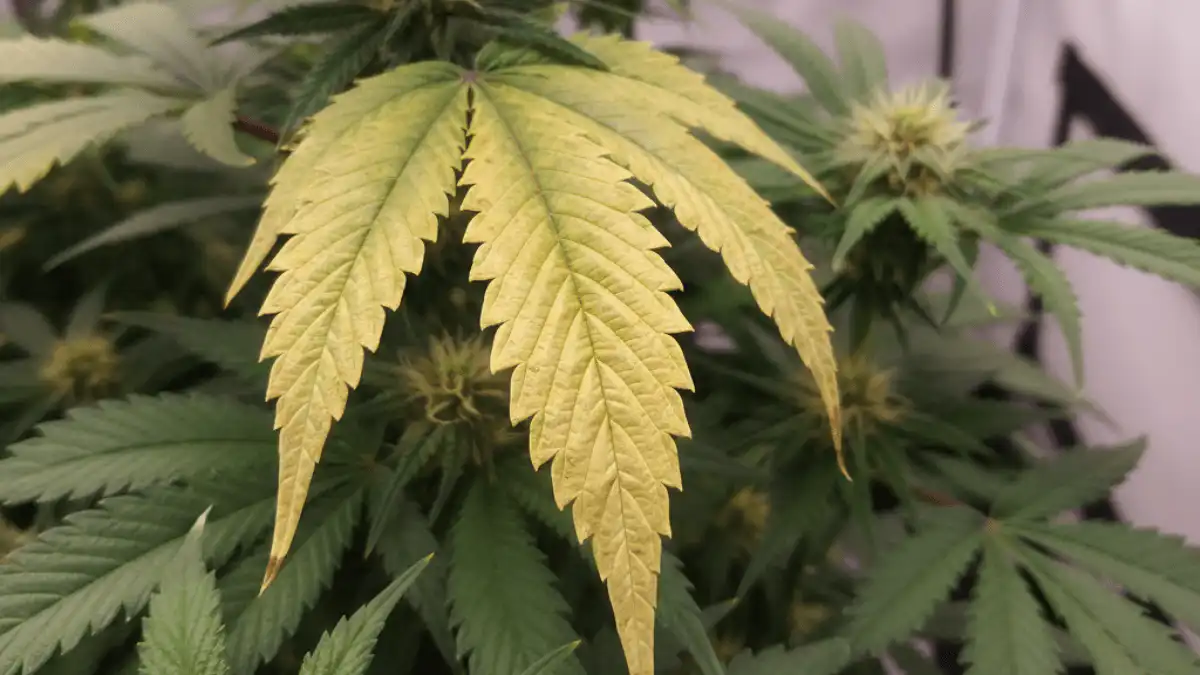
Yellowing leaves are the single most common issue collectors face. After diagnosing this on thousands of plants over 20+ years, I can tell you it’s a symptom, not a disease. Your plant is trying to tell you something is wrong with its environment. 99% of the time, it’s one of five common, fixable issues.
This guide will walk you through diagnosing the cause of yellowing leaves so you can fix the problem and get your plant healthy again.
Quick Answer: The 5 Main Causes of Yellowing Leaves
|
Issue |
Frequency |
Quick Identifier |
Fix Time |
|
💧 Overwatering |
45% of cases |
Droopy, heavy leaves + wet soil |
5-7 days |
|
🔬 Wrong pH |
30% of cases |
Yellowing despite feeding |
3-5 days |
|
📉 Nitrogen Deficiency |
15% of cases |
Bottom leaves yellow first |
3-7 days |
|
💡 Light Burn |
7% of cases |
Only top leaves bleached |
Immediate |
|
🌸 Late Flower (Normal) |
3% of cases |
Weeks 8-10, lower leaves only |
Not needed |
60-Second Diagnosis: Find Your Problem Fast
Use this decision tree to identify the cause in under a minute:
START HERE → Is the soil wet or dry?
- Wet soil + droopy leaves → Overwatering (see Step 1)
- Bone dry soil + limp leaves → Underwatering (see Step 1)
- Soil moisture is good → Continue ↓
Where is the yellowing happening?
- Only top leaves (under lights) → Light burn (see Step 4)
- Bottom leaves, moving up → Nitrogen deficiency (see Step 3)
- Middle leaves, yellow between veins → Magnesium deficiency (see Step 3)
- New growth pale/white with green veins → pH lockout/Iron issue (see Step 2)
- Lower leaves in weeks 8-10 flowering → Normal senescence (see bottom)
Still unsure? → Test your pH (Step 2)
Step 1: Is It Overwatering or Underwatering?
Before you reach for nutrients, check your watering. This is the #1 mistake I see—occurring in nearly half of all yellowing cases.
Overwatering (Most Common: 45% of Cases)
Symptoms:
- Leaves are a uniform, droopy yellow
- They feel heavy and full of water
- Whole plant looks wilted despite wet soil
- Soil stays wet for 5+ days
The Science: When soil is waterlogged, roots can’t get oxygen. They essentially drown, stop functioning, and can’t absorb nutrients—leading to yellowing even if nutrients are present.
The Fix:
- Stop watering immediately
- Let soil dry out completely (top 2-3 inches)
- Lift the pot to learn dry vs. wet weight
- Improve drainage: add perlite next time (30% perlite to 70% soil ratio)
- Only water when top 2-3 inches are dry
Recovery time: 5-7 days to see improvement
Underwatering (Less Common: 5% of Cases)
Symptoms:
- Leaves are droopy, limp, and lifeless
- They feel dry and papery
- Soil is bone dry throughout pot
- Leaves may be crispy at edges
The Fix:
- Water thoroughly until you see 10-20% runoff from bottom
- Plant should perk up within 2-6 hours
- Set a watering schedule to prevent recurrence
Pro tip: Underwatered plants recover fast. Overwatered plants take much longer and risk root rot.
Step 2: Could It Be Your pH?
This is the silent killer. If your pH is wrong, your plant can’t eat, no matter how much food you give it. Cannabis plants can only absorb nutrients within a specific pH range.
- Optimal pH Range: 6.0–6.5 for soil; 5.8–6.2 for coco/hydro.
The Science: Nutrient Lockout
If the pH is too high or too low, certain nutrients become chemically unavailable to the plant’s roots. The plant will show signs of deficiency even though the nutrients are present in the soil.
pH too high (>7.0): Iron, manganese, phosphorus locked out
pH too low (<5.5): Calcium, magnesium locked out
How to Test and Fix pH
What you need:
- pH test kit or digital pH meter (±0.1 accuracy)
- pH Up/Down solutions (citric acid/potassium hydroxide)
The process:
- Test your water after adding nutrients
- Adjust to target range using pH Up/Down
- Test again to confirm
- Also test runoff water from bottom of pot—this shows what’s happening at root level
Fix time: If pH was the issue, yellowing should stop spreading within 3-5 days.
Step 3: How to Diagnose Nutrient Deficiencies
If watering and pH are correct, then it’s time to look at nutrient deficiencies. The location of the yellowing tells you what nutrient is missing.
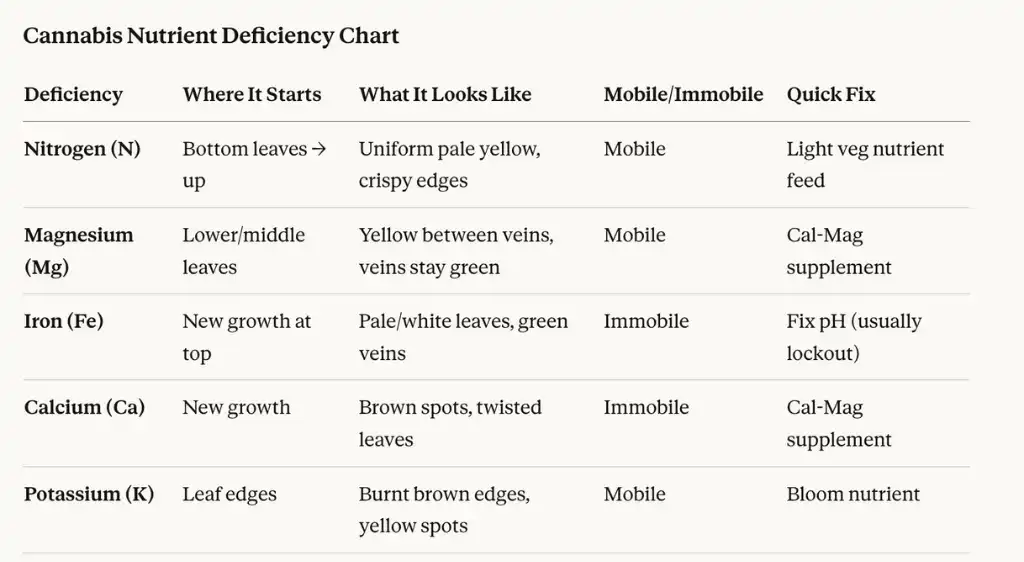
Nitrogen (N) Deficiency (Most Common Deficiency):
- Location: Starts at the bottom of the plant and moves up.
- Appearance: Lower leaves turn a uniform, pale yellow and will eventually become crispy and fall off. Nitrogen is a “mobile” nutrient, so the plant moves it from old leaves to new growth.
- Fix: A light feed with a balanced, nitrogen-rich vegetative nutrient. The problem should stop progressing within a few days.
Magnesium (Mg) Deficiency:
- Location: Starts on lower or middle leaves.
- Appearance: Yellowing appears between the veins of the leaves, while the veins themselves stay green (interveinal chlorosis). It can sometimes look like stripes or marbling.
- Fix: A light dose of Cal-Mag (Calcium-Magnesium supplement). Epsom salts can also work in a pinch.
Iron (Fe) Deficiency:
- Location: Starts on the newest growth at the top of the plant.
- Appearance: New leaves emerge pale yellow or almost white, with green veins. Iron is an “immobile” nutrient, so the plant can’t move it from old leaves.
- Fix: This is almost always a pH lockout issue, not a lack of iron in the soil. Correct your pH first.
Step 4: Are Your Lights Too Close?
If the yellowing is only happening at the very top of the plant, directly under the lights, it could be light burn.
- Symptoms: Topmost leaves look bleached, turning a bright yellow or almost white. The leaves will often be crispy and point upwards towards the light.
- The Fix: Raise your lights by 15-30cm. If you can’t raise them, dim the intensity. Use the “hand test”—if the back of your hand feels uncomfortably hot at canopy level, the light is too close.
→ Need a strain that’s famously resilient? Check out Northern Lights Feminised.
Is Late Flower Yellowing Normal?
Yes. In the final 1-2 weeks before harvest (weeks 8-10), it’s completely normal for lower fan leaves to yellow and drop off.
What’s Happening: Senescence
This is called senescence—a natural process where the plant pulls nitrogen from its lower fan leaves to focus energy on bud development and seed production (even though there are no seeds).
When it’s normal:
- Only lower/older leaves affected
- Happens in final 2 weeks before harvest
- Buds continue swelling and developing
- Top leaves stay healthy green
When it’s a problem:
- Yellowing spreads rapidly to middle/upper leaves
- Happens before week 7-8
- Buds stop developing
What to do: If you’re in late flower and only lower leaves are yellowing, do nothing. This is natural. Focus on checking trichomes for harvest timing.
Quick Troubleshooting Checklist
Still unsure? Run through this checklist:
✅ Watering: Is soil properly moist (not soaking wet or bone dry)?
✅ pH: Is water pH between 6.0-6.5 for soil or 5.8-6.2 for coco?
✅ Light distance: Are lights at proper height for growth stage?
✅ Growth stage: Are you in late flower (week 8+)? Lower leaf yellowing is normal
✅ Feeding: Have you fed in the last 10 days?
✅ New vs old leaves: Where did yellowing start—bottom or top?
→ Need bulletproof genetics? Our Gorilla Glue Feminised strain is famously resilient to beginner mistakes.
→ Try easy-to-grow autoflowers: Browse our autoflower seed collection
Frequently Asked Questions
Should I remove yellow leaves?
If a leaf is more than 50% yellow and dying, yes, you can gently remove it. This allows the plant to focus energy on healthy growth. If it’s only slightly yellow, leave it—the plant may still be drawing nutrients from it. Never remove more than 10-20% of leaves at once.
Can yellow leaves turn green again?
Rarely. Once a leaf has lost its chlorophyll and turned yellow, it usually won’t recover. The goal is to stop the yellowing from spreading to new leaves by fixing the underlying issue. Focus on new growth staying green.
Why are my seedling’s first leaves (cotyledons) yellow?
This is perfectly normal. The first two small, round leaves (cotyledons) provide initial energy for the seedling and are supposed to yellow and fall off after the first true leaves appear. This usually happens around days 7-14.
Is it normal for leaves to yellow during late flower?
Yes. In the final 1-2 weeks before harvest, it’s normal for the plant to pull nitrogen from lower fan leaves to focus energy on buds. This is called senescence and is actually a sign you’re close to harvest. See our harvest timing guide for next steps.
What’s the difference between nutrient burn and nutrient deficiency?
Nutrient burn (too much food) appears as yellow or brown, crispy tips on leaves, starting at the very tip and moving inward.
Nutrient deficiency appears as uniform yellowing or yellowing between the veins, usually starting from bottom leaves or between veins. Burn = too much, deficiency = too little.
My new growth is yellow, what is it?
Yellowing on new growth at the top is typically an iron deficiency, which is almost always caused by a pH problem (nutrient lockout). Check and correct your pH (5.8-6.2 for coco, 6.0-6.5 for soil) before adding any more nutrients. See Step 2 above.
Can overwatering cause nutrient deficiencies?
Yes. When roots are waterlogged, they can’t absorb oxygen or nutrients properly, leading to symptoms of deficiencies even when nutrients are available in the soil. This is why fixing watering issues (Step 1) always comes before adding nutrients. Overwatering is often misdiagnosed as nitrogen deficiency.
I’m growing in coco, why are my leaves yellow?
Coco coir is an inert medium—it contains no nutrients. You must provide nutrients from day 1 (after the first week for seedlings). Coco is also prone to calcium and magnesium deficiencies, so a Cal-Mag supplement is often necessary from week 2 onward. Target pH 5.8-6.2 for coco. See our coco coir growing guide.
How do I know if it’s overwatering vs underwatering?
Check the soil weight. Lift your pot:
- Heavy pot + wet soil + droopy leaves = Overwatering
- Light pot + dry soil + droopy leaves = Underwatering
Overwatered leaves feel swollen and heavy. Underwatered leaves feel dry and papery. When in doubt, let soil dry out—it’s safer to underwater than overwater.
Can I prevent yellowing entirely?
Not entirely—some yellowing in late flower is natural. But you can minimize issues by:
- Watering only when top 2-3″ of soil is dry
- Maintaining pH 6.0-6.5 (soil) or 5.8-6.2 (coco)
- Feeding at 1/4 to 1/2 strength for autoflowers, full strength for photoperiods
- Keeping lights at proper distances
- Starting with quality genetics like our beginner-friendly strains