Fat Bastard Strain Review: Effects, Genetics & Complete Grow Guide for Australian Growers
If you’re researching Fat Bastard feminised seeds Australia, you’re already asking the right question. This is one of the most rewarding strains we stock — a plant that grows with the kind of confidence and density that makes you stop and appreciate what good genetics actually look like in the ground.
Fat Bastard is a Blimburn Seeds original, and that matters. We met the Blimburn team at a cannabis conference in the States a few years back and came away with a lot of respect for how seriously they approach their breeding work. These aren’t marketing-first genetics dressed up with a provocative name. The stability, the resin density, the flavour complexity — it all traces back to a breeding programme that genuinely gives a damn. Fat Bastard is a cross of Goldmember and Monkey Spunk that manages to combine THC levels most breeders don’t even attempt with genuinely accessible growing characteristics. Not an easy thing to pull off.
You can buy Fat Bastard feminised seeds from Sacred Seeds Australia — but read the full guide first. There’s a lot worth knowing before you germinate.
In This Guide
- Fat Bastard Strain Review: Genetics, THC, and What to Expect
- Why Feminised Seeds Make Sense for Australian Home Growers
- Germination and Seedling Stage
- Growing Fat Bastard in Australia: Climate and Timing
- Vegetative Growth: What to Expect Week by Week
- Feeding Fat Bastard: Working With the Soil
- Training Fat Bastard for Maximum Yield
- Flowering Stage: Managing Fat Bastard’s Dense Structure
- Common Problems and How to Solve Them
- When to Harvest Fat Bastard: Reading Trichomes, Not the Calendar
- Drying and Curing: Don’t Rush This Part
- Is Fat Bastard the Right Strain for Your Garden?
- Frequently Asked Questions
Fat Bastard Strain Review: Genetics, THC, and What to Expect
Fat Bastard is a true 50/50 hybrid — equal parts indica and sativa — which explains a growth pattern that doesn’t quite fit either archetype neatly. You get the bud density and resin production of strong indica genetics alongside the structural openness and slightly longer internodal spacing of sativa influence. In practice this means a plant that fills out impressively without collapsing into an unmanageable bush, and a canopy that responds well to training without needing constant intervention.
The parent genetics tell the story clearly. Goldmember (OG Kush x Gold Leaf) is where the body comes from — the pungent, heavy aroma, the dense calyx structure, the deep physical effect. Monkey Spunk (Gorilla Glue #4 x Lilac Diesel) contributes the cerebral onset, the fuel and berry notes, and a potency ceiling that is genuinely exceptional. Put them together and you get a strain that hits hard on both levels rather than splitting the difference.
The THC range — 30–38% — puts Fat Bastard among the most potent high-THC cannabis seeds available in Australia. I want to be straightforward about what that means: this is serious medicine and serious recreational material. The effect profile runs euphoric, powerful, and relaxed. The onset is a genuine cerebral rush before the physical relaxation takes over. At higher doses this will put experienced consumers firmly on the couch. Newer consumers should approach with real caution and start with a fraction of what they’d normally use.
The terpene profile driving a lot of that experience is caryophyllene, myrcene, and humulene. Caryophyllene is the one I find most interesting — it’s peppery and spicy on the palate, but it’s also the only terpene that directly activates cannabinoid receptors (specifically CB2), which contributes to the body-effect profile in ways that go beyond flavour. Myrcene is the classic sedative terpene: earthy, slightly fruity, and responsible for enhancing cannabinoid permeability across the blood-brain barrier. There’s a reason myrcene-dominant strains hit harder than their THC numbers alone suggest — this is why. Humulene brings a woody, hoppy character (the same terpene prominent in many craft beers) and has demonstrated appetite-suppressing properties, which makes Fat Bastard’s effect profile more nuanced than straight indica sedation.
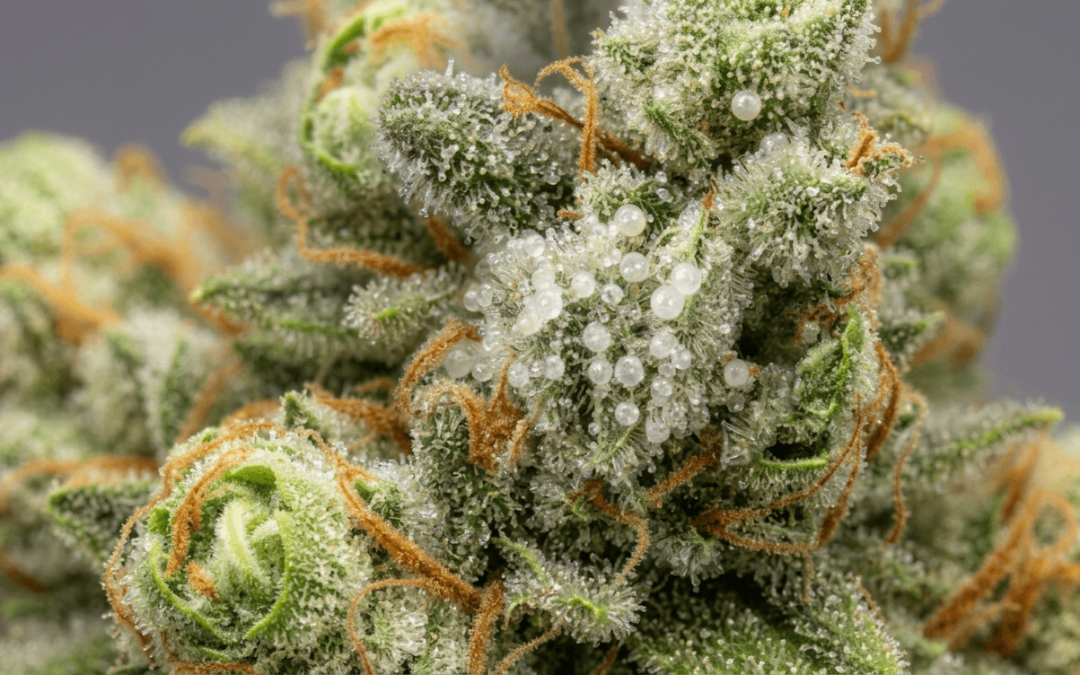
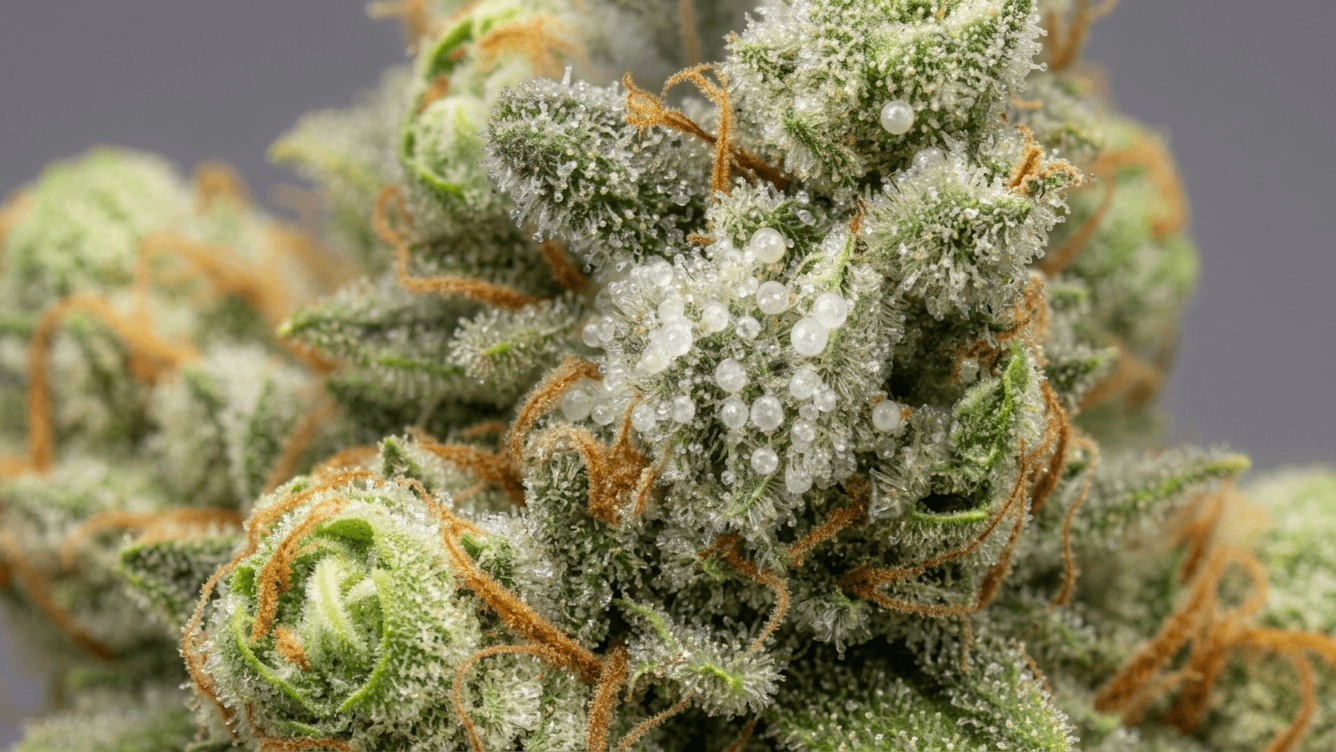
The flavour you’re working toward with a proper cure: fruity and skunky on the front end, developing into more complex resinous notes as the weeks progress. Some phenotypes will express berry or grape undertones in the final two weeks if they’ve seen slightly cooler temperatures — an anthocyanin response worth encouraging if your climate allows it. The exhale carries a distinctive fuel quality that signals the resin density you’re working with.
Fat Bastard — Official Blimburn Specs
| Breeder | Blimburn Seeds |
| Lineage | Goldmember x Monkey Spunk |
| Phenotype | 50% indica / 50% sativa |
| THC | 30–38% |
| Terpenes | Caryophyllene, Myrcene, Humulene |
| Flavours | Fruity, Skunk, Fuel |
| Effects | Euphoric, Powerful, Relaxed |
| Flowering time | 8–10 weeks |
| Indoor yield | 400–600 g/m² |
| Outdoor yield | 700–900 g/plant |
| Height | ~1.5m |
| Preferred climate | Dry |
| Seed type | Feminised photoperiod |
| Beginner friendly | Yes (the plant) — approach the product with experience |
Why Feminised Seeds Make Sense for Australian Home Growers
Fat Bastard is available as feminised photoperiod cannabis seeds, and for most home growers in Australia that’s the format that makes the most sense.
Feminised seeds are bred to produce exclusively female plants. The process involves stressing select females to produce pollen containing only female (XX) chromosomes, which then fertilises other females — the resulting seeds carry no male genetic material. Reputable breeders like Blimburn achieve feminisation rates above 99.5%. The rare hermaphrodite that does appear is almost always stress-induced (heat, light leaks, physical damage) rather than a genetic flaw in the seed.
The practical upside is straightforward: if you’re working within a limited plant count, every seed you germinate should produce a flowering plant. With regular seeds you’d need to germinate roughly twice as many, sex them at 4–6 weeks, and cull the males — wasted time, wasted space, wasted nutrients. There’s also the accidental pollination risk: a single missed male can seed an entire crop, redirecting plant energy from resin to seed development and tanking your cannabinoid concentration. Not a problem you want to discover at harvest.
For a deeper look: how feminised cannabis seeds work and when they’re the right choice.
Ready to grow Fat Bastard?
Genuine Blimburn genetics. Feminised. Discreet shipping across Australia.

Germination and Seedling Stage
Fat Bastard germinates reliably — Blimburn’s stabilised genetics mean you’re not gambling on inconsistent seeds. The method I’d recommend for Australian conditions is the paper towel technique: place seeds between two damp (not saturated) paper towels, seal inside a ziplock bag or between two plates, and keep in a warm dark spot at 22–26°C. Taproots typically emerge within 24–72 hours. Once the taproot reaches 1–2cm, transfer to your growing medium with the root facing down, 1cm deep.
Alternatively, direct sow into a small seedling pot filled with a light germination mix — avoid heavy potting soils at this stage as they can compact around delicate new roots. Keep the medium moist but not wet, and don’t feed until the seedling has developed its second set of true leaves. Overfeeding at the seedling stage is one of the most common ways growers stress plants before they’ve even had a chance to establish.
Seedlings want warmth and gentle, indirect light. Indoors, fluorescent or low-intensity LED at 18/6 is ideal for the first two weeks. Outdoors, protect young seedlings from direct afternoon sun until they have at least three to four nodes — the intensity can bleach new growth and check early development. Keep humidity higher during the seedling stage (60–70% RH) and begin reducing it gradually once plants are established.
Germination tip: water temperature matters
For the paper towel method, use water at room temperature — not cold tap water. Cold water slows germination noticeably, particularly in winter or in air-conditioned environments. If you’re germinating in late August for an outdoor season, your indoor ambient temperature may be lower than you think. A heat mat set to 24°C underneath the plates makes a meaningful difference to germination speed and consistency.
Growing Fat Bastard Seeds in Australia: Climate and Timing
Blimburn classify Fat Bastard as a dry-climate strain, and that’s the most important piece of environmental information to carry into your planning. Dense buds and humidity are a bad combination — botrytis takes hold fast in tight colas when airflow is poor and moisture is consistent. This doesn’t mean Fat Bastard can’t be grown in subtropical conditions, but it does mean you need to plan around it rather than hope for the best.
For most of temperate and semi-arid Australia — inland New South Wales, Victoria, South Australia, much of Western Australia — the dry climate preference is an advantage. Coastal and subtropical growers (northern NSW, Queensland) can absolutely make this work, but site selection for airflow becomes more critical than sun exposure. A plant with 7 hours of sun in a breezy spot will reliably outperform one with 10 hours in a still, humid microclimate with this strain.
On timing: in temperate zones, germinate indoors in late August or early September and transplant once frost risk passes — typically late September to early October. This gives plants a solid vegetative window before shortening autumn days trigger flowering naturally, landing harvest in late March to mid-April. In subtropical zones, a February–March start targets an autumn harvest and sidesteps peak summer humidity — the better choice for this strain over a spring start.
Environmental targets to aim for across the grow cycle:
| Stage | Day temp | Night temp | Humidity (RH) |
|---|---|---|---|
| Seedling | 22–26°C | 18–22°C | 60–70% |
| Vegetative | 22–28°C | 18–22°C | 50–70% |
| Early flower | 20–26°C | 16–20°C | 40–50% |
| Late flower | 18–24°C | 14–18°C | 35–45% |
The humidity reduction during flowering is non-negotiable with Fat Bastard. Those dense colas trap moisture at their core, and sustained humidity above 55% during weeks 6–10 of flower creates ideal conditions for botrytis to establish before you can see it on the surface. If you’re growing outdoors and late-season rain is forecast, see the problems section below.
Vegetative Growth: What to Expect Week by Week
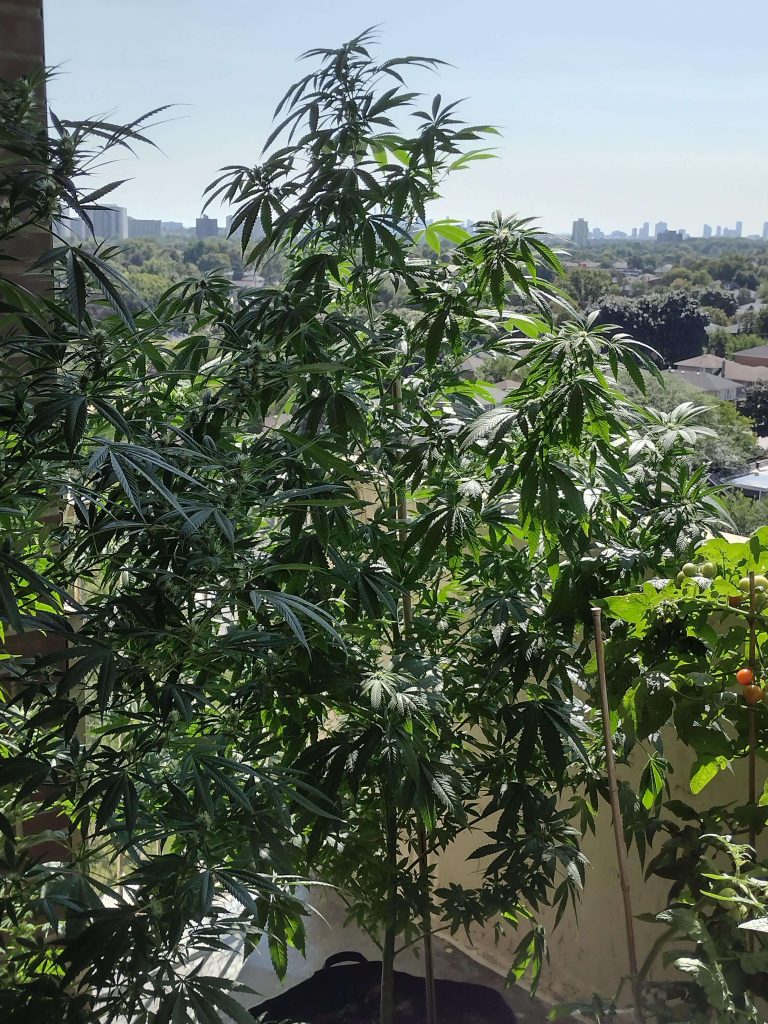
Fat Bastard enters vegetative growth with noticeable vigour. Once established, it moves quickly — expect 3–5cm of vertical growth per week under good conditions, with lateral branches developing simultaneously rather than sequentially. This is the 50/50 hybrid showing itself: more branching activity than a pure indica, more compact internodal spacing than a pure sativa.
Weeks 1–2 from transplant are establishment weeks. The plant is building its root system rather than putting on visible above-ground growth. Don’t be concerned if growth looks slow — if the leaves are a healthy dark green and no deficiency symptoms are present, it’s doing what it needs to do. Transplant stress is real but brief with Fat Bastard; fabric pots help here by air-pruning roots and encouraging lateral root development rather than circling.
Weeks 3–5 are when growth accelerates visibly. Lateral branches push outward, the canopy starts to fill, and this is your primary training window. Node spacing tightens as the plant matures, which is ideal for SCROG work — the short internodal gaps mean dense, productive bud sites rather than stretched, airy ones.
For outdoor grows, allow 8–10 weeks of vegetative growth from transplant before the shortening days trigger flowering. Plants that have had a full veg period develop the branching structure and root volume that translate to genuinely impressive outdoor yields. Cutting the veg period short to 5–6 weeks is the most common reason outdoor Fat Bastard underperforms relative to its potential.
Indoors, I’d recommend a minimum of 4 weeks veg on 18/6 before flipping, and 5–6 weeks if you’re running SCROG and want to fill the net properly before locking it down. Fat Bastard responds well to an extended veg period — the extra time directly translates to more main colas and a fuller final canopy.
Feeding Fat Bastard: Working With the Soil
My preference with high-THC outdoor strains is to work with the soil biology rather than around it. A well-amended organic grow will produce a more complex terpene expression than a synthetically fed equivalent, and with a terpene profile as interesting as Fat Bastard’s, that’s worth caring about. The difference shows up most clearly in the cure.
Fat Bastard is a moderate-to-heavy feeder across all growth stages. Here’s how I’d structure the feed programme:
Seedling (weeks 1–2): No additional feeding if using a quality seedling mix. The cotyledons provide sufficient nutrition for early growth. Introduce nutrients at quarter-strength once the second set of true leaves has developed fully.
Vegetative (weeks 3–8 outdoors / weeks 3–6 indoors): Prioritise nitrogen with an NPK around 3-1-2. For organic grows, top-dress with quality compost and worm castings every 2–3 weeks. Compost teas brewed with worm castings, kelp, and mycorrhizal fungi inoculant support microbial activity in the root zone and improve nutrient uptake noticeably — not hype, there’s solid evidence behind it. Increase feeding frequency as the plant grows and root volume expands.
Transition (weeks 1–2 of flower): Begin reducing nitrogen and shifting toward phosphorus and potassium. An NPK of around 1-2-2 bridges veg nutrition with bloom requirements while the plant stretches. Don’t cut nitrogen entirely at this stage — the plant is still putting on significant vegetative mass during the first two weeks of flowering.
Flowering (weeks 3–8): Full bloom nutrition, NPK around 1-3-2. For organic grows, transition to a phosphorus-rich amendment like seabird or bat guano. Potassium supports both resin production and disease resistance — worth emphasising with a strain as susceptible to botrytis as Fat Bastard. Reduce feeding frequency in the final two weeks as the plant begins natural senescence.
Pre-harvest flush (final 7–10 days): Water only with pH-adjusted water to clear residual nutrient salts. This is not optional with Fat Bastard — the dense bud structure traps residual nutrients that will directly affect the smoothness and flavour of the final product. A properly flushed Fat Bastard will have measurably cleaner smoke than an unflushed one.
Always pH-adjust to 6.0–6.5 for soil, 5.5–6.0 for coco or hydro. Even the best nutrient programme delivers nothing useful if the pH is off and uptake is blocked.
Grower’s note: Cal-Mg vs iron deficiency
If you’re collecting rainwater or running reverse osmosis, supplement calcium and magnesium from the start. Cal-Mg deficiency is the most common issue I see in otherwise well-managed organic grows, and it’s frequently misidentified as iron deficiency because the visual symptoms look similar.
The key distinction: calcium and magnesium are immobile nutrients — the plant can’t relocate them from old tissue to new growth. Deficiency always appears on newer leaves first. Iron deficiency also hits new growth, but the yellowing is more uniform across the leaf blade rather than interveinal. Get the diagnosis right and you solve it in days rather than weeks.
Training Fat Bastard for Maximum Yield
Fat Bastard’s 50/50 structure — bushy enough to fill space, open enough to work with — makes it one of the more rewarding strains to train. Left alone it’ll still produce well. Put some consistent time into shaping it during veg and the difference at harvest is material. I’ve seen untrained Fat Bastard plants yield 400g outdoors and trained ones from the same batch yield over 700g. The genetics are the same; the result isn’t.
Low Stress Training (LST)
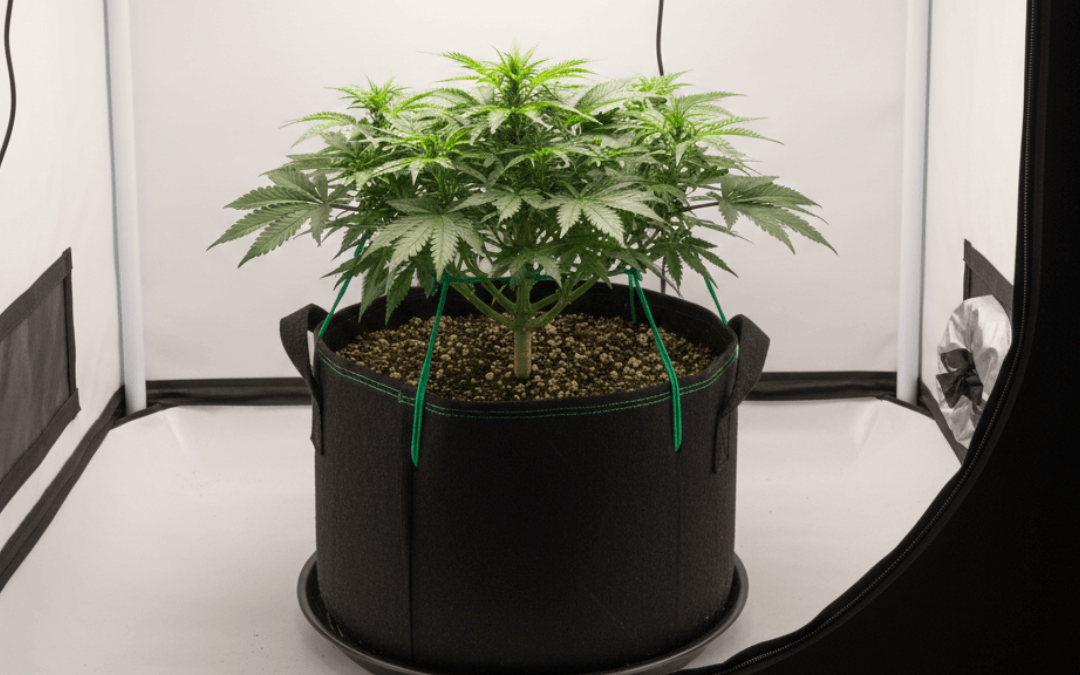
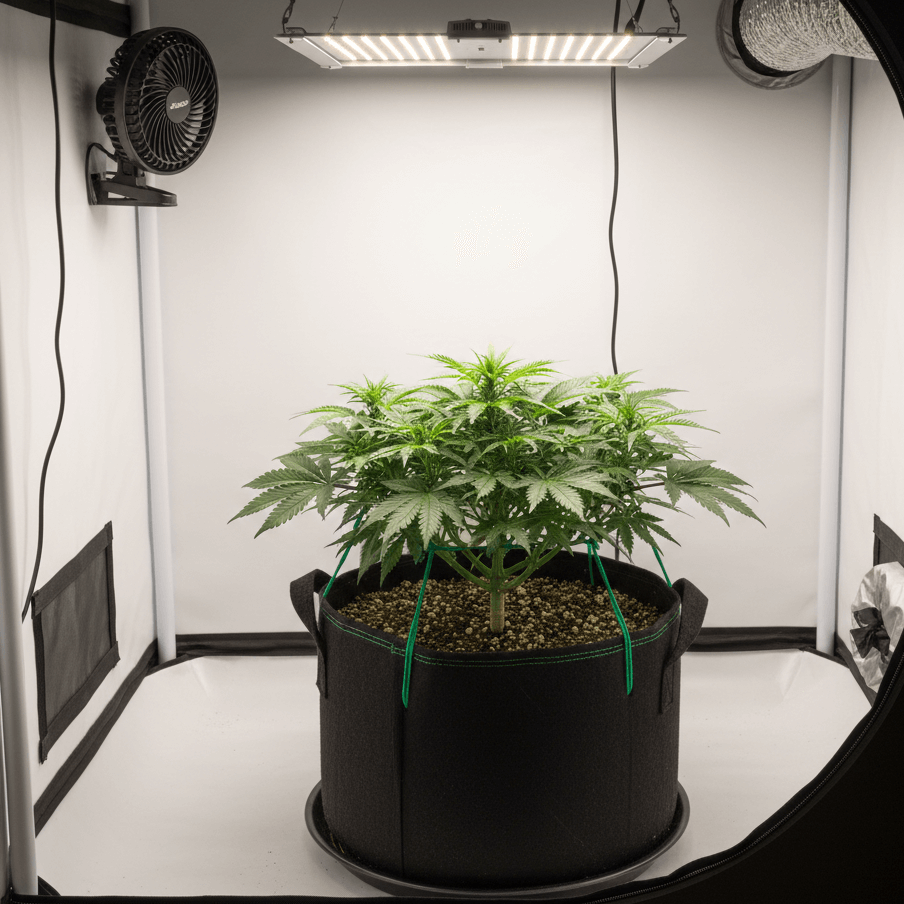
The entry point for most growers and highly effective with this strain. Begin when plants reach 20–30cm — bend the main stem to roughly horizontal and secure it with soft plant ties to the container edge or a stake. As lateral branches develop, continue bending and tying outward to maintain an even radial canopy. What you’re creating is a structure where every bud site gets equivalent light and the plant’s energy isn’t funnelled into one dominant apex at the expense of everything else. Visit the plant every 2–3 days during active veg and redirect new growth as it emerges.
SCROG (Screen of Green)
Takes LST further by weaving branches through a horizontal net positioned 30–40cm above the medium. As growth pushes through the screen openings, tuck it back and redirect to fill empty squares. Fat Bastard’s natural branching tendency makes it particularly well-suited to SCROG — it fills screens efficiently and the short internodal spacing means dense, productive bud sites at each node rather than gaps. Indoors, this is consistently the highest-yielding configuration per watt for this strain. The trade-off is access and mobility, so plan your watering and inspection logistics before you set the screen — once it’s filled you can’t easily move individual plants.
Topping
Removing the newest growth tip (the apical meristem) at the 5th or 6th node eliminates apical dominance and causes the two branches below the cut to become co-dominant main colas. Top once for 2 mains, top again once those have developed for 4 mains, top again for 8. Most growers get the best results from one or two toppings giving 4–8 main colas — beyond that the recovery time and veg extension starts to erode the yield advantage. Combined with LST, this is the setup I’d recommend for most growers: straightforward to execute, reliably better than an untrained plant, and works both indoors and out.
Lollipopping and defoliation
In the first week of flowering, remove all growth from the bottom third of the plant. These lower bud sites are too shaded to develop into meaningful flowers and they’re drawing resources away from the productive upper canopy. This single step — lollipopping — concentrates plant energy where it counts and significantly improves airflow through the lower structure, which matters enormously with Fat Bastard’s eventual bud density.
Light defoliation during veg (removing large fan leaves that are blocking bud sites or creating humidity pockets) is also worthwhile, but do it incrementally — remove no more than 20–25% of foliage at any one time and spread it over several days to avoid stressing the plant during critical growth phases. Stop all training and significant defoliation by week 3 of flower and let the plant focus its energy on bud development.
Training timeline summary
Week 2–3 of veg: Begin LST — first bend on main stem
Week 3–4 of veg: First topping at node 5 or 6
Week 4–6 of veg: Continue LST on all lateral branches; second topping if running SCROG
Week 6–8 of veg (SCROG): Fill screen — tuck and redirect growth
Week 1 of flower: Lollipop — remove all lower third growth
Week 3 of flower: Stop all training. Let the plant build.
Flowering Stage: Managing Fat Bastard’s Dense Structure
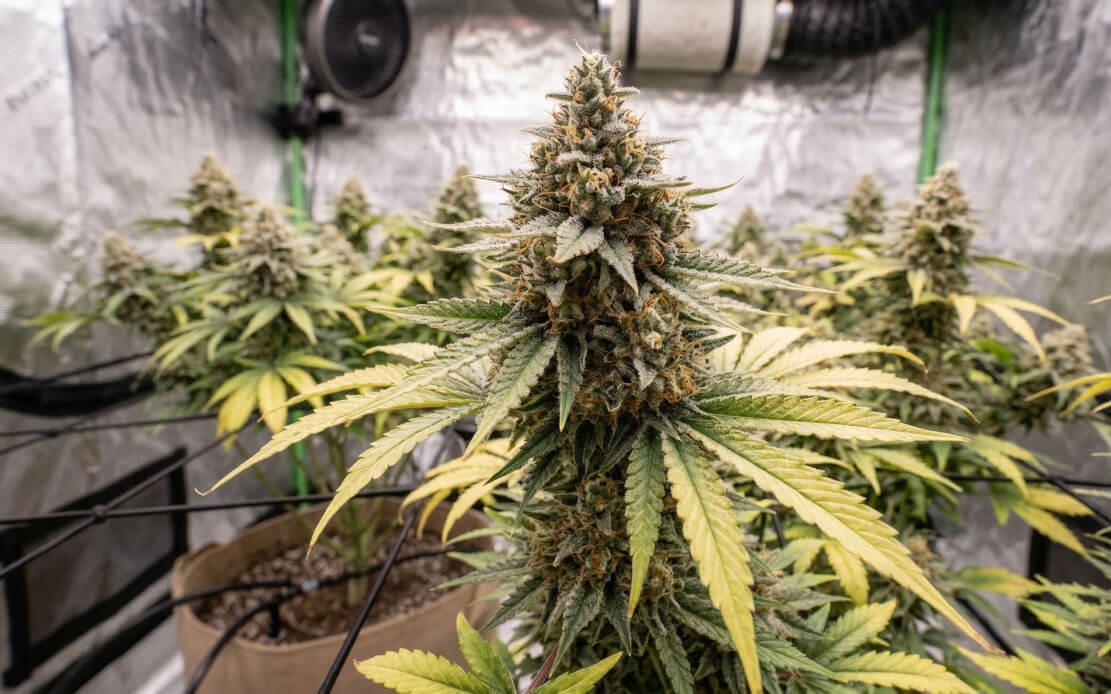
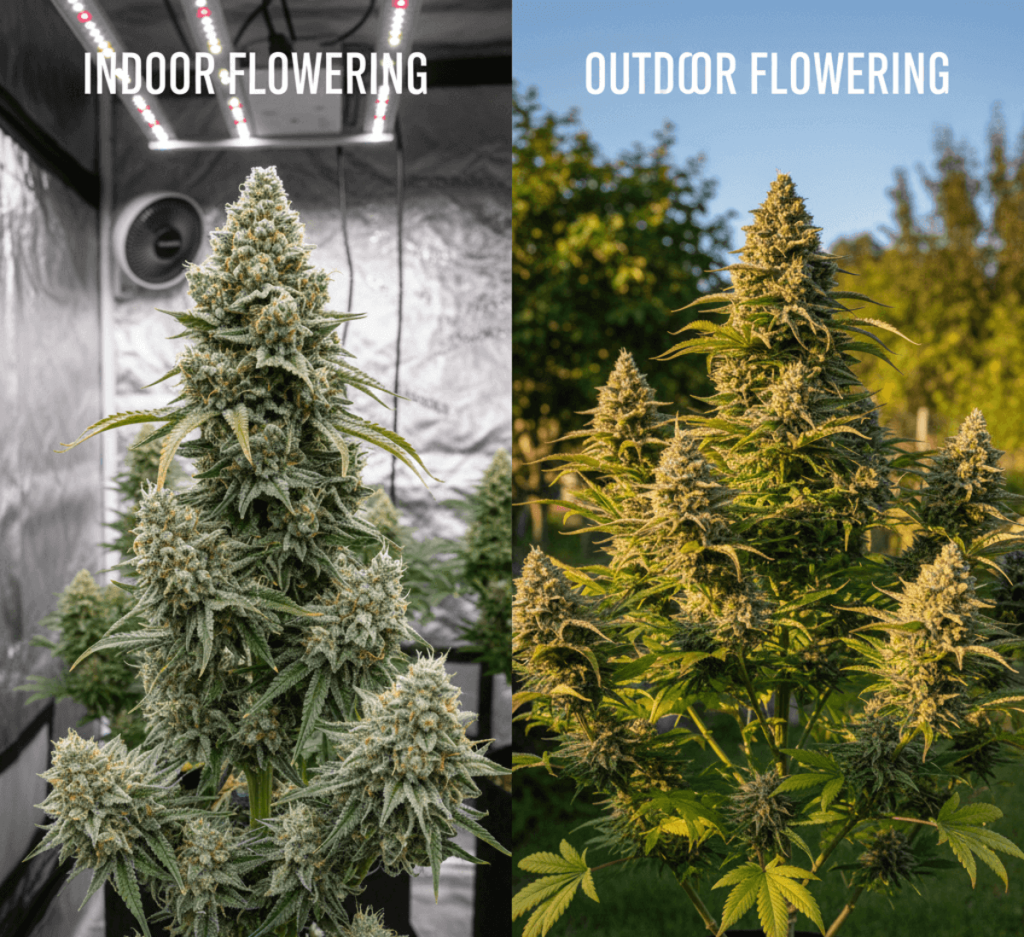
Fat Bastard’s flowering period runs 8–10 weeks from initiation. The first two weeks are stretch — expect 30–50% additional height as the plant redirects energy from lateral growth to vertical extension and initial bud site formation. This stretch is useful: it opens up the canopy, improves light penetration to lower sites, and the sativa genetics mean it stretches with better structure than a pure indica would. Manage it with your LST ties during this period, continuing to direct branches outward as they extend.
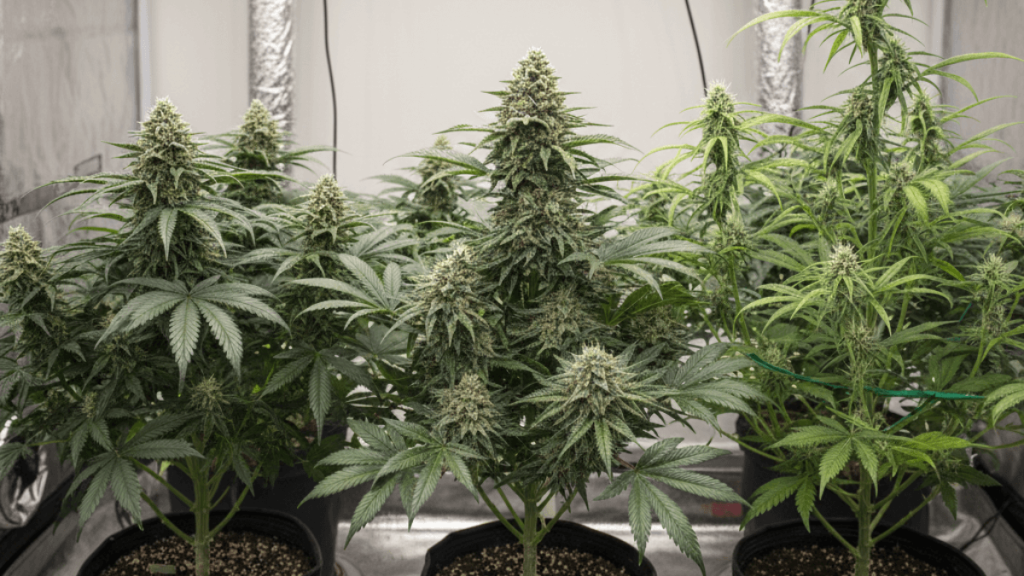
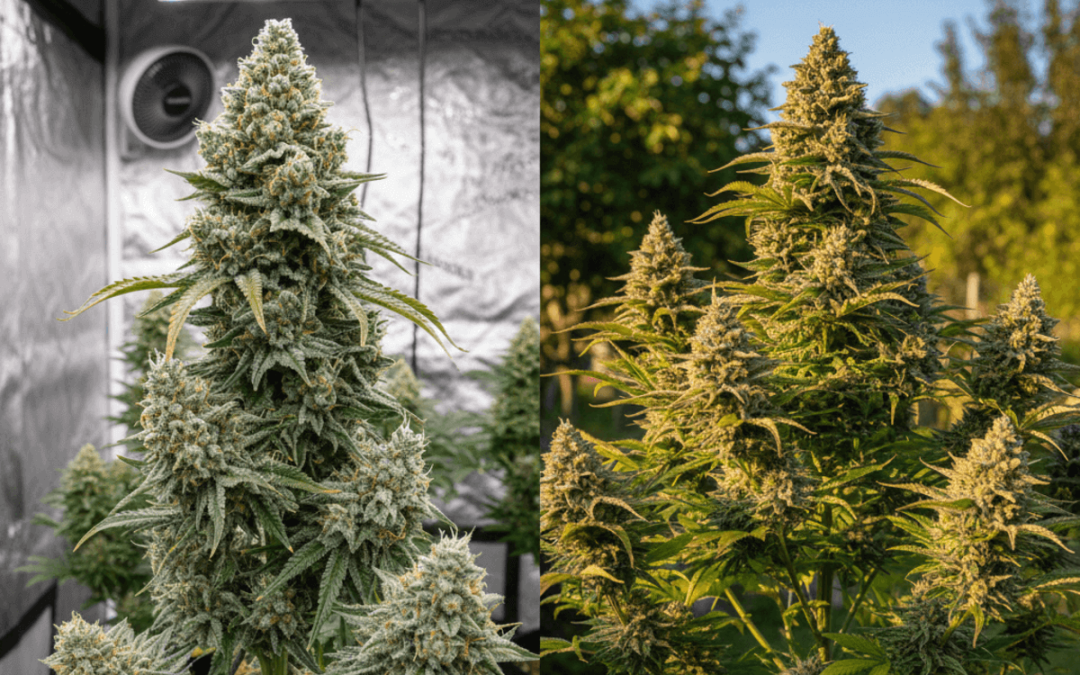
By weeks 3–4, bud sites are clearly forming and the stretch is largely complete. This is when you’ll start to appreciate the strain’s calyx-to-leaf ratio — Fat Bastard produces tight, resinous buds with relatively few excess leaves, which makes trimming at harvest considerably more manageable than its yield figures would suggest.
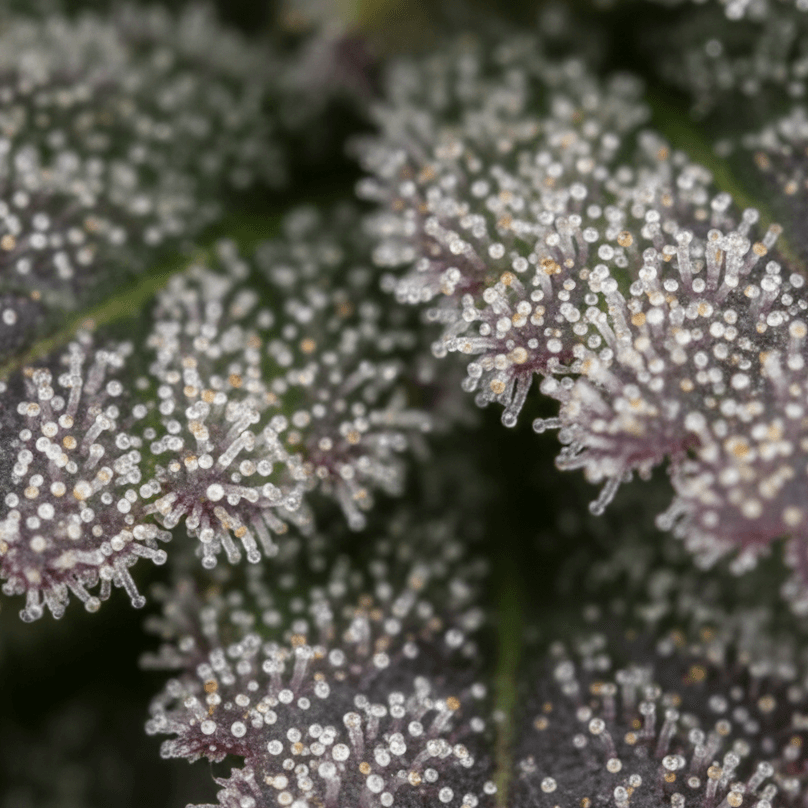
Weeks 5–7 are the bulk-building phase. Buds put on the majority of their mass during this period and resin production accelerates noticeably. Trichomes will be clearly visible to the naked eye by week 6. This is also when the density becomes a liability if your environment isn’t managed — airflow through and around the canopy needs to be consistent, and humidity should be actively managed downward toward 40–45% RH. Oscillating fans inside the canopy are not optional with this strain.
Weeks 8–10 are the finishing phase. Buds complete their final swell, trichomes mature, and the plant begins natural senescence — fan leaves yellowing and dropping as nutrients are redirected into the flowers. Support heavy colas with stakes or trellis netting during this period. The weight of mature Fat Bastard colas will snap unsupported branches, particularly after rain or heavy dew outdoors.
In the final two weeks, a deliberate temperature differential between day and night (dropping night temps to 14–18°C) can trigger anthocyanin expression in some phenotypes, producing purple hues in the buds and leaves. This doesn’t affect potency but it does affect visual appeal and is worth inducing if your climate allows it.
Common Problems and How to Solve Them
Botrytis (bud rot) — the primary risk
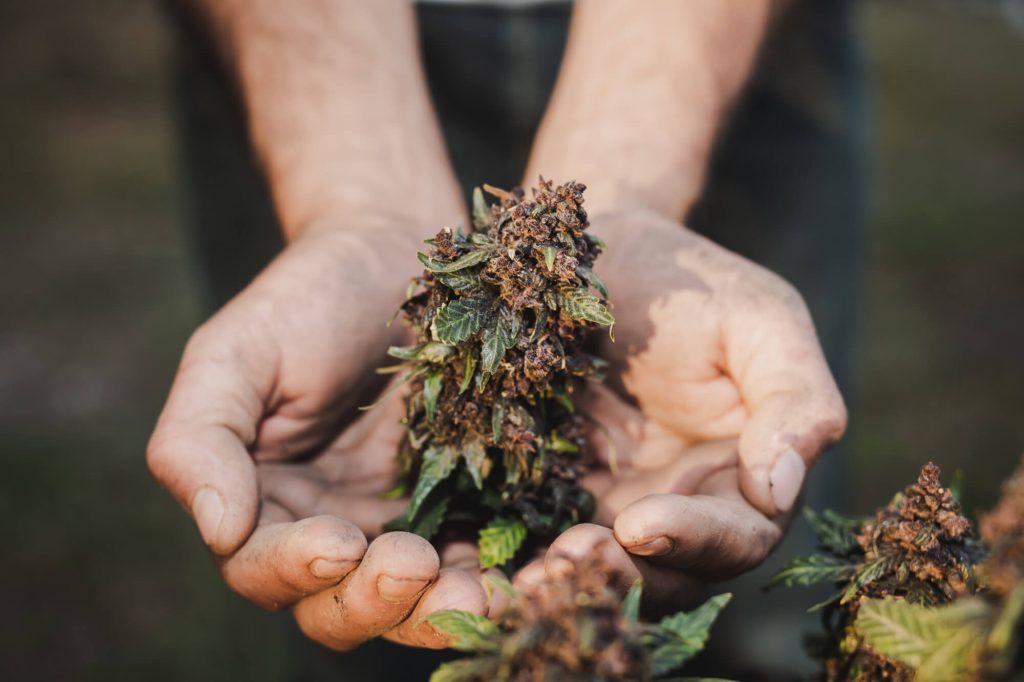
This is the threat most specific to Fat Bastard and it deserves serious attention. Botrytis cinerea is a fungal pathogen that thrives in the humid, warm conditions common to Australian autumn harvests. In dense-budded strains like Fat Bastard, it establishes at the bud’s core before becoming visible on the surface — by the time you can see the grey-brown rotting tissue, it has typically already spread several centimetres inward.
Prevention is everything with botrytis. Keep humidity below 50% during flowering, ensure excellent airflow around and through the canopy, avoid watering overhead during the flowering period, and inspect colas closely every 2–3 days from week 6 onward. If you find infected tissue, remove it immediately with clean scissors — cut at least 5cm below the visible infection — and bag and dispose of it away from the garden. Do not compost infected material. Treat the surrounding area with a potassium bicarbonate solution and dramatically improve environmental conditions.
For outdoor Australian growers, the autumn rain window (late February–April on the east coast) is the critical period. If sustained rain is forecast — three or more consecutive days — and your plant is past 65% cloudy trichomes with mostly brown pistils, seriously consider harvesting before it arrives. You’ll sacrifice some peak potency but that’s recoverable. Bud rot at harvest is not.
Nutrient deficiencies
The most common issues with Fat Bastard in Australian conditions are calcium/magnesium deficiency (interveinal chlorosis on new growth, as covered above), nitrogen deficiency in mid-veg (general yellowing starting on older lower leaves), and phosphorus deficiency in early flower (dark green or purplish leaves, slowed bud development). All three are most commonly caused by pH imbalance locking out available nutrients rather than actual nutrient absence — check and correct pH before adding more feed.
Spider mites
More prevalent indoors but a risk in outdoor grows, particularly during hot, dry periods. Fat Bastard’s dense foliage can harbour mite colonies that are difficult to detect early. Inspect leaf undersides with a loupe every 1–2 weeks. Early intervention with neem oil or insecticidal soap is effective; later-stage infestations during flowering require more targeted miticide treatment. Maintain adequate airflow and avoid excessive heat to discourage establishment.
Heat stress
Sustained temperatures above 30°C cause leaf tacoing (edges curling upward), slowed growth, and reduced resin production. Outdoors in Australian summers, shade cloth during peak afternoon heat and adequate irrigation are the primary tools. One specific issue worth knowing: temperatures above 35°C can cause premature trichome ambering on exposed top colas. This is heat stress, not ripeness — if top colas are showing heavy amber while mid-plant buds still look cloudy and white, read the middle of the plant for your actual harvest indicator.
When to Harvest Fat Bastard: Reading Trichomes, Not the Calendar
The 8–10 week flower window is a guide, not a signal. Your actual harvest indicator is trichome development. Get a jeweller’s loupe or basic digital microscope (30–60x, around $20 online) and use it — the difference between harvesting at the right moment versus a week early or late is significant in both potency and effect profile.
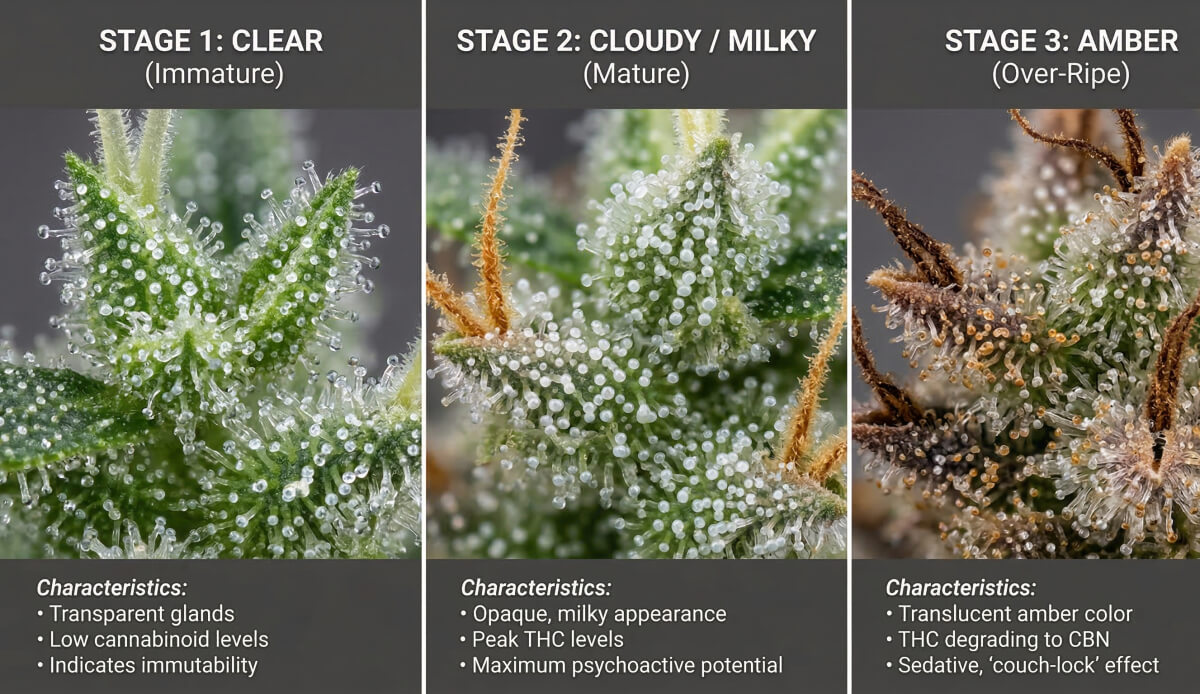
Trichomes progress from clear (immature — cannabinoids still developing) to cloudy/milky (peak THC — your target) to amber (THC converting to CBN, increasingly sedative). The “wait for 30% amber” advice that circulates in cannabis communities is wrong for a strain at this potency level. By the time you hit 30% amber across the plant, you’ve deliberately allowed a significant portion of your THC to degrade. For Fat Bastard’s characteristic profile — euphoric onset moving into powerful physical relaxation — harvest when 70–80% of trichomes are cloudy with 10–20% just beginning to turn amber.
Two important technique notes: check trichomes on the bud calyxes themselves, not the sugar leaves — sugar leaves mature 5–7 days earlier and will give you a misleading early reading. And check multiple bud sites at different heights, since top colas always mature faster than lower growth, sometimes by a full week.
If you prefer heavier, more sedative effects — for sleep or pain management — pushing to 20–30% amber is a legitimate choice. Just understand you’re trading THC potency for CBN sedation. There’s no free lunch in cannabis chemistry.
Two harvest techniques worth building into your routine
48-hour darkness: Run plants in complete darkness for the final 48 hours before cutting. There’s reasonable evidence this triggers a final resin push as the plant responds to what it reads as an extended night period. Easy to implement indoors; outdoors, cover plants with lightproof material.
Harvest in the morning: Terpene concentrations are highest early in the day before temperatures rise and volatile compounds begin evaporating. Handle branches minimally — trichome heads are fragile and shear off easily — and get plants into your drying environment within a few hours of cutting.
Drying and Curing Fat Bastard: Don’t Rush This Part
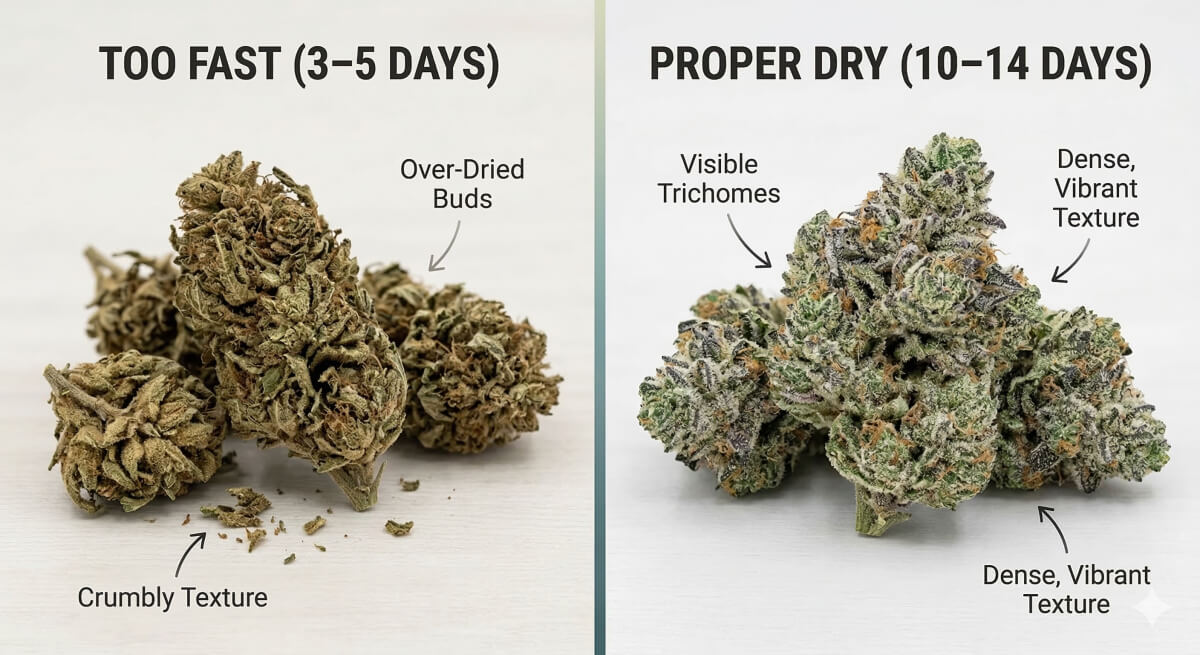
Most growers who tell me their Fat Bastard was good but not exceptional rushed the cure. The genetics deliver a complex terpene profile — but that complexity develops during the cure, not during the grow. Pull it from jars at two weeks and you’re not experiencing what this strain is actually capable of.
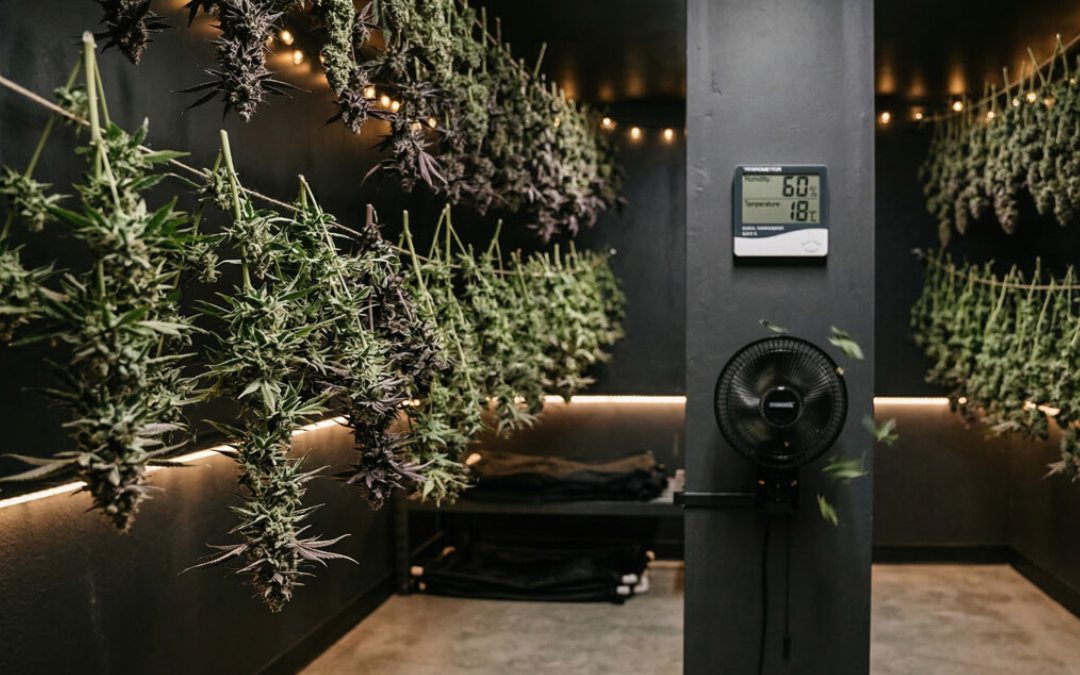
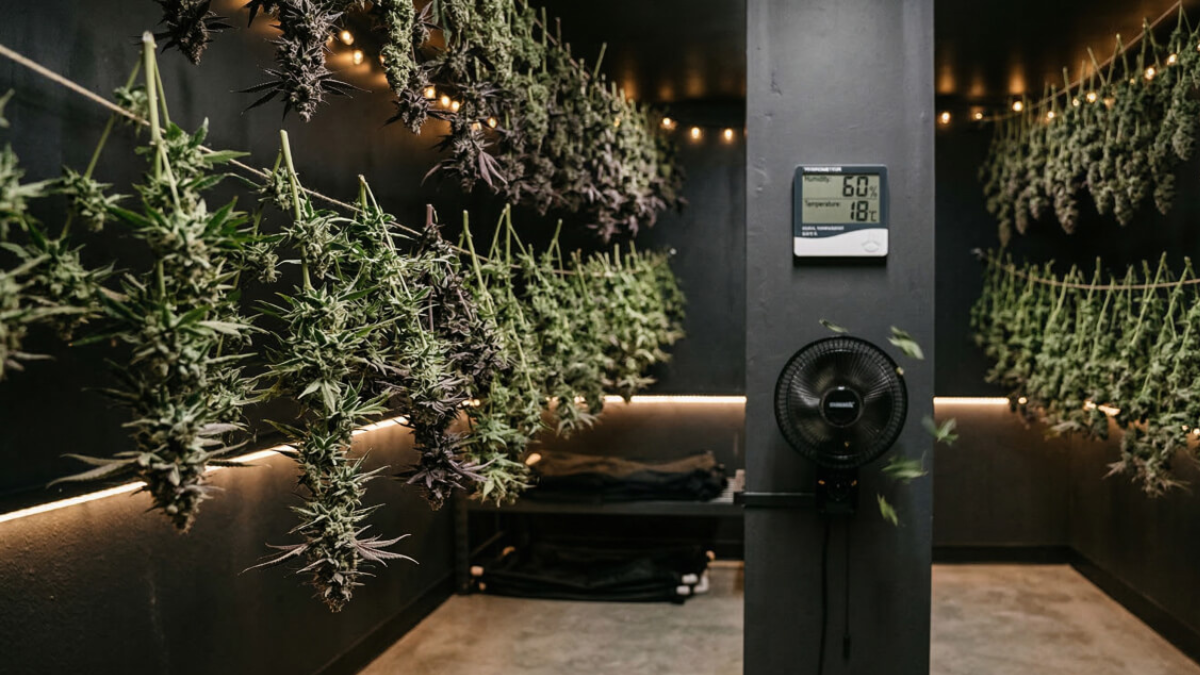
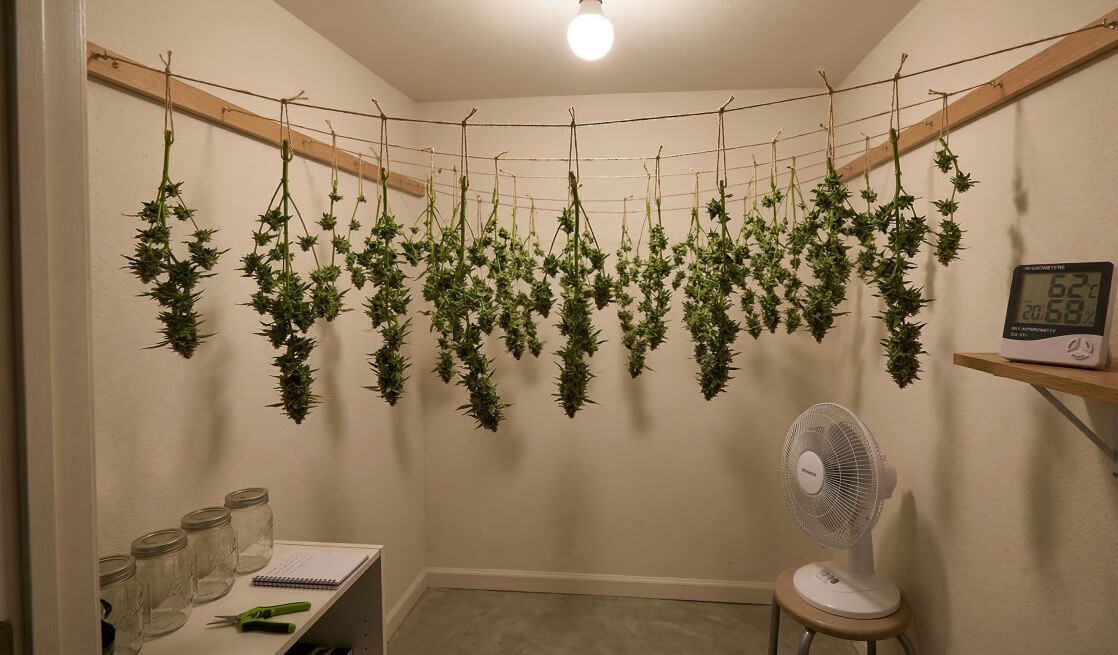
Dry in a dark, well-ventilated space at 15–21°C with 45–55% relative humidity. Hang whole branches rather than individual buds — the slower dry from retaining stem moisture produces better terpene retention and allows chlorophyll to break down more evenly, which directly affects smoothness. Fat Bastard’s density creates a specific risk during drying: the exterior of a cola can feel dry while significant moisture remains at the core. Test dryness by squeezing buds gently — no moisture should release — and by bending small stems, which should crack rather than snap cleanly. At 10–14 days in appropriate conditions you should be ready for jars.
Once in airtight glass jars, burp daily for the first two weeks — open each jar for 10–15 minutes to release excess moisture and exchange air. Watch for any ammonia smell in the first few days: this signals too-moist bud going into jars. If you detect it, spread buds on a rack for 24 hours before returning to jars. By week three, properly curing Fat Bastard will have shifted noticeably in aroma — the raw chlorophyll note fades, the fruity-skunk character sharpens, and the overall profile becomes rounder and more complex. After two weeks, reduce burping to 3–4 times weekly. Minimum four weeks for a proper cure. Six to eight weeks produces a meaningfully superior result if you can manage the patience.
For long-term storage, Boveda 62% humidity packs inside sealed jars maintain optimal RH without daily monitoring. Store away from light and heat — a dark cupboard at room temperature is ideal. Well-cured Fat Bastard stored properly will hold its quality for 12 months or more.
Is Fat Bastard the Right Strain for Your Garden?
If you’re looking for a potent, high-yielding strain that performs in real Australian conditions — outdoors, in natural soil, with variable weather — Fat Bastard feminised seeds belong on your shortlist. The 50/50 genetics make it more versatile and accessible as a plant than many strains in this THC range. The dry-climate preference suits a wide range of Australian growing environments. The yield potential is exceptional when the conditions are right.
Where it’s not the right fit: if you’re in a consistently high-humidity environment without the ability to manage airflow carefully, the botrytis risk with those dense buds is real and worth thinking through before you commit. In that case, look at something with a lighter bud structure or a faster flowering time that gets you out before the worst of the humid season. We have strains on both ends of that spectrum — browse our full range of cannabis seeds for Australian growers and filter by flowering time if that’s your primary constraint.
The Blimburn name behind it matters to us. These are people we’ve met, whose approach to breeding we respect, and whose genetics we’re confident stocking. When we put our name behind a strain, that’s not a throwaway endorsement.
If you want to explore other feminised photoperiod cannabis seeds before deciding, start there. And if you’re not sure which strain suits your specific setup, reach out — we’re growers, not a call centre.
Get Fat Bastard Seeds — Delivered Discreetly Across Australia
Blimburn genetics. Feminised. Genuine stock, honest advice.
Key Takeaways
- Fat Bastard is a Blimburn Seeds original — Goldmember x Monkey Spunk, a true 50/50 hybrid with verified THC levels of 30–38%.
- Beginner-friendly as a plant. The smoke is not — approach 30–38% THC with real caution.
- Dry-climate preference suits temperate and semi-arid Australia well. Airflow management is non-negotiable in humid coastal areas.
- Outdoor yields of 700–900g per plant are achievable with adequate root space, a full veg period, and good training.
- Botrytis in dense buds is the primary risk — keep humidity below 50% during flowering and inspect colas regularly.
- Harvest at 70–80% cloudy trichomes, not 30% amber — that’s degraded THC, not peak ripeness.
- Cure for minimum 4 weeks, ideally 6–8. This is where the terpene complexity the strain is capable of actually develops.
Frequently Asked Questions: Fat Bastard Seeds
What are Fat Bastard’s parent strains?
Fat Bastard is a Blimburn Seeds original bred from Goldmember and Monkey Spunk. Goldmember is a cross of OG Kush and Gold Leaf — responsible for Fat Bastard’s pungent aroma and deep body effect. Monkey Spunk is a cross of Gorilla Glue #4 and Lilac Diesel, contributing cerebral potency and complex skunky-berry notes. Together they produce a true 50/50 hybrid with THC of 30–38%.
Is Fat Bastard suitable for beginner growers?
As a plant, yes — Blimburn classify it as beginner-friendly and grower reports back that up. It germinates reliably, grows vigorously, and is forgiving of minor cultivation errors. Where caution is needed is with the end product: 30–38% THC can be genuinely overwhelming for inexperienced consumers. The grow is accessible. The smoke demands respect.
How long does Fat Bastard take to flower?
Blimburn’s spec is 8–10 weeks from flower initiation. For Australian outdoor growers that typically means a late March to mid-April harvest depending on latitude and when you germinated. Use the calendar as a starting point only — trichome development is always the reliable harvest indicator.
What yields can I realistically expect from Fat Bastard?
Blimburn’s figures are 400–600g/m² indoors and 700–900g per plant outdoors. Hitting the top of those ranges requires dialled conditions, quality lighting indoors, solid training, and a full vegetative period outdoors. A well-managed plant in a 100–200 litre container with properly amended soil can genuinely reach the upper end outdoors in a good Australian temperate season.
Is Fat Bastard indica or sativa?
A true 50/50 hybrid. Effects move from an initial sativa-leaning cerebral euphoria into a progressively deeper indica body stone. It doesn’t sit cleanly at either end of the spectrum, which is part of what makes it versatile.
What climate does Fat Bastard prefer?
Blimburn classify it as a dry-climate strain. Australian temperate and semi-arid zones suit it well. Coastal and subtropical growers can succeed with it but need to prioritise airflow and humidity management to protect dense buds from botrytis, particularly during late flowering.
What does Fat Bastard taste and smell like?
Fruity and skunky — exotic fruit notes over a sweet, pungent skunk base, with a distinctive fuel quality on the exhale. The terpene profile (caryophyllene, myrcene, humulene) adds peppery, earthy, hoppy character that develops significantly during the cure. Some phenotypes express berry or grape undertones with cooler late-flower temperatures.
Can Fat Bastard be grown outdoors in Australia?
Yes, and outdoor is where it shines — 700–900g per plant is possible in good Australian temperate conditions. Germinate indoors in late August, transplant after frost risk passes in late September or October, and target a late March to mid-April harvest in temperate regions. Subtropical growers should start in February to avoid peak humidity during the critical late flowering period.
How do I prevent bud rot on Fat Bastard?
Keep humidity below 50% during flowering — ideally 40–45% in late flower. Ensure strong airflow through and around the canopy, not just above it. Avoid overhead watering during the flowering period. Inspect colas every 2–3 days from week 6 onward — botrytis establishes at the bud’s core before becoming visible on the surface. If sustained rain is forecast outdoors and the plant is past 65% cloudy trichomes, seriously consider harvesting early. Bud rot is unrecoverable; a slightly early harvest is not.
Where can I buy Fat Bastard seeds in Australia?
We stock Fat Bastard feminised seeds with discreet shipping across Australia. If you have questions about the strain or whether it suits your setup, get in touch — we’re growers, not a call centre.