Growing cannabis in small spaces is not about squeezing a normal grow into a smaller box. It is a different problem with a different answer, and almost everyone gets the first decision wrong.
The myth is that you need room. You do not. People pull respectable harvests out of a wardrobe, a cupboard, a 60cm tent, even a modified computer tower. What you need is to understand what is actually limiting you, and it is not the floor space. Here is how small-space growing really works, what the standard advice gets wrong, and what changes when you are doing it through an Australian summer.
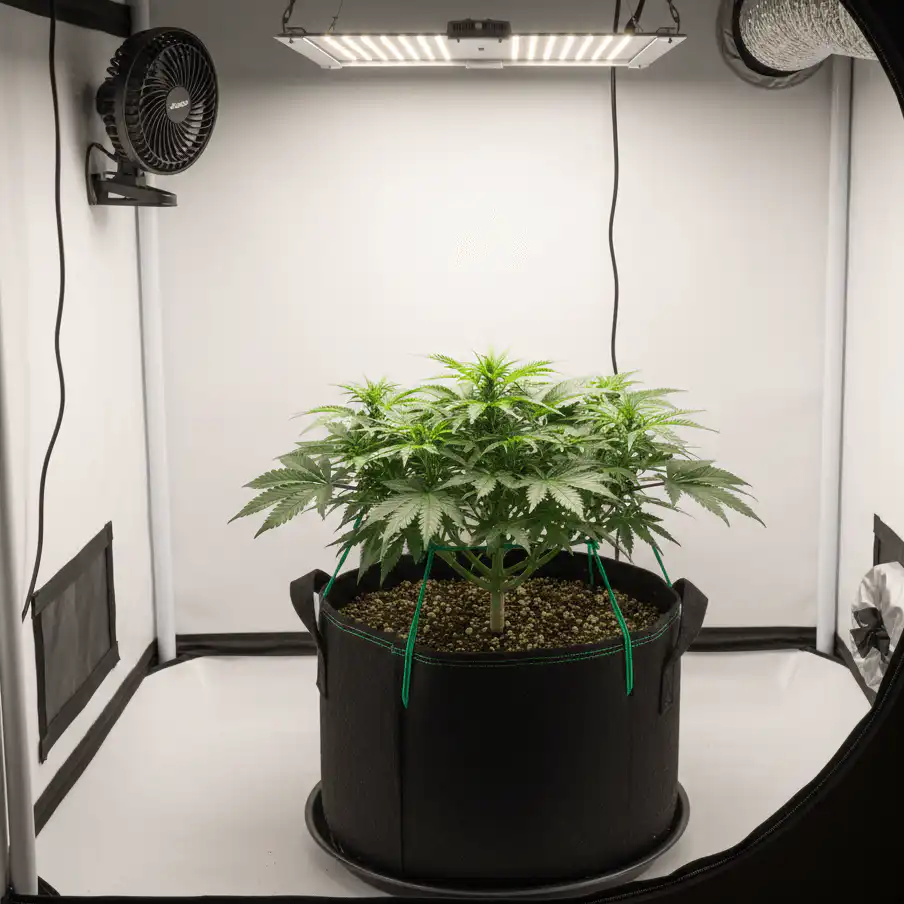
Growing Cannabis in Small Spaces: Height Is the Real Constraint
This is the thing nobody tells you, and it is the reason most first small grows go wrong. You look at a 60 by 60 by 120cm tent and think about the footprint. The footprint is almost never the problem. The ceiling is.
Do the arithmetic honestly. Take that 120cm of height. Your pot and saucer eat roughly 25cm off the bottom. Your light, its hanging gear and ratchets take 20 to 30cm off the top. Then you need to leave sensible clearance between the light and the canopy, call it another 30cm for a decent LED. Add it up and you are left with something like 35 to 45cm of actual plant.
Forty centimetres. That is your real grow space, and it is a fraction of what the tent’s dimensions suggested. Now factor in that a photoperiod plant roughly doubles in height after you flip it to 12/12, and sometimes more, and you can see how a plant that looked perfectly manageable at week four ends up pressed against the light with the top colas cooking.
So the whole discipline of growing cannabis in small spaces is vertical budgeting. Every decision below, the strain, the pot, the training, the light distance, is really a decision about height. Work out your actual usable height first, before you buy a seed, and everything else follows from that number.
Strain Choice: Where the Standard Advice Is Half Right
Every guide you read says the same thing: small space, grow autoflowers. That advice is half right, and the half it gets wrong matters.
What is true is that autos are simple and predictable. They flower on age rather than light, so there is no timer to change, no flip to get wrong, no light leak quietly ruining your bloom, and they finish the whole job in eight to twelve weeks. Most stay under a metre. If you want the least complicated path from seed to jar, that is a real advantage, and it is why the advice exists.
Here is the half nobody says out loud. An auto’s final size is decided by its genetics and its clock, not by you. That cuts both ways. Yes, it will probably stay small. But if that seedling has a rough fortnight, gets overwatered, gets shocked by a transplant, or sits under a light hung too close, it does not wait for you to fix it. It flowers on schedule at whatever size it happens to have reached, and you harvest a disappointment. There is no pause button and no recovery window.
A photoperiod is the opposite. Its size is decided by you, because you choose when to flip. Ask experienced growers in tight cupboards and you will hear the same thing repeatedly: if you are short on height, train it low and flip it early, because a photoperiod is easier to control than an auto. Want a 40cm plant? Flip at 20cm and let the stretch take it where it is going. If a young plant gets sick or stressed, you simply keep it in veg longer and let it recover before you flip. That recovery window is the whole difference between a ruined run and a good one.
So the honest answer is that it depends what kind of mistake you are more likely to make. If you want maximum simplicity and you will commit to babying the seedling through its first fortnight, an autoflower is a fine choice and it will get you there fast. If you want the most control over final height and room to make errors and recover from them, a compact feminised photoperiod flipped early is genuinely the better tool for a tight space, whatever the internet tells you.
Either way, genetics set the ceiling on what training can fix. Look for indica-dominant plants, which are naturally shorter and bushier, and Afghani or Kush lineage in particular runs short and dense. Northern Lights is the textbook example: compact, genuinely forgiving of mistakes, and quick to finish. What you should not do is take a stretchy sativa into a cupboard and expect to win. A pure haze can double or triple after the flip and will run out of room no matter how well you train it. That is not a training problem, it is a genetics problem, and when you are growing cannabis in small spaces you cannot train your way out of the wrong seed.
Pot Size, and the Australian Catch
Pot size is a height tool. Root volume caps plant size, so restricting the root zone deliberately keeps the plant in your budget. Five to ten litres is the usual sweet spot for a small space: enough to grow a healthy plant, small enough to stop it getting away from you. Fabric pots are the standard recommendation because they air-prune the roots, which builds a denser root mass, and they are much harder to overwater than a plastic pot.
Now the part the overseas guides do not mention, because they are not writing for our climate. A 5 litre fabric pot in an Australian summer dries out fast. Fabric breathes, which is exactly why it resists overwatering, and that same property will have a small pot bone dry in a matter of hours when it is 35 degrees. On a hot week you can be watering twice a day, and if you go away for a weekend without a plan you will come home to a dead plant. That is the trade. The small pot that protects you from overwatering exposes you to drying out, and in this country drying out is the more likely way to lose a plant.
The practical answer is to size up slightly if you are somewhere genuinely hot, take the ten litres rather than the five, and lean on training rather than root restriction to control the height. You get the same size control with a lot more margin for error on a scorching day.
Training: The Whole Game
When you are growing cannabis in small spaces, training is not a refinement. It is the technique that makes the whole thing work, and low-stress training is the one to learn.
The idea is simple. A cannabis plant naturally wants to grow one dominant central stem, which is exactly the wrong shape for a space with a low ceiling, because all your height budget goes into one cola while the lower branches sit in the shade producing nothing. LST breaks that habit. You gently bend the main stem sideways and tie it down so it runs parallel to the soil, and as the side branches turn upward toward the light, you keep tying them down and out. What you end up with is a flat, wide canopy of many equal colas instead of one tall one. You have converted vertical growth, which you cannot afford, into horizontal growth, which is free.
Start once the plant has four or five sets of leaves, use soft ties, and keep at it through the stretch rather than doing it once and walking away. Bend, do not snap: if you hear a crack you have gone too far, though a plant will usually recover from a small split if you tape it.
Topping, cutting out the growing tip so the plant sends up two leaders instead of one, works well on photoperiods and makes them bushier. Do it in veg, and give the plant a week or so to recover before you flip. Do not top an autoflower. There is no recovery time in a fixed clock, and you are trading yield for a shape you could have got more safely with LST anyway.
If a plant does get away from you and you are running out of headroom mid-flower, supercropping is the emergency tool. You pinch and crush the inside of a stem between your fingers until it goes soft, then bend it over. It is genuinely stressful for the plant, so treat it as a last resort on a healthy one, not a routine technique.
Jason’s Tip: Measure Before You Buy
Before you spend a cent on seed, go and measure your actual usable height. Floor to ceiling, minus the pot, minus the light and its hangers, minus your clearance. Write the number down. That number, not the tent’s advertised size, is what you are growing in, and it should drive every decision that follows.
Then be honest about which mistake you are more likely to make. Are you going to forget a light timer, or are you going to fuss a seedling to death in week two? Autos protect you from the first. Photoperiods protect you from the second. That is really the whole choice, and everything else people argue about is noise.
Light and Heat: What Actually Kills Small Grows Here
A small sealed box with a light in it is a very efficient oven, and in an Australian summer that is the thing most likely to end your grow. Heat is the real enemy of small-space growing in this country, more than pests, more than nutrients, more than anything you will read about in a guide written for a European winter.
Modern full-spectrum LED is the only sensible choice, and not mainly for the electricity. LEDs run far cooler than the old HPS lamps, which means you can bring them closer to the canopy without cooking the tops, and in a space where you are counting centimetres that matters twice over. A quality 100 to 150 watt LED is plenty for a small tent. Light distance is also a height tool in its own right, because a light that is too far away makes the plant stretch toward it and spends your height budget for you.
Ventilation is not optional and it is not a nice-to-have. You want at least a small clip-on fan moving air around inside, which strengthens stems and keeps humidity from sitting still in the canopy, and an extraction fan pulling the hot air out and drawing fresh air in. Without that exchange, a small tent in a Queensland or western Sydney summer will sit ten degrees above room temperature and your plant will stop growing, or worse, that stagnant humid air in a dense canopy turns into bud rot in late flower. Air movement solves both problems at once.
If you are running the tent in a room you can air-condition, use it. If not, run your lights overnight and keep them off through the worst of the afternoon heat, which is the simplest heat fix available to an Australian grower and costs nothing.
Smell
A flowering plant in a small home is loud, and it gets louder every week through bloom. A carbon filter fitted to your extraction fan is the answer, and it needs to be the extraction fan, not a filter sitting decoratively in the corner, because the whole principle is that all air leaving the space passes through the carbon first. Get one rated for at least your fan’s airflow, and replace it when it stops working rather than when it looks dirty. Small tents also leak from the seams and the zip, so if the smell matters to you, negative pressure inside the tent, which you get by extracting slightly more than you bring in, is what keeps the air going out through the filter instead of out through the gaps.
What You Can Realistically Expect
Some honesty here, because the numbers people quote online are usually best-case. From one well-trained plant in a small tent, thirty to sixty grams is a realistic target with decent genetics and technique. You can beat that with experience and a good setup, and plenty of people do worse on their first run. That is normal.
For a first small-space grow, one plant trained properly beats several plants competing for light, water and root room. Managing one plant well teaches you more than managing four badly, and in a tight space four plants very quickly becomes a tangle you cannot get your hands into. Sea of green, growing many small single-cola plants with almost no veg time, is a legitimate small-space method and it is efficient, but it is a technique for someone who already knows what they are doing, not a first project.
Who Small-Space Growing Suits
A small grow suits anyone short on room, anyone who wants a discreet setup, and anyone who would rather learn properly on one plant than gamble on a big one. It rewards attention over equipment, and the constraints teach you more, faster, than a big tent will. It is not the path if you want volume, and it is not the path if you cannot give it a look most days, because small pots and small margins mean problems escalate quickly. If you have the height and the patience for a larger plant, take them.
Not sure which genetics suit your setup? Our strain finder takes six quick questions and matches you to three strains based on your space, your experience and the effect you are after. You can also browse the full range of cannabis seeds Australia to see what is on offer, and our cannabis seedling care guide covers the fortnight that matters most.
Key Takeaways
Height is the constraint when growing cannabis in small spaces. A 120cm tent leaves you roughly 35 to 45cm of actual plant once the pot, the light and your clearance are accounted for. Work that number out first.
The auto advice is half right. Autos are simpler and predictably small, but their fixed clock means no recovery from early mistakes. A compact photoperiod flipped early gives you more control over height, not less.
Genetics set the ceiling. Indica-dominant and Afghani or Kush lineage stay short. No amount of training rescues a stretchy sativa in a cupboard.
Small pots cut both ways here. Five to ten litres controls size, but a 5 litre fabric pot in an Australian summer can need water twice a day. Size up if you are somewhere hot and control height with training instead.
LST is the whole game. Bend the plant flat and wide to turn height you cannot afford into width you can. Do not top autos.
Heat is what kills small grows in Australia. Cool-running LED, real extraction, air movement, and run your lights overnight through summer.
Frequently Asked Questions
What is the smallest space you can realistically grow in?
A space around 40 by 40 by 120cm will produce a genuine result with the right genetics and good training. People go smaller still, converting cabinets and even computer towers into micro-grows, and it works. What shrinks as the space shrinks is your margin for error, not your ability to finish a plant.
How much height do I actually have in a 120cm tent?
Far less than 120cm. Subtract roughly 25cm for the pot and saucer, 20 to 30cm for the light and its hanging gear, and around 30cm of clearance between the light and the canopy. That leaves something like 35 to 45cm of plant. Measuring this before you choose a seed is the single most useful thing you can do.
Are autoflowers always the best choice for a small space?
No, and this is where most advice is lazy. Autos are simpler and reliably compact, which is a real advantage. But their size is fixed by their clock, and an early setback cannot be recovered from. A compact photoperiod flipped early gives you more control over final height and a recovery window if something goes wrong. Choose based on which mistake you are more likely to make.
How much can I yield in a small space?
Thirty to sixty grams from a single well-trained plant in a small tent is a realistic target with good genetics and technique. Experienced growers beat that, and plenty of first runs come in under it. Treat bigger numbers you see quoted online as best-case rather than expected.
Is it better to grow one trained plant or several small ones?
One, for a first grow. A single plant trained well is easier to manage, easier to reach into, and teaches you more than several plants competing for light and root room. In a tight space, extra plants become a tangle faster than you expect.
What size pot should I use?
Five to ten litres is the usual range, and fabric pots are worth it for the root health and the resistance to overwatering. In hot parts of Australia lean toward ten litres, because a 5 litre fabric pot can dry out in hours on a 35 degree day and drying out is the more common way to lose a plant here.
What is LST and why does it matter so much in a small space?
Low-stress training means gently bending and tying the stems down so the plant grows flat and wide instead of tall. It matters because height is the thing you cannot afford and width is free. Instead of one tall cola with shaded branches underneath, you get many even colas across a flat canopy, all getting light.
Can I top an autoflower to keep it short?
Better not to. Topping costs the plant time to recover, and an auto has none to give, so you pay for it in yield. Use LST instead, which achieves the same low, wide shape without the setback.
My plant is getting too tall mid-flower. What can I do?
Supercropping is the emergency option: pinch and soften a stem between your fingers, then bend it over so the plant grows sideways rather than up. It is genuinely stressful, so use it as a last resort on a healthy plant. You can also raise the light to its maximum safe height and lean harder on tying branches outward.
Can I use a regular desk lamp or household bulb?
No. Household bulbs do not deliver the spectrum or the intensity a cannabis plant needs to photosynthesise properly, and the plant will stretch desperately toward the light and produce almost nothing. A dedicated full-spectrum LED is the minimum, and a good 100 to 150 watt unit covers a small tent.
How do I stop a small grow overheating in an Australian summer?
Run cool-running LED rather than HPS, get real extraction pulling hot air out and fresh air in, and keep a small fan moving air inside. The cheapest and most effective trick is to run your lights overnight and have them off through the worst of the afternoon, which shifts your heat load to the coolest part of the day.
How do I control the smell?
A carbon filter on the extraction fan, sized to at least match the fan’s airflow. The point is that all the air leaving the space passes through carbon first, so a filter sitting loose in the tent does nothing. Keep slightly negative pressure inside so air leaves through the filter rather than the zip and seams.
What is a Sea of Green setup?
Sea of green means growing many small plants with little or no veg time so each produces a single main cola, creating one flat sea of buds. It is efficient in a small footprint and finishes quickly, but it needs more plants and more confidence, so it suits a grower who already has a few runs behind them rather than a first attempt.
Sacred Seeds Australia sells cannabis seeds strictly as souvenirs and for genetic preservation, in accordance with local laws. In Australia it is illegal to germinate cannabis seeds unless you are in the ACT or hold a specific licence. This guide is provided for those in jurisdictions where cultivation is legal. Nothing in this article is medical advice.