The history of marijuana seeds is the history of human civilisation in more ways than most people realise. Cannabis has been cultivated, traded, consumed, and revered for at least ten thousand years — longer than wheat, longer than rice in some regions, and across more cultures than any other plant with psychoactive properties. The seeds that growers germinate today carry genetic lineages that trace back to ancient China, the Hindu Kush mountain valleys, the plains of Central Asia, and the fields of the Kandahar region in Afghanistan.
Jason and I have spent years building Sacred Seeds around genetics that matter — strains with real lineage, real history, and real character. Some of that interest is personal. In the early 1990s, before the Taliban changed everything, we travelled through Afghanistan and spent time in the Kandahar region — one of the world’s oldest and most significant cannabis-cultivating areas. What we saw there wasn’t an industry. It was a culture. Tight-knit villages, extraordinary generosity from people who had almost nothing, and a relationship with the cannabis plant that was ancient, practical, and deeply woven into daily life. That experience changed how we think about cannabis, and it’s why the history of marijuana seeds isn’t just academic for us.
In this guide:
- Ancient China — the earliest recorded use
- Ancient India — spiritual significance and sacred texts
- Ancient Egypt — medicine and ritual
- Central Asia and the Scythians
- Afghanistan — Kandahar and the hash tradition
- Ancient Greece and Rome
- The modern era — prohibition and renaissance
- What ancient cannabis means for modern genetics
- FAQ
Ancient China — The Earliest Recorded Use of Cannabis Seeds
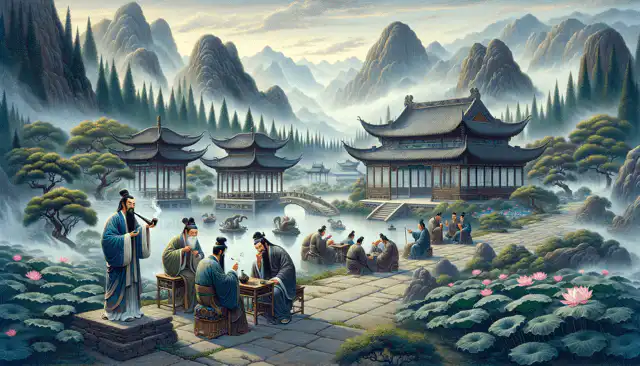
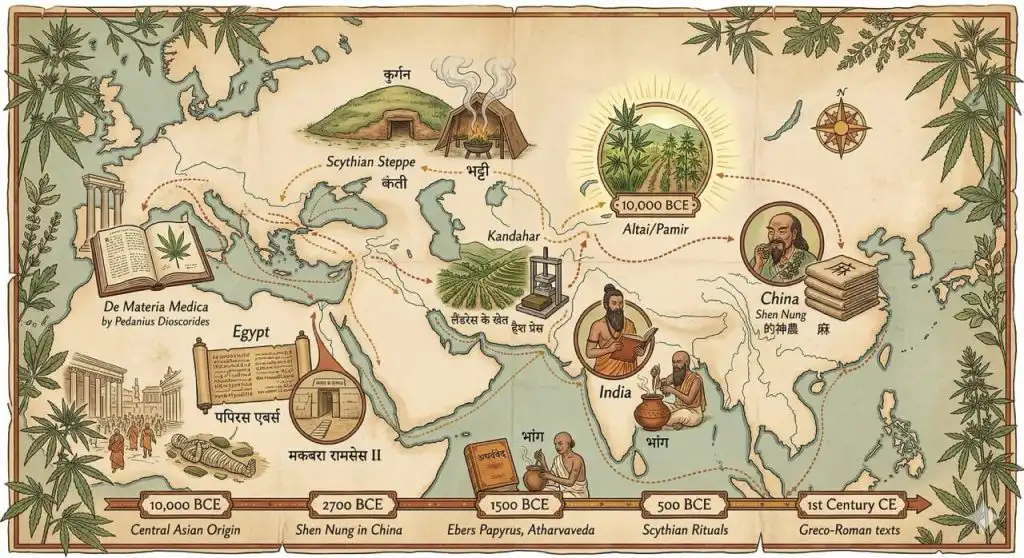
The earliest documented evidence of cannabis use comes from China, where archaeological findings suggest cultivation dating back to at least 10,000 BCE. Cannabis seeds have been found in ancient Chinese burial sites, and hemp cordage impressions have been identified on pottery from the same period — evidence that the plant was being deliberately cultivated and processed rather than simply foraged.
The most cited historical reference is the legendary Emperor Shen Nung, known as the Divine Farmer, credited with living around 2700 BCE. His pharmacopeia — the Shen Nung Ben Cao Jing — describes cannabis as a remedy for gout, rheumatism, malaria, and absent-mindedness. He recommended different preparations from the seeds, leaves, and roots for different conditions. Whether Shen Nung was a historical figure or a mythologised archetype of early Chinese medicine is debated, but the text itself is real and its references to cannabis are among the earliest written records of the plant’s medicinal use.
Beyond medicine, cannabis seeds were a food source in ancient China — consumed as grain, pressed for cooking oil, and used for lamp oil. The plant’s fibre produced textiles, rope, and paper. Cannabis was not a specialised drug plant in this context; it was an agricultural staple whose psychoactive properties were one dimension of a multifaceted relationship.

Ancient India — Spiritual Significance and the Sacred Texts
The Indian relationship with cannabis is perhaps the most spiritually significant in the ancient record. The Atharvaveda — one of the four sacred texts of Hinduism, dating to around 1500 BCE — lists cannabis as one of five sacred plants, describing it as a source of happiness, a joy-giver, and a liberator. In the Indian tradition, cannabis was not a vice or an indulgence; it was a divine gift, associated with the god Shiva, and used in religious ceremonies that continue in modified forms today.
The preparation known as bhang — made from the leaves and flowers of the cannabis plant, ground with milk, spices, and sometimes seeds — has been consumed in ritual and festive contexts in India for at least three thousand years. It is still prepared and consumed during the festival of Holi and at Shiva temples across the subcontinent.
The Ayurvedic medical texts, which form the foundational framework of traditional Indian medicine, document the use of cannabis seeds and other plant parts to treat pain, inflammation, sleep disorders, and a range of other conditions. Cannabis in the Ayurvedic tradition was understood as a powerful medicine requiring careful dosing and preparation — an understanding that reflects sophisticated pharmacological knowledge developed over centuries of observation.
The Indian subcontinent also gave the world the charas tradition — hand-rubbed live resin collected from flowering cannabis plants at altitude in the Hindu Kush and Himalayan foothills. This is one of the oldest cannabis extraction methods in existence, producing a product fundamentally different to pressed hash and requiring an intimate knowledge of plant maturity and handling that was passed between generations.

Ancient Egypt — Medicine, Ritual, and the Ebers Papyrus
The ancient Egyptian relationship with cannabis is documented in some of the oldest surviving medical texts in history. The Ebers Papyrus, dating to approximately 1550 BCE and one of the most comprehensive ancient medical documents known, contains multiple references to cannabis preparations — including a cannabis-based remedy applied for inflammation and pain relief. The text describes cannabis as shemshemet and documents its use across several medical applications.
Cannabis pollen was found in the tomb of Ramses II, one of the most powerful pharaohs in Egyptian history, who died around 1213 BCE. The presence of cannabis in royal burial contexts suggests it held significance beyond medicine — it was connected to ritual, spiritual practice, and potentially to beliefs about the afterlife. Whether it was burned as an offering, consumed by priests, or simply present as a valued commodity is debated among Egyptologists, but the archaeological evidence of its deliberate inclusion in one of history’s most significant tombs is unambiguous.
Central Asia and the Scythians — Cannabis as Ritual
The Scythians — nomadic peoples who occupied the Eurasian steppe from roughly the 9th to 4th centuries BCE — are among the most extensively documented ancient cannabis users in the archaeological record. The Greek historian Herodotus, writing in the 5th century BCE, described Scythian funeral rituals in which mourners threw cannabis seeds and plant material onto heated stones inside enclosed felt tents, inhaling the vapour and crying out in response. Herodotus wrote that they “howled with pleasure” — one of the earliest descriptions of recreational cannabis intoxication in the historical record.
Archaeological excavations of Scythian burial mounds across modern-day Russia, Kazakhstan, and Ukraine have confirmed the presence of cannabis seeds, charred plant material, and brazier equipment consistent with Herodotus’s description. These findings validate his account and establish the Scythians as one of the most significant vectors for the spread of cannabis use across Eurasia — their nomadic range covering thousands of kilometres of territory where cannabis knowledge and seeds would have been traded, gifted, and planted.
The Scythian homeland overlaps directly with the geographic origin of many of the world’s most significant cannabis landraces — including the Afghani genetics that form the backbone of modern indica breeding. The connection between Central Asian nomadic culture and the spread of cannabis genetics across the ancient world is not coincidental.
Afghanistan — Kandahar and the Hash Tradition
Of all the ancient cannabis-cultivating regions in the world, the Kandahar area of southern Afghanistan may be the most significant for understanding the genetics that dominate the modern cannabis catalogue. Afghani landrace cannabis — the compact, resinous, fast-flowering plant that became the foundational indica of Western breeding programmes — has been cultivated in this region for thousands of years. The plants that Western breeders brought to the Netherlands in the 1970s and 1980s, which formed the genetic basis of strains like Northern Lights and countless modern hybrids, came from this lineage.
The traditional hash production of the Kandahar region is pressed Afghani hash — flat, dark slabs produced by sieving dried cannabis over fine mesh screens and pressing the collected resin under heat. This is a fundamentally different tradition to the Northern Indian charas method of hand-rubbing live plants. The Afghani method produces a product that is dense, earthy, and intensely aromatic — reflecting the terpene profile of the landrace genetics from which it comes. The myrcene, caryophyllene, and pinene-dominant terpene profile of Afghani cannabis that makes strains like Northern Lights and Black Domina so distinctive in the modern catalogue is the same profile that has characterised Kandahar cannabis for millennia.
🌿 Jason & Jess — Kandahar, Early 1990s
We were in Afghanistan in the early 1990s — pre-Taliban, a period that already felt fragile but where travel was still possible in some regions. Getting to the Kandahar area was not straightforward, but we were young and curious about cannabis in a way that went beyond the recreational. We wanted to understand where the genetics came from. Where the plant actually lived before it became a catalogue entry.
What we found there stayed with us. The communities were extraordinary — close-knit villages where hospitality to strangers was a point of honour, where people who had very little would share everything. The cannabis fields were part of the landscape in a way that had no equivalent in what we’d seen in California or Amsterdam. Not hidden, not a secret industry — woven into agricultural life the way wheat fields are somewhere else.
The hash production was traditional pressed Afghani — the sieving method, not the hand-rubbing charas tradition of Northern India. We watched it being done by people who had learned from their fathers and their fathers’ fathers. The care in the process, the knowledge of the plant at different stages, the way they talked about different plants from different valleys producing different results — it was a level of botanical understanding that most Western growers would find humbling.
When we handle Afghani-lineage seeds now — Northern Lights, Black Domina, the genetics that trace back to that part of the world — we think about those villages. About the people who cultivated those landrace plants for centuries before a single Western seed bank existed. The genetics in our catalogue carry that history. It matters to us that growers know it.
Ancient Greece and Rome — Medical Documentation
The ancient Greeks and Romans engaged with cannabis primarily through a medical lens, and their writings produced some of the most detailed early pharmacological descriptions of the plant. The Greek physician Pedanius Dioscorides, writing in the first century CE, included cannabis in his foundational medical text De Materia Medica — one of the most influential pharmaceutical references in Western history, remaining in use for over fifteen centuries after its composition. Dioscorides described cannabis as useful for treating earaches, reducing inflammation, and relieving pain. He also noted that the seeds, when consumed in large quantities, could diminish sexual function — an early observation of cannabis’s physiological effects beyond its psychoactive properties.
The Roman naturalist Pliny the Elder, writing in his encyclopaedic Natural History around 77 CE, described both the cultivation of hemp for fibre and the medicinal properties of the plant. He noted that the roots, boiled in water, could be applied to joints to relieve cramping and gout — consistent with uses documented in Chinese and Indian texts from centuries earlier, suggesting that by the Roman period, cannabis’s medicinal properties were well-established across multiple independent medical traditions.
The Greek historian Herodotus, already cited for his account of the Scythians, provides a crucial cultural link — connecting the Central Asian cannabis tradition to the Mediterranean world through his documentation of Scythian practices. His writing suggests that by the 5th century BCE, knowledge of cannabis’s psychoactive properties was not confined to any single cultural tradition but was spreading through the ancient trade networks that connected China, India, Central Asia, and the Mediterranean.
The Modern Era — Prohibition, Research, and Renaissance
The 20th century represents the most dramatic reversal in cannabis’s relationship with human culture in its recorded history. A plant that had been cultivated continuously for at least ten thousand years — used as food, fibre, medicine, and ritual substance across dozens of civilisations — was effectively criminalised across most of the world within a few decades. The United States Marijuana Tax Act of 1937 was the most significant early legislative step, followed by the inclusion of cannabis in the 1961 UN Single Convention on Narcotic Drugs, which established the global prohibition framework that most countries adopted.
The irony is that the decades of prohibition coincided with the beginning of serious scientific research into cannabis’s pharmacology. The isolation of THC by Raphael Mechoulam in 1964, and the subsequent discovery of the endocannabinoid system in the 1980s and 1990s, revealed that cannabis interacts with a biological regulatory system present in every mammal — a system that the plant’s compounds had been engaging for the entirety of its relationship with human biology.
The current period of partial legalisation and decriminalisation in various jurisdictions represents not a new development in human cannabis culture but a return to the historical norm — the criminalization of the 20th century being the anomaly in a ten-thousand-year story of cultivation and use. In Australia, the ACT permits adults to possess limited quantities of cannabis and grow up to two plants per person. Across the globe, the legal landscape continues to shift toward recognition of what ancient Chinese, Indian, Egyptian, and Central Asian cultures understood empirically: that this plant has a legitimate place in human life.
What Ancient Cannabis Means for Modern Genetics
The landrace cannabis varieties that ancient civilisations cultivated — the Afghani plants of the Kandahar valleys, the Hindu Kush varieties of the Northern Indian highlands, the Durban landraces of South Africa, the Thai sativas of Southeast Asia — are the genetic foundation of the modern cannabis catalogue. Every significant modern strain traces its lineage to one or more of these ancient regional varieties.
When breeders in the Netherlands in the 1970s and 1980s crossed Afghani landrace genetics with Northern Californian sativas, they were working with genetic material that had been shaped by thousands of years of natural selection in specific environments. The compact structure, fast flowering, and dense resin production of Afghani genetics are adaptations to the short growing seasons and high altitudes of the Hindu Kush and Kandahar regions. The terpene profile — the myrcene-dominant earthy musk that characterises Afghani-lineage strains — is the product of that same environmental selection pressure.
Understanding this history matters practically for growers. Indica-dominant strains with Afghani lineage — Northern Lights, Godfather OG, Black Domina — carry the genetic adaptations of plants that evolved to thrive in specific conditions. Their mould resistance, their fast flowering, their compact structure are not arbitrary breeding outcomes — they are ancient survival strategies encoded in the genetics.
Similarly, African landrace sativas like Durban Poison carry the genetic profile of plants that evolved in a specific climate and photoperiod — which is why they perform so well in Australian conditions that approximate the South African outdoor season. The sativa-dominant genetics in our catalogue connect back to growing traditions that predate the modern seed bank industry by centuries.
Key Takeaways — The History of Marijuana Seeds
Cannabis has been cultivated continuously for at least ten thousand years across China, India, Egypt, Central Asia, and beyond — used as food, fibre, medicine, and ritual substance long before the modern cannabis industry existed. The landrace genetics that ancient civilisations developed in specific environments — Afghani, Hindu Kush, Durban, Thai — form the genetic foundation of every significant strain in the modern catalogue. The 20th century prohibition of cannabis was a historical anomaly in a ten-thousand-year story of cultivation and use. The genetics in today’s cannabis seeds carry that entire history, and understanding it gives growers a deeper appreciation of what they’re actually working with. For Australian growers interested in strains with genuine historical lineage, the Sacred Seeds catalogue stocks Afghani-lineage indicas, African sativas, and modern hybrids that trace their genetics to these ancient cultivating traditions.
Explore strains with genuine lineage
Answer six questions and Jess will match you to three strains based on your setup, experience, and goals.
History of Marijuana Seeds — Frequently Asked Questions
How long have humans been using cannabis seeds?
Archaeological evidence suggests cannabis cultivation dates back at least 10,000 years in China, where seeds and hemp cordage impressions have been found at ancient sites. Written records documenting cannabis’s medicinal use begin around 2700 BCE with references in ancient Chinese texts, with Indian, Egyptian, and Central Asian records following from roughly 1500–500 BCE.
Where did cannabis originate?
The most widely accepted origin is Central Asia — the Hindu Kush mountain range and surrounding areas including modern-day Afghanistan, Pakistan, and Northwestern China. From this geographic centre, cannabis spread through trade routes and human migration across Asia, the Middle East, Africa, and eventually Europe and the Americas. The genetic diversity of modern cannabis reflects thousands of years of cultivation in these distinct regional environments.
What did ancient cultures use cannabis seeds for?
Ancient cultures used cannabis seeds as a food source — ground as grain or pressed for oil — as well as in medicinal preparations documented in Chinese, Indian, and Egyptian medical texts. Seeds were also used in ritual contexts, found in burial sites from Egypt to the Scythian burial mounds of Central Asia. The plant’s fibre was used for textiles, rope, and paper across multiple ancient civilisations.
What is the history of hash production in Afghanistan?
The Kandahar region of Afghanistan has one of the oldest continuous cannabis cultivating traditions in the world. Traditional Afghani hash is produced by sieving dried cannabis plant material over fine screens to collect the resin, which is then pressed under heat into flat slabs — a method distinct from the hand-rubbing charas tradition of Northern India. This Afghani hash tradition has been practised for centuries, and the landrace genetics developed in this region form the backbone of modern indica breeding worldwide.
How did cannabis prohibition happen?
Cannabis prohibition in the modern era began primarily through US legislation — the Marijuana Tax Act of 1937 effectively criminalised the plant — and was globalised through the 1961 UN Single Convention on Narcotic Drugs. The prohibition represented a dramatic reversal of thousands of years of cannabis cultivation and use. Scientific research conducted during the prohibition period ironically produced the most significant discoveries about cannabis’s pharmacology, including the isolation of THC in 1964 and the discovery of the endocannabinoid system in the 1980s and 1990s.
How does the history of cannabis connect to modern strains?
Every significant modern cannabis strain traces its genetic lineage to ancient regional landrace varieties. Afghani landrace genetics — from the Kandahar and Hindu Kush regions — form the foundation of indica breeding and appear in strains like Northern Lights, Godfather OG, and Black Domina. African landraces from South Africa underpin sativa-dominant strains like Durban Poison. Southeast Asian genetics contributed to classic sativas. The breeders who created the modern cannabis catalogue in the 1970s and 1980s were working with genetics that had been shaped by thousands of years of natural selection in specific environments.
Is it legal to collect marijuana seeds in Australia?
Cannabis seeds are sold as novelty collector’s items in Australia. The legal status of germinating or cultivating cannabis varies by state — the ACT permits limited personal cultivation for adults; all other states prohibit cultivation. Sacred Seeds sells seeds strictly as collectibles in accordance with Australian law. Always check the specific laws in your state before germinating or cultivating.
Related Reading
Cannabis seed collecting in Australia — the philosophy and practice of building a serious genetics collection.
How to store cannabis seeds in Australia — preserving viability and genetics over the long term.
From landrace to hybrid — how cannabis genetics evolved — the breeding history from ancient landraces to modern strains.
Choosing the best cannabis strains — Sacred Seeds full guide — how to navigate the catalogue and find the right genetics for your grow.
Browse all cannabis seeds — feminised, autoflower, and photoperiod strains shipped from Australia.
Seeds are sold strictly as novelty collector’s items. They contain no THC or CBD. This page does not constitute medical or legal advice. By purchasing you agree to our terms and conditions. Always check local laws before germinating or cultivating cannabis.