The Pineapple Express strain is a sativa-dominant cross of Trainwreck and Hawaiian, and it is the most recognisable cannabis name on earth. People who have never been inside a dispensary can name it. That is not true of Skunk #1, or White Widow, or anything else in the catalogue.
Here is the strange part. There is a serious argument that the name existed before the plant did.
This review covers where the genetics actually came from, what the two competing origin stories are, how the tropical terpene profile works, and how it behaves in Australian conditions. Pineapple Express feminised seeds are available now as both a photoperiod and a Pineapple Express autoflower.
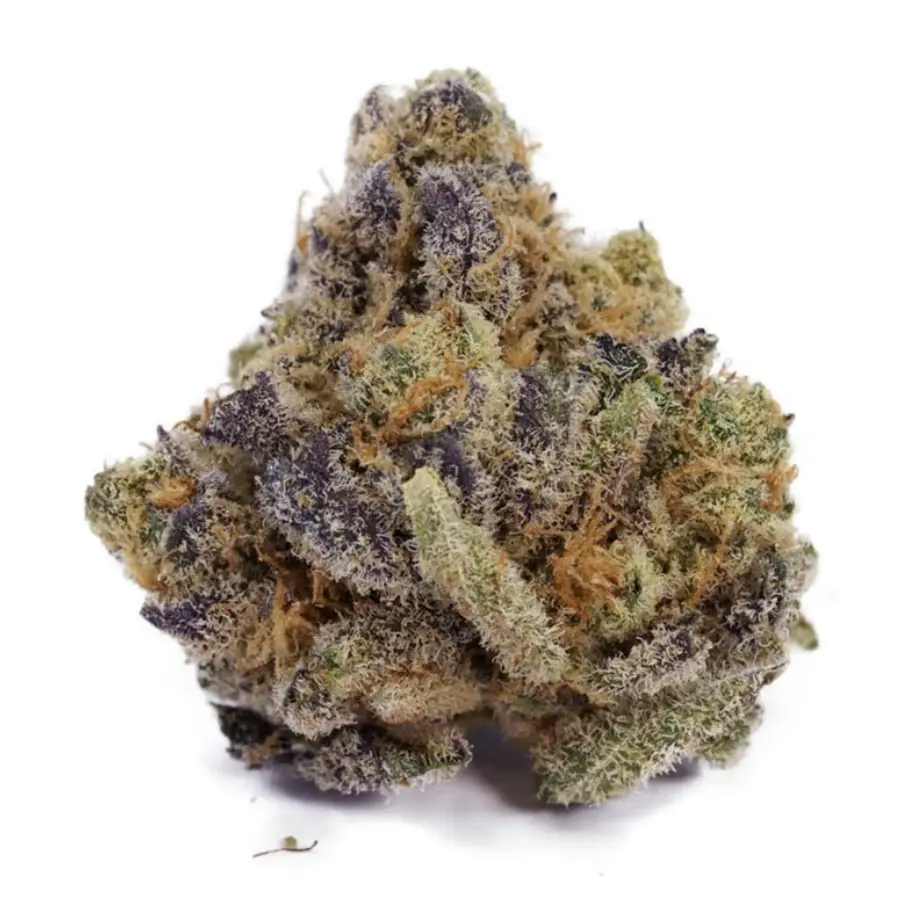
Pineapple Express at a Glance
| Attribute | Detail |
|---|---|
| Type | Sativa-dominant hybrid, roughly 60/40 |
| Genetics | Trainwreck × Hawaiian |
| Emerged | Mid 2000s, California and the wider US market |
| THC | 17 to 25%, most batches 18 to 22% |
| Dominant terpenes | Limonene, caryophyllene, pinene |
| Flowering | 7 to 9 weeks |
| Indoor yield | Moderate to high, rewards training heavily |
| Structure | Medium to tall, heavy lateral branching |
| Bud character | Lighter and fluffier than Kush-style flowers, bright lime green |
| AU outdoor finish | Roughly April |
| Difficulty | Straightforward to grow, needs training and support |
On this page
Is Pineapple Express indica or sativa?
Where the Pineapple Express strain came from
Did the movie invent the strain?
What Pineapple Express tastes and smells like
Growing Pineapple Express in Australia
What Pineapple Express left behind
Which Pineapple Express are you buying?
Frequently asked questions
Is the Pineapple Express Strain Indica or Sativa?
Sativa-dominant, generally put at around 60/40. Both parents lean that way, so there was never much indica in the cross to begin with.
What the indica quarter does here is different to what it does in a strain like AK-47. It is not there to shorten the flower or add body weight so much as to take the edge off. Trainwreck on its own is famously fast and sharp, the kind of sativa that can tip into too much. Hawaiian is mellow and fruit-forward but was never especially strong. Crossing them produced something that kept Trainwreck’s speed and lifted Hawaiian’s potency, while sanding down the parts of each that people struggled with. For the underlying framework, our guide to sativa and indica cannabis genetics explains why those labels describe plant structure far more reliably than they describe effect.
What to Expect
Fast onset, often inside a few minutes, bright and clear-headed. It settles into something sociable and talkative rather than racing. There is a light physical ease underneath that keeps it comfortable without slowing you down. Suits mornings and afternoons, creative work and company. Not a wind-down strain.
Where the Pineapple Express Strain Came From
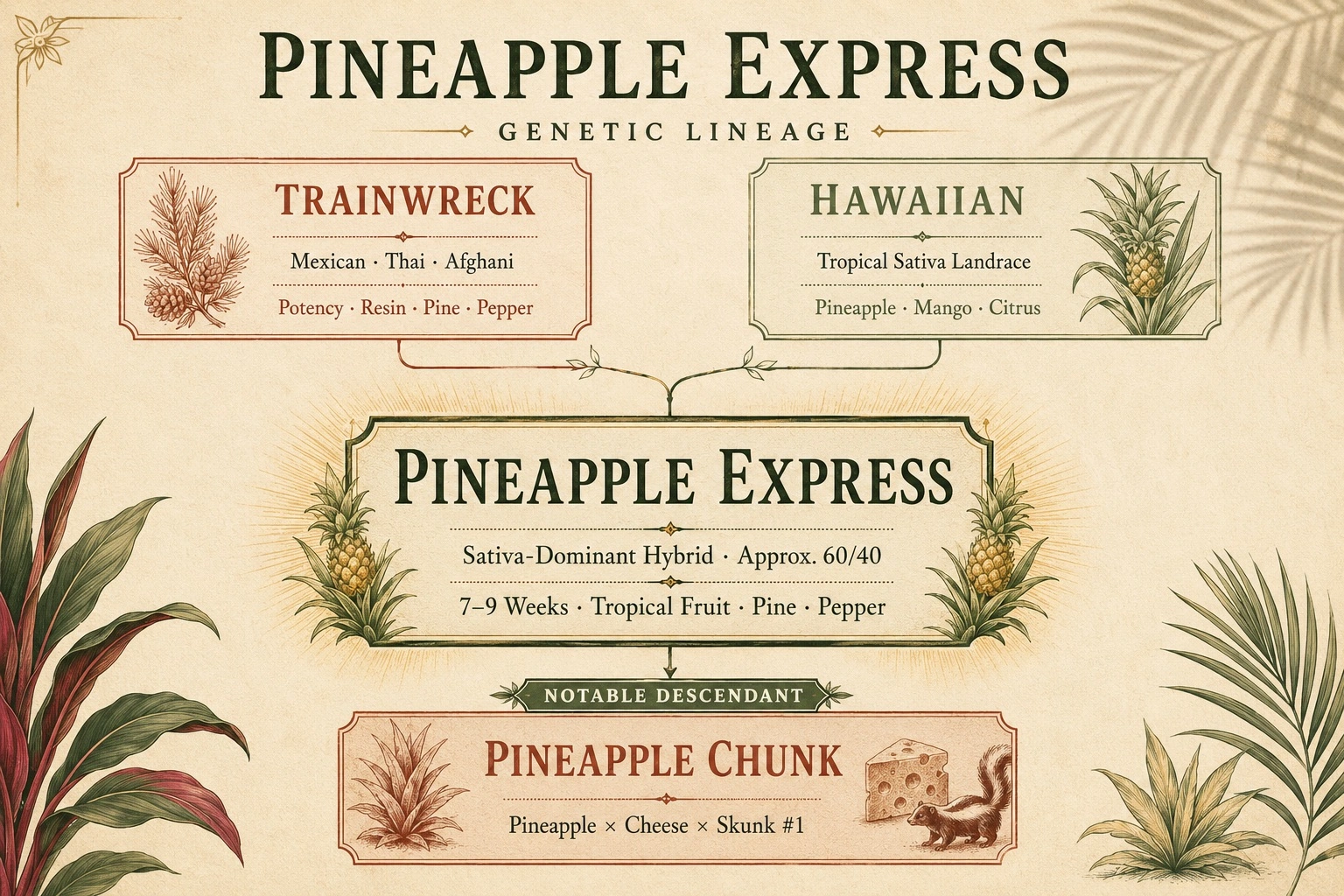
The genetics are Trainwreck crossed with Hawaiian. G13 Labs is the house most often credited with the cross and claims to have made it in the mid 2000s, after which it spread through Californian dispensaries. Other accounts point toward Hawaiian breeding operations. Nobody has produced documentation that settles it.
The parents are worth understanding on their own, because they explain almost everything about the plant.
Trainwreck is a Northern Californian hybrid built from Mexican, Thai and Afghani stock. That is very nearly the same landrace deck behind the other great stabilisation projects of the era, and the Mexican side is the same lineage that runs through Acapulco Gold. What Trainwreck contributes here is speed of onset, the cerebral sharpness, resin production, and the pine and pepper notes sitting underneath the fruit.
Hawaiian is a pure tropical sativa landrace, and it is the half people actually taste. Hawaiian lines are known for bright fruit aromas, pineapple and mango and citrus, and for a gentle, unhurried character. It is the same island genetics behind Maui Wowie. Everything that makes this strain smell like its name comes from this side of the cross.
Read together, the logic is straightforward. One parent brought the punch and one brought the flavour, and neither was quite complete without the other. If you want the wider map of how the landrace lines fed into the hybrids that followed, our cannabis genetics family tree traces it, and the guide to how landrace genetics became modern hybrids covers the breeding logic in more depth.
Did the Movie Invent the Strain?
This is the question people actually arrive with, and the answer is genuinely unresolved.
Seth Rogen has said plainly that no strain of that name existed when the 2008 film was made. His account is that the name came from a Hawaiian weather system, an atmospheric river that carries warm moisture from the islands toward the west coast of North America, and that his writing partner heard it years earlier and thought it would make a good film title. Rogen’s version is that they hoped someone would eventually sell weed under the name, because that would mean the film had landed.
Against that, G13 Labs and several seed banks place the cross in the mid 2000s, before the film. Growers on the west coast have said the same. Neither side can produce anything conclusive, partly because in the early 2000s strain naming was informal and cultivars moved by word of mouth rather than through any register.
The most likely reading is that both are partly right. A tropical Trainwreck cross probably existed in small circulation without a settled name or any distribution, the film gave the name enormous value, and the market rushed to attach that name to whatever came closest. Which is a considerably more interesting thing to know about a strain than a tidy origin story would be.
Jess on Why the Name Question Misses the Point
People get very worked up about whether it is a real strain, and I understand why, but it has never bothered me. Every strain name is made up by somebody. Skunk got named after how it smelled, Northern Lights after a light show, White Widow after a spider. None of that tells you anything about the plant.
What matters is whether the thing in the jar does what the name promises, and this one does. It smells like pineapple. Actual pineapple, not a vague sweetness someone decided to call tropical. If a film is the reason more people found that out, fine.
What the Pineapple Express Strain Tastes and Smells Like
Limonene leads, and that is the whole signature. It carries the bright citrus lift that reads as pineapple rather than lemon, helped by the tropical fruit character Hawaiian brings. Caryophyllene sits behind it with a peppery warmth and pinene supplies a woody, resinous base. Ocimene turns up in smaller amounts and adds a sweet herbal edge.
In plain terms: ripe pineapple and mango on the nose, then cedar and pine underneath, with a peppery finish on the exhale. Grind it and the wood and pepper come forward. It is one of very few strains whose aroma is identifiable without knowing anything about terpenes at all.
The thing worth knowing is that the fruit needs the base to work. A version with strong limonene and nothing underneath tastes like confectionery, and a version with weak limonene tastes flat and woody with no pineapple in it anywhere. The good phenotypes have both. Our guide to cannabis terpenes covers how these compounds shape aroma and flavour.
Jess on the Cure
This is the one I always tell people not to rush. The pineapple is the first thing to go if you dry it too fast, and once it is gone you cannot get it back. I have had jars that smelled like fruit salad at three weeks and barely of anything at all when they were hurried. Give it the full slow dry and then leave it alone for a month. It is the difference between a nice sativa and the thing people remember.
Growing the Pineapple Express Strain in Australia
It suits most of the country. A seven to nine week photoperiod flower puts harvest around April, which is late enough to miss the worst of the summer humidity and early enough to finish comfortably before the cold arrives in the south. Our guide to growing cannabis outdoors in Australia has the seasonal calendar by region, and the sativa-by-region guide covers where the longer-flowering sativas do and do not work.
The buds are lighter and airier than a Kush-style flower, which means humidity is less of a problem here than it is with dense-budded genetics. That is a real advantage in a wet autumn.
The structure is the thing to plan for, and it is the one place where the two parents pull against each other.
Jason on Structure: Where the Yield Actually Comes From
In the greenhouse this plant behaves like the Hawaiian side is running the architecture and the Trainwreck side is running the flower. You get the open, wide-branching frame of a tropical sativa, then bud sites that fill in far denser than that frame suggests they should. That mismatch is the whole yield story. The plant builds a structure it then has to hold up, and it does not always plan for that.
Which means the yield is decided in veg, not in flower. Top it early and get those laterals out horizontal while they are still soft, because a Pineapple Express run flat with an open canopy will out-produce the same seed run as a single leader by a long way. Support goes in at the start of bloom, not when something starts leaning. A limb that has already been stressed does not get its vigour back and you finish smaller on that side.
On consistency, be realistic. This is not a locked line like Northern Lights. Across a pack I see meaningful variation in how tall they run and how hard the fruit comes through, so if you have the space, pop a few and keep the one that noses up best. That is not a fault in the seed, it is what happens when several breeders each stabilise a cross their own way.
Feeding is unremarkable. It carries a decent appetite through the stretch and takes a standard bloom feed with phosphorus and potassium support from around week four, but it is not a heavy feeder and it will show tip burn if you push it. Read the plant rather than the schedule, using our reference on diagnosing cannabis nutrient deficiencies.
On timing, check the resin rather than the calendar using the method in our guide to reading amber trichomes at harvest, then dry it slowly and give it a proper cure. The product page carries the full feeding schedule, EC targets and week-by-week timeline, so this review stays on what the strain is rather than repeating the mechanics.
Photoperiod or autoflower?
Both are available. The photoperiod version gives you the full plant and the option to train it into a much bigger yield, and it is the one to choose if you have a season to work with. Pineapple Express Autoflower runs on a fixed timeline regardless of daylight, which suits a short window, a balcony, or a grower who wants something in and out inside three months. Because Auto Pineapple Express sets its own schedule from germination, there is no veg period to extend and no recovery window if something goes wrong, so it asks for a steadier hand than the photoperiod does. Our guide to autoflower versus photoperiod seeds sets out the trade-off properly.
What Pineapple Express Left Behind
For a strain with this much name recognition, the descendant list is short, and that is telling. Most of what carries the name commercially is a version of Pineapple Express rather than a cross out of it. The breeding work it did produce, though, went in two clear directions.
Pineapple Chunk is the one worth knowing about, because it pulls the tropical profile into your own catalogue’s territory. It crosses Pineapple with Cheese and Skunk #1, putting the fruit over a funk-and-skunk base instead of a pine one. The result is heavier, denser and far more pungent than Pineapple Express itself, and it finishes shorter. If you like the pineapple but want weight underneath it rather than lift, that is the direction the breeders went looking.
Pineapple Kush went the other way, crossing Pineapple Express with Master Kush to push it toward the indica side while keeping the fruit. It is the evening version of the same flavour idea, and it demonstrates something useful about the original: the tropical terpene profile is dominant enough to survive being crossed into heavy indica genetics without disappearing.
Backwards, the connections are richer than forwards. The Mexican and Thai lines inside Trainwreck are the same stock behind Acapulco Gold and the wider landrace sativa story that also produced Durban Poison. The Hawaiian side belongs to the island genetics that gave us Maui Wowie. Very few modern hybrids sit on two landrace decks that broad.
Which Pineapple Express Are You Buying?
This is the honest caveat, and no competitor page will tell you about it.
Because the name became valuable very suddenly, a number of seed banks each set out to produce their own definitive Pineapple Express. Several different lines now circulate under the name, and they are not identical. Some lean harder into the citrus, some carry more of Trainwreck’s pine and diesel, and reported terpene profiles vary enough across sources that no two lists quite agree.
That is not a reason to avoid it. It is a reason to buy on the described profile rather than on the name, and to judge it on what actually turns up. The core character holds across versions: tropical fruit up front, wood and pepper underneath, fast bright onset, seven to nine weeks. What varies is the emphasis.
Who Pineapple Express Suits
A good fit if you want a bright daytime sativa without a long flower, you like fruit-forward profiles, you are growing somewhere with a wet autumn where dense-budded strains struggle, or you want a first sativa that is unlikely to be overwhelming.
Look elsewhere if you want an evening strain, you are chasing the highest THC number available, you have no room to train a plant with wide lateral branching, or you want a guaranteed identical result every time.
If the first paragraph sounds like your setup, Pineapple Express seeds are in stock now.
Frequently Asked Questions
Is Pineapple Express indica or sativa?
Sativa-dominant, generally put at around 60/40. Both parents lean sativa, so the indica influence is there to soften rather than to sedate. Our sativa versus indica guide explains why those labels describe structure more reliably than effect.
What are Pineapple Express genetics?
Trainwreck crossed with Hawaiian. Trainwreck is a Northern Californian hybrid built from Mexican, Thai and Afghani landraces. Hawaiian is a pure tropical sativa landrace and is where the fruit comes from.
Did Pineapple Express exist before the movie?
Unresolved. Seth Rogen has said no strain of that name existed when the 2008 film was made, and that the title came from a Hawaiian weather system. Several seed banks place the cross in the mid 2000s, before the film. The likeliest reading is that a tropical Trainwreck cross was circulating without a settled name, and the film gave it one.
Why is it called Pineapple Express?
The name predates both the film and the strain. It is a meteorological term for an atmospheric river that carries warm moisture from near the Hawaiian islands toward the west coast of North America. It suits a strain built on Hawaiian genetics rather better than anyone planned.
How strong is the Pineapple Express strain?
Typically 17 to 25% THC, with most batches landing between 18 and 22%. That is solidly in the middle of the modern market. The character comes from the speed and clarity of the onset rather than the ceiling.
How long does Pineapple Express take to flower?
Seven to nine weeks as a photoperiod, which is short for something this sativa-leaning. The Pineapple Express Auto runs on a fixed timeline from germination instead, typically finishing inside eleven to thirteen weeks seed to harvest.
When does Pineapple Express finish outdoors in Australia?
Around April for most regions on a standard photoperiod season. Our Australian outdoor growing guide has the full seasonal calendar.
Does Pineapple Express need training?
Yes, and this is the main practical thing to know. Heavy lateral branching plus long spear-shaped colas means limbs get heavy late in flower. Top early, trellis or stake from the start of bloom, and tie the outer branches in before the weight arrives.
Is Pineapple Express good for a first grow?
It is forgiving on feed and it is not fussy, so on cultivation grounds it is a reasonable first photoperiod. The training requirement is the only thing that asks more of a beginner than the truly easy strains do. Our beginner strain guide covers gentler starting points.
Which terpenes are in Pineapple Express?
Limonene leads, with caryophyllene and pinene supporting and ocimene present in smaller amounts. Reported profiles vary between sources, which reflects the fact that several different lines circulate under the name. Our terpene guide explains what each contributes.
Why do different Pineapple Express seeds vary so much?
Because the name became commercially valuable very quickly, several seed banks each produced their own version rather than working from one line. The core character is consistent but the emphasis differs. Buy on the described profile rather than on the name alone.
What strains came from Pineapple Express?
Pineapple Chunk is the best known, crossing Pineapple with Cheese and Skunk #1 to put the tropical fruit over a funk base. Pineapple Kush crosses it with Master Kush for a heavier evening version. The descendant list is short for a strain this famous, because most of what carries the name is a version of it rather than a cross out of it.
How does Pineapple Express compare to Blue Dream?
Both are bright daytime hybrids with fruit-forward profiles. Blue Dream is sweeter and gentler with berry rather than tropical character, and it is the softer of the two. Pineapple Express has a sharper onset and more pepper and pine underneath. The Blue Dream review covers that side in depth.
How does Pineapple Express compare to Amnesia Haze?
Amnesia Haze is the more demanding sativa: longer flowering, taller, and more intense in the head. Pineapple Express finishes several weeks sooner and is considerably easier to live with. Read the Amnesia Haze review for the comparison.
How should Pineapple Express be dried and cured?
Slowly, and this matters more here than with most strains. The tropical fruit character is the first thing a fast dry destroys and it does not come back. Follow the method in our drying guide, then cure for at least three to four weeks.
Cannabis seeds are sold as souvenirs and for genetic preservation. Germination is illegal in most Australian states and territories. Cultivation of a small number of plants is permitted for adults in the ACT under specific conditions. Check the law where you live before you do anything with a seed.
Related reading: browse the full range of cannabis seeds Australia, our Durban Poison review for a pure landrace sativa, the Moby Dick review for another big sativa-leaning hybrid, and the guide to the best cannabis strains for the Australian climate.