Cannabis Nutrient Deficiencies: How to Diagnose and Fix Them
Cannabis leaves are a communication system. When they start yellowing, developing spots, curling, or changing colour in patterns that don’t look right, the plant is telling you something is wrong with its nutrient supply. The problem most growers run into isn’t identifying that something is wrong — it’s knowing which nutrient is missing, why it’s missing, and what to do that will actually fix it rather than making it worse.
This guide gives you the framework to diagnose cannabis nutrient deficiencies correctly and fix them before they cost you yield. The starting point is a concept that most guides skip past too quickly — and it’s the one that makes the difference between systematic diagnosis and guesswork.
The One Concept That Changes Everything: Mobile vs Immobile Nutrients
Before looking at any specific symptom, you need to understand how the plant moves nutrients internally. This is the master key that makes deficiency diagnosis logical rather than guesswork — and most growers either don’t know it or don’t apply it consistently.
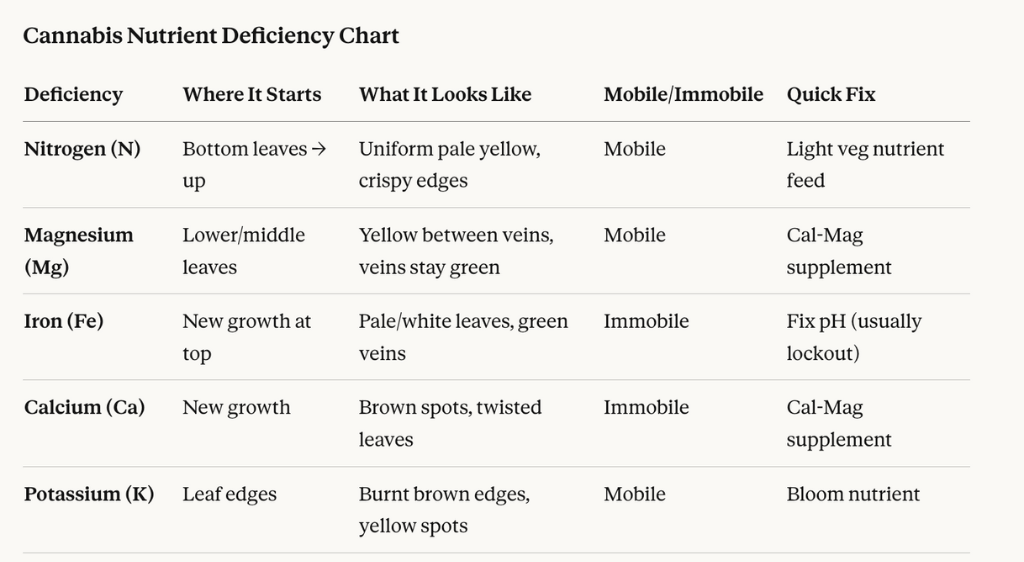
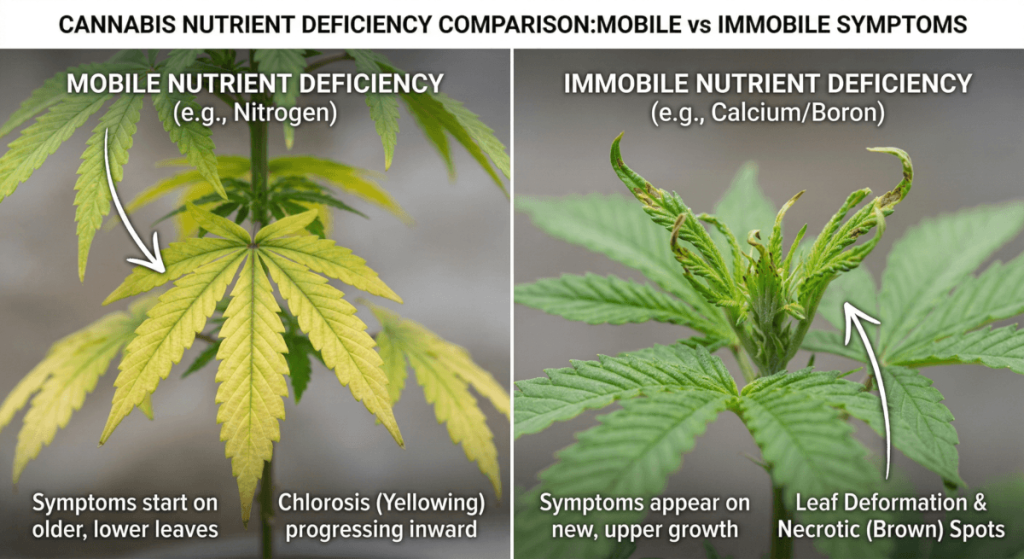
Mobile nutrients — nitrogen, phosphorus, potassium, magnesium — can be relocated by the plant. When supplies run low, the plant cannibalises older, lower leaves to feed new growth at the top. This means mobile deficiencies always show up on the bottom of the plant first, working upward as the deficiency progresses.
Immobile nutrients — calcium, sulphur, iron, manganese, zinc — get locked into plant tissue permanently once delivered. The plant can’t retrieve and relocate them. So when these run short, new growth suffers first because the plant can’t pull from existing tissue to compensate. The problem appears at the top of the plant, on the newest leaves.
Your two-step starting point for any deficiency diagnosis: is the problem on the lower, older leaves? Mobile nutrient deficiency. Is the problem on the upper, newer growth? Immobile nutrient deficiency. That single observation cuts your diagnostic list in half immediately and points you toward the right category of fix.
The Mobile Nutrient Deficiencies — What Shows Up on Lower Leaves
Nitrogen Deficiency
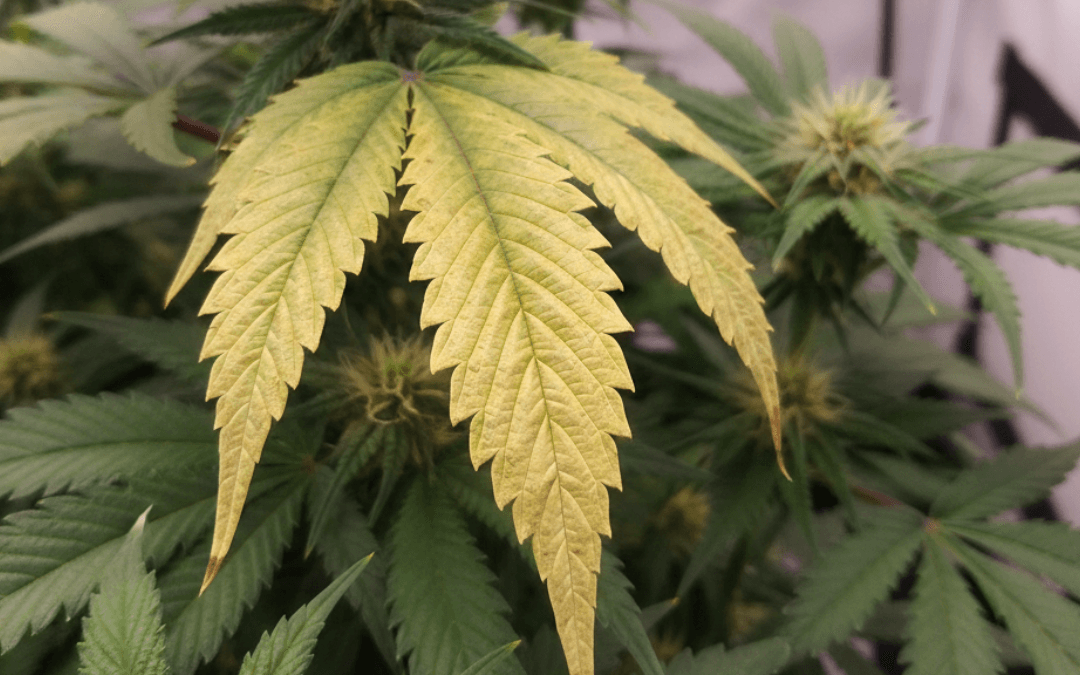
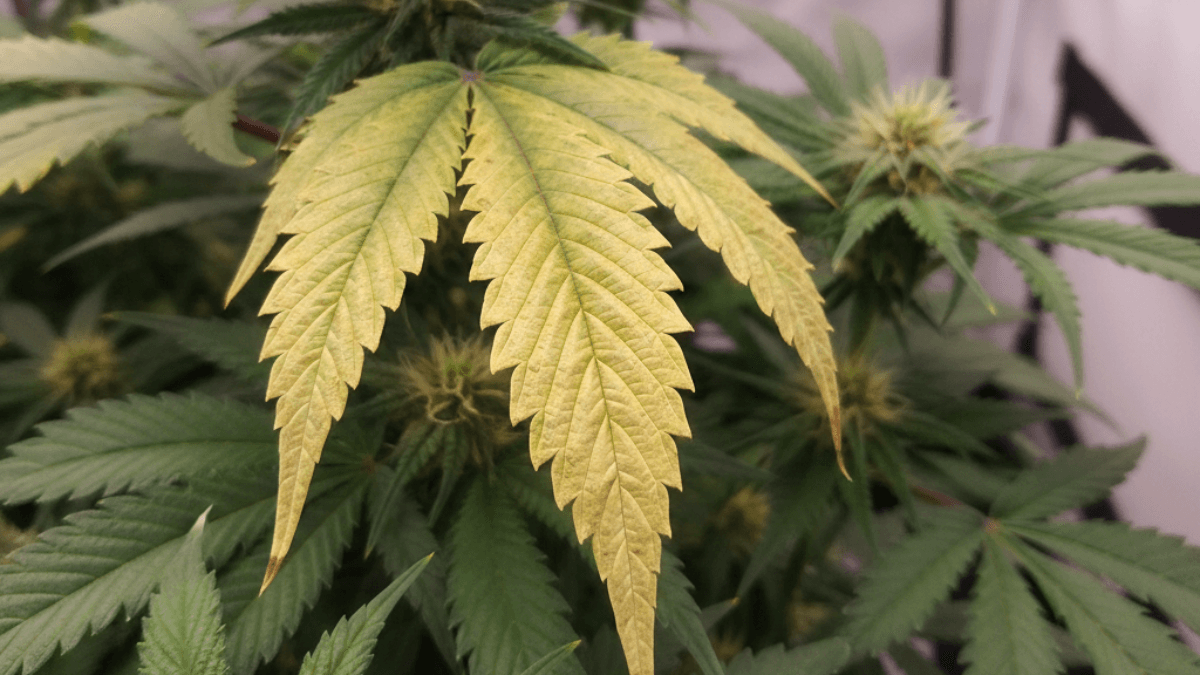
Nitrogen deficiency is the most common deficiency in cannabis and one of the easier ones to identify correctly. It shows as a uniform, pale yellowing across the entire leaf — not patchy, not spotted, just an even fade from green to yellow starting on the oldest, lowest leaves and progressing upward as the plant continues cannibalising lower foliage to feed new growth. Affected leaves will eventually wilt and drop.
It’s most common during the vegetative stage because nitrogen is the primary driver of leaf and stem growth — a fast-growing plant in active veg can burn through available nitrogen quickly. The fix is straightforward: feed with a nitrogen-rich grow formula and the plant will respond visibly within a week.
One important caveat: don’t reach for high-nitrogen nutrients during flowering. Excess nitrogen late in the grow suppresses bud development and affects the final smoke quality. Natural yellowing of lower fan leaves in weeks six to eight of flower is expected and correct — it’s the plant redirecting resources to bud production, not a deficiency that needs correcting.
Phosphorus Deficiency
Phosphorus deficiency is easy to misread because it doesn’t present as straightforward yellowing. Instead, affected leaves develop a dark, bluish-green discolouration. The specific giveaway is the stems and leaf petioles — look closely for a purplish or reddish tint there, which combined with the dark leaf colour is a reliable indicator of phosphorus shortage rather than other causes. Growth slows noticeably and plants look generally stressed without an obvious single cause.
It’s most common in the flowering stage, because phosphorus is critical for bud formation. A phosphorus deficiency during flower will reduce your final yield more significantly than almost any other deficiency because it’s affecting the plant at exactly the moment it’s doing the most important work. Switch to or increase your phosphorus-rich bloom formula. For organic growers, bone meal worked into the medium is an effective longer-term solution.
Note: purple stem colouration also occurs in some genetics as a normal phenotypic expression — particularly in Afghani and Kush-lineage indicas — and from cold temperatures. Don’t confuse this with phosphorus deficiency. The diagnostic check is whether the dark leaf colour and slow growth accompany it.
Potassium Deficiency
Potassium deficiency has a distinctive pattern once you know what to look for: yellowing and browning that starts at the leaf edges and tips while the centre of the leaf stays green. It looks like the margins of the leaf have been lightly scorched. Don’t confuse this with nutrient burn — burn typically affects tips only and presents alongside dark green leaves rather than general yellowing.
Potassium deficiency can strike at any stage but it’s particularly damaging during flowering, when potassium demand spikes alongside phosphorus. A balanced bloom nutrient addresses most potassium shortfalls. Kelp meal is a good organic supplement. If the issue persists after correct feeding, check pH — potassium uptake is sensitive to pH imbalance and the nutrient may be present but unavailable.

The Immobile Nutrient Deficiencies — What Shows Up on New Growth
Calcium Deficiency
Calcium deficiency appears as irregularly shaped brown or rust-coloured spots on young leaves. New growth may be stunted, twisted, or come in misshapen. The spots aren’t uniform — they look like random splashes of damage rather than a consistent pattern, which distinguishes them from other deficiency presentations.
The important thing to understand about calcium deficiency is that more often than not, the calcium is already present in the medium — the plant just can’t access it because pH is outside the absorption range. This is especially common in coco coir, which has almost no natural buffering capacity and requires calcium supplementation from day one regardless of what else you’re feeding.
Check pH first before adding calcium. For soil, target 6.0–7.0. For coco and hydro, target 5.5–6.5. Once pH is corrected, supplement with a Cal-Mag product. In coco, Cal-Mag should be a non-negotiable part of every feed from seedling through harvest.
Magnesium Deficiency
Magnesium is technically a mobile nutrient but most often presents on middle to lower leaves and frequently co-occurs with calcium issues — which is why Cal-Mag addresses both simultaneously. The distinctive symptom is interveinal chlorosis: the areas between leaf veins turn yellow while the veins themselves stay green, creating a striped or marbled appearance that’s fairly easy to identify once you’ve seen it. Leaf edges may curl upward.
Cal-Mag covers both calcium and magnesium, which is why it’s such a useful staple. If you want a simple standalone fix for confirmed magnesium deficiency, Epsom salts work well — dissolve one teaspoon per four litres of pH-balanced water and feed as normal. Results are typically visible within five to seven days.
Quick Diagnosis Reference
| Symptom | Location | Likely cause |
|---|---|---|
| Uniform yellowing, leaf drop | Lower / older leaves | Nitrogen (N) |
| Bluish-green leaves, purple stems | Lower / older leaves | Phosphorus (P) |
| Yellowing / browning at leaf edges and tips | Lower / older leaves | Potassium (K) |
| Brown spots, stunted or twisted new growth | Upper / new growth | Calcium (Ca) — check pH first |
| Yellow between veins, veins stay green | Mid to lower leaves | Magnesium (Mg) |
| Dark green leaves, crispy brown tips only | Tips throughout | Nutrient burn — too much, not too little |
| Multiple deficiency symptoms at once | Anywhere | pH lockout — check pH before anything else |
The Most Overlooked Cause: Nutrient Lockout
This is where most growers lose weeks of time and a lot of money in unnecessary nutrients. The problem often isn’t a lack of nutrients at all — it’s lockout. Nutrients are physically present in the medium but chemically unavailable to the plant because the pH is outside the absorption window.
Cannabis can only uptake nutrients within a relatively narrow pH range. Stray outside it and no amount of feeding will solve the problem. The plant keeps looking sick, you keep adding nutrients, and you end up with toxic salt buildup on top of everything else. Multiple simultaneous deficiencies are a lockout signature — not a multi-nutrient shortage. When multiple symptoms appear at once, always check pH before adjusting any nutrients.
pH targets by medium: soil targets 6.0–7.0 with the sweet spot around 6.5. Coco coir and hydro target 5.5–6.5. These ranges aren’t suggestions — they’re the windows within which each nutrient becomes chemically accessible. A pH of 7.5 in coco will lock out calcium, magnesium, and iron simultaneously regardless of how much of each is present in your feed.
🧠 Jason — On pH and Nutrient Diagnosis
The number of growers I’ve spoken to who spent weeks trying to fix a calcium or magnesium deficiency that was actually a pH problem is genuinely frustrating. They keep adding Cal-Mag, the symptoms persist, they add more Cal-Mag, and the problem gets worse because the salt load is climbing while the plant still can’t access the nutrients. A quality pH pen is the highest-return investment in any grow kit. Check it before every feed, check it at the root zone if you’re seeing persistent symptoms, and correct it before you start chasing specific deficiencies. Most of what growers diagnose as a deficiency is lockout — and lockout doesn’t respond to more nutrients.
Nutrient Burn — The Opposite Problem
It’s worth addressing nutrient burn here because it’s frequently confused with deficiency, and the treatment is the opposite. Nutrient burn presents as dark green leaves with crispy, brown-burnt tips — the darkness of the green is the first indicator that the plant has excess nutrient salts rather than insufficient ones. The tips brown because the plant is pushing excess salts to the outer extremities.
If you see this: stop feeding immediately, flush with plain pH-balanced water at two to three times the volume of your pot, and let the medium dry slightly before resuming at a significantly reduced feeding rate. Feeding more when you see nutrient burn makes it worse — the instinct to reach for nutrients when the plant looks sick is the most common way growers escalate a manageable problem into a serious one.
Looking for genetics bred for resilience?
Answer six questions and Jess will match you to three strains based on your setup, experience, and goals.
Key Takeaways — Cannabis Nutrient Deficiencies
Mobile nutrients (N, P, K, Mg) deficiencies show on lower, older leaves — the plant cannibalises old growth to feed new. Immobile nutrients (Ca, S, Fe, Mn, Zn) deficiencies show on upper, new growth — the plant can’t relocate these from existing tissue. Multiple symptoms appearing simultaneously almost always indicates pH lockout rather than multiple actual deficiencies — check and correct pH before adding any nutrients. A pH pen is the highest-return tool in any grow kit: check before every feed, correct before diagnosing. Nutrient burn (dark green leaves, crispy tips) is the opposite of deficiency — flush rather than feed. Natural lower-leaf yellowing in weeks six to eight of flower is expected and shouldn’t be treated as a deficiency. When in doubt, stop feeding, check pH, wait and observe before making any changes. The full nutrient requirements by growth stage are covered in the autoflower nutrients guide.
Cannabis Nutrient Deficiencies — Frequently Asked Questions
What’s the difference between nutrient deficiency and nutrient burn?
They’re opposite problems. Nutrient deficiency is a shortage of one or more nutrients — the plant can’t access enough to function correctly. Nutrient burn is excess — too much nutrient salt in the medium, presenting as dark green leaves with crispy brown tips. The treatment for deficiency is corrected feeding; the treatment for burn is flushing and reducing feed. Treating burn as deficiency by adding more nutrients will make it significantly worse.
Should I check pH every feed?
Yes — every feed, without exception. A quality pH pen is the highest-return tool in any grow kit and the check takes thirty seconds. Most stubborn deficiency problems trace back to pH being out of range rather than an actual nutrient shortage. Many growers would have saved weeks of stress by checking pH before reaching for any other solution.
Can I use the same nutrients from seed to harvest?
Not optimally. Vegetative growth demands nitrogen-heavy grow formulas. Flowering demands phosphorus and potassium-heavy bloom formulas. Using a grow formula into flower is one of the most common reasons growers end up with small, airy buds — excess nitrogen suppresses bud development. The transition from grow to bloom nutrients should happen at the flip or shortly after pre-flowers appear.
Are organic nutrients better for avoiding deficiencies?
Organics are more forgiving — the microbial ecosystem in living soil buffers against both deficiencies and overfeeding, releasing nutrients slowly as the plant needs them. Synthetics feed the plant directly and are more precise but less forgiving of errors in either direction. Neither is universally better, but for growers who are still developing feeding discipline, organics offer a wider margin for error.
My plant has several problems at once. Where do I start?
Stop adding nutrients. Check pH. Correct it if it’s out of range. If salt buildup is suspected from overfeeding, flush with plain pH-balanced water at two to three times the pot volume. Wait three to five days and observe before making any further adjustments. Chasing multiple symptoms with multiple simultaneous fixes is how you turn a manageable problem into a dead plant. Multiple deficiency symptoms at once almost always means lockout — fix the pH and most of the symptoms will resolve without any additional intervention.
Why are my lower leaves yellowing in late flower?
This is almost certainly not a deficiency — it’s the plant redirecting resources from fan leaves to bud production as it approaches harvest. Some yellowing of lower fan leaves from week six of flower onward is a normal part of the plant’s senescence process. The diagnostic check: is the yellowing progressing rapidly upward through the canopy, or staying on the lower leaves only? Rapid progression warrants investigation; slow yellowing confined to lower leaves during late flower generally doesn’t.
Related Reading
Why are my cannabis leaves turning yellow? — the full guide to leaf yellowing including causes beyond nutrient deficiency.
Autoflower nutrients guide — feed schedules, EC targets, and nutrient timing by growth phase for autoflowering genetics.
Cannabis seedling care in Australia — the first two weeks after germination including early feeding and overwatering avoidance.
Why aren’t my cannabis seeds germinating? — troubleshooting failed germination before the nutrient stage begins.
Browse all cannabis seeds — feminised, autoflower, and photoperiod strains shipped from Australia.
Seeds are sold strictly as novelty collector’s items. They contain no THC or CBD. This page does not constitute medical or legal advice. By purchasing you agree to our terms and conditions. Always check local laws before germinating or cultivating cannabis.