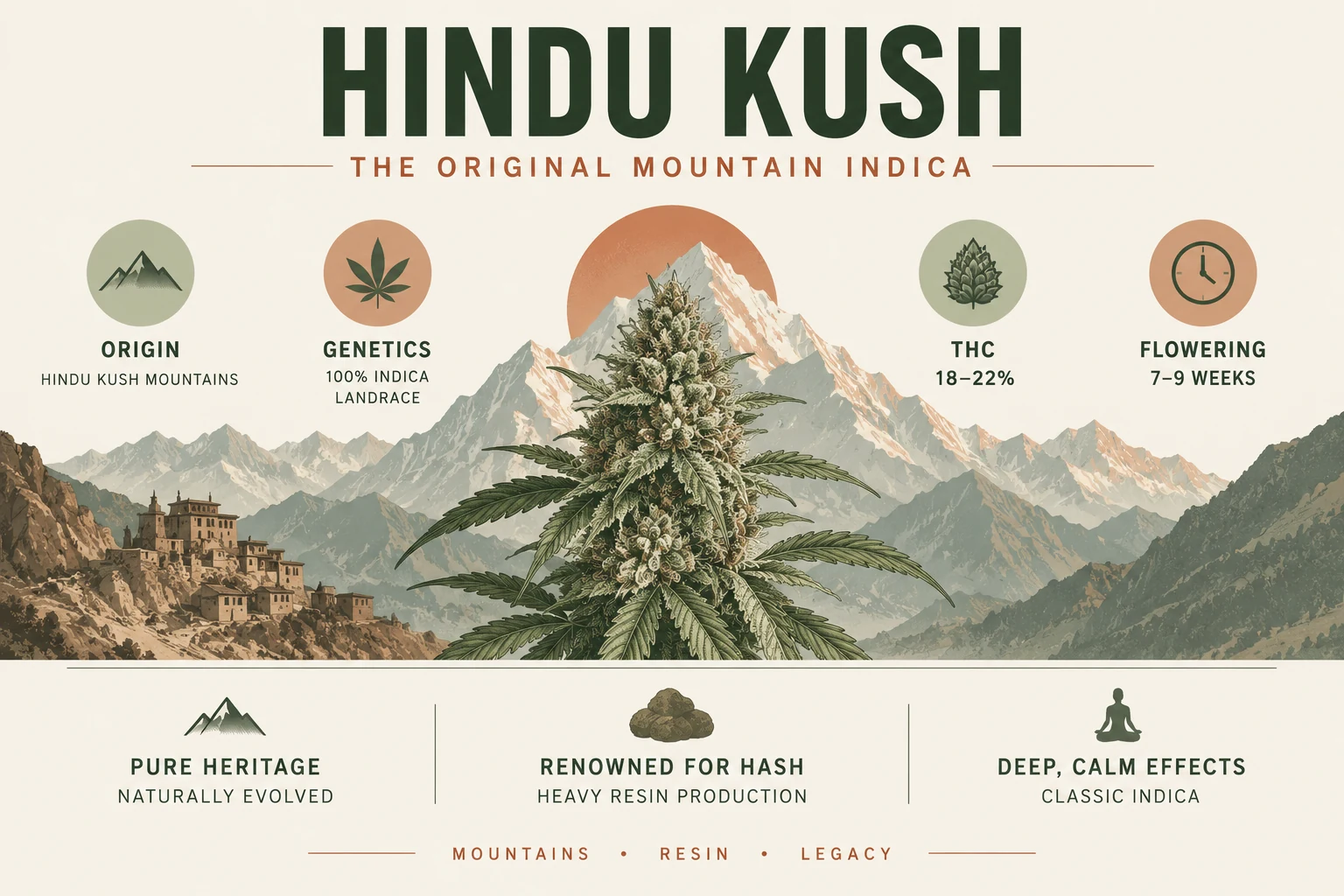
The Hindu Kush strain is the pure landrace indica that the entire Kush family grew out of, carried down from the mountain range that runs along the Afghanistan and Pakistan border.
This is the strain story: where Hindu Kush comes from, what those mountain conditions did to the plant, the resin it produces, how it actually feels, and how it behaves in Australian gardens. For the full grow detail, the feeding, the yields and the harvest timing, the Hindu Kush feminised seeds page sets all of that out. We stock Hindu Kush as a photoperiod only, and that is deliberate, for reasons I will get to in the growing section.
Quick answer
Hindu Kush is a pure indica landrace from the mountain range along the Afghanistan and Pakistan border, carrying the dense trichome coverage that made the region’s hashish famous.
Hindu Kush is best known as the genetic root of the Kush family, including Purple Kush, Master Kush and much of the OG Kush line. CBD sits below 0.2%.
In this review
Hindu Kush Strain at a Glance
Hindu Kush is a 100% indica landrace testing 15% to 20% THC with CBD below 0.2%, flowering in seven to nine weeks and yielding 350 to 450 grams per square metre indoors. Hindu Kush stays compact, rarely passing 150 centimetres outdoors, and rates easy to moderate on difficulty.
| Type | 100% indica — pure landrace, not a hybrid |
| Genetics | Landrace population from the Hindu Kush range, Afghanistan and Pakistan |
| THC | 15–20% (lab averages cluster near 17%; individual panels range 12.8% to 20.9%) |
| CBD | Below 0.2%, typically under 0.1% |
| Other cannabinoids | CBG around 1%, which is high for a landrace indica |
| Dominant terpenes | Caryophyllene leads, with limonene and myrcene close behind |
| Flavour and aroma | Earthy, sweet, sandalwood and incense, dry spice on the exhale |
| Effects | Heavy and physical, body first, quiet-headed, sedating toward the back end |
| Flowering time | 7–9 weeks |
| Indoor yield | 350–450 g/m² |
| Outdoor yield | 400–500 g per plant in a good season |
| Height | 60–100 cm indoors, rarely above 150 cm outdoors |
| Difficulty | Easy to moderate — forgiving except in humidity |
| Australian outdoor harvest | March into April in the southern states; dry season only in the tropics |
| Awards | None — Hindu Kush predates the awards circuit. Its standing is genealogical |
| Format stocked | Photoperiod feminised only |
Hindu Kush is a pure indica landrace, meaning the strain was never bred in a grow room by anyone chasing a trait. Hindu Kush was shaped over generations by altitude, cold nights, thin air and a short growing window, and the plant that came out the other side is compact, broad-leafed, fast to finish in seven to nine weeks, and coated in resin. Every one of those characteristics is a survival adaptation that happens to be exactly what growers want.
Hindu Kush is one of the two or three genuine foundation stones of modern indica genetics. If you have grown anything with Kush in the name, or anything descended from Afghani lines, you have grown something that traces back to this region. That makes Hindu Kush less of a novelty pick and more of a reference point, which is the main reason it is worth having in the landrace range.
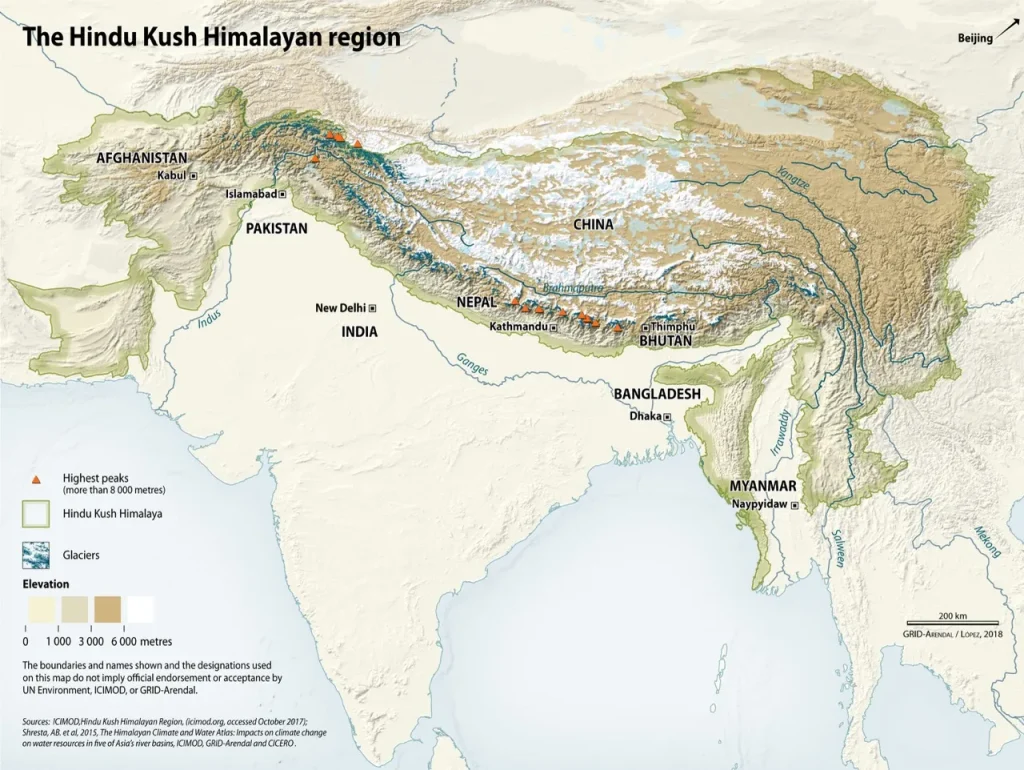
Where Does the Hindu Kush Strain Come From?
Hindu Kush comes from the Hindu Kush mountain range, roughly 800 kilometres of high country running from central and eastern Afghanistan into northwestern Pakistan and clipping southern Tajikistan. Cannabis has grown there for generations, cultivated not for flower but for charas — hand-rubbed hashish — and that single fact explains most of what the plant is.
The traditional product of that region was never smoked flower. It was resin, separated from living plants by hand and pressed. When the entire agricultural purpose of a crop is resin, the plants that get kept and replanted year after year are the ones that produce the most of it. Centuries of that selection pressure is the main reason Hindu Kush is as frosty as it is. The environment probably helped — heavy trichome coverage is widely thought to buffer a plant against UV exposure and cold at altitude, though the evidence for that is less settled than the internet suggests. The deliberate human selection is not in doubt at all.
Which is a neat illustration of something that runs through the whole history of cannabis seed: landraces are not wild plants. They are farmed populations, shaped by what the farmer wanted.
Jason on what those plants actually look like
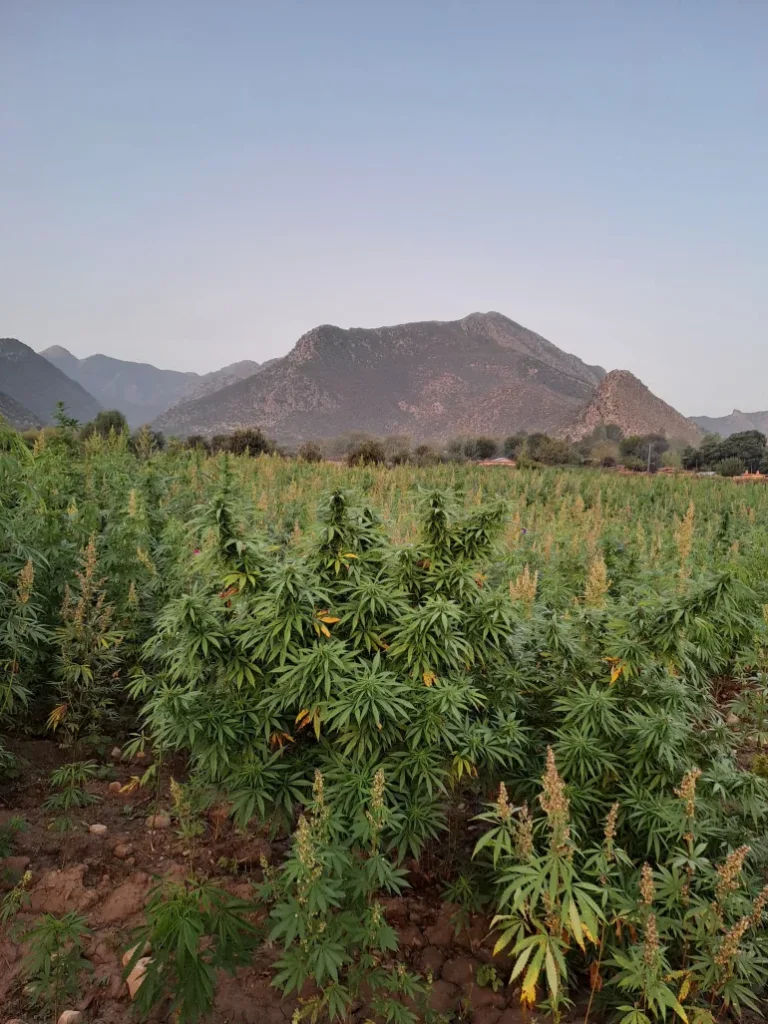
I have spent time in that part of the world, through Pakistan and later through Himachal Pradesh, and what stays with me is how little those plants resemble anything in a Western catalogue. Short, thick-stemmed, broad leaves, almost nothing spent on height. The plant’s whole budget goes into the top half and into resin.
What that means in a grow room is that you are working with a plant that has no instinct to stretch. Growers come to Hindu Kush looking for the training solution, the way you would with a modern hybrid, and there is not a problem to solve. Leave it alone and it builds the shape you wanted anyway.
Jason · Grow room & greenhouse
When Western growers started collecting seed from that region through the 1960s and 1970s and carrying it back to Europe and North America, those genetics became the indica half of almost everything that followed. The Afghani and Hindu Kush lines are what gave modern hybrids their density, their resin, their short flowering time and their compact structure. Nearly every strain in the cannabis seeds Australia catalogue owes something to them, and our cannabis genetics family tree maps how those lines connect.
One caveat about what is actually in the packet. Seed sold as Hindu Kush in the West is almost never seed collected from the mountains. What circulates commercially is a line that was brought back decades ago and stabilised in Europe and North America ever since, selected for uniformity in a way a true landrace population never is. That makes it a faithful representation of the genetics rather than a wild sample, and anyone offering you a literal Afghan mountain landrace in a ten-pack is overselling it. The character is intact. The provenance is a lineage, not a postcode. If the distinction interests you, our guide to landrace to hybrid genetics covers how that stabilisation process works.
What Does the Hindu Kush Strain Feel Like?
Hindu Kush is heavy, physical and slow. At 15% to 20% THC the strain arrives in the body rather than the head, settles into the shoulders and legs over the first twenty minutes, and holds there for a couple of hours. There is no cerebral opening phase the way there is with a hybrid.
The mental side is quiet rather than busy, which is the part people either love or find dull depending on what they wanted from it. Hindu Kush is an evening strain and it is not subtle about the fact. It suits the end of the day when nothing else is planned, and it does not suit an afternoon where you still intend to be useful.
Compared to a modern high-THC hybrid, Hindu Kush is less sharp and less racy at the front end, which some growers read as weakness. It is not weaker. It is older in character. Landrace indica effect is broad and slow rather than pointed, and the difference between 18% THC spread across a slow physical build and 26% THC delivered as a spike is a difference in shape, not in strength. If you want the comparison drawn out properly, our guide to sativa versus indica genetics covers why the two families land so differently.
What to expect
Quiet-headed rather than stimulating, and physical from the start. If you want something that keeps conversation going, our sativa range is a better place to look.
Hindu Kush Flavour, Aroma and Terpenes
Hindu Kush tastes earthy first, then sweet underneath, with a sandalwood and incense quality characteristic of the old Kush lines and almost absent from anything bred in the last fifteen years. Caryophyllene leads the terpene profile at around 0.44%, with limonene and myrcene both near 0.31%.
There is a dry, spicy edge on the exhale that comes straight off the caryophyllene. Hindu Kush is not a loud strain in the modern candy-and-fuel sense, and anyone arriving from Runtz or Zkittlez will find the nose restrained by comparison.
The terpene numbers are worth sitting with, because they contradict the story everyone tells about this plant. The received version is that myrcene leads, since myrcene is the terpene people reach for whenever a strain feels heavy. Lab panels do not support it. Caryophyllene tests highest, limonene matches or beats myrcene, and some panels put limonene first outright. The weight of the effect is clearly real and the simple myrcene explanation for it is clearly wrong, which is a decent reminder that single-terpene shorthand explains less than it promises. Our guide to cannabis terpenes goes further into why.
Jess on the cure
This is the strain where a rushed dry shows up worst. Hindu Kush that came down too fast tastes flat and hay-like and you would never guess there was sandalwood in there at all. The incense character is the last thing to arrive and it only arrives if you are patient.
Slow dry, then weeks in jars, not days. It is the clearest before-and-after I have tasted on any strain we stock — the curing guide is worth following properly here rather than approximately.
Jess · Flavour & selection
Growing the Hindu Kush Strain in Australia
Hindu Kush is a hardy, forgiving plant in the right climate and a genuinely risky one in the wrong climate, and the difference is humidity rather than heat. Hindu Kush rates easy to moderate, finishes in seven to nine weeks, and yields 350 to 450 grams per square metre indoors.
The plant itself is easy to like. Hindu Kush stays short and stocky at 60 to 100 centimetres indoors, does not stretch much after the flip, and fits a tent or a small outdoor spot without training gymnastics. Hindu Kush handles temperature swings better than almost anything else we stock, a direct inheritance from cold mountain nights, so inland gardens with big day-to-night differentials suit it well. The seven to nine week finish is the single most useful trait for growers in the southern states, because it lets you get in and out before the autumn rain arrives.
There is a useful rule of thumb on latitude. The standard outdoor guidance for Hindu Kush is to stay inside 42 degrees, which in Australian terms covers every capital except Hobart, sitting at 42.9 degrees south. Launceston, at 41.4 degrees, is just inside the band. That is a guide rather than a wall — southern Tasmanian growers do finish this strain — but it does mean a Hobart outdoor run wants a north-facing wall and a tolerance for a late, cold finish.
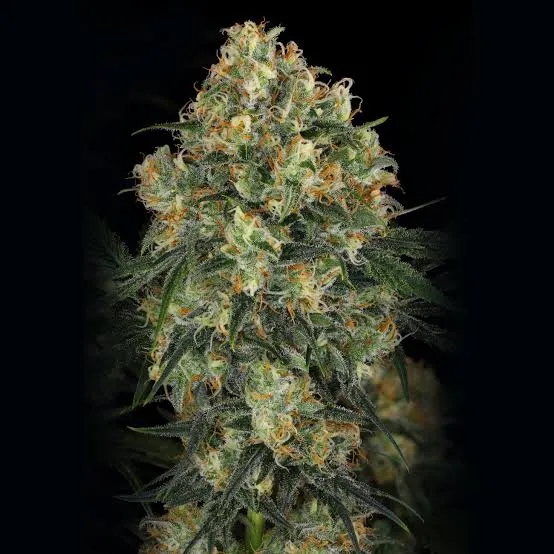
The catch is what those dense buds do in moisture. Hindu Kush was shaped by an arid environment and has no evolutionary experience of a humid subtropical autumn. The buds are tight and heavy and they hold water, so in Queensland, the Northern Territory or anywhere on a humid coastal strip you are managing bud rot risk from the moment flower sets. Airflow is not optional, selective defoliation through the canopy is worth the effort, and in the tropics the dry season is the only sensible window. In Victoria, Tasmania, South Australia, Western Australia and the southern half of New South Wales, none of that applies with anything like the same force.
Jason on the bud density
The thing people underestimate is how tight these buds get. You can have a plant that looks perfect from the outside and has rot starting in the middle of the biggest cola, because there is no air moving through the centre of it and the structure holds moisture like a sponge.
Check inside the big ones, not just the surface. If you are on the coast, I would rather you took a plant down at eight weeks in good condition than pushed to nine and lost the top third of it.
Jason · Grow room & greenhouse
Outdoors in the southern states the usual pattern applies: in the ground around September or October, flowering from late summer as the light drops, harvest through March and into April. Cool nights in the final fortnight will often pull deeper colour into the buds, which is cosmetic rather than a potency signal but makes for a good-looking harvest. Our guide to growing cannabis outdoors in Australia covers the seasonal timing in detail, and reading trichomes at harvest matters more than usual on a strain this resinous.
Precise feeding, EC targets and the week-by-week timeline sit on the Hindu Kush seeds page rather than here.
There is no autoflower version in our range and no plan for one. The fixed timeline of an auto removes the recovery window that makes a photoperiod forgiving, and the whole appeal of this plant is that it tolerates a grower who is still learning — the trade-off is laid out in our autoflower versus photoperiod comparison. Putting Hindu Kush on a clock would remove the best thing about it. If a fixed timeline is what you need, Northern Lights Autoflower carries closely related Afghani genetics in that format, and the wider autoflower range has the rest.
Who Hindu Kush suits
- Growers in southern or inland Australia who want a fast, compact, low-drama photoperiod
- Anyone with limited height to work with, indoors or on a balcony — see the compact range
- Hash and rosin makers, since the resin density is the whole point of the plant
- Collectors who want a foundational landrace rather than a modern cross
- Newer growers who want something that tolerates mistakes, alongside the rest of our beginner-friendly strains
- Anyone who prefers a heavy, quiet evening effect over a bright or racy one
Think twice if you are on a humid coastal strip without airflow, if you want a daytime strain, or if you are chasing a headline THC number — at 15% to 20%, Hindu Kush is not the strongest thing in the high-THC photoperiod range and was never going to be.
Which Strains Come From Hindu Kush?
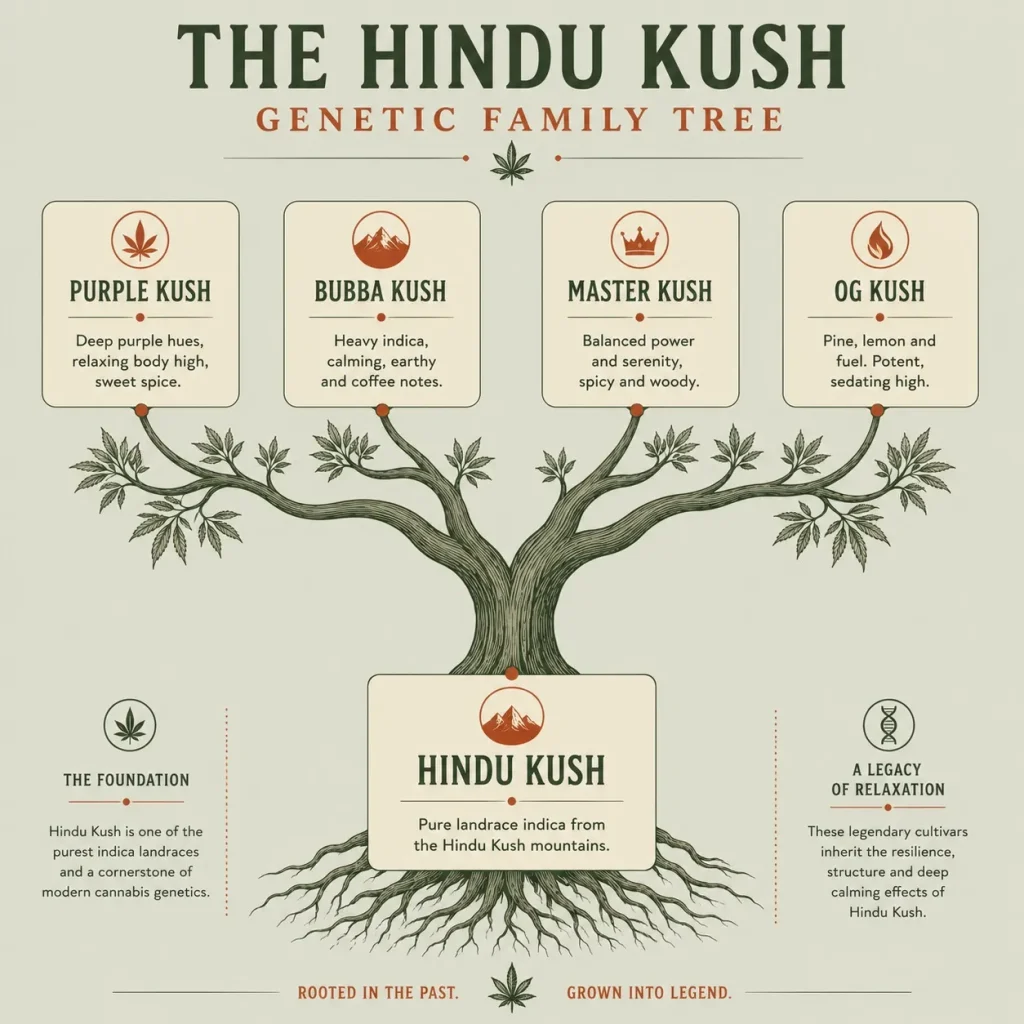
Hindu Kush is a direct parent of Purple Kush and Master Kush, and is commonly traced behind Bubba Kush and the OG Kush line, though the OG lineage is disputed. Through the broader Afghani family, Hindu Kush genetics sit behind Northern Lights and a very large share of modern indica breeding.
This is where Hindu Kush earns its place. Its descendants are everywhere, and several of them are strains people know far better than they know the original.
| Strain | Relationship to Hindu Kush | How certain |
|---|---|---|
| Purple Kush | Direct cross with Purple Afghani — keeps the pure indica structure, adds the colour | Well established |
| Master Kush | Two separate landraces from within the Hindu Kush region — effectively crossed with a cousin of itself | Well established |
| Bubba Kush | Hindu Kush commonly named on the indica side | Widely repeated, not documented |
| OG Kush | Hindu Kush frequently cited as an ancestor | Disputed — anyone claiming certainty is overstating it |
| Godfather OG | Downstream of the OG Kush line, so inherits whatever OG inherited | Indirect |
| Northern Lights | Built on Afghani rather than Hindu Kush specifically — neighbouring landrace, same mountain system | Related, not descended |
| Black Domina | Stacks four heavy indica lines from the same genetic territory | Related, not descended |
| Granddaddy Purple | Purple Afghani on one side, so shares the colour genetics rather than the Kush line | Related, not descended |
The connection to the Afghani side of the family is worth being precise about, because the two names get used interchangeably far more often than they should be.
| Compare | Hindu Kush | Afghani |
|---|---|---|
| Origin | The Hindu Kush range proper, into Pakistan | Broader Afghan growing regions, overlapping territory |
| Relationship | Neighbouring landraces, not the same plant | Neighbouring landraces, not the same plant |
| Best known for | Founding the Kush naming family | Sitting behind Northern Lights and most modern indica breeding |
| In our range | Photoperiod feminised only | Expressed through Northern Lights and Black Domina |
Two of those descendants are stocked in both formats. Purple Kush is the most direct example and the closest thing to Hindu Kush with colour added, available as Purple Kush Autoflower as well. If you want to see how the whole picture fits together rather than one branch at a time, the cannabis genetics family tree lays out the connections between the landraces and the modern hybrids they produced, and the indica seeds guide covers the family as a whole.
If you are weighing Hindu Kush against the rest of the indica range and are not sure where you land, the strain finder will narrow it down in seven questions based on your setup and what you are actually after. The old school collection gathers the rest of the heritage genetics in one place.
Hindu Kush is not the strongest thing we stock and was never going to be. What Hindu Kush is instead is the origin point for a very large part of what everyone else is growing, in a plant that is compact, fast, hardy and genuinely pleasant to work with.
Key takeaways
Hindu Kush Strain: Frequently Asked Questions
Is Hindu Kush a pure indica?
Yes. Hindu Kush is one of the few genuinely pure indica landraces in commercial circulation rather than an indica-dominant hybrid. That shows in the plant structure, the broad leaves, the short stature and the weight of the effect. Worth knowing that commercial Hindu Kush seed is a Western-stabilised line descended from the original population, not seed collected from the mountains.
Where does the Hindu Kush strain come from?
The Hindu Kush mountain range, running about 800 kilometres from central and eastern Afghanistan into northwestern Pakistan and touching southern Tajikistan. Hindu Kush was cultivated there for hashish production long before the strain reached Western seed catalogues.
How strong is the Hindu Kush strain?
Hindu Kush tests between 15% and 20% THC, with lab averages clustering near 17% and individual panels ranging from 12.8% to 20.9%. CBD sits below 0.2%. That puts Hindu Kush in the moderate band by modern standards, but the effect feels heavier than the number suggests because it arrives slowly and physically rather than as a spike.
What does a landrace strain actually mean?
A landrace is a population that developed in one geographic region over a long period without deliberate crossbreeding, shaped by local climate and local selection. Landraces are the ancestors modern hybrids were built from. Durban Poison is the sativa equivalent in our range, and the wider landrace collection has the rest.
How long does Hindu Kush take to flower?
Seven to nine weeks, which is fast and one of the main reasons Hindu Kush works for Australian outdoor growers in the southern states. Precise timing, yields and feeding are on the Hindu Kush feminised seeds page.
What yield and height should I expect from Hindu Kush?
Hindu Kush yields 350 to 450 grams per square metre indoors and 400 to 500 grams per plant outdoors in a good season. Height runs 60 to 100 centimetres indoors and rarely passes 150 centimetres outdoors, with limited stretch after the flip, which makes Hindu Kush manageable in a tent or a small outdoor space without heavy training.
Is Hindu Kush good for beginners?
Yes, in the right climate. Hindu Kush rates easy to moderate, tolerates temperature swings, stays short and gives a photoperiod grower room to recover from mistakes. The exception is humidity — in a humid coastal or tropical garden the bud density makes rot management a real skill, which is not a beginner job. Our beginner strain guide covers the alternatives.
Is Hindu Kush good for Australian conditions?
In southern and inland Australia, yes. Hindu Kush handles temperature swings well and finishes early enough to beat the autumn rain. In humid subtropical and tropical regions Hindu Kush needs a lot more attention because the dense buds hold moisture. The standard latitude guidance of 42 degrees puts every Australian capital except Hobart comfortably inside the band. Our guide to the best strains for the Australian climate covers the regional picture.
Is there an autoflower version of Hindu Kush?
Not in our range, and it is not planned. The fixed auto timeline removes the recovery window that makes Hindu Kush a forgiving photoperiod. For related Afghani genetics on a fixed timeline, Auto Northern Lights is the closer match.
What is the difference between Hindu Kush and Afghani?
Hindu Kush and Afghani are neighbouring landraces from an overlapping mountain region, not the same plant, though the names get used interchangeably. Hindu Kush founded the Kush naming family. Afghani is the line that sits behind Northern Lights and much of modern indica breeding. In practice the two are close enough that most growers will not tell them apart blind.
Which strains come from Hindu Kush?
Purple Kush is the most direct descendant we stock, crossed with Purple Afghani. Master Kush came from two landraces within the same region. Bubba Kush and the OG Kush line are both commonly traced back to Hindu Kush, though the OG lineage is disputed and anyone claiming certainty is overstating the case.
Why is Hindu Kush so resinous?
Centuries of selection for charas production meant the highest-resin plants were the ones replanted each year, generation after generation. Altitude probably contributed as well, since heavy trichome coverage is thought to buffer a plant against UV and cold, though that part is less settled than the deliberate human selection.
Is Hindu Kush good for hash and rosin?
Hindu Kush is one of the better options in the catalogue for it, which follows directly from what the plant was originally cultivated for. Keep the trim — the resin density makes it worth processing. Black Domina is the other strong choice in the same territory.
What does Hindu Kush taste like?
Earthy and sweet with a distinct sandalwood and incense quality, and a dry, spicy note on the exhale. Caryophyllene leads the terpene profile at around 0.44%, with limonene and myrcene both near 0.31%. A slow cure makes a large difference here — rushed Hindu Kush tastes flat and hay-like.
Is Hindu Kush a daytime or evening strain?
Evening, without much ambiguity. The effect is heavy and physical rather than stimulating, so Hindu Kush suits the end of the day when nothing else is planned. For daytime, the sativa range is the right direction, and our guide to the best sativa strains by region narrows it down by climate.
Where can I buy Hindu Kush seeds in Australia?
Directly from us, shipped from within Australia with tracked delivery and no customs exposure. The Hindu Kush feminised seeds page has current pricing and pack sizes.
Sacred Seeds Australia sells cannabis seeds strictly as souvenirs and for genetic preservation, in accordance with local laws. The Australian Capital Territory permits limited personal cultivation for adults. All other states and territories prohibit it. Nothing in this article is medical or legal advice. Always check the laws that apply where you live before germinating or cultivating.
Related reading: the Northern Lights review for the Afghani side of the same family, the Purple Kush review for the most direct descendant, the cannabis genetics family tree for how the landraces connect to everything modern, our indica-dominant range, and the full cannabis seeds Australia catalogue.