I have a soft spot for anything with Kush in the name. Purple Kush goes a step further. I first came across it during the bud-picking days in California, and the sight and smell of it still takes me straight back there. Dense flower, dark colour, earth, hash and just enough sweetness. Proper old California weed, from before half the strain names started sounding like rejected energy drinks.
Purple Kush at a glance
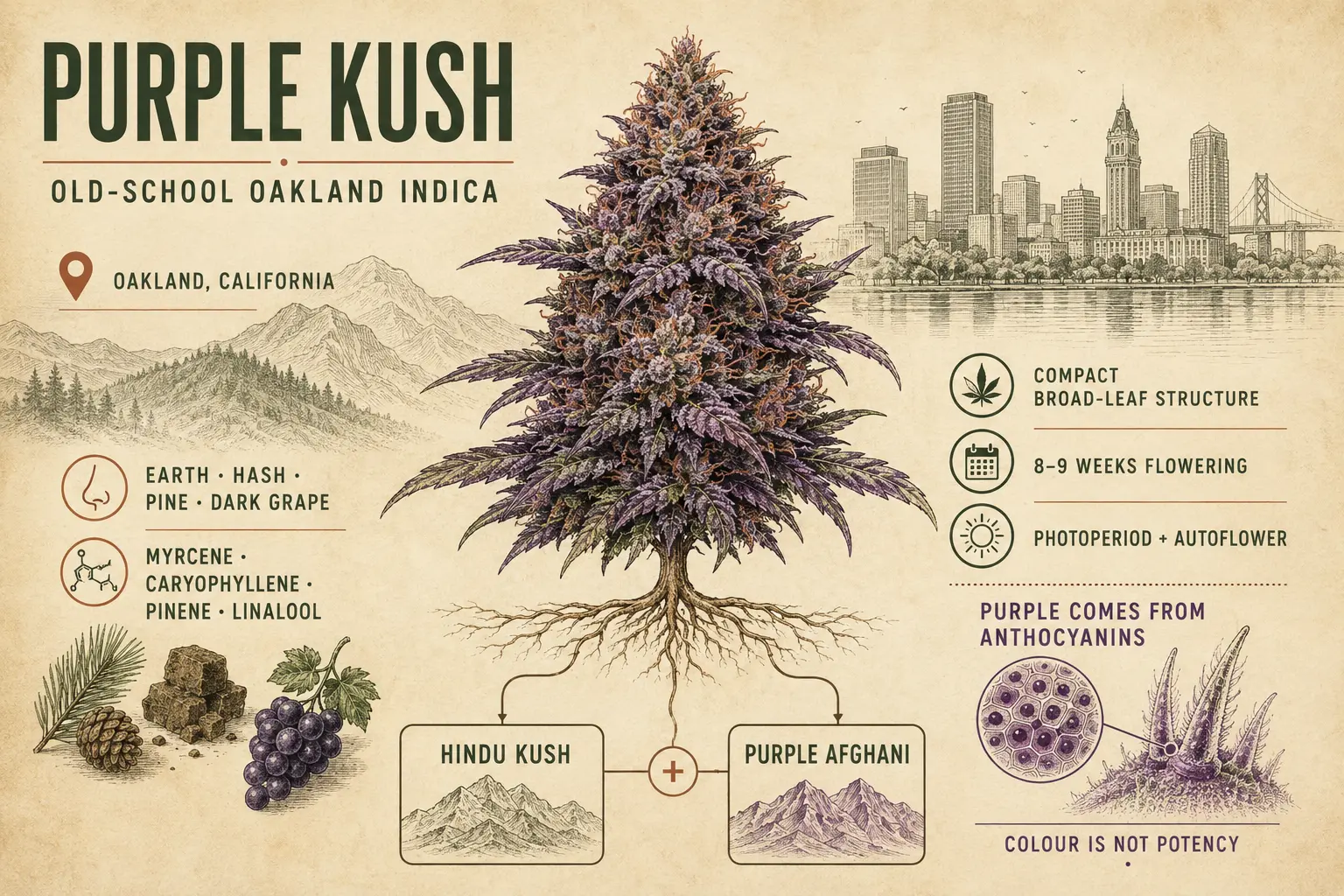
- Lineage: Hindu Kush × Purple Afghani
- Origin: Oakland, California
- Type: Heavily indica, commonly described as pure indica
- Typical THC range: Approximately 17–22%
- Aroma and flavour: Earth, hash, grape, berry, pine and floral spice
- Common terpenes: Myrcene, beta-caryophyllene, pinene and linalool
- Photoperiod flowering: Usually around 8–9 weeks
- Structure: Short to medium, bushy and compact
That nostalgia is not the only reason Purple Kush has lasted. The strain has real pedigree: Hindu Kush and Purple Afghani genetics, an Oakland history, compact indica structure and a flavour that does not need icing, cereal or a trademarked dessert to make itself interesting.
This Purple Kush strain review covers the history we can verify, the parts that remain uncertain, its likely terpene and effect profile, what makes the plant turn purple, and the differences between photoperiod Purple Kush and Purple Kush autoflower seeds.

What is Purple Kush?
Purple Kush is a heavily indica strain most commonly recorded as Hindu Kush × Purple Afghani. It became known through Oakland and the wider California Bay Area, although nobody has produced a convincing record of one original breeder or a precise year of creation.
That fuzzy history is believable. Purple Kush was circulating before every cross had a launch campaign, a logo and six people arguing about ownership online. The safest description is that it emerged from Oakland’s cannabis community using old Afghan and Hindu Kush stock, then travelled because the flower was hard to forget.
Published samples and seed lines are commonly described in the 17–22% THC range. Treat that as an indication, not a guarantee. Purple Kush is a name shared across different selections, and the finished result changes with phenotype, environment, harvest timing and cure.On this page
What is Purple Kush?
Genetics and Oakland history
Flavour and terpene profile
Purple Kush effects
Why Purple Kush turns purple
Growing characteristics
Autoflower vs photoperiod
Purple Kush vs Granddaddy Purple
Frequently asked questions
Purple Kush genetics and Oakland history
The usual lineage, Hindu Kush crossed with Purple Afghani, makes sense when you look at the plant. Both sides come from the broad-leaf mountain indica gene pool associated with Afghanistan and the Hindu Kush region.
Hindu Kush is known for compact growth, resin production and dry, earthy hash aromas. Purple Afghani brings similar broad leaves and dense flowers, with a stronger chance of violet colour and a sweeter fruit edge. Purple Kush does not hide either parent particularly well.
Oakland matters because Purple Kush is a California strain as well as a mountain-genetics strain. The Bay Area became a meeting point for Afghan genetics, local purple selections and growers who kept good plants alive through informal networks. Purple Kush appears to have come out of that world rather than one commercial breeding programme.
You will find confident creation dates and breeder names repeated online, but repetition is not evidence. Hindu Kush × Purple Afghani and an Oakland origin are the well-established parts. Beyond that, the early history is mostly oral. Our cannabis genetics family tree places Purple Kush within the broader classic indica and purple families.
What Purple Kush smells and tastes like
The first note I remember is earth. Then comes hash, pepper and pine, with dark grape or berry sitting behind it. Some plants lean more floral, almost lavender-like. Others are woody, musky and barely sweet at all.
This is where Purple Kush differs from many newer purple strains. It can smell fruity, but it is not confectionery. The grape note sits inside the Kush character instead of taking over the room. If Granddaddy Purple is the sweeter glass of red, Purple Kush is the dusty cellar it came from.
Purple Kush terpene profile
There is no single laboratory profile that represents every Purple Kush seed line. Across published strain references, the same four terpenes appear regularly:
- Myrcene: earthy, musky and herbal
- Beta-caryophyllene: peppery, woody and spicy
- Pinene: fresh pine and resin
- Linalool: floral and lightly lavender-like
The order and concentration will vary between plants. That is why one Purple Kush can smell like grape skin and violets while another is mostly earth, pepper and pine. The name gives you a family resemblance, not a factory setting.
Purple Kush effects
Purple Kush is known for a heavy, settling indica effect. The usual pattern is an initial lift in mood followed by a slower, more physical feeling. It is not generally chosen for a busy afternoon, a tax return or any task requiring great enthusiasm.
That description is a reputation, not a promise. Cannabinoid content, terpene balance, dose and individual tolerance all change the experience. Strong flower may also cause dry mouth, dry eyes, dizziness or discomfort when too much is consumed. We describe strain characteristics for education only and do not make medical claims.
Jason on Why Purple Kush Stuck
For me, the appeal is bigger than potency. Purple Kush has the unmistakable feel of a classic Kush: dense in the hand, earthy when opened and almost instantly recognisable. The nostalgia arrives before anything else does.
Why does Purple Kush turn purple?
The colour comes from anthocyanins. These plant pigments can appear red, blue or violet depending on genetics and the chemistry inside the plant tissue. As chlorophyll declines late in flower, a genetically capable Purple Kush phenotype may reveal purple leaves and flowers underneath.
Cooler nights can help that colour show, but cold cannot add purple genetics that the plant does not possess. Deliberately freezing a plant is more likely to cause stress than produce a masterpiece.
Just as importantly, purple does not mean stronger. A green Purple Kush phenotype may be every bit as resinous and potent as a dark violet one. Colour is bag appeal, not horsepower.
We cover the pigment science, temperature question and other violet cultivars in our guide to the best purple cannabis strains in Australia.
Purple Kush growing characteristics
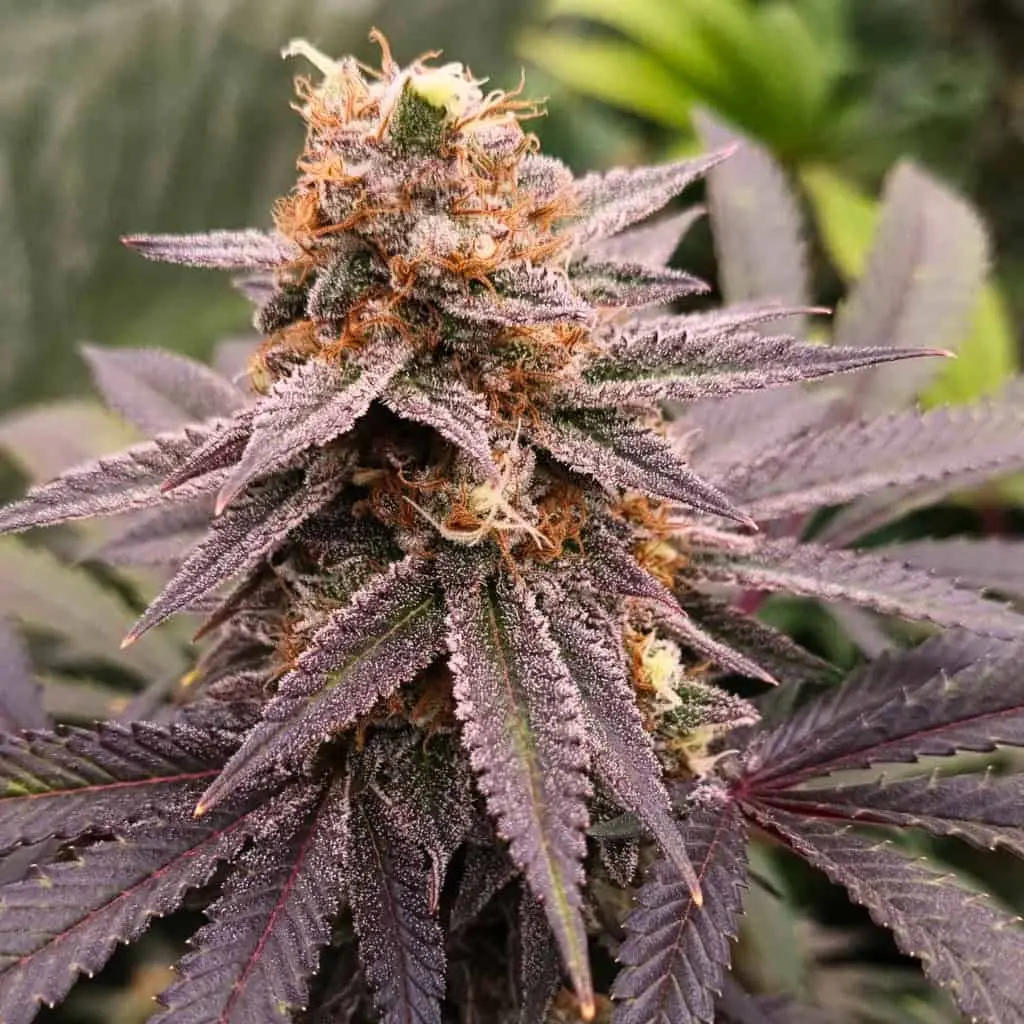
Purple Kush normally carries broad leaves, close internodal spacing and strong lateral branching. Photoperiod plants tend to remain short to medium rather than stretching dramatically. The flowers are usually compact, dense and heavily coated when the phenotype is good.
Most Purple Kush photoperiod lines finish in about 8–9 weeks of flowering. That number is a guide. Do not cut a plant simply because the packet says week eight and the calendar has become impatient. Flower development, the overall fade and resin maturity tell you more. Our guide to when to harvest cannabis explains how to read those signals together.
Growing Note: Dense Flowers Need Air
The dense flower structure makes airflow worth watching. Humidity trapped inside thick Kush buds is not charming. It is how a promising finish becomes a botrytis inspection.
Our Purple Kush feminised seeds are the traditional photoperiod format. They suit collectors who want control over the vegetative period, final size and the point at which flowering begins.
Purple Kush autoflower vs photoperiod
The original Purple Kush is a photoperiod strain. A Purple Kush autoflower introduces ruderalis-derived automatic flowering, so the plant begins to bloom according to age rather than waiting for a shorter light cycle.
Our Auto Purple Kush feminised seeds keep the Kush family character in a smaller, faster format. A Purple Kush auto has a fixed life cycle and less time to recover from early stress. The photoperiod version gives you more time and control.
Put simply, Purple Kush autoflower seeds suit speed, compact spaces and growers who do not want to manage a flowering light change. Auto Purple Kush is less forgiving of a rough start. Traditional Purple Kush takes longer overall but lets you decide how large the plant becomes before flower.
| Trait | Purple Kush photoperiod | Purple Kush autoflower |
|---|---|---|
| Flower trigger | Shorter light cycle | Plant age |
| Timing | Vegetative period plus about 8–9 weeks flowering | Roughly 10–11 weeks from seed as a general guide |
| Control | More control over size and recovery time | Fixed, faster life cycle |
| Typical structure | Compact to medium | Compact |
| Best fit | Growers wanting the classic format and more control | Growers prioritising speed and simplicity |
If you are still deciding between the formats, our autoflower vs photoperiod guide explains the practical differences without pretending one is always better.
Choose Your Purple Kush Format
Purple Kush Feminised Seeds → | Auto Purple Kush Feminised Seeds →
Purple Kush vs Granddaddy Purple
Purple Kush and Granddaddy Purple are easy to confuse. Both are California-associated indicas, both can turn violet, and both carry grape and berry notes. They are not the same strain.
Purple Kush is generally recorded as Hindu Kush × Purple Afghani. Granddaddy Purple is most widely recorded as Purple Urkle × Big Bud, although GDP has its own disputed history. Purple Kush is usually earthier, hashier and more pine-led. Granddaddy Purple tends to be sweeter and more openly grape-and-berry.
| Trait | Purple Kush | Granddaddy Purple |
|---|---|---|
| Accepted lineage | Hindu Kush × Purple Afghani | Purple Urkle × Big Bud is the most widely cited |
| Genetic character | Heavily indica, often called pure indica | Indica-dominant hybrid |
| Aroma emphasis | Earth, hash, pine and restrained grape | Sweet grape, berry and floral notes |
| Structure | Compact and bushy | Compact, with more hybrid yield influence |
We stock Granddaddy Purple feminised seeds as well. Choose GDP if the sweeter grape profile is the main attraction. Choose Purple Kush if you want the drier, earthier and more traditional Kush side of the purple family.
Jason’s Purple Kush verdict
I am biased toward Kush strains and not especially sorry about it. Purple Kush has the dense flower, resin and earthy hash character I want from the family, but the colour and dark-fruit edge give it a personality of its own.
More than anything, it takes me back to California. There are strains you remember because somebody told you they were important. Purple Kush is one I remember because I encountered it, opened it and immediately understood the fuss.
Purple Kush strain FAQ
Is Purple Kush indica or sativa?
Purple Kush is a heavily indica strain and is often described as a pure indica. Its accepted parents, Hindu Kush and Purple Afghani, both come from the broad-leaf mountain indica gene pool.
What are the genetics of Purple Kush?
The accepted Purple Kush lineage is Hindu Kush × Purple Afghani. The strain is associated with Oakland, California, although its original breeder and exact creation date are not reliably documented.
How long does Purple Kush take to flower?
Photoperiod Purple Kush generally flowers for around 8–9 weeks. A Purple Kush autoflower commonly completes its full seed-to-harvest cycle in roughly 10–11 weeks, depending on phenotype and conditions.
Does Purple Kush always turn purple?
No. Colour depends on phenotype, anthocyanin genetics and the growing environment. Cooler nights can encourage a capable plant to show more purple, but the colour is not guaranteed and does not indicate greater potency.
Is Purple Kush the same as Granddaddy Purple?
No. Purple Kush is commonly Hindu Kush × Purple Afghani. Granddaddy Purple is most widely recorded as Purple Urkle × Big Bud. They share purple colour and indica traits but have different genetic histories and flavour profiles.
Australian laws concerning cannabis seeds and cultivation vary by jurisdiction and can change. Sacred Seeds Australia supplies seeds for lawful purposes only. Check the rules that apply where you live.