Cannabis harvest day takes far longer than most first-time growers plan for, makes more mess than they expect, and ends with roughly a quarter of the weight they started the morning with.
This guide covers the day itself — what to have ready before you cut, how many hours to block out, whether to trim wet or dry, and what you realistically end up with. Deciding whether today is the day is a separate question, and our guide to when to harvest and the plant signals to read covers that in full, and reading amber trichomes is the close-up version of the same question. This one assumes you have already decided.
Quick answer
Cannabis harvest day means cutting, bucking and trimming, and hand trimming runs at roughly 30 minutes per ounce of finished flower. A single large plant is a full working day, not an afternoon.
Drying then removes 70 to 80% of the weight, so a kilogram of wet flower on the table becomes 200 to 300 grams in the jar. Build the drying space before you cut anything.
In this guide
What Does Cannabis Harvest Day Actually Look Like?
Cannabis harvest day runs in three stages: cutting the plant down, bucking the branches into manageable pieces, and trimming the flower. Cutting takes minutes. Bucking takes under an hour. Trimming takes the rest of the day and is the part everyone underestimates.
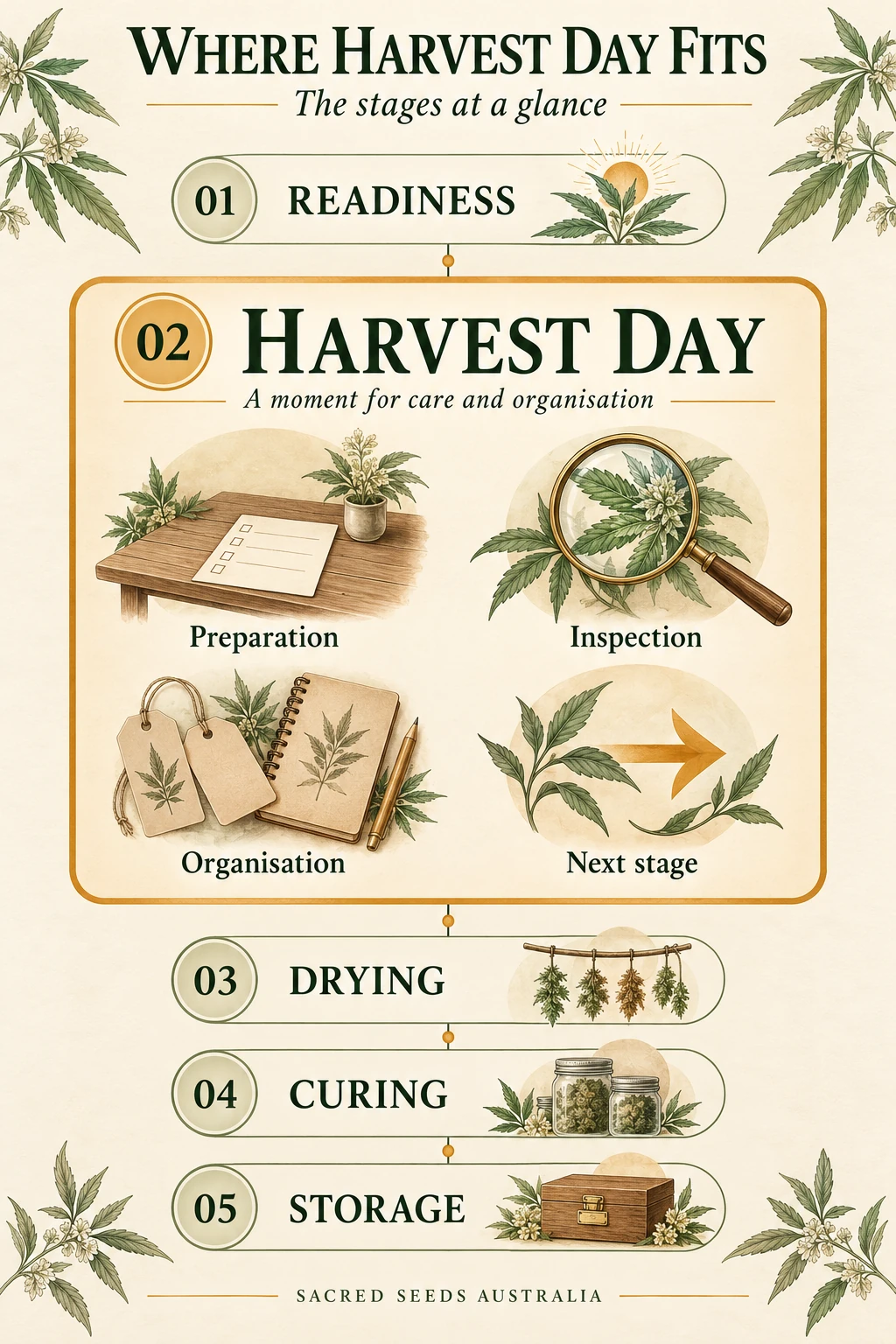
The mental model that causes trouble is thinking of harvest as an event. It is a shift. The cutting is the quick, satisfying part and it is over almost immediately, which is why so many growers start at four in the afternoon with a pair of scissors and finish at one in the morning with a sore neck and half a plant still on the table.
One more thing worth knowing before you plan the day: a tent of autoflowering plants rarely finishes together. Photoperiod plants flipped at the same time come down within days of each other, while autos run on their own clocks and often need three or four separate sessions a fortnight apart. Our comparison of autoflowers and photoperiods covers why.
Cut early in the day if you can. Harvesting at the start of the dark period, or first thing in the morning for an outdoor plant, is the long-standing convention, and whatever you believe about its effect on the flower, the practical argument is the stronger one: it gives you the daylight hours to do the work.
How the day runs
Three stages, wildly different in length.
What to Have Ready Before You Cut
Build the drying space before harvest day, not after. A cut plant cannot wait while you work out where to hang it, and wet flower left in a pile for even a few hours is the most common way a good grow is ruined at the last step.
The drying space is the one piece of preparation that genuinely cannot be improvised. Everything else on the list below can be solved with a trip to the shops. Somewhere dark, with moving air, that holds roughly 15 to 20°C — that takes planning, and in an Australian February it may take a cooled room rather than a shed. If you are working in a tent or a spare cupboard, our guide to growing cannabis in small spaces covers how to free up drying room in a setup that has none to spare.
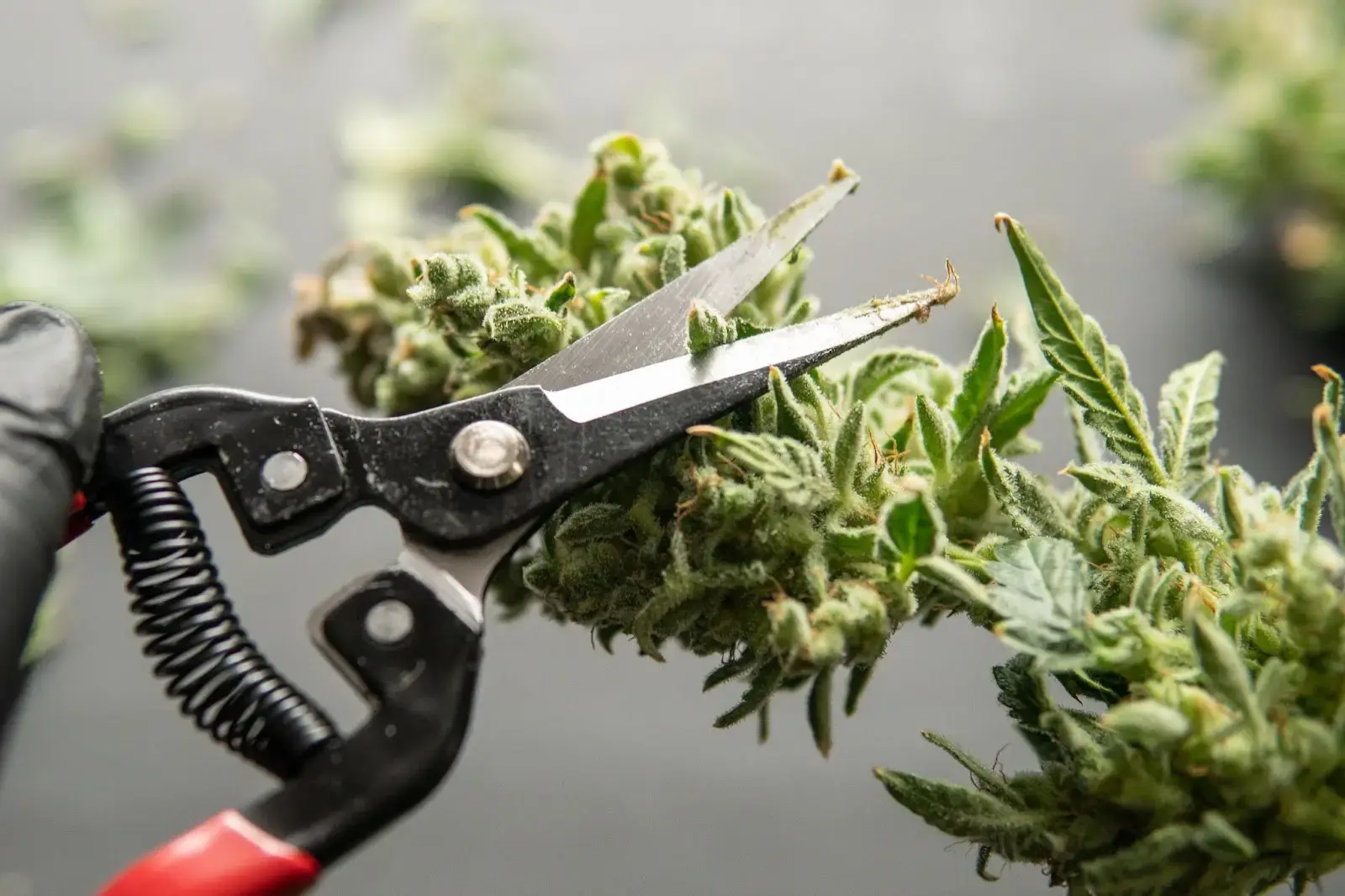
Ready before you cut
- Drying space built, dark, with gentle airflow and no fan pointed at the flower
- A hygrometer in that space, checked for a day beforehand
- Two pairs of spring-loaded trimming scissors, so one can soak while you use the other
- Isopropyl alcohol and a rag for cleaning resin off the blades
- Nitrile gloves, and clothes you do not mind writing off
- Scales, and something to record wet weight before anything dries
- A tray or bowl for trim, which is worth keeping
- Somewhere comfortable to sit for several hours, with good light
On the much-discussed darkness period — 24, 48 or 72 hours of no light before cutting — the honest position is that the evidence is thin. A Dutch trial reported a THC increase in buds held in darkness for 72 hours, while a separate dataset covering 30 strains found only four showed higher trichome concentration, with the remainder developing hermaphrodite traits or malformed buds. Neither result is strong enough to build a practice on. If your plants are ready, the defensible reason to harvest in the dark is scheduling, not chemistry.
Jason on the drying space
Every year someone messages me the night of their harvest asking where they can hang it, and by then it is already a problem. You cannot leave wet flower in a pile on a table overnight while you sort it out. It holds heat, it holds moisture, and you will find mould in the middle of the biggest colas in the morning.
Build the space a week early and run a hygrometer in it. If it sits above 65% you have a decision to make about the room, not about the plant. That is a job for the week before, not the night of.
Jason · Grow room & greenhouse
How Long Does Cannabis Harvest Day Take?
Hand trimming takes about 30 minutes per ounce of finished flower, which works out to roughly eight hours for a 450 gram plant. Experienced trimmers also cap themselves at six to eight hours a day, because accuracy and hand strength both fall off after that.
That single figure is the most useful thing to know before harvest day, because it converts an abstract job into a number of hours you can put in a calendar. Work backwards from your expected dry yield.
| Expected dry yield | Wet weight on the day | Hand trim time | What that means |
|---|---|---|---|
| 50 g — small autoflower | ~200 g | About 1 hour | An evening |
| 150 g — compact photoperiod | ~600 g | 2½ to 3 hours | An afternoon |
| 300 g — solid indoor plant | ~1.2 kg | 5 to 6 hours | A full day |
| 500 g — large indoor or small outdoor | ~2 kg | 8 to 9 hours | At the limit of one day |
| 1 kg — mature outdoor plant | ~4 kg | About 18 hours | Split across two or three days |
A bowl trimmer takes a 450 gram plant from roughly eight hours down to about two, including bucking and touch-up. The trade-off is a rounder, more uniform-looking bud and more handling of the flower, which costs some trichomes. For one or two plants a year, hands and good scissors are still the better answer. Past three or four large plants, the maths changes.
If this is your first harvest, add time rather than trimming faster. Everyone speeds up across their second and third plant, and nobody does good work in hour nine.
This is also worth carrying into next season’s seed choice, because yield is a scheduling decision as much as a volume one. A famously heavy producer like Moby Dick is a two-day job in a good year, while a compact photoperiod in a tent is an afternoon. Expected yield per plant is listed across the feminised seed range, and our guide to the best cannabis strains in Australia compares them side by side.
Should You Wet Trim or Dry Trim?
The wet versus dry trim decision is settled by the humidity of your drying space, not by preference. Above 60% relative humidity, trim wet. Below 50%, trim dry. Between the two, remove the fan leaves on the day and manicure the sugar leaves after drying.
Wet trimming means doing all the work on harvest day, with the flower still fresh. Less leaf mass means faster drying and less time for mould to take hold, which is why it suits humid rooms. Dry trimming means hanging whole branches with the leaves intact, waiting seven to fourteen days, and trimming the dried flower. The leaves slow moisture loss, which protects terpenes — a controlled trial found dry-trimmed flower held the highest terpene content, while the partial wet trim produced the highest cannabinoid content. Our guide to cannabis terpenes explains why those compounds are the first thing lost to heat and handling, and the entourage effect covers how they work alongside the cannabinoids.
For Australian growers that turns into a regional answer, because the drying space in a Darwin wet season and a Mildura autumn are not the same problem.
| Where you are | Typical drying-space RH | Trim method |
|---|---|---|
| Darwin, Cairns, coastal Queensland | Often above 65% | Wet trim, and consider a dehumidifier in the room |
| Coastal NSW, Brisbane, Byron hinterland | 60–70% through autumn | Wet trim |
| Melbourne, Sydney, Adelaide, Perth | 50–60% | Partial wet trim — fan leaves now, sugar leaves later |
| Hobart, Canberra, inland NSW and Victoria | 45–55% | Partial or dry trim |
| Alice Springs, Mildura, inland WA | Often below 45% | Dry trim, and watch that it does not dry too fast |
Measure rather than assume. A closed room with a dehumidifier in Brisbane can be drier than a garage in Ballarat, and the number on the hygrometer is what decides this, not the postcode. Dense-budded genetics raise the stakes either way — anything in the Hindu Kush family holds moisture in the centre of a cola and wants the faster-drying wet trim in anything but a genuinely dry room, and Black Domina is denser again. Airier sativa structure is far more forgiving here, which is one of the quieter arguments for the regional sativa picks in a humid garden.
Jess on keeping the trim
The sugar leaf you cut off is not waste. It is the frostiest material on the plant after the flower itself, and most first-time growers sweep it into the bin along with the fan leaves because nobody told them otherwise.
Keep two bowls going while you work — one for fan leaves, one for sugar leaf. The sugar leaf dries alongside everything else and it is the best argument for growing a resinous strain in the first place.
Jess · Flavour & selection
How Much Will You Actually End Up With?
Fresh cannabis is up to 80% water, and drying removes 70 to 80% of the harvest weight. Multiply your wet weight by 0.20 to 0.30 for a realistic dry figure — a kilogram of wet flower becomes 200 to 300 grams in the jar.
This is the part of harvest day that catches people hardest, and it is worth saying plainly before it happens rather than after. The scales on harvest day will show a number that feels enormous. Three weeks later the jars hold roughly a quarter of it. Nothing has gone wrong. That is simply what water weighs.
The grower-facing version of the rule: a plant that gives you 2 kilograms wet is a 400 to 500 gram plant. A plant that gives you 500 grams wet is a 100 to 150 gram plant. Weigh wet anyway, because it tells you how much drying space you need and gives you a baseline for comparing grows, but do not quote the wet number to anyone as a yield. Published yield figures on a seed listing are always dry weight, so that is the number to compare against when you judge a strain from the cannabis seeds Australia range.
Target moisture at the end of drying is roughly 10 to 15%, which on a hygrometer sealed in a jar with the flower reads as about 58 to 62% relative humidity. Below that and you have overdried, which cannot be undone.
Things Nobody Warns You About
The smell peaks the moment you start cutting, resin coats everything within reach, and the job is physically harder on the hands and neck than it sounds. None of these are problems if you expect them, and all of them are a bad surprise at hour six.
The smell is the one that catches suburban growers out. A plant that was noticeable in the garden becomes genuinely loud the moment it is cut and moved indoors, and it stays that way through drying. Carbon filtration in the drying space, and keeping the room closed, is the difference between a quiet week and a conversation with a neighbour. Australian cultivation law is unforgiving almost everywhere, and our guide to cannabis law in Australia is worth reading before you get to this point rather than after.
Resin is the second. Scissors gum up within about twenty minutes and need cleaning with isopropyl several times across a day. That blackened residue, scraped off the blades, is finger hash and is entirely usable, which is a small consolation at hour four.
The third is that outdoor plants come inside with passengers. Check the flower for caterpillars, spiders and ants before anything goes near the drying space, and look inside the denser colas rather than at the surface — our guide to organic pest control covers what to watch for during the season so this is a smaller problem on the day.
Finally, the physical side. Trimming is fine-motor work in a fixed position, and six hours of it will find any weakness in your hands, wrists and neck. Work in 50-minute blocks with real breaks, keep the light good, and sit properly rather than hunching over a coffee table.
What Happens After the Last Cut
Harvest day ends with the flower hanging, not with it finished. Drying takes seven to fourteen days and curing takes weeks after that, and more good harvests are lost in those two stages than on the day itself.
Once everything is hung, the work changes character completely. There is nothing to do but hold the room steady and check it daily, which is harder than it sounds for anyone who has just spent eight hours working. Resist the urge to speed it up — heat, a fan pointed at the flower, or an open window on a dry day will all dry the outside of a bud while the inside is still wet.
Our complete guide to drying cannabis covers the temperature, humidity and airflow targets in detail, and the curing guide picks up from the moment it goes into jars. The cure is where flavour actually arrives, and it is the stage most growers cut short.
And once the jars are filled, the next season is closer than it feels — in the southern states the ground work starts again in September, which our guide to spring growing in Australia covers.
Key takeaways

Cannabis Harvest Day: Frequently Asked Questions
How long does cannabis harvest day take?
Cutting takes minutes and bucking takes under an hour, but trimming runs at roughly 30 minutes per ounce of finished flower. A plant yielding 300 grams dry is about five to six hours of trimming; a 500 gram plant is eight to nine, which is the practical limit for one day.
Should I harvest in the morning or at night?
Harvesting at the start of the dark period, or early morning for an outdoor plant, is the long-standing convention. The strongest argument for it is practical rather than chemical — an early start gives you the daylight hours to finish trimming, and trimming is the part that takes all day.
Do I need 48 hours of darkness before harvest?
The evidence is thin. One Dutch trial reported a THC increase after 72 hours of darkness, while a separate dataset across 30 strains found only four showed higher trichome concentration, with most of the rest developing hermaphrodite traits or malformed buds. Neither is strong enough to treat as settled. If the plant is ready, harvest it.
Should I wet trim or dry trim?
Let the humidity of your drying space decide. Above 60% relative humidity, wet trim so the flower dries faster and mould has less time to take hold. Below 50%, dry trim to protect terpenes. Between 50 and 60%, take the fan leaves on the day and manicure the sugar leaves after drying.
How much weight does cannabis lose when drying?
Between 70 and 80%. Fresh cannabis is up to 80% water, so multiply your wet weight by 0.20 to 0.30 for a realistic dry figure. A kilogram of wet flower becomes roughly 200 to 300 grams once dried.
What do I need to have ready before harvest day?
The drying space above all — dark, with gentle airflow, around 15 to 20°C, with a hygrometer already running in it for a day beforehand. Then two pairs of spring-loaded scissors, isopropyl alcohol for cleaning resin off the blades, nitrile gloves, scales, and somewhere comfortable to sit for several hours.
Should I cut the whole plant or branch by branch?
Whichever suits your drying space. Branch by branch is easier to handle alone and easier to hang in a small room. Taking the whole plant at the base and hanging it upside down slows drying slightly, which can help in a very dry room. Neither affects quality meaningfully.
Is a bowl trimmer worth it?
For one or two plants a year, no. A bowl trimmer takes a 450 gram plant from about eight hours of hand trimming down to roughly two, but the extra handling costs trichomes and gives a rounder, more uniform bud. Past three or four large plants a season the time saving starts to outweigh that.
Should I keep the trim?
Keep the sugar leaf, which is the small resinous leaf growing out of the flower. It carries real trichome coverage and is the best material for hash and rosin. The large fan leaves are worth composting rather than keeping. Run two bowls while you work so they do not get mixed.
How bad is the smell on harvest day?
Much stronger than during the grow. Cutting releases the aroma all at once, and it intensifies as the plant comes indoors and stays loud through drying. Carbon filtration in the drying space and keeping the room closed make the difference, particularly on a suburban block.
When is harvest season for outdoor growers in Australia?
In the southern states, photoperiod plants typically come down from March into April as the light drops. In the tropical north the dry season is the only sensible window. Our guide to growing cannabis outdoors in Australia covers the seasonal timing by region, and the Australian climate strain guide covers which genetics finish before the autumn rain.
What happens if I leave wet flower in a pile overnight?
It holds heat and moisture and will often show mould in the centre of the densest buds by morning. This is the most common way a good grow is lost at the final step, and it is the reason the drying space needs to exist before anything is cut.
How do I know when drying is finished?
Target moisture is roughly 10 to 15%, which reads as about 58 to 62% relative humidity on a hygrometer sealed in a jar with the flower. Drying usually takes seven to fourteen days. The drying guide covers the full process.
Is harvest day different for autoflowers?
The work is identical, just smaller. Autoflower plants yield less per plant, so a single autoflowering plant is often an evening rather than a day. The bigger difference is that autos frequently finish at staggered times rather than together, so several smaller harvest sessions are common. Our week-by-week autoflower guide covers the timeline, and the autoflower range lists what finishes when.
Can I trim over several days?
Yes, and for a large plant you should. Experienced trimmers cap themselves at six to eight hours a day because accuracy drops after that. Hang the untrimmed branches in the drying space and work through them — that is effectively a dry trim, so make sure the room suits it.
Sacred Seeds Australia sells cannabis seeds strictly as souvenirs and for genetic preservation, in accordance with local laws. The Australian Capital Territory permits limited personal cultivation for adults. All other states and territories prohibit it. Nothing in this article is medical or legal advice. Always check the laws that apply where you live before germinating or cultivating.
Related reading: when to harvest and the signals to read, reading amber trichomes, the drying guide and curing guide for what comes next, our beginner strain guide if this is your first run, and the full cannabis seeds Australia catalogue.