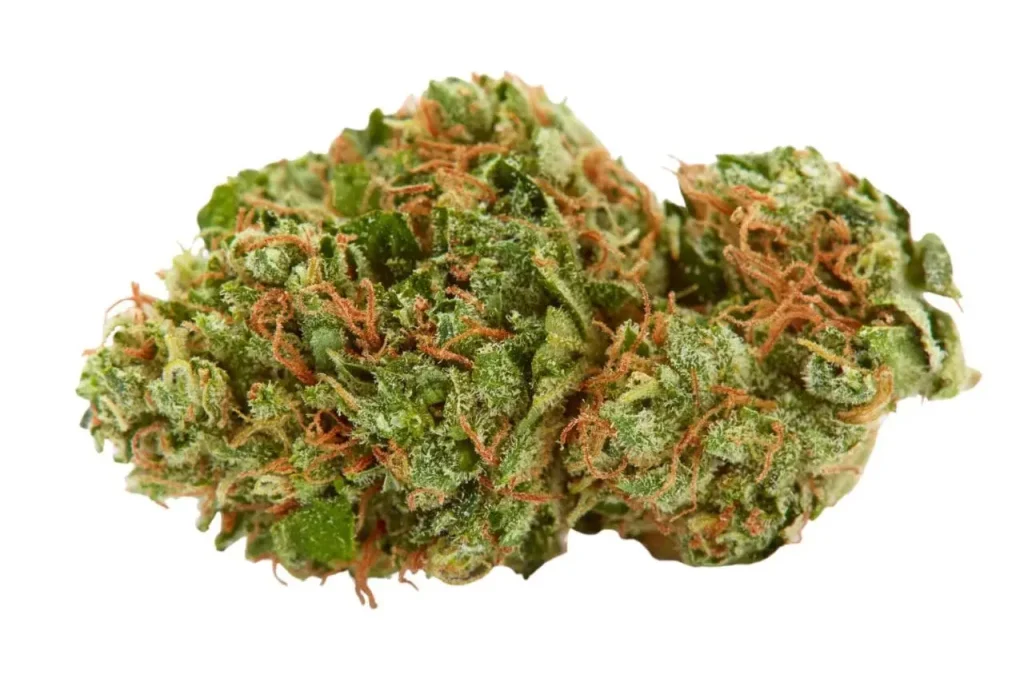
The AK-47 strain is a majestic and iconic four-way landrace cross released in Amsterdam in 1992. It is one of the very few hybrids in cannabis history built from four separate gene pools rather than two. Colombian, Mexican and Thai sativas on one side. Afghani indica on the other. Three continents in a single packet.
Three sativa parents and 1 indica.
There is magic in this combination, you can actually feel the different notes coming from these 4 parents and this is part of what makes AK47 one of my all time favourite strains. If you are not usually a person who loves sativas (like me) then this could be the one that opens up a whole new world to you. The Afghan indica parent does so much to alchemise this strain into one of the most enjoyable and relaxing ones I have experienced
This review covers where the strain came from, why it became a cult favourite, what the terpene profile actually does, and how it behaves in Australian conditions. AK-47 feminised seeds are available now, and the product page carries the full grow spec, feeding detail and week-by-week timing.
AK-47 at a Glance
| Attribute | Detail |
|---|---|
| Type | Sativa-dominant hybrid, roughly 65/35 |
| Genetics | Colombian × Mexican × Thai × Afghani |
| Released | Amsterdam, 1992 |
| THC | 17 to 22% |
| Dominant terpenes | Myrcene, caryophyllene, pinene |
| Flowering | 8 to 9 weeks |
| Indoor yield | 350 to 500 g/m² |
| Height | Medium indoors, to 180cm outdoors |
| AU outdoor finish | Mid to late April |
| Difficulty |
Beginner-accessible plant, intermediate odour management |
On this page
Is AK-47 indica or sativa?
Where the AK-47 strain came from
Why AK-47 became a cult strain
What AK-47 tastes and smells like
Growing AK-47 in Australia
What AK-47 left behind
Frequently asked questions
Is AK-47 Indica or Sativa?
Sativa-dominant, somewhere around 65/35, but the honest answer is that AK-47 has spent three decades refusing to sit still in either category. Three of its four parents are sativa landraces. The fourth, Afghani, is doing more work than a quarter share suggests.
A three-quarters sativa cross would normally run fast and slightly wired, and it would take its time finishing. AK-47 does neither. The Afghani contribution pulls the flowering window back to eight or nine weeks, tightens the bud structure, and puts a layer of body underneath the head effect that most sativas simply do not have. The result reads as sativa in the first twenty minutes and as something more grounded after that.
If you want the underlying framework rather than the marketing shorthand, our guide to sativa and indica cannabis genetics explains why the labels describe plant structure far more reliably than they describe effect.
What to Expect
A fast opening, usually inside a few minutes, bright and talkative. It settles after roughly half an hour into something steadier with clear physical weight. Suits afternoons and social evenings rather than either end of the day. Duration runs long for a hybrid, commonly two to three hours.
Where the AK-47 Strain Came From
The strain arrived on Amsterdam menus in 1992, released through Serious Seeds by a breeder known simply as Simon, who has never published the full pedigree. What he has confirmed is the source material: Colombian, Mexican, Thai and Afghani seed stock, worked through thousands of test plants until the line ran true.
That secrecy is not evasion so much as ordinary practice for the period, and the four named landraces are enough to explain the plant. Each one is solving a different problem.
| Parent | Type | What it contributes |
|---|---|---|
| Colombian | Sativa | The bright, wide-awake head effect, plus vigour and height |
| Mexican | Sativa | Hardiness, sturdy structure, and the sociable, uncomplicated character |
| Thai | Sativa | The exotic, incense-like edge to the aroma and the long duration |
| Afghani | Indica | Short flowering, dense bud structure, resin, and the body weight underneath |
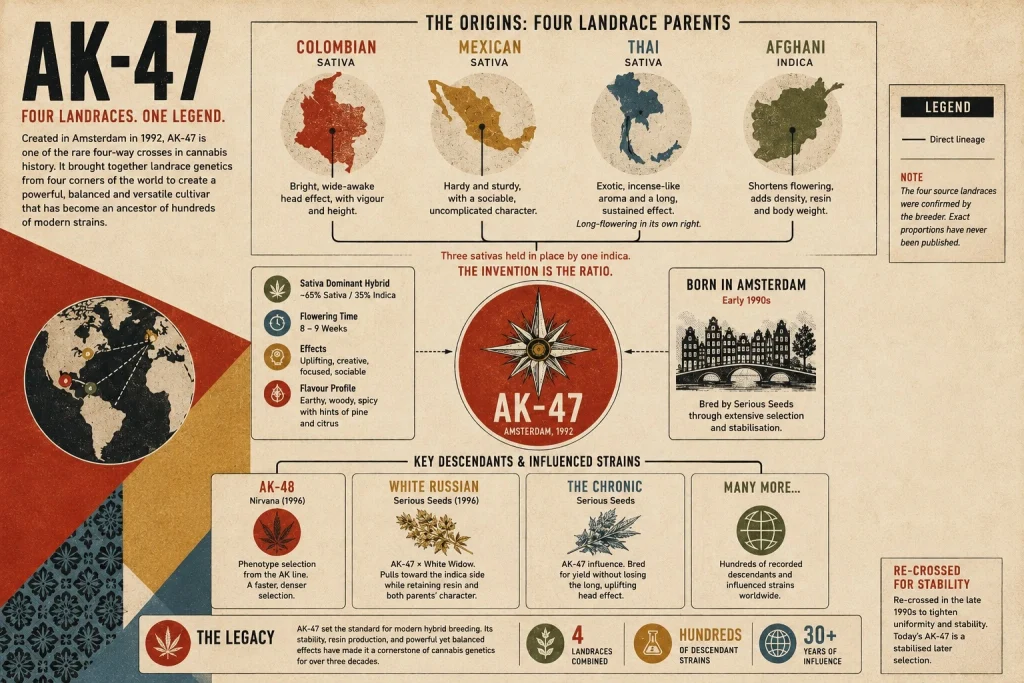
Read down that last column and the design becomes obvious. Three sativas from three continents, left to themselves, would have produced something tall, slow, variable and quite possibly too much for anyone who does not get on with pure sativas. Each of those four problems is fixed by the Afghani quarter, and none of them is fixed at the expense of the head effect. That is the part worth understanding about this plant. It is not a blend of four things averaged out into something moderate. It is three sativas held in place by one indica, which is why the effect arrives sativa-fast and then finds a floor instead of running away.
The Mexican side is the same lineage running through Acapulco Gold, and the Afghani quarter is the same stock that anchors the Kush family. Neither is doing anything exotic on its own. The invention here is the ratio.
Four gene pools is the unusual part, and it was not showing off. Most famous hybrids are two-parent crosses, because every additional parent multiplies the variation a breeder then has to select out, and four parents is a considerably harder problem than two. Simon took that on because nothing simpler would have produced what he was after, and arriving at a line stable enough for commercial release is the achievement. It is also why AK-47 sits at a genuine junction in the modern family tree rather than on a branch. If you want the wider map, our cannabis genetics family tree shows where the landrace lines feed into the hybrids that followed, and the guide to how landrace genetics became modern hybrids covers the breeding logic in more depth.
One correction worth making early, because it comes up constantly. The AK-47 sold today is not the 1992 release. The line was re-crossed toward the end of the nineties to tighten uniformity, and growers who ran the original still describe it as a longer-flowering, more sativa-leaning plant than the current version. Both are AK-47. They are not the same plant.
The award nobody else has
AK-47 placed second in the Sativa category at the 1999 High Times Cannabis Cup, then second in the Indica category in 2003. It is the only strain to have placed in both. Read that as evidence rather than as a trophy: judges working four years apart, in two opposed categories, both found what they were looking for in the same genetics.
Why AK-47 Became a Cult Strain
Potency alone does not explain it. Plenty of strains from that period were strong and are now forgotten. AK-47’s reputation was built on a stack of things that happened to arrive together.
The name did work no other name could. White Widow, Northern Lights and Skunk #1 are descriptions. AK-47 is a claim, and it needed no translation for a customer reading a laminated menu in a second language. It arrived with a built-in promise that the product happened to keep.
Then there was the absence of measurement. No lab results appeared on a coffeeshop board in 1993, so potency reputation moved by anecdote, and AK-47 had the best anecdote in the city. People were putting it down after one hit. A story like that transmits between strangers in a way a percentage never has.
The part growers cared about was different again. The line was selected hard for consistency at a time when most seed packs threw wildly variable plants, and a cultivar that behaves the same way every run is what commercial supply actually needs. AK-47 won two constituencies for two unrelated reasons, which is rare.
Jason’s Note: What the Menu Didn’t Say
I was living in London in the early nineties and the coach to Amsterdam was cheap enough that you went whenever you had a free weekend. The first time I saw AK-47 written on a board was at Siberië, a small quiet place on the Brouwersgracht that the tour groups never found. Winter of 1994. Half a gram, and the bloke behind the counter did something none of the other shops did with any other strain on that menu. He asked how long I had been smoking before he would sell it to me.
I told him long enough. He sold it to me anyway, then said to smoke half of what I normally would and wait. I ignored him, because I was twenty-three and I knew everything. I spent the next two hours in the corner of that shop with a coffee going cold in front of me, watching the canal and not saying very much at all.
The bud itself was nothing special to look at. Compact, a bit scruffy, not the frosted showpiece you would put on a poster. Thirty years and a lot of grows later, that gap is the whole point. Reputation was the only specification available back then, and AK earned one strong enough that the shop staff were rationing it themselves.
There is a second-order version of the cult now, and it is a different thing to the nineties one. AK-47 is admired today partly because it is not exotic. No candy terpenes, no colour, no hype cycle. In a market that renews its favourites every eighteen months, a thirty-year-old four-way landrace cross has become the considered pick.
What AK-47 Tastes and Smells Like
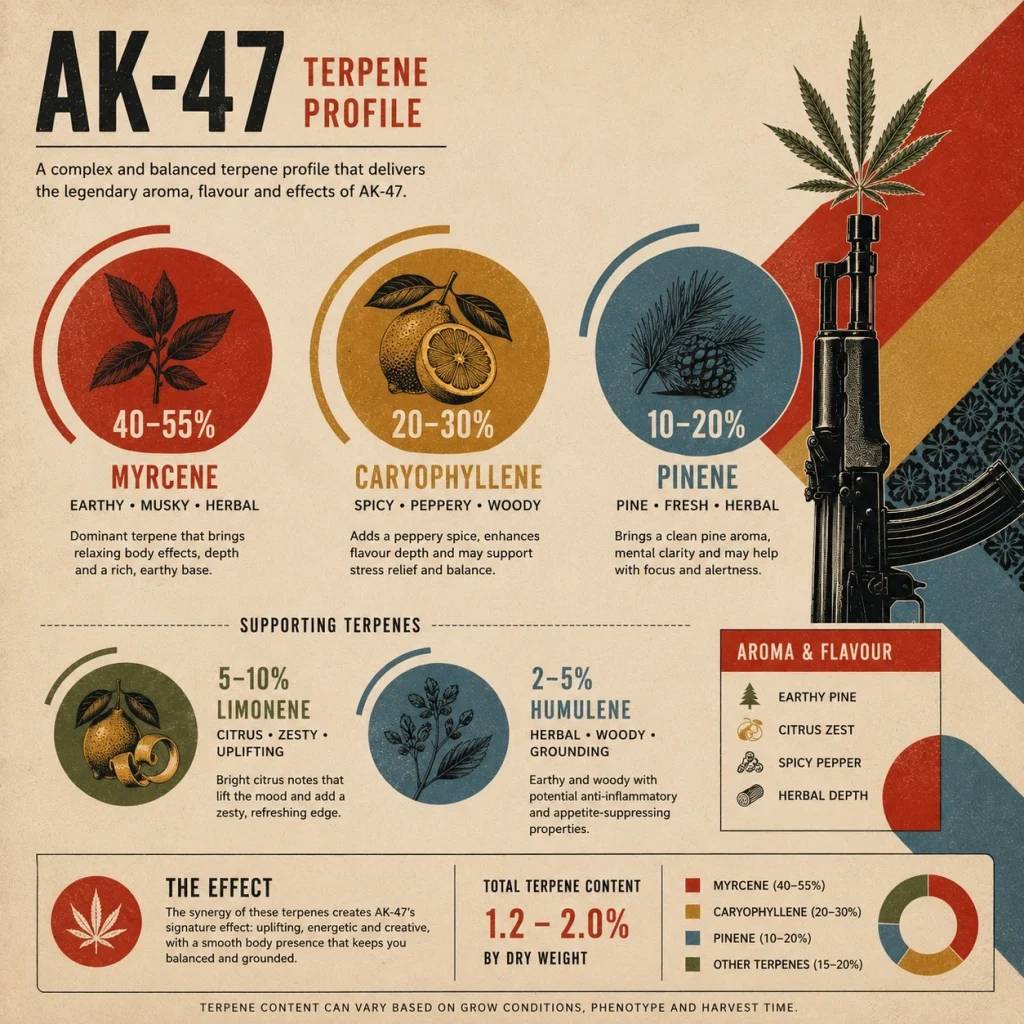
Myrcene leads, which puts an earthy, faintly musky base under everything else. Caryophyllene sits behind it with a peppery warmth, and pinene keeps the top note bright so the whole profile does not go heavy. Limonene shows up in smaller amounts and reads as a sour citrus flash on the grind.
Described plainly: sour earth first, then something closer to sandalwood, with pine on the exhale. There is a skunk backbone underneath from the wider Dutch hybrid pool of that era. It is a savoury profile rather than a sweet one, and it is one of the reasons AK-47 reads as old-school to anyone raised on the dessert strains.
Total terpene content commonly lands between 1 and 2% by dry weight, which is respectable without being remarkable. The character comes from the ratio rather than the volume. Our guide to cannabis terpenes covers how these compounds shape aroma and flavour in more detail.
Is AK-47 Suited to the Australian Climate?
For most of the country, yes, and the reason is the calendar rather than the genetics. An eight to nine week photoperiod flower puts harvest around mid to late April, which lands the densest part of bloom after the humid tail of summer rather than in the middle of it. That timing does more for an Australian grower than any amount of claimed hardiness.
Bud density is the thing to plan around. Those compact, resin-heavy flowers are the reason the strain yields well, and they are also the reason it does not want a wet late season. Queensland and northern New South Wales growers should be thinking about airflow through the canopy from week four. Cooler southern sites have the easier run of it, since an April finish is comfortably inside the season. Our guide to growing cannabis outdoors in Australia sets out the seasonal timing by region.
You will see AK-47 described elsewhere as mould-resistant. Treat that with scepticism. The genetics are hardy in general terms, but dense flowers are dense flowers, and the honest position is that this plant needs air moving through it rather than that it shrugs off wet weather. If your site is genuinely damp through autumn, a strain bred for that problem is the better choice.
None of that makes it a difficult plant. AK-47 handles feed variation better than most, the structure is vigorous without being unruly, and a short flower means a mistake in week three is not fatal. The one thing that does catch people out has nothing to do with horticulture.
Jason’s Warning: Easy to Grow, Hard to Hide
The breeder’s own description of this strain carries a warning about odour, in capitals, and after growing it I understand why it is written that way. AK-47 is not merely pungent in flower. It carries, and it carries further than the density of the buds would lead you to expect.
Indoors this means a carbon filter that is properly sized and actually maintained, not a filter you bought two years ago and have not thought about since. Outdoors it means being realistic about your fence line and your neighbours. I would put this plant behind a windbreak and away from a boundary every time. It is the one genuine cost of the strain, and it is worth deciding on before you germinate rather than in week six.
Beyond climate and odour, the practical detail belongs somewhere else. Feeding rates and EC targets, training, the week-by-week flowering timeline, indoor and outdoor yield figures and the harvest window that decides whether you get the bright version of this strain or the heavy one are all set out on the AK-47 seeds product page. This review stays on what the strain is and where it came from.
What AK-47 Left Behind
A strain becomes structurally important when other breeders start using it as raw material, and by that measure AK-47 is one of the more consequential releases of the nineties. Seed databases list hundreds of descendants tracing back to it.
The most direct is White Russian, an AK-47 crossed with White Widow, which pulls the balance toward the indica side while keeping the resin production of both parents. AK-48 is a phenotype selection rather than a cross, hunted out of the same line for density and speed. The Chronic carries AK-47 influence in the same direction, chasing yield without losing the long functional head effect.
Its backwards connections are just as interesting for anyone building a collection around genuine heritage. The Mexican side is shared with Acapulco Gold. The Afghani quarter is the same stock behind the Kush lines. The Thai and Colombian contributions belong to the tropical sativa story that also produced Durban Poison and the Haze family that runs through Amnesia Haze. Very few single strains touch that many branches at once.
The same Amsterdam breeding programme also produced Kali Mist, which took the sativa expression in the opposite direction: longer, lighter, and entirely without the body weight AK-47 keeps in reserve. Read side by side, the two make a useful pair for understanding what the Afghani quarter is actually contributing.
Who AK-47 Suits
A good fit if you want a heritage strain with a genuinely distinctive effect rather than a modern flavour project, you have somewhere odour will not cause a problem, and you value a plant that behaves the same way every run.
If that first paragraph sounds like your setup, the AK-47 seeds are in stock now.
Look elsewhere if your grow is close to neighbours with no filtration, your site stays damp through autumn, or you are chasing candy terpenes and colour. AK-47 offers neither and never has.
Frequently Asked Questions
Is AK-47 indica or sativa?
Sativa-dominant, around 65/35, though it is the rare strain that has placed in Cannabis Cup categories on both sides. Three of its four landrace parents are sativas and the fourth, Afghani, supplies the indica counterweight. Our sativa versus indica guide explains why the labels describe structure more reliably than effect.
What are AK-47’s genetics?
A four-way cross of Colombian, Mexican, Thai and Afghani landraces. The exact proportions were never published. Four-parent hybrids are unusual because each additional parent multiplies the variation a breeder has to stabilise, which is why the cannabis genetics family tree is dominated by two-parent crosses.
Why is it called AK-47?
The breeder has said the name refers to a one-hit reputation rather than to violence. It stuck partly because it needed no translation for the international customers reading Amsterdam coffeeshop menus in the nineties.
How strong is the AK-47 strain?
Modern examples generally test between 17 and 22% THC, which places it in the upper middle rather than at the top of the current market. At the 1999 Cannabis Cup an independent test returned 21.5% on a submitted sample, the highest of any entry that year, which says more about how much potency ceilings have moved than about the strain.
Is the AK-47 sold today the same as the original?
No. The line was re-crossed in the late nineties to improve uniformity, and growers who ran the earlier version describe it as longer-flowering and more sativa-leaning. The current cut is faster and more consistent. This is the same distinction that applies to most heritage strains, and our guide to how landraces became modern hybrids covers why stabilisation work changes a line.
How long does AK-47 take to flower?
Eight to nine weeks, which is short for a plant this sativa-heavy. The speed comes from the Afghani parent, and it is the single most useful thing the indica quarter contributes. The full week-by-week timeline is on the product page.
When does AK-47 finish outdoors in Australia?
Mid to late April for most regions on a standard photoperiod season. That timing works in your favour, since it puts the densest part of flower past the worst of the summer humidity. Our Australian outdoor growing guide has the full seasonal calendar.
Is AK-47 mould resistant?
Not reliably, despite what you will read. The plant is hardy in general terms but the flowers are dense, and dense flowers hold moisture. Plan for airflow through the canopy from week four and dropping humidity through bloom. If your site is genuinely wet through autumn, choose genetics bred for that.
Does AK-47 smell a lot?
Yes, and this is the single most important practical thing to know about it. The breeder’s own material warns about odour in capital letters. Budget for a properly sized carbon filter indoors and think hard about your boundary line outdoors.
Is AK-47 suitable for a first grow?
The plant itself is forgiving, so on cultivation grounds the answer is yes. The odour is the reason to hesitate. A first-time grower in a shared house or a tight suburban block will find the smell a bigger problem than anything horticultural. Our beginner strain guide covers gentler starting points.
What strains came from AK-47?
White Russian is the best known, an AK-47 crossed with White Widow. AK-48 is a phenotype selection from the same line, and The Chronic carries its influence. Seed databases record hundreds of descendants overall.
How does AK-47 compare to Amnesia Haze?
Amnesia Haze is the purer sativa experience: longer flowering, taller, and lighter on the body. AK-47 finishes several weeks sooner and keeps a physical undercurrent that Haze genetics do not have. If you want the full Amnesia Haze picture, the review covers it in depth.
Which terpenes are in AK-47?
Myrcene leads, with caryophyllene and pinene supporting and limonene present in smaller amounts. Total terpene content usually falls between 1 and 2% by dry weight. Our terpene guide explains what each contributes.
Cannabis seeds are sold as souvenirs and for genetic preservation. Germination is illegal in most Australian states and territories. Cultivation of a small number of plants is permitted for adults in the ACT under specific conditions. Check the law where you live before you do anything with a seed.
Related reading: pick up AK-47 feminised seeds, browse the full range of cannabis seeds Australia, the Skunk #1 review for the other foundational Dutch stabilisation project, our Acapulco Gold review for the Mexican landrace side of the family, and the guide to the best cannabis strains for the Australian climate.