Container Sizing for Cannabis Seedlings — and When to Transplant

Container Sizing for Cannabis Seedlings — and When to Transplant

Before we get into sizes and timing, one rule worth stating plainly at the top: if you’re growing autoflowering seeds, you don’t transplant. You pick your final container before the seed goes in the ground and you don’t move the plant again. If that’s your situation — skip to the autoflower section below and treat it as its own guide. The transplanting advice that follows is for photoperiod growers.

Autoflowering Seeds — Start in the Final Container, Full Stop

Autoflowers run on a fixed seed-to-harvest timeline. The plant begins developing its flower sites at 3–4 weeks from germination regardless of what you’re doing to it, and there’s no veg stage you can extend to compensate for lost time. Transplanting — even a careful one — sets the plant back 5–7 days while it recovers. That’s a week of its fixed timeline gone. You cannot get it back.

For autoflowering seeds, the right container size is the one the plant finishes in. Indoors: 10–15 litres. Outdoors: 15–20 litres minimum. Germinate directly into that container. If the seedling looks small and lost in a large pot for the first two weeks, that’s fine — water in a small ring around the seedling rather than flooding the whole medium, and resist the urge to move it somewhere more proportionate. It will catch up.

The medium you choose for the final container needs to work at the seedling stage too — which is another reason I prefer coco with perlite for autos. What to use is covered in the seedling soil guide. Light, airy, inert — it suits a seedling with minimal roots and scales into an established plant without any changes.

Why I Don’t Like Transplanting

I’ll tell you my preference upfront: I don’t like transplanting, and I avoid it where the grow situation allows. Every time you move a plant you’re introducing a recovery period, and recovery periods are time the plant isn’t building root mass or canopy. Photoperiod plants can absorb that cost during a long veg stage — but it’s still a cost, and it adds up across a grow.

The growers who swear by progressive transplanting — small cup to mid-size container to final pot — argue that a root system that fills each container before moving develops more vigorously than one that starts in a large volume. There’s something to that. A seedling in a 15-litre pot of coco has a lot of medium it can’t yet reach, which makes overwatering much more likely and root development slower in those outer zones. Starting smaller gives the seedling a more manageable environment.

My preference is to find a middle ground: start in a container large enough that I only transplant once, not twice. One move, well-timed, is something most photoperiod plants handle without much drama. Two moves is pushing it. Three is unnecessary stress with no real payoff for a home grower.

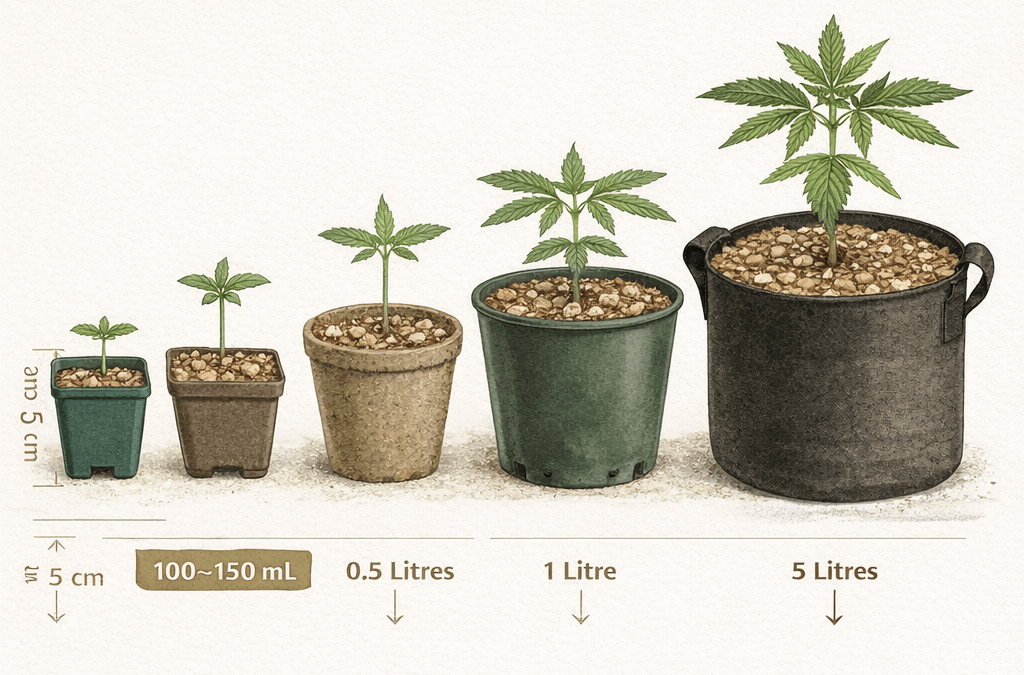
Cannabis seedling containers shown in relative sizes — 100–150ml, 0.5 litre, 1 litre and 5 litre fabric pot with plants at corresponding growth stages

Container Sizes for Photoperiod Seedlings

The standard starting container for a photoperiod seedling is 0.5–1 litre — a small plastic pot, a cut-down milk container, or a seedling tray cell. The goal is a volume of medium that dries out at a rate the seedling can manage, which reduces overwatering risk dramatically. A small container also means the roots fill it relatively quickly, which is your signal to move.

From there, the path depends on how big you intend the plant to get:

Small indoor plants (SOG, SCROG, limited tent space): Seedling container → 3–5 litre → final pot of 8–12 litres. One transplant, or two if you’re running SOG and want very short veg time in small pots before flipping.

Standard indoor plants: Seedling container → 10–15 litre final pot. One transplant. This is the approach I’d use for most indica-dominant and shorter hybrid genetics where you’re not chasing maximum size.

Large indoor or outdoor plants: Seedling container → 10 litre intermediate → 20–30 litre final pot. Two transplants — only justified if you’re running sativa-dominant genetics with long veg periods, or large outdoor plants where root volume genuinely matters for yield.

The rule of thumb that holds across all of these: the final pot should be large enough that the plant never becomes root-bound before harvest. A root-bound plant in late flower is harder to manage than one with room to grow, and the yield hit from restriction late in the cycle isn’t worth whatever space you saved.

Container size by strain type

Starting container, final container, and how many transplants to expect

Format Container path Transplants

Auto — indoor
auto

Fixed timeline — no veg stage

10–15 L final pot

Germinate directly into final container
None

Auto — outdoor
auto

Fixed timeline — no veg stage

15–20 L final pot

Germinate directly into final container
None

Photo — small indoor
photo

SOG, SCROG, limited tent
0.5–1 L

8–12 L final
Once

Photo — standard indoor
photo

Most indica and hybrid genetics
0.5–1 L

10–15 L final
Once

Photo — large outdoor
photo

Sativa-dominant, long veg
0.5–1 L

10 L

20–30 L final
Twice

Autoflowers are never transplanted. The fixed seed-to-harvest timeline means any transplant stress costs time the plant cannot recover. Start in the final container from day one.

Why Fabric Pots — and One Thing Most Growers Don’t Know About Them Outdoors

My preference across the whole grow is fabric pots. The reason is air pruning. In a standard plastic pot, roots hit the wall and have nowhere to go — they spiral around the inside, eventually choking themselves and blocking drainage. In a fabric pot, when roots reach the wall they’re exposed to air, the tip dries out and stops growing, and the plant responds by throwing out new lateral roots from the same point. The result is a dense, fibrous root mass through the entire volume of medium rather than a circling knot around the edges.

More roots means more surface area for water and nutrient uptake. The practical difference shows up most clearly in how well the plant handles high feed EC in mid-flower — an air-pruned root system is better equipped to manage it than one that’s been circling plastic for eight weeks.

The thing most growers don’t know: for outdoor grows in Australian summer, fabric pots regulate root zone temperature significantly better than black plastic. Black plastic containers can push substrate temperature 8–10°C above ambient on a hot day — that’s roots sitting at 32–35°C when your ambient temperature is 25°C. Root stress above 26°C reduces nutrient uptake noticeably. Fabric pots, particularly white or light-coloured ones, allow constant heat exchange with ambient air and keep root zone temperature 4–6°C cooler. For outdoor summer grows in Queensland and northern NSW, that difference is meaningful.

The one adjustment with fabric pots: they dry out faster than plastic because moisture evaporates from the sides as well as the top. You’ll water more frequently, which most growers find is a feature rather than a problem — it’s harder to overwater when the medium dries out at a reasonable rate.

When to Transplant — What the Plant Is Telling You

Most guides give you a timeframe — “transplant at 3–4 weeks.” I’d rather you watch the plant than the calendar, because strain variation, environment, and medium all affect how quickly a seedling fills its container.

The most reliable signal is roots showing at the drainage holes. If you can see white root tips emerging from the bottom of the pot, the plant has explored the full volume of medium available to it and needs more room. Don’t wait past this point — a root-bound seedling goes into transplant stress from a worse starting position than one moved at the right time.

Secondary signals that together suggest the plant is ready: the medium is drying out within 24 hours of a full watering (the roots are consuming the available water faster as they develop), growth has visibly slowed despite healthy feeding and lighting, and the plant looks proportionally large relative to its container.

One signal that’s often misread: leaf colour alone is not a transplant indicator. A seedling showing pale or yellowing leaves may need nutrients or a pH correction, not a bigger pot. Check drainage holes and medium dry-down rate before concluding the container is the problem.

How to Transplant Without Stressing the Plant

Water 12–24 hours before transplanting. The medium should be moist but not saturated — moist soil holds its structure around the roots, which means the root ball stays intact when you remove it. Dry medium crumbles, disturbs the root system, and dramatically increases transplant shock risk. This is the single most important preparation step and it’s regularly skipped.

Prepare the new container first. Fill it with your medium, make a hole in the centre sized to the root ball of the plant you’re moving, and water the new medium before the transplant. You want the new environment to be ready before the plant is out of its old one — roots exposed to dry medium and dry air for even a few minutes adds unnecessary stress.

Remove the plant root ball intact. For plastic pots — squeeze the sides gently to break the medium away from the wall, then turn upside down with your hand supporting the base of the stem and let gravity do the work. Don’t pull the stem. For fabric pots being used as seedling containers — these are harder to remove cleanly, which is another reason I prefer to start seedlings in plastic and move to fabric for the final container. If you are using a small fabric pot, cut it away rather than trying to pull the plant out.

Transfer directly into the new container. Root ball goes into the pre-made hole in the new medium. Backfill gently around the sides without compressing the medium — you want structure, not compaction. The root ball should sit at the same depth it was in the previous container. Don’t bury the stem.

Transplant at lights-off, or in the evening for outdoor grows. Moving a plant into intense light immediately after transplanting adds heat and photosynthetic demand at a moment when the root system is disrupted and can’t meet it. Indoor growers should transplant right before the light schedule goes dark — the plant gets several hours to settle before it has to work again. Outdoor growers: evening transplants, same logic.

Water in and hold nutrients for 5–7 days. Water gently after transplanting to settle the medium around the root ball. Then hold nutrient feeding for the first five to seven days — plain pH-adjusted water only. The root system needs to establish in the new medium before it can process nutrients effectively, and adding fertiliser to a disrupted root system contributes to salt stress rather than helping recovery.

How to Tell If the Transplant Went Well

Some drooping in the first 24–48 hours after transplanting is normal and not a cause for concern. The root system is re-establishing its ability to take up water and the plant may look softer than usual. As long as the medium is appropriately moist and temperature is stable, this resolves on its own.

The recovery indicator worth watching for is new white root tips at the drainage holes of the new container, usually visible within 4–7 days of a successful transplant. New root growth is the clearest sign the plant has settled in and is expanding into the new medium. If you see no new growth at the surface and no recovery from drooping after 5–7 days, check pH, check medium moisture, and check root health by carefully inspecting the base of the container.

Persistent drooping, yellowing that started after the transplant, or slowed growth that doesn’t resolve in a week are signs the transplant caused more stress than usual — most likely from root disturbance, temperature shock, or medium issues in the new container. Hold feeding and reassess timing using the seedling feeding guide.

The full range of cannabis seeds available from Sacred Seeds Australia — autoflowering, photoperiod, and fast version — each have different container requirements from day one. Getting that decision right before germination is easier than correcting it mid-grow.


Frequently Asked Questions — Container Sizing and Transplanting Cannabis Seedlings

Can I start a cannabis seedling in its final large container?

Yes — but it requires more careful watering. A seedling in a large volume of medium has a small root system relative to the available moisture, which makes overwatering the most likely mistake. Water in a ring around the seedling rather than flooding the full pot, and let the medium dry appropriately between waterings. Many growers prefer to start in a smaller container and transplant once specifically to avoid this, but starting in the final container works if you’re disciplined with watering volume. For autoflowering seeds, starting in the final container isn’t optional — it’s required.

What size container does an autoflower need?

10–15 litres indoors, 15–20 litres for outdoor grows. These are the final containers — autoflowers are never transplanted, so the size you start in is the size you finish in. Going smaller limits the root volume available during the fixed grow window and costs yield. Going significantly larger doesn’t hurt the plant but increases overwatering risk in the seedling stage, which needs to be managed with careful watering volume in the early weeks.

How do I know when to transplant a cannabis seedling?

Watch for roots emerging from the drainage holes — that’s the clearest signal the plant has used the available root space and needs more. Secondary signals include the medium drying out within 24 hours of a full watering and visibly slowed growth despite good conditions. Don’t rely on timing alone — strain variation and environment affect how quickly different plants fill a container, and moving too early is almost as disruptive as moving too late.

How many times should I transplant a photoperiod cannabis plant?

Once if you can manage it — seedling container to final pot. Starting in a container large enough to go straight to the final size reduces recovery periods and simplifies the grow. Two transplants are justified for large outdoor plants or sativa-dominant genetics with long veg periods where root volume genuinely contributes to final size. Three or more transplants is rarely necessary for home growers and adds cumulative stress with diminishing returns.

Why are fabric pots better than plastic for cannabis?

Fabric pots allow air to reach the outer root zone through the container walls. When roots hit the fabric they’re exposed to air, the tip dries out and stops extending, and the plant generates new lateral roots from that point. Over a full grow this produces a dense, branched root mass through the entire pot rather than circling roots around the inside wall. More root surface area means better water and nutrient uptake, better drainage, and a plant that handles higher feed concentrations more efficiently in mid-flower. For outdoor growers in Australian summer, fabric pots also regulate root zone temperature better than black plastic — a meaningful advantage when ambient temperatures push above 30°C.

Should I use nutrients right after transplanting?

No — hold nutrients for 5–7 days after transplanting and water with plain pH-adjusted water only. The root system needs to establish contact with the new medium before it can process nutrients effectively. Introducing fertiliser to a disrupted root system adds salt load without the plant being in a position to use it. Resume normal feeding once you see signs of recovery — new growth at the surface and no persistent drooping.

Can I transplant an autoflower if I started in too small a container?

Strongly not recommended. The fixed timeline of an autoflower means any stress-related growth pause costs time the plant cannot recover. Even a careful transplant sets most autos back 5–7 days. If you’ve germinated an auto in too small a container, your best option is to manage the situation where it is — water carefully, feed appropriately for its size, and accept the yield impact rather than making it worse. Next time, start in the correct final container size from day one.

When to Start Feeding Cannabis Seedlings

When to Start Feeding Cannabis Seedlings

The most consistent mistake I see from growers who’ve had reasonable success elsewhere — in the veggie garden, with other plants, even with cannabis at the later stages — is feeding cannabis seedlings too early. It’s not laziness or carelessness. It usually comes from a logical place: the plant is growing, nutrients help plants grow, so nutrients should help now. That logic breaks down completely at the seedling stage, and understanding why is the whole point of this article.

A cannabis seedling in its first two to three weeks has almost no root mass. What’s down there is a taproot and the earliest hints of lateral branching — a structure with very limited surface area for uptake and almost no capacity to buffer excess salt. When you feed that plant, most of what you’re putting in sits in the medium and accumulates. The seedling can’t flush it, can’t process it, and can’t grow through it. It just sits there building salinity until the symptoms show up on the leaves.

The good news is that a seedling in a properly prepared medium doesn’t need anything from you for the first two to three weeks. What a good seedling medium provides is covered in the soil guide. Your job in that window is to water correctly, maintain stable temperature and humidity, and watch — not feed.

What Good Seedling Medium Already Provides

If you’re running coco coir that’s been properly buffered with a Cal-Mag solution before use, the cation exchange sites are saturated — the coco isn’t going to rob calcium and magnesium from your seedling before it can access them. That’s all you need at this stage. The seedling isn’t asking for nitrogen, phosphorus, or potassium in week one. It’s asking for stable moisture, oxygen at the root zone, and light.

If you’re using a quality organic seedling mix or a light cannabis-specific base soil, there’s typically enough slow-releasing organic matter present to carry the plant comfortably through weeks one and two without any additions. The EC of good seedling medium — if you test a slurry sample — should read 0.5–0.8. That’s a small but real amount of available nutrition. It’s exactly what the plant needs at that stage and not significantly more.

Where growers run into trouble is using a potting mix that reads 1.5–2.0 EC in a slurry test and then adding nutrients on top of it. The medium is already hot by seedling standards, and anything added on top pushes it into territory where tip burn is essentially guaranteed within the first two weeks. Check your medium before you germinate. It saves a lot of headaches later.

The Trigger — When the Plant Is Ready

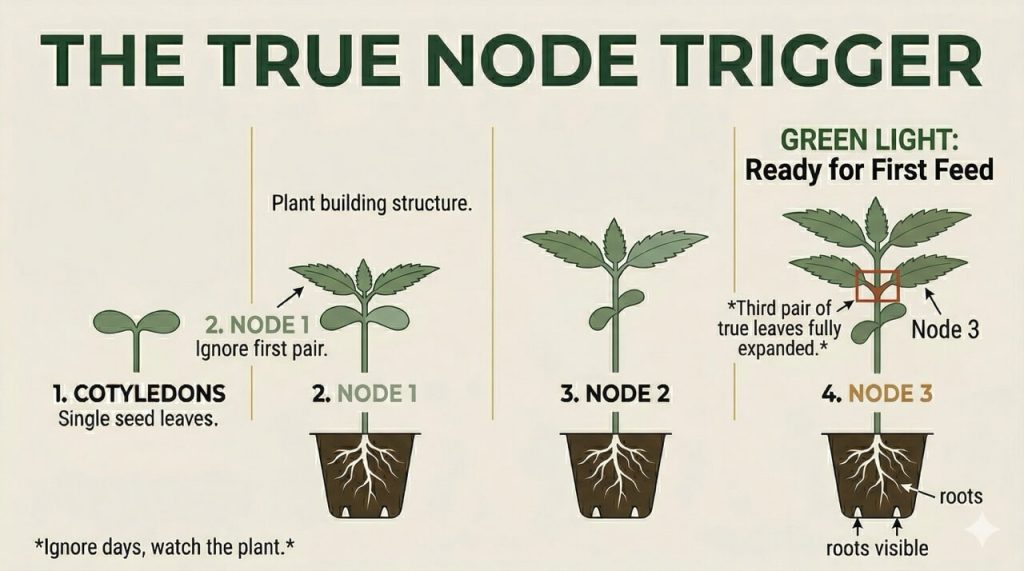
I don’t use days as the trigger for first feed. I use the plant. The indicator I watch for is the third node — the third pair of true leaves developing clearly — combined with a root system that’s visibly active. In coco you can sometimes see the first roots at the drainage holes by this point. In soil it’s less visible, but the medium drying down at a reasonable rate (rather than staying wet for days) tells you the roots are working.

In practice this usually falls somewhere between days 14 and 21 from germination, but I’ve seen it as late as day 28 in slower-developing phenotypes or cooler environments. The calendar is a rough guide. The plant is the actual benchmark.

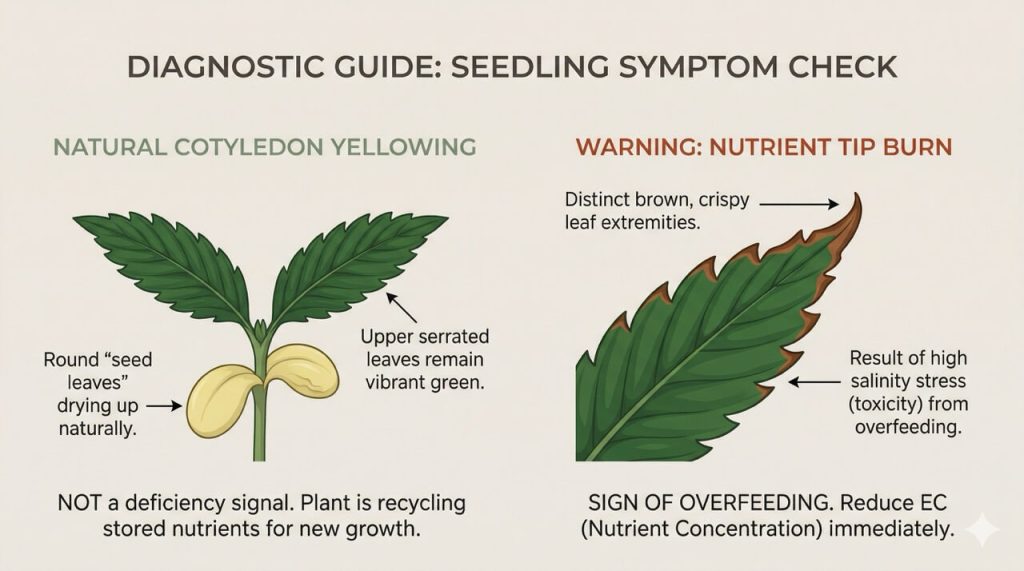
A useful secondary check before the first feed: look at the cotyledons — the round first leaves that emerge with the seedling. In a healthy seedling with no nutrient needs, they’ll be pale green and beginning to yellow naturally as the plant draws on them and moves nutrients upward. That natural yellowing of cotyledons is not a deficiency signal — it’s the plant doing exactly what it should. If the cotyledons are yellowing heavily and the true leaves are also pale or showing symptoms, that’s a different situation and worth investigating before feeding.

Diagram showing cannabis seedling development from cotyledons through to node 3 — the third node with roots visible at drainage holes is the trigger for first feed

What to Start With — and What EC to Target

My preference for first feeds is a biostimulant or organic liquid before anything resembling a standard nutrient solution. Seasol — the straight seaweed extract, not the Seasol PowerFeed blend — at well below label rate is something most Australian growers already have on hand and it’s a genuinely good first feed for seedlings. It introduces beneficial compounds and gentle root stimulation without the salt load of a conventional nutrient feed. If you’re running a purpose-built organic line through the whole grow — Aptus, Gaia Green, Dr Greenthumbs — follow the seedling rate on the product and halve it for the first application.

For growers who want to stay in the Bunnings ecosystem entirely, Nitrosol at 1ml per litre is a well-tested starting point that Australian growers have used for years. It’s a fish and kelp liquid fertiliser — organic, low salt, and forgiving enough that it won’t burn a seedling at that dilution. Switch to PowerFeed (the red bottle) once the plant is in early flower. It’s not sophisticated, but it works, and that’s worth saying plainly.

EC targets: First feed should land at 0.4–0.6 EC in the final solution going in. That’s well below what most nutrient calculators recommend for “seedling stage” — and deliberately so. You’re not trying to push growth at this point, you’re introducing the root system to the concept of nutrient solution without stressing it. By the end of week three, building toward 0.8–1.0 EC is reasonable as the plant establishes. Don’t chase the numbers on the nutrient label — those are written for established plants, not seedlings.

One practical note: always pH your feed solution after adding nutrients, not before. Nutrient additions change pH, sometimes significantly. Target 6.2 at the point of application for soil and coco grows. Why 6.2 and how to hit it consistently is explained in the seedling soil guide.

What Overfeeding Looks Like — and Why It’s Easy to Miss Early

The first sign of overfeeding in a cannabis seedling is tip burn — the very tips of the serrated leaf edges turn brown and curl slightly. It looks minor. Most growers see it and assume it’s a one-off or a handling mark. It isn’t. Tip burn on a seedling is the plant telling you the salt concentration at the root zone is higher than it can manage, and the damage is being expressed at the extremity of the leaf where water delivery is weakest.

Diagnostic guide comparing natural cotyledon yellowing versus nutrient tip burn in cannabis seedlings — cotyledon yellowing is normal, brown crispy leaf tips indicate overfeeding

The instinct when you see tip burn is sometimes to water more, thinking the plant is dry. In an overfed seedling this makes it worse — you’re adding more solution to a root zone that’s already carrying excess salt. The correct response is to water with plain pH-adjusted water for the next one or two waterings and let the root zone flush through naturally before reintroducing nutrients at a lower rate.

Beyond tip burn, other overfeeding symptoms that show up slightly later include: leaf edges cupping downward (a classic sign of nitrogen toxicity — the leaf is trying to reduce surface area exposed to excess nutrient uptake), deep, almost blue-green colouration in the leaves (again, nitrogen excess), and in more severe cases, leaf clawing where the tips hook downward sharply. By the time you’re seeing clawing in a seedling, the root zone has been under significant salt stress for a while and recovery will take time the plant — particularly an auto — doesn’t have.

What makes early overfeeding easy to miss is that the plant often looks healthy for a few days after the damage is done. The tip burn appears 3–5 days after the overfeed event, not immediately. Growers who feed on a schedule sometimes don’t connect the symptom to the feed because there’s a delay between cause and effect. This is why watching the plant — rather than following a fixed feeding schedule — matters at this stage.

Autoflowers — Why the Feeding Rules Are Stricter

Everything above applies to both autoflowering and photoperiod seedlings, but the stakes are higher for autos. A photoperiod plant that gets overfed in week two loses time recovering — you can hold it in veg while it rights itself and the overall impact on the final plant is manageable. An auto that gets overfed in week two loses days from a fixed timeline it cannot extend. The damage carries through to harvest.

For autoflowering seeds specifically, I’d push the no-feed window to three full weeks rather than two, and I’d start even lower — 0.3–0.4 EC for the first application, building slowly. The genetics that carry through in auto crosses — OG, Cookies, Haze — tend to carry the nutrient sensitivity of their photoperiod parents alongside the ruderalis autoflowering trait. An Auto OG or Auto GSC will show tip burn from overfeeding just as readily as the photoperiod version, and it has less time to recover.

The growers who do best with autos in the seedling stage are the ones who understand that restraint at this point isn’t timid growing — it’s the setup for everything that follows. A seedling with an undisturbed, healthy root system entering week three is in a fundamentally better position than one that spent its first two weeks fighting salt stress.

Building From the First Feed

Once you’ve introduced the first feed at 0.4–0.6 EC and the plant has responded well — no tip burn, continued new leaf development, healthy colour — you build from there. Week three to four: 0.8–1.0 EC. Week four into early veg: 1.0–1.2 EC. These are gradual steps, not jumps. Each increment gives the root system time to adapt before the next increase.

Watch the tips at every stage. They’re the early warning system. A bit of tip discolouration tells you to hold the current EC rather than increase it. Clear, clean leaf edges tell you the plant is handling what it’s receiving. That feedback loop — feed, observe, adjust — is how experienced growers dial in a feeding programme. Not by following the nutrient label, and not by guessing.

How you feed connects directly to the containers you’re running and whether you’ve transplanted. The container sizing and transplanting guide covers how medium volume and root development affect feeding readiness. A seedling that’s just been transplanted needs a hold on nutrients for 5–7 days regardless of where it was in the feeding cycle — the root system needs to re-establish before it can process anything.

The full range of cannabis seeds available from Sacred Seeds Australia spans genetics with varying nutrient sensitivities — from robust ruderalis-heavy autos to finicky OG and Haze crosses. Whichever you’re running, the seedling feeding principles are the same. Start later than you think you need to, start lower than the label suggests, and let the plant tell you when to move forward.


Frequently Asked Questions — Feeding Cannabis Seedlings

When should I start feeding cannabis seedlings?

When the third node is clearly developing — the third pair of true leaves showing — and the root system is visibly active. In practice this is usually days 14–21 from germination, but the plant is the benchmark rather than the calendar. A seedling in good medium doesn’t need nutrients before this point and overfeeding early causes more damage than holding off does.

What EC should I use for the first feed?

0.4–0.6 EC in the final solution. That’s deliberately conservative — below most nutrient label recommendations for seedling stage, which are written for established plants. The goal at first feed is to introduce the root system to nutrient solution without stressing it. Build toward 0.8–1.0 EC by the end of week three as the plant establishes, then continue increasing gradually from there.

What nutrients should I use for cannabis seedlings?

A biostimulant or dilute organic liquid before anything resembling a full nutrient feed. Seasol (straight seaweed extract, not PowerFeed) at well below label rate is a solid starting point that’s widely available in Australia. If you’re running a full organic programme — Aptus, Gaia Green, Dr Greenthumbs — halve the seedling rate for the first application. For growers sticking to Bunnings products, Nitrosol at 1ml per litre is a proven low-risk starting feed. Start conservative regardless of the line you’re running.

What does overfeeding a cannabis seedling look like?

Tip burn first — the very tips of the leaf edges browning and curling slightly, appearing 3–5 days after the overfeed event. Later signs include leaves cupping downward, deep blue-green colouration indicating nitrogen excess, and in severe cases, leaf clawing where tips hook sharply downward. If you see tip burn, water with plain pH-adjusted water for the next couple of sessions before reintroducing nutrients at a lower rate.

Do cannabis seedlings need Cal-Mag?

Not as a nutrient feed, but as a buffer if you’re using raw coco coir. Coco has a natural affinity for calcium and magnesium — it will pull them from your feed water and bind them before the plant can access them unless the cation exchange sites are pre-saturated. Buffer raw coco with a Cal-Mag solution before use (water through to runoff, wait 30 minutes, water through again) and this issue is resolved. Pre-treated coco from quality brands handles this before bagging. In soil, Cal-Mag supplementation at the seedling stage is rarely needed unless you’re using reverse osmosis water with no mineral content.

Should I feed autoflower seedlings differently to photoperiod seedlings?

Same principles, stricter application. The no-feed window for autos should extend to three full weeks rather than two, and the first feed EC should start at 0.3–0.4 rather than 0.4–0.6. Autoflowers have a fixed timeline — damage done in week two carries to harvest without a recovery window. Many popular auto genetics also carry the nutrient sensitivity of their photoperiod parents. An Auto OG or Auto GSC will show tip burn from overfeeding as readily as the full photoperiod version, with less time to recover from it.

Why do my seedling leaves look yellow even though I haven’t fed yet?

Check which leaves are yellowing. Natural yellowing of the cotyledons — the round first leaves — is normal and expected. The plant is drawing the nutrition stored in them upward as it develops true leaves, and they’ll yellow and drop off in the first two to three weeks. This is not a deficiency. If the true leaves — the serrated ones that develop after the cotyledons — are yellowing or pale, that’s a different issue and worth investigating: check pH, check medium EC, and check watering frequency before reaching for a nutrient bottle.

How quickly should I increase EC after the first feed?

Gradually, over one to two weeks. First feed at 0.4–0.6 EC, then build toward 0.8–1.0 EC by the end of week three, and 1.0–1.2 EC into early veg. Watch the leaf tips at each stage — they’re the most reliable indicator of whether the plant is handling the current level. Any tip discolouration means hold the current EC rather than increasing. Clean, crisp leaf edges mean you can move forward. Never jump EC based on the calendar alone.

What Soil to Use for Cannabis Seedlings

What Soil to Use for Cannabis Seedlings

The seedling stage is where more grows go wrong than at any other point, and most of the damage happens before the seed even germinates. Growers spend money on good genetics, get the germination right, and then pot into whatever mix they have on hand — often something too rich, too dense, or too wet-retaining for a seedling that has no root mass yet to draw on. I’ve seen it enough times to know it’s worth writing about properly.

This covers what I use, what the seedling actually needs in its first few weeks, and what to avoid. Whether you’re running autoflowering seeds or photoperiods, the seedling stage requirements are the same — but for auto growers especially, getting the medium right from the start matters more, because there’s no recovery window if something goes wrong in week one.

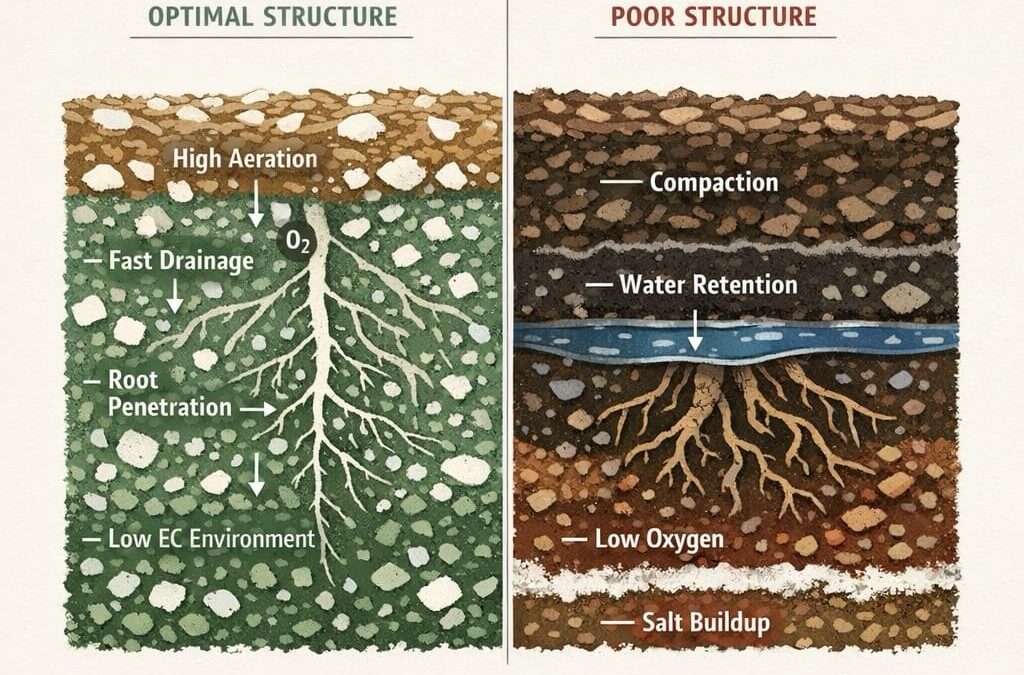
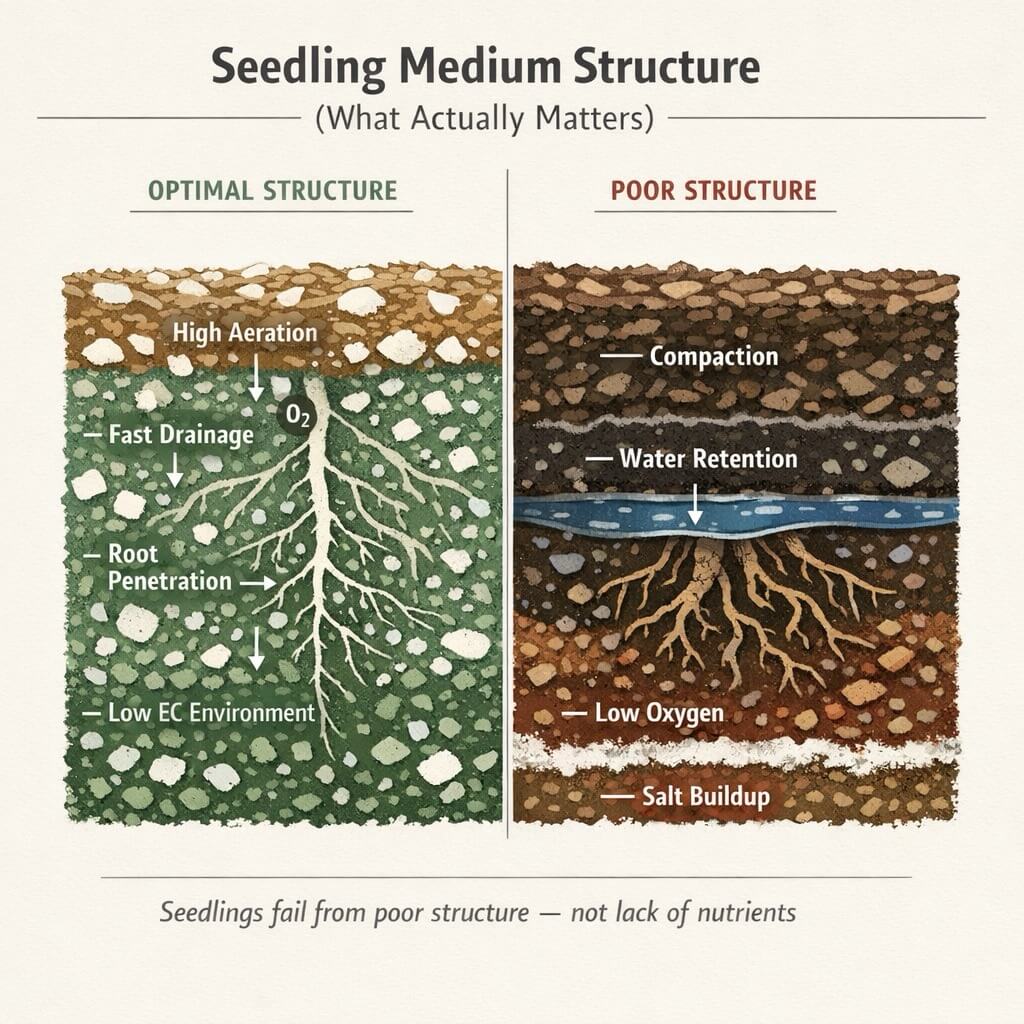
Cross-section diagram comparing optimal vs poor cannabis seedling medium structure — aeration, drainage, root penetration, salt buildup

What a Cannabis Seedling Actually Needs From Its Medium

A seedling’s root system is minimal for the first two to three weeks. It cannot access nutrients the way a mature plant can, and it has almost no tolerance for salt build-up. What it needs from a growing medium is not nutrition — it’s structure. Specifically: good drainage so water moves through rather than sitting, aeration so the roots can access oxygen, and a light enough texture that the taproot can push through without resistance.

The nutrition comes later. The soil or coco mix you start in should provide almost nothing in the way of available nutrients. A seedling in a rich, hot mix will show tip burn and early nitrogen toxicity before it has its third set of leaves. Correcting that in an auto is difficult. Correcting it in a photoperiod costs you time. Better to start light and introduce nutrients deliberately once the plant is established.

pH sits at 6.2 for soil grows. That’s the target at the root zone, not just in the water going in. A consistent 6.2 keeps all the major and minor nutrients available without locking any out. Drift higher toward 7.0 and you start seeing iron and manganese deficiencies. Drop below 6.0 and calcium and magnesium uptake suffers. Get a decent pH pen and use it every time.

Why I Prefer Coco Coir for Seedlings

My preference for seedlings is coco coir or cocopeat — not a soil-based mix. I’ll explain why, because I know it’s not what most people start with.

Coco is inert. It contains no nutrients of its own, which sounds like a disadvantage but is exactly what you want for seedlings. You control what goes in. There’s no guessing what the mix already contains, no risk of a hot base soil burning roots that can’t yet handle it. Coco also has a naturally high air-to-water ratio — it retains moisture well enough that you’re not watering every day, but it drains freely enough that roots aren’t sitting in saturation. For a seedling with minimal root mass, that balance is hard to beat.

The other advantage is consistency. Soil mixes vary batch to batch and brand to brand. Coco is predictable. Once you know how it behaves, you can dial in your watering and feeding routine and trust it will respond the same way every time.

What to add to coco for seedlings: Run coco at roughly 70–80% with 20–30% perlite. The perlite improves drainage and aeration further, which matters most in the seedling stage when overwatering is the biggest risk. For seedlings I go toward the higher end of perlite — 30% — and reduce it slightly for the established plant in its final container.

Pre-treating coco: If you’re using raw coco coir bricks or loose coco, rinse and buffer before use. Coco naturally contains high levels of sodium and potassium, and it has a strong cation exchange affinity for calcium and magnesium — meaning it will pull Cal-Mag out of your feed water and bind it before the plant can access it. Buffering with a Cal-Mag solution (follow the product rate, water to runoff, leave 30 minutes, water through again) saturates the cation exchange sites so they don’t rob your seedlings. Pre-treated coco from reputable brands handles this before bagging, but it’s worth knowing.

If You’re Using Soil — What to Look For

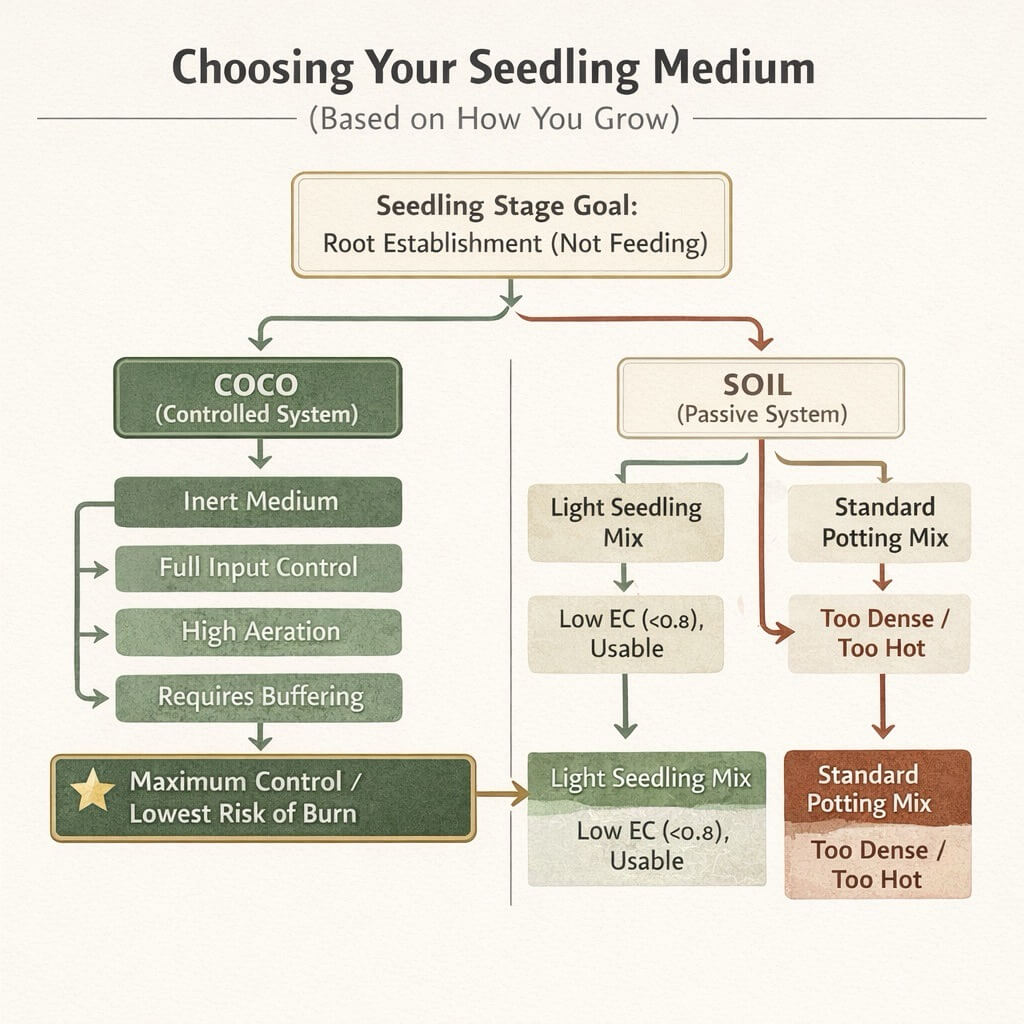
Not everyone wants to run coco, and that’s fine. Soil works well for seedlings when it’s the right mix. The key is choosing something light and airy rather than a heavy potting mix designed for vegetables or flowering plants. Standard potting mixes from hardware stores are typically too dense, too nutrient-rich, and too water-retentive for cannabis seedlings. They’re formulated to hold moisture and deliver nutrition — two things that will cause problems at the seedling stage.

What you want is something marketed as a seedling mix or propagation mix, or a quality cannabis-specific base soil. Look for perlite already in the mix, or add it yourself to bring it up to 20–30%. Peat-based mixes work, though they tend to become hydrophobic once dry — water carefully and evenly. Cocopeat-based mixes (which is essentially the same thing as coco coir in compressed form) are my preference if you’re going soil-adjacent rather than full coco.

What to avoid: Slow-release fertiliser granules in the base mix — these are common in Australian potting mixes and will overfeed seedlings regardless of what you’re adding in water. The Osmocote range at Bunnings is a good example: the seed raising mix is reasonable for seedlings, but the premium potting mixes contain slow-release fertiliser that makes them too hot at the seedling stage. Heavy, bark-based mixes that compact when wet. Anything described as “premium” or “enriched” for established plants. Water-crystals or gel additives that hold moisture.

The Scotts Osmocote seed raising mix — the plain one, not the potting mix — comes up regularly in Australian grower forums as a workable seedling medium when you’re not running full coco. It’s light, drains reasonably well, and the nutrient load is low enough for the seedling stage. Mix in 20–30% perlite and it’s a solid starting point.

A useful test before you commit to a soil: check the EC of a slurry sample (1:1 soil to pH-neutral water, stir, let settle, test the water). Seedling-appropriate soil should read 0.5–0.8 EC. Anything above 1.2 is too hot for a seedling and will cause problems within the first two weeks.

Flowchart showing how to choose cannabis seedling medium — coco coir vs soil options, EC levels and burn risk for Australian growers

Container Size and the Seedling Stage

The medium you start in and the container you start in are related decisions. Getting both right is covered in the companion guide to container sizing and transplanting. For now, the short version: seedlings do not benefit from large volumes of medium. A small container — 0.5 to 1 litre — dries out at a rate the seedling can manage, which makes overwatering much less likely. A seedling in a 10-litre pot of coco is sitting in a large volume of wet medium it has no roots in yet, and root rot risk goes up significantly.

The exception is autoflowering seeds, where you start in the final container from day one. This is a non-negotiable rule for autos — transplanting at any stage disrupts the fixed timeline and costs yield that the plant cannot recover. For auto growers, that means choosing a medium with seedling-appropriate properties that also suits the established plant: coco with 20–25% perlite handles both stages well.

When Feeding Starts

Not at the seedling stage. A seedling in good coco or a light seedling mix does not need nutrients for the first two to three weeks. When to start feeding cannabis seedlings covers the timing and EC targets in detail. The short answer: watch the plant, not the calendar, and don’t reach for the nutrient bottle because a week has passed.

The most consistent mistake I see in growers who’ve had success with outdoor vegetable gardens is applying the same feeding logic to cannabis seedlings. Garden plants in established beds have mature root systems buffered by soil biology. A cannabis seedling in week one has almost nothing — a short taproot and the first hints of lateral growth. Feed it like a hungry teenager and you’ll burn it.

What to Use — The Short Version

My preference: Coco coir or cocopeat mixed with 20–30% perlite. Pre-buffered if using raw coco. pH your water to 6.2 before it goes in. Feed nothing for the first two to three weeks. Simple and repeatable.

If using soil: Light propagation or seedling mix, or a quality cannabis-specific base soil. Check EC before using — below 0.8 is appropriate. Add perlite to 20–30% if not already present. Avoid anything with slow-release nutrients, heavy bark content, or moisture crystals.

What matters most: Good drainage, aeration, low initial nutrient load, and pH at 6.2. The genetics you’re growing will take care of the rest if the foundation is right. Browse the full range of cannabis seeds available from Sacred Seeds Australia — auto, photoperiod, and fast version — and match your medium setup to the format you’re running.


Frequently Asked Questions — Soil for Cannabis Seedlings

Can I use regular potting mix for cannabis seedlings?

Most standard potting mixes sold in Australian hardware stores and nurseries are not suitable for cannabis seedlings. They’re typically too dense, hold too much moisture, and contain slow-release fertilisers that will overfeed a plant with no root mass to handle it. If potting mix is what you have, cut it heavily with perlite (at least 30%) and check the EC before use. A seedling-appropriate medium reads below 0.8 EC in a slurry test. Anything significantly above that is going to cause tip burn within the first two weeks.

Is coco coir better than soil for seedlings?

For most setups, yes — and specifically because it’s inert. There’s no pre-loaded nutrient content to manage, no variability between batches, and the drainage and aeration properties are better suited to the seedling’s minimal root system. The trade-off is that you’re responsible for everything the plant gets from day one, which means a more attentive watering and feeding routine as the plant establishes. For growers who want less active management, a good quality light soil or seedling mix with added perlite is a reasonable alternative.

What pH should my water be for cannabis seedlings in soil or coco?

6.2 is my target for soil and coco-based grows. Not a range — a target. Consistent pH at 6.2 keeps all the major nutrients available at the root zone without locking anything out. Check your pH every time before watering, especially in coco where pH drift can happen quickly if you’re not monitoring it.

Do I need to add perlite to my seedling mix?

Almost certainly, yes. Most commercial seedling mixes and base soils benefit from added perlite, and for coco grows it’s essentially non-negotiable. 20–30% perlite by volume improves drainage and oxygen availability at the root zone significantly. Without it, the medium holds too much water for the seedling’s root system to manage, and overwatering becomes the path of least resistance.

Why shouldn’t I feed cannabis seedlings straight away?

Because the root system at week one has almost no capacity to process nutrients, and any excess sits in the medium and builds salinity. The seedling’s job in the first two to three weeks is to establish its root network — and it can do that from the small amount of nutrition present in a good seedling mix or buffered coco without any additional input from you. Adding fertiliser to a seedling that’s not ready for it causes tip burn, root stress, and slowed development. The full guide to when to start feeding cannabis seedlings covers first feed timing and EC targets.

Can I use the same medium for autoflowers and photoperiods?

Yes — the seedling medium requirements are the same. The key difference is what you do at transplant time. Photoperiod plants move from a small seedling container to a larger vegetative container to their final pot as they develop. Autoflowering seeds start in their final container from day one and do not get transplanted. This means your coco or soil mix needs to work for the full lifecycle of the auto plant from the first day — which is another reason I prefer coco with perlite for autos specifically. It performs well at the seedling stage and scales into the established plant without any changes.