The seedling stage is where more grows go wrong than at any other point, and most of the damage happens before the seed even germinates. Growers spend money on good genetics, get the germination right, and then pot into whatever mix they have on hand — often something too rich, too dense, or too wet-retaining for a seedling that has no root mass yet to draw on. I’ve seen it enough times to know it’s worth writing about properly.
This covers what I use, what the seedling actually needs in its first few weeks, and what to avoid. Whether you’re running autoflowering seeds or photoperiods, the seedling stage requirements are the same — but for auto growers especially, getting the medium right from the start matters more, because there’s no recovery window if something goes wrong in week one.
What a Cannabis Seedling Actually Needs From Its Medium
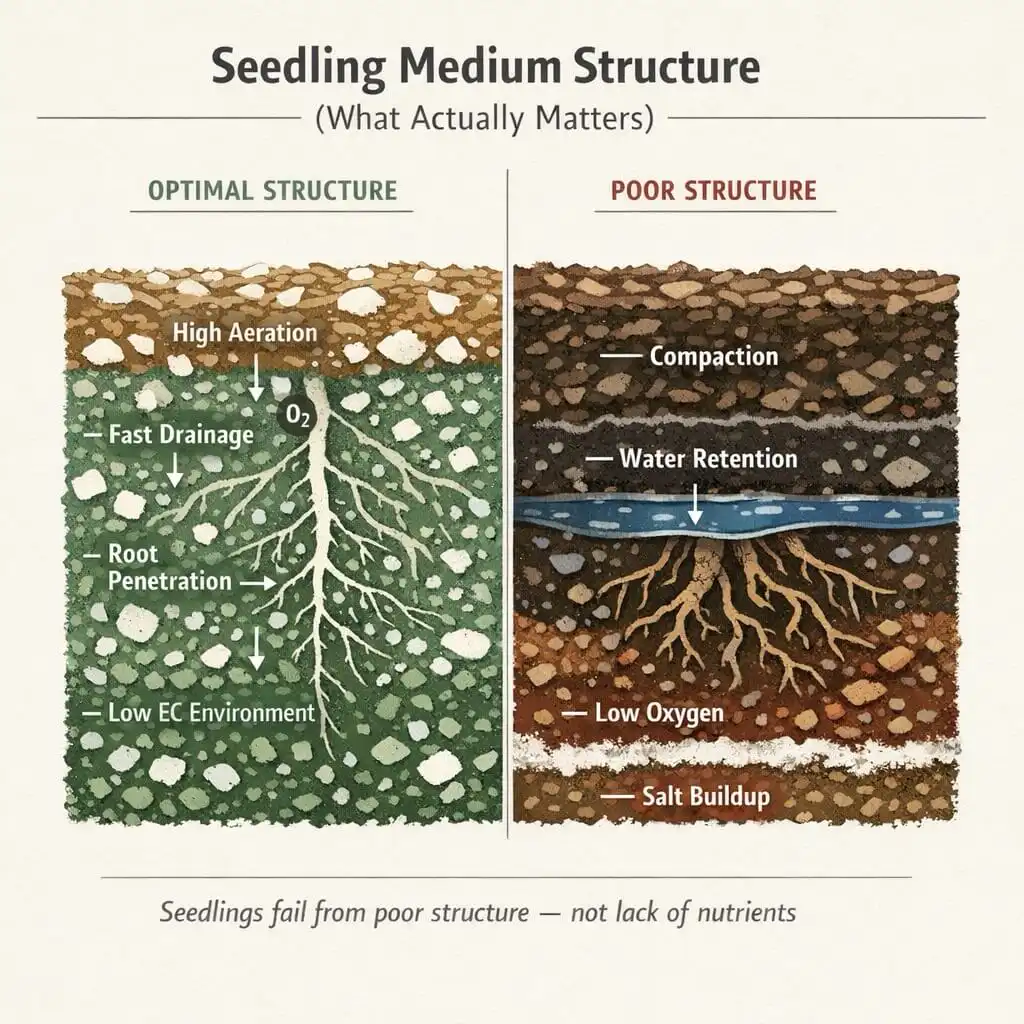
A seedling’s root system is minimal for the first two to three weeks. It cannot access nutrients the way a mature plant can, and it has almost no tolerance for salt build-up. What it needs from a growing medium is not nutrition — it’s structure. Specifically: good drainage so water moves through rather than sitting, aeration so the roots can access oxygen, and a light enough texture that the taproot can push through without resistance.
The nutrition comes later. The soil or coco mix you start in should provide almost nothing in the way of available nutrients. A seedling in a rich, hot mix will show tip burn and early nitrogen toxicity before it has its third set of leaves. Correcting that in an auto is difficult. Correcting it in a photoperiod costs you time. Better to start light and introduce nutrients deliberately once the plant is established.
pH sits at 6.2 for soil grows. That’s the target at the root zone, not just in the water going in. A consistent 6.2 keeps all the major and minor nutrients available without locking any out. Drift higher toward 7.0 and you start seeing iron and manganese deficiencies. Drop below 6.0 and calcium and magnesium uptake suffers. Get a decent pH pen and use it every time.
Why I Prefer Coco Coir for Seedlings
My preference for seedlings is coco coir or cocopeat — not a soil-based mix. I’ll explain why, because I know it’s not what most people start with.
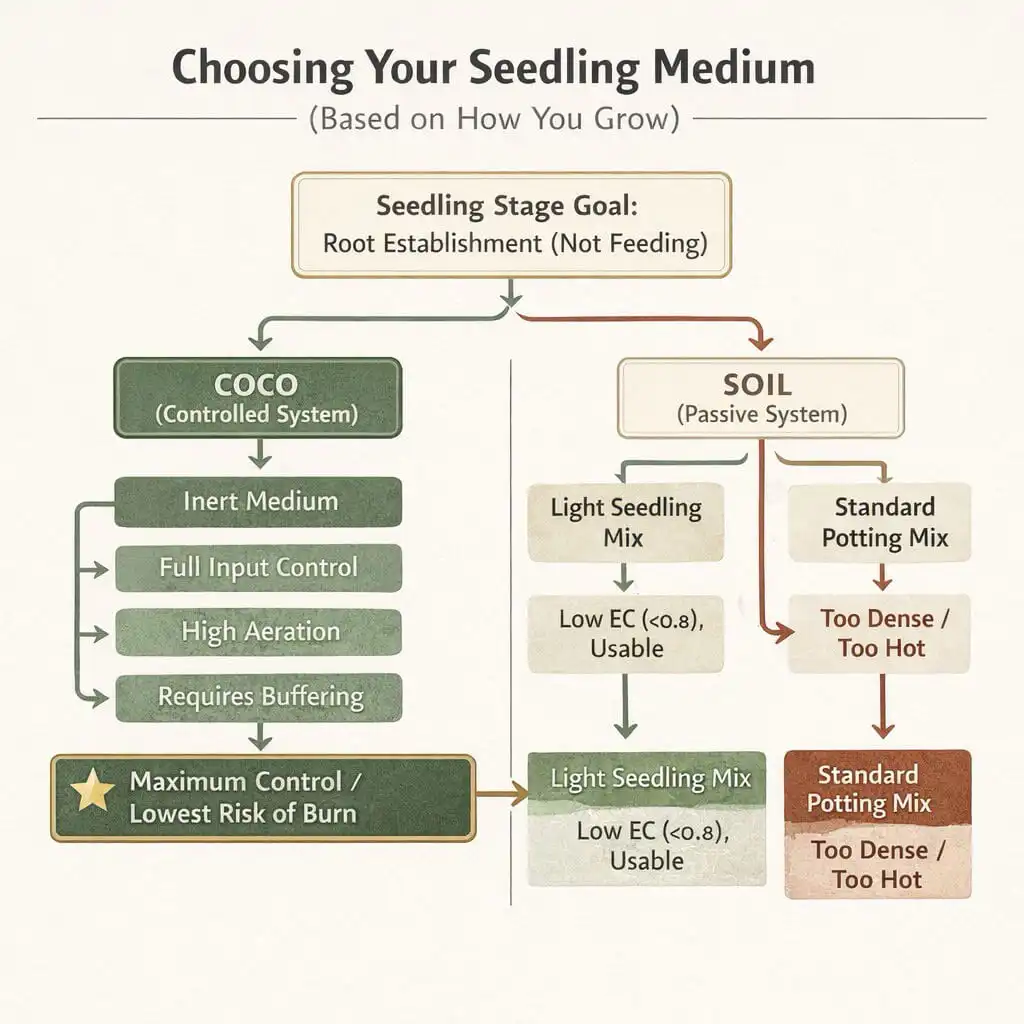
Coco is inert. It contains no nutrients of its own, which sounds like a disadvantage but is exactly what you want for seedlings. You control what goes in. There’s no guessing what the mix already contains, no risk of a hot base soil burning roots that can’t yet handle it. Coco also has a naturally high air-to-water ratio — it retains moisture well enough that you’re not watering every day, but it drains freely enough that roots aren’t sitting in saturation. For a seedling with minimal root mass, that balance is hard to beat.
The other advantage is consistency. Soil mixes vary batch to batch and brand to brand. Coco is predictable. Once you know how it behaves, you can dial in your watering and feeding routine and trust it will respond the same way every time.
What to add to coco for seedlings: Run coco at roughly 70–80% with 20–30% perlite. The perlite improves drainage and aeration further, which matters most in the seedling stage when overwatering is the biggest risk. For seedlings I go toward the higher end of perlite — 30% — and reduce it slightly for the established plant in its final container.
Pre-treating coco: If you’re using raw coco coir bricks or loose coco, rinse and buffer before use. Coco naturally contains high levels of sodium and potassium, and it has a strong cation exchange affinity for calcium and magnesium — meaning it will pull Cal-Mag out of your feed water and bind it before the plant can access it. Buffering with a Cal-Mag solution (follow the product rate, water to runoff, leave 30 minutes, water through again) saturates the cation exchange sites so they don’t rob your seedlings. Pre-treated coco from reputable brands handles this before bagging, but it’s worth knowing.
If You’re Using Soil — What to Look For
Not everyone wants to run coco, and that’s fine. Soil works well for seedlings when it’s the right mix. The key is choosing something light and airy rather than a heavy potting mix designed for vegetables or flowering plants. Standard potting mixes from hardware stores are typically too dense, too nutrient-rich, and too water-retentive for cannabis seedlings. They’re formulated to hold moisture and deliver nutrition — two things that will cause problems at the seedling stage.
What you want is something marketed as a seedling mix or propagation mix, or a quality cannabis-specific base soil. Look for perlite already in the mix, or add it yourself to bring it up to 20–30%. Peat-based mixes work, though they tend to become hydrophobic once dry — water carefully and evenly. Cocopeat-based mixes (which is essentially the same thing as coco coir in compressed form) are my preference if you’re going soil-adjacent rather than full coco.
What to avoid: Slow-release fertiliser granules in the base mix — these are common in Australian potting mixes and will overfeed seedlings regardless of what you’re adding in water. The Osmocote range at Bunnings is a good example: the seed raising mix is reasonable for seedlings, but the premium potting mixes contain slow-release fertiliser that makes them too hot at the seedling stage. Heavy, bark-based mixes that compact when wet. Anything described as “premium” or “enriched” for established plants. Water-crystals or gel additives that hold moisture.
The Scotts Osmocote seed raising mix — the plain one, not the potting mix — comes up regularly in Australian grower forums as a workable seedling medium when you’re not running full coco. It’s light, drains reasonably well, and the nutrient load is low enough for the seedling stage. Mix in 20–30% perlite and it’s a solid starting point.
A useful test before you commit to a soil: check the EC of a slurry sample (1:1 soil to pH-neutral water, stir, let settle, test the water). Seedling-appropriate soil should read 0.5–0.8 EC. Anything above 1.2 is too hot for a seedling and will cause problems within the first two weeks.
Container Size and the Seedling Stage
The medium you start in and the container you start in are related decisions. Getting both right is covered in the companion guide to container sizing and transplanting. For now, the short version: seedlings do not benefit from large volumes of medium. A small container — 0.5 to 1 litre — dries out at a rate the seedling can manage, which makes overwatering much less likely. A seedling in a 10-litre pot of coco is sitting in a large volume of wet medium it has no roots in yet, and root rot risk goes up significantly.
The exception is autoflowering seeds, where you start in the final container from day one. This is a non-negotiable rule for autos — transplanting at any stage disrupts the fixed timeline and costs yield that the plant cannot recover. For auto growers, that means choosing a medium with seedling-appropriate properties that also suits the established plant: coco with 20–25% perlite handles both stages well.
When Feeding Starts
Not at the seedling stage. A seedling in good coco or a light seedling mix does not need nutrients for the first two to three weeks. When to start feeding cannabis seedlings covers the timing and EC targets in detail. The short answer: watch the plant, not the calendar, and don’t reach for the nutrient bottle because a week has passed.
The most consistent mistake I see in growers who’ve had success with outdoor vegetable gardens is applying the same feeding logic to cannabis seedlings. Garden plants in established beds have mature root systems buffered by soil biology. A cannabis seedling in week one has almost nothing — a short taproot and the first hints of lateral growth. Feed it like a hungry teenager and you’ll burn it.
What to Use — The Short Version
My preference: Coco coir or cocopeat mixed with 20–30% perlite. Pre-buffered if using raw coco. pH your water to 6.2 before it goes in. Feed nothing for the first two to three weeks. Simple and repeatable.
If using soil: Light propagation or seedling mix, or a quality cannabis-specific base soil. Check EC before using — below 0.8 is appropriate. Add perlite to 20–30% if not already present. Avoid anything with slow-release nutrients, heavy bark content, or moisture crystals.
What matters most: Good drainage, aeration, low initial nutrient load, and pH at 6.2. The genetics you’re growing will take care of the rest if the foundation is right. Browse the full range of cannabis seeds available from Sacred Seeds Australia — auto, photoperiod, and fast version — and match your medium setup to the format you’re running.
Frequently Asked Questions — Soil for Cannabis Seedlings
Can I use regular potting mix for cannabis seedlings?
Most standard potting mixes sold in Australian hardware stores and nurseries are not suitable for cannabis seedlings. They’re typically too dense, hold too much moisture, and contain slow-release fertilisers that will overfeed a plant with no root mass to handle it. If potting mix is what you have, cut it heavily with perlite (at least 30%) and check the EC before use. A seedling-appropriate medium reads below 0.8 EC in a slurry test. Anything significantly above that is going to cause tip burn within the first two weeks.
Is coco coir better than soil for seedlings?
For most setups, yes — and specifically because it’s inert. There’s no pre-loaded nutrient content to manage, no variability between batches, and the drainage and aeration properties are better suited to the seedling’s minimal root system. The trade-off is that you’re responsible for everything the plant gets from day one, which means a more attentive watering and feeding routine as the plant establishes. For growers who want less active management, a good quality light soil or seedling mix with added perlite is a reasonable alternative.
What pH should my water be for cannabis seedlings in soil or coco?
6.2 is my target for soil and coco-based grows. Not a range — a target. Consistent pH at 6.2 keeps all the major nutrients available at the root zone without locking anything out. Check your pH every time before watering, especially in coco where pH drift can happen quickly if you’re not monitoring it.
Do I need to add perlite to my seedling mix?
Almost certainly, yes. Most commercial seedling mixes and base soils benefit from added perlite, and for coco grows it’s essentially non-negotiable. 20–30% perlite by volume improves drainage and oxygen availability at the root zone significantly. Without it, the medium holds too much water for the seedling’s root system to manage, and overwatering becomes the path of least resistance.
Why shouldn’t I feed cannabis seedlings straight away?
Because the root system at week one has almost no capacity to process nutrients, and any excess sits in the medium and builds salinity. The seedling’s job in the first two to three weeks is to establish its root network — and it can do that from the small amount of nutrition present in a good seedling mix or buffered coco without any additional input from you. Adding fertiliser to a seedling that’s not ready for it causes tip burn, root stress, and slowed development. The full guide to when to start feeding cannabis seedlings covers first feed timing and EC targets.
Can I use the same medium for autoflowers and photoperiods?
Yes — the seedling medium requirements are the same. The key difference is what you do at transplant time. Photoperiod plants move from a small seedling container to a larger vegetative container to their final pot as they develop. Autoflowering seeds start in their final container from day one and do not get transplanted. This means your coco or soil mix needs to work for the full lifecycle of the auto plant from the first day — which is another reason I prefer coco with perlite for autos specifically. It performs well at the seedling stage and scales into the established plant without any changes.