The Cheese strain is a single Skunk #1 plant that someone in England decided was worth keeping, and it went on to define British cannabis for two decades.
No breeder set out to make it. It came out of a bag of Skunk #1 seeds in the late 1980s, one phenotype among many, and it smelled so unlike the rest that whoever grew it kept the plant alive as a cutting and started passing it around. That is the entire origin story. Everything Cheese became followed from one person noticing that one plant smelled wrong in an interesting way.
This review covers where it came from, why the aroma is what it is, how the effect actually lands, and how it behaves in Australian conditions. For pricing, pack sizes and the full grow spec, the Cheese feminised seeds page has it.
Cheese Strain at a Glance
| Genetics | Skunk #1 phenotype, originally clone-only |
| Type | Balanced hybrid, close to 50/50 |
| THC | Around 17%, up to the low twenties |
| Origin | United Kingdom, late 1980s |
| Flowering | 8 to 9 weeks |
| Stretch | Significant, often doubling after the flip |
| Difficulty | Intermediate |
| Dominant terpenes | Myrcene, caryophyllene, humulene |
| Aroma | Sour, savoury, tangy. Unlike other skunks |
| Best for | Growers who want flavour character over raw potency |
Is Cheese Indica or Sativa?
Cheese is a balanced hybrid, close to a 50/50 split, which follows from its parentage. Skunk #1 is itself a cross of Afghani, Acapulco Gold and Colombian Gold, one indica landrace and two sativas, and Cheese sits near the middle of that inheritance. Some seed versions lean slightly one way or the other, but the original cut is best described as balanced rather than indica or sativa dominant.
What that means in the plant is a medium height with vine-like branching that needs support, because the flowers get heavy enough to pull thin branches down. What it means in the effect is something that carries weight without sedating you.
Anyone expecting a modern indica-dominant hybrid will find it more alert than they anticipated. Anyone expecting a pure sativa will find it heavier.
Where the Cheese Strain Came From
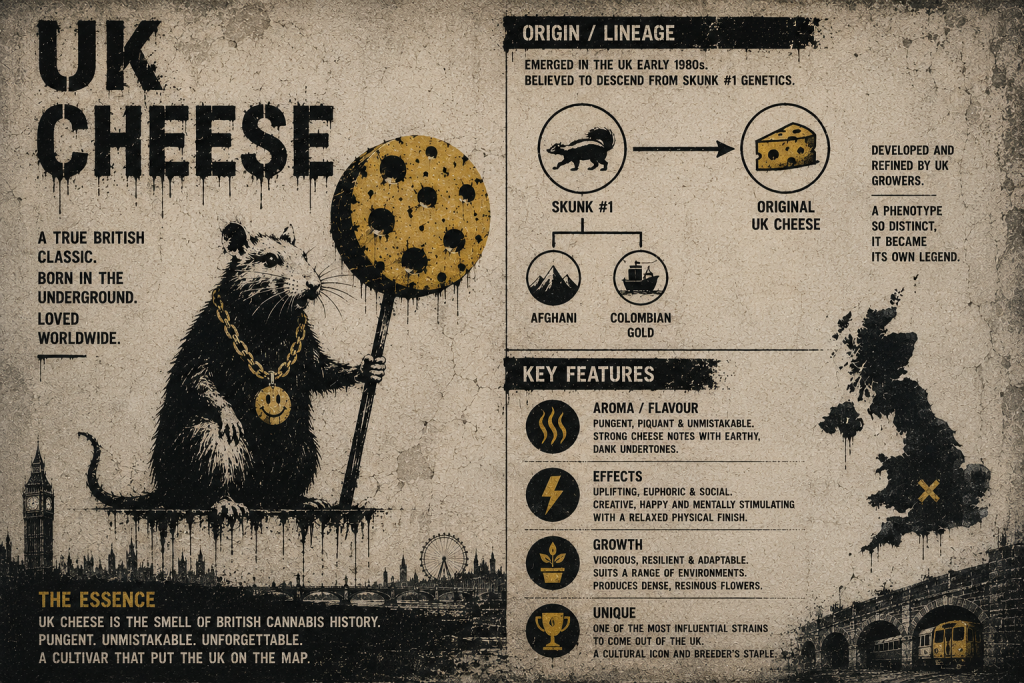
Skunk #1 arrived in Britain from the Netherlands during the 1980s, and it arrived as seed rather than as a fixed clone. That distinction is the whole story, because a bag of seeds contains variation and somebody has to look through it. The Skunk #1 review covers the parent strain in full.
In or around 1988, a grower working through a Skunk #1 batch found one plant that did not smell like the others. Where the rest gave the expected sweet, sour, skunky profile, this one produced something sharper and more savoury, a tang that people immediately reached for dairy comparisons to describe. It was kept as a mother plant, cuttings were taken, and those cuttings began to circulate.
The distribution is the part that made it a phenomenon rather than a curiosity. The cut spread through the Exodus Collective, a Luton-based community and free party organisation, which is why the strain is still often called Exodus Cheese. It moved hand to hand rather than through any commercial channel, and within a few years it had become the default in large parts of the country. For most of the 1990s, cannabis in Britain effectively meant Cheese.
That is a strange kind of fame. Most famous strains were marketed. This one was given away.
For how Skunk #1 itself was assembled out of landrace genetics, our landrace to hybrid guide traces the lines back.
Why Does Cheese Smell Like That?
Because a terpene combination that usually sits in the background moved to the front.
Myrcene leads, as it does across most of the Skunk family, and it brings the earthy, musky base. Caryophyllene sits behind it with a peppery edge. The distinguishing element is humulene, the same compound that gives hops their character, and in Cheese it arrives with unusual prominence. Sulphur compounds in the same family that make skunk smell skunky push the whole profile sideways into something sour and savoury rather than sweet.
The result reads as tangy and fermented rather than fruity or floral. The dairy comparison is imprecise, since it smells nothing like actual cheese, but it captures the sourness and the savoury quality better than anything else people reached for.

What matters practically is that the aroma is distinctive in a market where a great deal of modern flavour is variations on sweet, fuel and citrus. Cheese does not smell like anything bred in the last twenty years, and for a lot of growers that is precisely the appeal. The terpene guide covers how these compounds work together.
Jason’s Note
I lived in London in my early twenties, and Cheese is basically all any of us smoked back then. UK skunk, and Cheese in particular. So for me this smell is not an abstract terpene description, it is a specific time and place. Catch it now and it takes me twenty-five years back in a single breath, which is a thing only a handful of smells can do. A good seed Cheese gets you most of the way back to that, close enough that the memory lands. That is worth saying plainly, because a lot of what gets written about aroma is guesswork. This one I know from the inside.
The cure matters more here than with almost anything else in the catalogue. Rushed Cheese loses the sourness and lands somewhere generic and skunky, which wastes the entire point of growing it. A slow dry followed by a patient cure of four weeks or longer is what brings the tang forward, and the curing guide covers the process.
Jason’s Take
Cheese is one of the few older strains where the flavour is the reason to grow it rather than a bonus on top of potency. It is not the strongest thing in the catalogue and it was never trying to be. What it has is a character that nothing bred since has replicated, and that is worth more to me than another two percent THC.
Cheese Strain Effects: What to Expect
A quick, noticeable onset that arrives faster than you might expect. It opens bright and slightly euphoric, sociable rather than introspective, then settles gradually into physical relaxation over the following half hour.
The settle is real but it does not flatten you. This is what a balanced hybrid does well: it lands with weight while leaving you functional, which is why it worked as an everyday strain for a generation of British smokers rather than an evening-only one.
Potency averages around 17 percent and reaches the low twenties in the best examples, which is moderate by modern standards. That is not a criticism. It is why the strain suits a longer session and why the flavour has room to be the point.
Late afternoon into evening is where it fits. Not first thing, and not when precision matters.
Who it suits
- Growers who value flavour character over headline potency
- Anyone interested in the heritage side of British cannabis rather than modern exotics
- Growers with genuine odour control, since this is not a discreet plant
- Southern and inland Australian gardens where autumn stays dry
- Anyone who wants a hybrid that relaxes without shutting the evening down
Growing Cheese in Australia
Intermediate, and the reasons are specific rather than vague.
The plant itself is straightforward enough. It is vigorous, it branches willingly, and it finishes in 8 to 9 weeks, which is quick enough to get a southern outdoor crop in and out before the autumn rain sets in. Harvest in the southern states typically falls through March and into early April.
Three things make it more demanding than a beginner plant.
The stretch is substantial. Cheese can double in height in the two to three weeks after the flip, sometimes more. Plan your space around the post-stretch size, not the size at the switch, or you will spend late flower fighting the ceiling. The branching is thin and vine-like, and the colas get heavy enough that those branches will bend or snap without support, so plan to stake or tie as the flowers fill. Topping or low stress training during vegetative growth is worth the effort here, and the small space guide covers managing it in a confined area.
The buds get dense. Dense flowers plus humid air is how bud rot starts, and Cheese produces exactly the kind of tight, heavy cola that holds moisture. In Victoria, Tasmania, South Australia, Western Australia and southern New South Wales this is a manageable consideration. In Queensland, the Northern Territory or anywhere on a humid coastal strip it is the central problem of the grow, and airflow and selective defoliation stop being optional. Our Australian climate guide covers the regional picture, and the outdoor growing guide covers timing.
And then there is the smell.
Jason’s Warning
I would not grow Cheese without proper carbon filtration, and I would not grow it outdoors anywhere the neighbours are close. This is one of the loudest strains there is, the smell starts well before flowering finishes, and it carries. A filter that handles most of the catalogue will struggle with this one. Size up, and replace the carbon on schedule rather than when you notice it failing, because by then everyone else has noticed too.
Harvest timing follows the usual approach. Check trichomes from around day 50 and take it between mostly cloudy and roughly 20 percent amber for the balanced version of the effect, with the amber trichomes guide covering how to read them and the harvest timing guide covering the wider set of signals. Dropping night temperatures to 15 to 18 °C in the final fortnight will sometimes pull deeper colour into the flowers, which is cosmetic rather than a potency signal.
Then dry it slowly. Everything good about this strain is in the aroma, and a fast dry throws it away.
Cheese Strain Family Tree
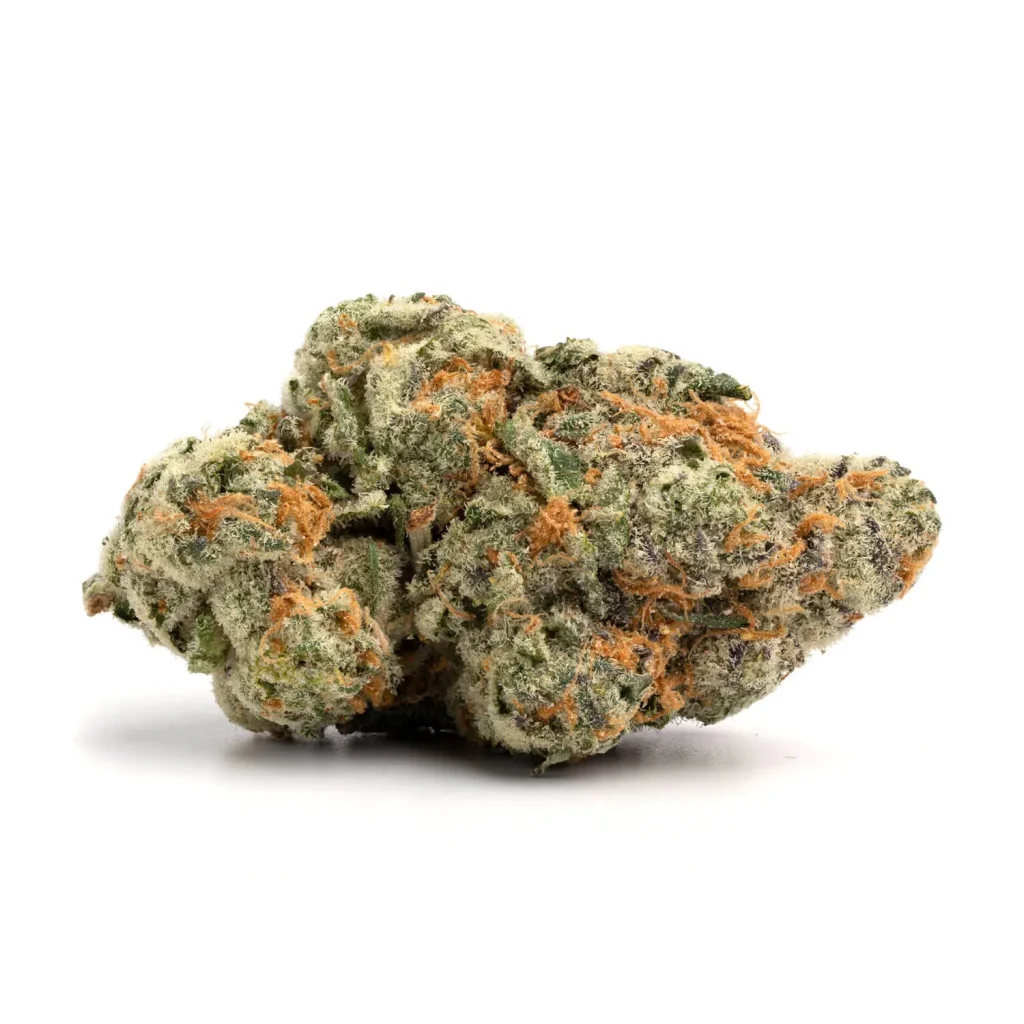
Cheese sits inside the Skunk family rather than beside it, which is why the names get used interchangeably. UK Cheese, Exodus Cheese and Cheese Skunk all describe the same lineage.
Its parent is Skunk #1, the 1970s cross that made stable commercial breeding possible in the first place. Its closest relative in our catalogue is Super Skunk, which took Skunk #1 in the opposite direction, crossing back to Afghani for weight and density rather than selecting for aroma. Comparing the two is the clearest illustration available of how much variation one seed line contains: same parent, entirely different results, one selected and one bred. There is also an autoflowering Super Skunk if a fixed timeline suits you better.
One thing worth being straight about. The original Cheese was clone-only, which means it existed as a single plant and its cuttings and nothing else. Every seed version since is a recreation. The best known came from Milo of Big Buddha, who crossed the Exodus cutting with an Afghan male to fix it into seed form and launched Big Buddha Seeds in 2005 with Cheese as the only strain in the range, the first to bring it to the UK seed market. That is not a criticism of seed Cheese, which is how the strain reached anyone outside the clone-sharing networks, but it is the honest position. A seed will get you very close to the Cheese character. It will not get you the 1988 plant, because nothing does except a cutting descended from it.
Forward from there, Cheese became a parent in its own right. It is the mother of the entire Cheese family: Big Buddha Cheese, Blue Cheese, and the many crosses that carry the name. Big Buddha’s Cheese took the Best Indica prize at the 2006 High Times Cannabis Cup, and Blue Cheese, a cross with Blueberry, took third in Best Sativa the same year. For a strain that started as one weird plant nobody bred on purpose, that is a considerable second act.
A coincidence we cannot resist mentioning
The Skunk #1 that Cheese was selected from traces back to a Californian growers’ collective of the 1970s that was also, as it happens, called Sacred Seeds. No relation to us, and we make no claim on that lineage. But the strain that came to define British cannabis owes its genetics to a group who shared our name, which is the kind of coincidence that is too good not to note.
If you are weighing this against the rest of the hybrid range and are not sure, the strain finder narrows it down in about six questions. To see how the whole Skunk line connects to the wider landraces and modern hybrids, the cannabis genetics family tree maps it out.
Cheese earns its place through character rather than numbers. It is not the strongest, the biggest yielding or the easiest, and it has outlasted a great many strains that were all three.
Key takeaways
A Skunk #1 phenotype selected in England around 1988 and spread by hand rather than sold, which made it the default British strain for most of the 1990s.
The aroma is the reason to grow it. Sour, savoury and tangy, driven by humulene alongside myrcene and caryophyllene, and unlike anything bred since.
Intermediate to grow. It stretches hard after the flip, the dense buds need airflow in humid regions, and the smell demands serious carbon filtration.
Finishes in 8 to 9 weeks with a southern Australian harvest through March into early April, and rewards a slow dry and a long cure more than most.
Cheese Strain FAQ
Is Cheese indica or sativa?
A balanced hybrid, close to a 50/50 split. Its parent Skunk #1 combines one indica landrace with two sativas, and Cheese sits near the middle of that. Some seed versions lean slightly one way, but the original cut is best called balanced rather than dominant either way.
Why is it called Cheese?
Because of the aroma. The original plant produced a sour, savoury tang unlike the sweet skunk profile of its siblings, and dairy was the nearest comparison anyone could reach for. It does not actually smell like cheese, but the sourness is close enough that the name stuck.
What is the difference between Cheese and UK Cheese?
Nothing. UK Cheese, Exodus Cheese and Cheese Skunk all describe the same lineage. The UK prefix distinguishes it from later crosses that carry Cheese in the name without descending from the original cut.
Is Cheese a Skunk strain?
Yes. It is a selected phenotype from a Skunk #1 seed batch rather than a separate cross, which is why the names are used interchangeably. Super Skunk comes from the same parent by a different route, crossed back to Afghani instead of selected for aroma.
How strong is the Cheese strain?
Moderate by modern standards, averaging around 17 percent and reaching the low twenties in the best examples. It was never a potency strain and it has survived on flavour, which is the more unusual achievement.
How long does Cheese take to flower?
8 to 9 weeks. Southern Australian outdoor growers usually harvest through March into early April, early enough to stay ahead of the autumn rain.
Is Cheese hard to grow?
Intermediate. The plant itself is vigorous and cooperative, but it stretches heavily after the flip, the dense buds need real airflow in humid conditions, and the smell requires proper filtration. None of those are difficult individually. Together they mean it is not a first grow.
Does Cheese smell as strong as people say?
Yes, and probably stronger. It is among the loudest strains available, the aroma builds well before flowering finishes, and it carries further than most. Carbon filtration is not optional indoors, and outdoor growing near neighbours needs thinking about.
Does Cheese grow well in Australia?
Very well in southern and inland regions, where the dry autumn suits the dense flowers and the fast finish beats the weather. In humid subtropical and tropical areas it needs considerably more attention to airflow and canopy management. The Australian climate guide covers the regional detail.
Why does cure matter so much with Cheese?
Because the aroma is the entire point of the strain and a fast dry destroys it. Rushed Cheese loses the sour tang and lands somewhere generic and skunky. A slow dry followed by four weeks or more of curing is what brings the character forward, and the curing guide covers how.
Is seed Cheese the same as the original clone?
Close, but not identical. The original was clone-only, so every seed version is a recreation produced by crossing the cut back to Skunk #1 or an Afghani line and selecting for the closest phenotype. A seed gets you the Cheese character. Only a cutting descended from the 1988 plant is the original.
What strains come from Cheese?
Cheese is the mother of the whole Cheese family. Big Buddha Cheese is the best known seed version, and Blue Cheese, a cross with Blueberry, is the other major descendant. Big Buddha’s Cheese won Best Indica at the 2006 High Times Cannabis Cup and Blue Cheese took third in Best Sativa the same year. Countless later crosses carry the Cheese name and the aroma that goes with it.
What does Cheese taste like?
Sour and savoury with a tangy, fermented quality and an earthy skunk base underneath. Humulene, the compound behind the character of hops, sits unusually forward in the profile alongside myrcene and caryophyllene.
When should I use it?
Late afternoon into evening. It opens brighter and more sociable than most indica-leaning hybrids and settles into physical relaxation without flattening you, which is why it worked as an everyday strain rather than a night-only one.
Where can I buy Cheese seeds in Australia?
Through our catalogue, shipped domestically with tracked delivery and no customs exposure. The Cheese feminised seeds page has current pricing and pack sizes, and every batch we stock is tested before dispatch under our germination guarantee.
Sacred Seeds Australia sells cannabis seeds strictly as souvenirs and for genetic preservation, in accordance with local laws. The Australian Capital Territory permits limited personal cultivation for adults. All other states and territories prohibit it. Nothing in this article is medical or legal advice. Always check the laws that apply where you live before germinating or cultivating.
Related reading: the Skunk #1 review for the parent strain, our Northern Lights review for the Afghani side of the same era, the cannabis genetics family tree for how the Skunk line connects to everything else, the drying guide for the stage that decides whether the aroma survives, and the full cannabis seeds Australia catalogue.