THCV is the cannabinoid that most cannabis users have never heard of — and the one that changes how they think about cannabis once they have. While the industry has spent years obsessing over THC percentages, THCV has been quietly doing something more interesting: producing a functional, clear-headed, energised effect that sits in a completely different category to the heavy sedation most associate with cannabis. We’ve been fascinated by it for years, and the arrival of Durban Poison in our catalogue — one of the highest-THCV strains available — felt like the right moment to write about it properly. Moby Dick is another THCV-bearing strain in our range, combining White Widow and Haze genetics with a clearer, more energetic profile.
This guide covers what THCV cannabis actually is, how it differs from THC and CBD, what the research says about its effects on appetite, metabolism, and neurology, and why Durban Poison is the strain to grow if you want to experience it in Australia.
THCV — At a Glance
| Full name | Tetrahydrocannabivarin (δ9-THCV) |
| Psychoactive? | At low doses: no. At higher doses: mildly, differently to THC |
| Effect profile | Clear-headed, energising, appetite-suppressing — shorter duration than THC |
| Receptor action | CB1 antagonist at low doses • CB2 partial agonist |
| Key difference from THC | Shorter hydrocarbon side chain — produces opposite effects to THC at CB1 |
| Highest natural sources | African landrace sativas — particularly Durban Poison |
| Research areas | Appetite suppression, metabolic health, neuroprotection, antipsychotic effects |
| Australian strain | Durban Poison feminised |
In this guide:
- What is THCV and how does it differ from THC?
- What does THCV feel like?
- THCV and appetite — the anti-munchies cannabinoid
- THCV and metabolic health
- Neurological effects and neuroprotection
- How THCV interacts with the endocannabinoid system
- High-THCV strains — Durban Poison in Australia
- Growing for THCV expression
- FAQ

What Is THCV and How Does It Differ from THC?
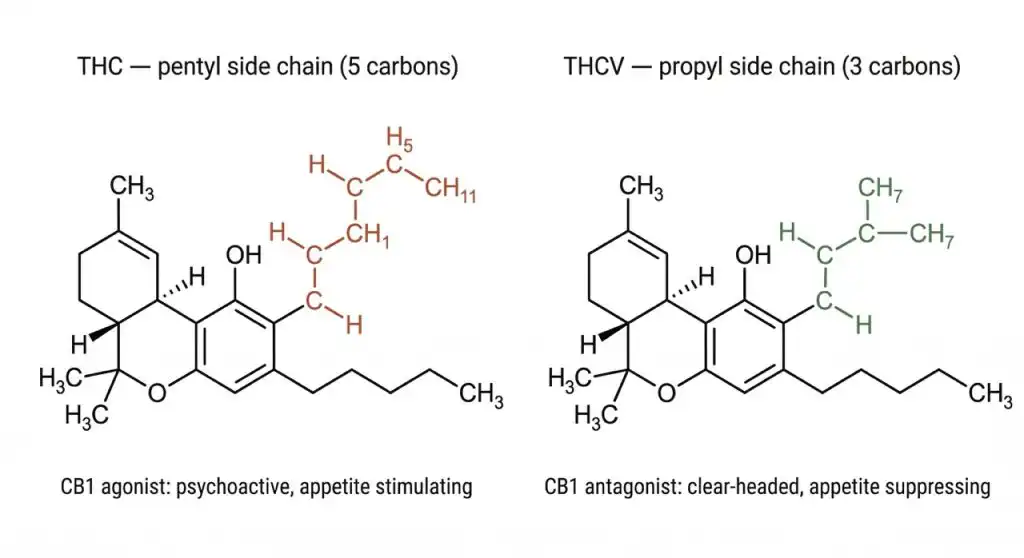
THCV — tetrahydrocannabivarin — shares a molecular structure with THC but differs in one critical way: a shortened propyl hydrocarbon side chain rather than the pentyl chain in THC. That structural difference produces effects that are almost opposite to THC at the CB1 receptor. Where THC binds to CB1 as an agonist — activating it, producing psychoactive effects, stimulating appetite — THCV acts as a CB1 antagonist at most doses, blocking that receptor and producing the opposite: no significant psychoactive effect, appetite suppression, and a cleaner, shorter-duration experience.
THCV is not CBD. This distinction matters because the two are frequently lumped together as “non-psychoactive cannabinoids” as though they work the same way. They don’t. CBD works primarily through indirect mechanisms — influencing receptor activity without binding strongly to CB1 or CB2. THCV binds directly to those receptors, acts as a CB1 antagonist and a CB2 partial agonist, and produces distinct physiological effects that CBD doesn’t. The two compounds have different chemical structures, different receptor interactions, and different effect profiles. The only thing they share is the absence of the heavy THC psychoactive load at standard doses.
THCV is also dose-dependent in a way that most cannabinoids aren’t. At low to moderate doses, THCV blocks CB1 and produces the clear, functional, appetite-suppressing effects described throughout this article. At higher doses, the CB1 antagonism may shift toward partial agonism and a mild psychoactive effect emerges — described by most users as stimulating and clear rather than heavy or sedating. The practical implication is that THCV-dominant strains like Durban Poison behave very differently at different consumption levels.
🌿 Jason — On Discovering THCV
The first time I grew Durban Poison I wasn’t sure what to expect. I’d read about THCV but hadn’t experienced a genuinely high-THCV strain before — most of what’s commercially available is bred for THC and THCV content is minimal. Durban Poison is different. The effect was immediately distinct from anything in the THC-dominant part of the catalogue. Alert, functional, creative — the kind of headspace where a walk in the bush or an afternoon working on something with your hands feels genuinely enhanced rather than impaired. We wish it had a less threatening name. The genetics are extraordinary.
What Does THCV Feel Like — The Effect Profile
The effect profile of a high-THCV strain is unlike anything in the indica or THC-dominant sativa categories. Where most cannabis produces some degree of cognitive slowing, appetite stimulation, and sedation — even sativas tend toward these effects at sufficient THC levels — THCV produces the opposite across all three dimensions.
The onset is fast — faster than comparable THC doses — and the character of the effect is alert rather than intoxicated. Thoughts are clear. Appetite is suppressed rather than stimulated. Physical energy is available rather than depleted. The duration is shorter than THC, which some users find a limitation and others find a feature — you’re not committed to three hours of impairment if you have something to do later.
The combination of THCV and THC in the same strain — which is what Durban Poison and similar African sativas deliver — produces something that neither cannabinoid produces alone. The THCV’s CB1 antagonism partially modulates the THC effect, reducing the cognitive heaviness and appetite stimulation while the THC contributes depth and duration. The result is a high-functioning, creative, sociable experience that growers and users who’ve spent time with it consistently describe as one of the most distinctive effects in the cannabis catalogue.
🌿 Jason — On the THCV Experience
The best way I can describe a high-THCV session is: capable. You feel capable. Alert, present, creative, energised — the kind of state that’s genuinely useful for a nature walk, a day of physical work, making music, surfing, socialising. The people who gravitate toward Durban Poison in our catalogue tend to be experienced users who’ve tried the heavy THC end of the spectrum and want something different. The refined palate, as Jess likes to say. THCV rewards curiosity about cannabis beyond the THC percentage race.
THCV and Appetite — The Anti-Munchies Cannabinoid
The appetite-suppressing effect of THCV is one of its most researched and most consistently reported properties. The mechanism is direct: by acting as a CB1 antagonist, THCV blocks the receptor activation that drives the appetite stimulation associated with THC. The endocannabinoid system plays a central role in appetite regulation — CB1 activation increases hunger, promotes fat storage, and drives the reward-driven eating that produces the munchies. THCV interference at CB1 suppresses this entire pathway.
Beyond simple appetite suppression, research suggests THCV may also reduce the reward appeal of high-calorie food specifically. The mechanism involves modulation of neurotransmitter activity in the brain’s reward regions — the ventral tegmental area and nucleus accumbens — reducing the dopamine-driven pull toward calorie-dense food choices. This is meaningfully different from simply suppressing hunger; it suggests THCV may affect the motivational dimension of eating behaviour rather than just the physiological hunger signal.
Rodent studies have demonstrated appetite reduction, increased satiety, and upregulated energy metabolism with THCV administration. Human research is more limited but the direction of findings is consistent. The honest framing is that the evidence is promising and the mechanism is well understood, but the clinical picture in humans requires more study before confident conclusions can be drawn about specific applications.
THCV and Metabolic Health — Insulin, Blood Glucose, and Weight
The metabolic research on THCV is among the most substantive in the cannabinoid literature outside of CBD and THC. Several converging lines of evidence suggest THCV influences insulin sensitivity and blood glucose regulation through its interaction with CB2 receptors and transient receptor potential (TRPV1) channels — receptor systems that play a direct role in metabolic function.
In obese mouse models, THCV improved insulin sensitivity, enhanced glucose tolerance, and positively impacted lipid parameters. A human pilot study in type 2 diabetic patients found THCV significantly reduced fasting plasma glucose, enhanced β-cell function, and improved adiponectin and Apo A concentrations — markers of improved metabolic health. These are meaningful outcomes from a well-characterised mechanism, not speculative associations.
The weight management picture follows from the appetite suppression research. THCV administration in rodent studies produced weight loss, lowered food intake, and decreased body fat content. The combination of appetite suppression, improved insulin sensitivity, and upregulated energy metabolism represents a coherent set of metabolic effects that has attracted serious research attention. As with the appetite research, the human clinical picture needs more development — but the mechanistic foundation is solid and the early results are compelling.
THCV and the Brain — Neuroprotection and Cognitive Effects
The neurological research on THCV covers two distinct areas: its ability to modulate THC-induced cognitive impairment, and its potential neuroprotective effects as a standalone compound.
Modulating THC’s cognitive effects
As a CB1 antagonist, THCV directly counteracts some of THC’s negative cognitive effects — the memory impairment, the slowed processing, the cognitive fog that accompanies heavy THC use. This is not theoretical; it follows directly from the receptor pharmacology. THC activates CB1 to produce its psychoactive and cognitively impairing effects; THCV blocks CB1 and reduces those effects proportionally. In practical terms, a strain that delivers both THCV and THC — like Durban Poison — produces a more cognitively functional experience than a comparable THC-only strain at equivalent total cannabinoid content.
Neuroprotective properties
Separately from its THC-modulating effects, THCV has demonstrated neuroprotective properties in preclinical research — the ability to reduce neuronal damage and potentially slow neurodegeneration. The published research on THCV’s neuroprotective effects suggests potential relevance to conditions involving neurodegeneration, though the translation from preclinical models to human therapeutic applications requires significantly more clinical research before any conclusions can be drawn. The mechanism is believed to involve CB1 and CB2 receptor interactions, though the full picture is still under investigation.
THCV has also shown antipsychotic potential in research settings — a property shared with CBD and consistent with the CB1 antagonist mechanism, since CB1 overactivation is implicated in psychosis risk. This is one of the more intriguing research directions, though again the clinical evidence is at an early stage.
How THCV Interacts with the Endocannabinoid System
The endocannabinoid system is a biological regulatory network present throughout the body — in the brain, organs, immune system, and peripheral tissues. It operates through two primary receptor types: CB1, concentrated in the central nervous system and involved in cognition, appetite, pain, and mood; and CB2, concentrated in the immune system and peripheral tissues and involved in inflammation and immune response. The system also produces its own endogenous cannabinoids — primarily anandamide (AEA) and 2-arachidonoylglycerol (2-AG) — and the enzymes that synthesise and break them down.
THCV’s interaction with this system is unusually complex. At low doses, it acts as a CB1 antagonist — blocking the receptor rather than activating it, and thereby producing effects opposite to THC and to the body’s own endocannabinoids at that receptor. At higher doses, this relationship appears to shift toward partial agonism. Simultaneously, THCV acts as a potent CB2 partial agonist — activating the anti-inflammatory and immune-modulating pathways associated with CB2. The combination of CB1 antagonism and CB2 agonism is what underlies THCV’s distinctive profile: reduced psychoactivity, appetite suppression, and anti-inflammatory effects operating simultaneously through different receptor pathways.
There is also evidence that THCV influences the enzymes that regulate endocannabinoid metabolism — specifically fatty acid amidohydrolase (FAAH) and monoacylglycerol lipase (MAGL), which break down AEA and 2-AG respectively. By modulating these enzymes, THCV may increase endocannabinoid tone — the background level of endocannabinoid activity — which could contribute to its mood-regulating, appetite-controlling, and neuroprotective effects through pathways beyond direct receptor binding. Research by Thomas et al has explored these mechanisms in detail.
High-THCV Strains — Durban Poison in Australia
THCV occurs naturally in cannabis but at very low concentrations in most commercially bred strains. The modern seed bank industry has optimised almost entirely for THC — which means THCV has been selected out of most hybrid genetics over decades of breeding. The strains that retain meaningful THCV content are primarily African and South Asian landraces that haven’t undergone the same THC-maximisation pressure, and their direct descendants.
Durban Poison is the most accessible and commercially significant high-THCV strain available. It’s a pure African sativa landrace from the Durban region of South Africa — one of the most geographically isolated cannabis-growing traditions in the world — and it has retained its THCV content precisely because it hasn’t been extensively crossed with THC-dominant Dutch or American genetics. The THCV levels in Durban Poison are among the highest of any commercially available feminised strain, and the overall cannabinoid and terpene profile makes it a genuinely distinctive grow and experience.
Other strains with elevated THCV content include Doug’s Varin (bred specifically for THCV expression), Jack the Ripper, Pineapple Purps, and Tangie — though most of these are harder to source in Australia as feminised seeds. For Australian growers, Durban Poison is the practical answer to the question of how to experience THCV.
Durban Poison — Available from Sacred Seeds Australia
Durban Poison is the primary high-THCV strain in our catalogue — a pure African sativa landrace with one of the highest natural THCV profiles of any commercially available feminised strain. We stock both the photoperiod feminised version and the autoflowering format for Australian growers who want the fixed timeline flexibility.
Durban Poison Feminised Seeds — photoperiod, full season outdoor or indoor, maximum THCV and terpene expression.

Growing for THCV Expression — What Affects Cannabinoid Content
THCV content in a cannabis plant is primarily determined by genetics — you can’t turn a low-THCV strain into a high-THCV strain through growing technique. Starting with the right genetics is the non-negotiable first step, and Durban Poison is currently the practical answer for Australian growers wanting meaningful THCV expression.
Within the genetic ceiling set by the strain, several environmental factors influence the final cannabinoid profile. Light intensity and quality have the most significant impact — higher light intensity through the flowering phase supports greater overall cannabinoid synthesis. THCV is produced through the same biosynthetic pathway as THC but from a different precursor (divarinolic acid rather than olivetolic acid), so the factors that support THC production generally support THCV production in strains where the genetic machinery is present.
Temperature management in late flower affects the preservation of THCV as much as its production. Cannabinoids degrade under heat — the same principle that drives terpene loss at high temperatures applies to THCV. Keeping the flowering environment below 26°C, particularly from week five onward, preserves the cannabinoid content that the plant has produced rather than allowing degradation before harvest.
Harvest timing is critical for THCV specifically. THCV degrades into cannabivarin (CBV) as amber trichomes develop — so a harvest at 10–15% amber preserves significantly more THCV than one pushed to 25–30% amber. For growers specifically seeking THCV expression, the earlier harvest window applies more strongly here than with any other strain. This is the opposite recommendation to a Northern Lights or Godfather OG grow where pushing to full amber produces the desired indica body effect — with Durban Poison, harvest earlier rather than later.
🌿 Jason — On Growing Durban Poison for THCV
The two things that matter most for THCV expression in Durban Poison are light intensity through flower and harvest timing. Run the highest quality light you can through the flowering phase and keep temperatures controlled — above 26°C in flower and you’re degrading what you’re trying to produce. On timing: I harvest Durban Poison earlier than most of the other strains in the catalogue. The THCV is at its peak before the trichomes go fully amber, and the experience you’re after from this strain — the clarity, the energy, the functional high — comes from catching it at that window. Push it too far and you end up with something closer to a conventional sativa. Good, but not what Durban Poison is actually capable of.
For outdoor Australian growers: Durban Poison suits the Queensland and Northern NSW climate well. It’s a long-season sativa that wants warmth and light. If you’re in Victoria or Tasmania, the auto version is the more practical choice — the fixed timeline brings it in before the season closes.
Not sure if Durban Poison suits your setup?
Answer six questions and Jess will match you to three strains based on your experience, space, and goals.
Key Takeaways — THCV Cannabis
THCV is a CB1 antagonist and CB2 partial agonist with a distinct effect profile from THC — clear-headed, energising, appetite-suppressing, and shorter in duration. It occurs naturally at meaningful concentrations primarily in African landrace sativas, with Durban Poison being the most commercially accessible high-THCV strain available in Australia. Research suggests potential in appetite regulation, metabolic health, and neuroprotection — with the metabolic and appetite research being the most substantiated and the neurological research the most promising. For growers, THCV expression is maximised by starting with the right genetics, running high light intensity through flower, managing temperature below 26°C, and harvesting at the earlier end of the trichome window rather than pushing to full amber.
THCV Cannabis — Frequently Asked Questions
What is THCV and how is it different from THC?
THCV — tetrahydrocannabivarin — shares a similar molecular structure to THC but has a shorter hydrocarbon side chain that produces opposite effects at the CB1 receptor. Where THC activates CB1 to produce psychoactive effects and appetite stimulation, THCV blocks CB1 at most doses — producing a clear-headed, energising, appetite-suppressing effect rather than the sedating, hunger-inducing experience associated with high-THC cannabis.
Will THCV get me high?
At low to moderate doses, THCV is not significantly psychoactive. At higher doses, a mild stimulating effect can emerge — described by most users as alert and functional rather than intoxicating in the conventional THC sense. High-THCV strains like Durban Poison, which contain both THCV and THC, produce a combined effect that is more clear-headed and energised than a THC-only strain of equivalent potency.
What does THCV feel like?
Alert, capable, creative, and energised — with appetite suppressed rather than stimulated. The duration is shorter than THC. Users consistently describe high-THCV strains as suited to active, functional activities: physical work, creative projects, social situations, outdoor activity. It’s a different category of experience from the sedating or heavily intoxicating end of the cannabis spectrum.
Does THCV suppress appetite?
Research suggests it does — through direct CB1 antagonism, which blocks the receptor activation that drives appetite stimulation. Rodent studies have consistently shown appetite reduction and increased satiety with THCV. The mechanism is well understood; the human clinical picture requires more research but is consistent with the preclinical findings.
Is THCV legal in Australia?
THCV is a naturally occurring cannabinoid in cannabis. The legal status of cannabis and its cannabinoids in Australia varies by state and context. Seeds are sold by Sacred Seeds strictly as collectibles. Always check your local laws before cultivating or consuming cannabis.
Which strains are highest in THCV?
African landrace sativas have the highest natural THCV content. Durban Poison is the most commercially accessible high-THCV strain available in Australia. Other high-THCV varieties include Doug’s Varin, Jack the Ripper, Pineapple Purps, and Tangie — though most are harder to source as quality feminised seeds in Australia.
How do I maximise THCV when growing?
Start with the right genetics — Durban Poison is the primary choice for Australian growers. Beyond that: maximise light intensity through the flowering phase, keep temperatures below 26°C from week five onward to prevent cannabinoid degradation, and harvest at the earlier end of the trichome window (10–15% amber rather than 25–30%). THCV degrades to CBV as trichomes amber — harvesting earlier preserves the THCV content the plant has produced.
Is THCV the same as CBD?
No. Both are considered non-psychoactive at standard doses but they work through completely different mechanisms. CBD operates primarily through indirect receptor modulation and doesn’t bind strongly to CB1 or CB2. THCV binds directly to both receptors — as a CB1 antagonist and CB2 partial agonist — and produces distinct physiological effects that CBD doesn’t. They’re different molecules with different receptor profiles and different effect characteristics.
What is Durban Poison and why does it have high THCV?
Durban Poison is a pure African sativa landrace from the Durban region of South Africa. Its high THCV content is the result of thousands of years of natural selection in isolation from the THC-focused breeding that has dominated the Western seed bank industry. Because it hasn’t been extensively crossed with Dutch or American high-THC genetics, it has retained the cannabinoid profile of its African landrace ancestors — including unusually high THCV expression. It’s available from Sacred Seeds as feminised photoperiod seeds.
Related Reading
Cannabis terpenes — what they are and why they matter — the aromatic compounds that work alongside cannabinoids like THCV to shape the overall experience.
Sativa-dominant cannabis seeds — the category Durban Poison sits in, alongside other energising and functional effect profiles.
Best cannabis strains for Australian conditions — regional strain selection and seasonal timing, including long-season sativas like Durban Poison.
The entourage effect — cannabinoid and terpene synergy — how THCV, THC, CBD, and terpenes interact to produce strain-specific experiences.
Browse all cannabis seeds — feminised, autoflower, and photoperiod strains shipped from Australia.
Seeds are sold strictly as novelty collector’s items. They contain no THC or CBD. This page does not constitute medical or legal advice. By purchasing you agree to our terms and conditions. Always check local laws before germinating or cultivating cannabis.