Quick Answer: What You Need to Know
🌱 Autoflower seeds flower automatically after 3-4 weeks, regardless of light schedule
🕐 Photoperiod seeds only flower when you change the light cycle to 12/12
⏱️ Autoflowers finish in 8-12 weeks total; photoperiods take 3-5 months
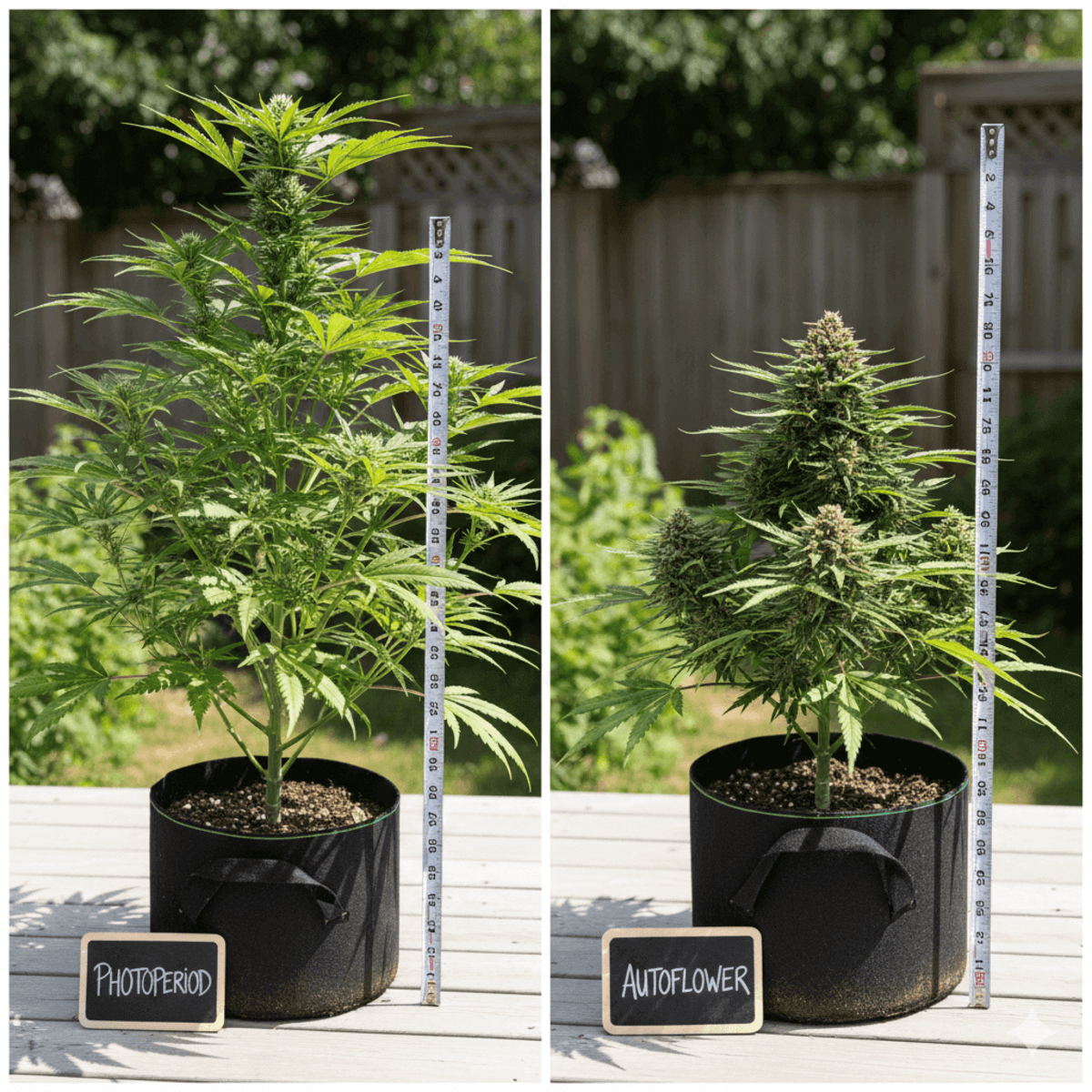
📏 Autoflowers stay smaller (60-100cm); photoperiods grow larger (100-200cm+)
🎯 Autoflowers = speed and simplicity; photoperiods = control and yield
If you’re choosing between seed types, start here: our complete range of cannabis seeds in Australia.
The Fundamental Difference: Light Dependency
The core difference between autoflower and photoperiod cannabis seeds comes down to one thing: how they decide when to flower.
Photoperiod plants are light-sensitive. In nature, they flower when days get shorter (late summer/autumn). Indoors, you control this by switching from 18/6 light to 12/12 light. Until you make that change, they stay in vegetative growth.
Autoflower plants ignore light schedules entirely. They flower based on age—typically 3-4 weeks after sprouting, no matter what light cycle you’re running. This trait comes from Cannabis ruderalis genetics, a subspecies that evolved in regions with short summers where waiting for shorter days would mean missing the growing season entirely.
I’ve tested hundreds of autoflower and photoperiod strains over the years, and this genetic difference creates a cascade of practical differences that affect everything from grow time to final yield.
The Genetic Marvel: How Autoflowers Were Created
Autoflower cannabis is one of the most impressive breeding achievements in modern horticulture. Here’s the fascinating story:
Enter Cannabis ruderalis – a wild subspecies that evolved in the harsh climates of Siberia, northern Russia, and Central Asia. Unlike Cannabis indica and Cannabis sativa (which evolved near the equator with consistent day/night cycles), ruderalis developed in regions with extreme seasonal variation.
In these short-summer environments, waiting for autumn’s shorter days would be fatal—plants would freeze before flowering. So ruderalis evolved a survival mechanism: age-based flowering. After 3-4 weeks of growth, ruderalis automatically flowers regardless of light schedule, ensuring it completes its lifecycle before winter arrives.
The problem? Wild ruderalis is tiny, low-potency, and produces minimal flowers. Not exactly what collectors want.
The breakthrough came in the 1970s-80s when breeders realized they could cross ruderalis with elite indica and sativa strains. Through careful selection over multiple generations, they created plants that:
✨ Retained the auto-flowering trait from ruderalis
✨ Gained potency, flavor, and yield from indica/sativa parents
✨ Stabilized genetics so the auto trait breeds true
Early autoflowers (2000s) were weak—maybe 8-12% THC with mediocre yields. But modern autoflowers from quality breeders now regularly hit 20-25% THC with respectable yields, all while finishing in 10 weeks. That’s decades of selective breeding compressed into plants that combine the best of three cannabis subspecies.
It’s genuinely remarkable: You’re growing plants that carry ancient survival genetics from Siberian ruderalis, wrapped in the potency and terpenes of California or Amsterdam elite strains. Every single gorilla glue autoflower seed, for example, represents thousands of hours of breeding work to perfect that genetic balance.
What Are Autoflower Seeds?
Autoflower seeds produce plants that automatically transition from vegetative growth to flowering based on age, not light cycle.
Key Characteristics:
⏱️ Fast lifecycle: 8-12 weeks seed to harvest
📏 Compact size: Usually 60-100cm tall
🌞 Light flexible: Can run 18/6 or even 20/4 throughout entire grow
🔄 No re-veg risk: Once flowering starts, it’s committed
🚀 Beginner-friendly: Simpler light management
📦 Lower yields: Typically 30-80g per plant
Best for:
✓ First-time growers
✓ Limited space
✓ Quick turnaround
✓ Outdoor grows in short seasons
✓ Perpetual harvests (stagger planting)
At Sacred Seeds, our most popular autoflowers finish in 9-11 weeks with minimal fuss. They’re forgiving of beginner mistakes and don’t require light schedule changes.
What Are Photoperiod Seeds?
Photoperiod seeds produce plants that flower only when exposed to 12 hours of darkness per day.
Key Characteristics:
🕐 Light-dependent: Need 12/12 light cycle to flower
📏 Larger plants: Can grow 100-200cm+ depending on veg time
⏳ Longer lifecycle: 3-5 months total (you control veg length)
🌿 Bigger yields: 100-300g+ per plant possible
🔬 More control: Extend veg time, take clones, train heavily
🎨 Full genetic expression: Terpenes and potency often more pronounced
Best for:
✓ Experienced growers
✓ Maximizing yield
✓ Taking clones (autoflowers can’t be cloned effectively)
✓ Training techniques (topping, mainlining, SCROG)
✓ Outdoor grows in full summer season
Photoperiods give you complete control over plant size. Want a small plant? Veg for 2 weeks. Want a massive plant? Veg for 8 weeks. This flexibility is why experienced growers often prefer them.
Side-by-Side Comparison
Growing Time
🟢 Autoflower: 8-12 weeks total
🔵 Photoperiod: 12-20 weeks total (depending on veg time)
Plant Size
🟢 Autoflower: 60-100cm (compact)
🔵 Photoperiod: 100-200cm+ (you control size)
Yield Per Plant
🟢 Autoflower: 30-80g typical
🔵 Photoperiod: 100-300g+ possible
Light Schedule
🟢 Autoflower: Any schedule works (18/6, 20/4, even 24/0)
🔵 Photoperiod: 18/6 for veg, must switch to 12/12 for flower
Difficulty Level
🟢 Autoflower: Beginner-friendly
🔵 Photoperiod: Requires more knowledge
Training Tolerance
🟢 Autoflower: Limited (no time to recover from stress)
🔵 Photoperiod: Excellent (can extend veg to recover)
Cloning Ability
🟢 Autoflower: Not practical
🔵 Photoperiod: Easy to clone
Outdoor Suitability
🟢 Autoflower: Multiple harvests per season possible
🔵 Photoperiod: One harvest per season (follows natural light)
Which Should You Choose?
Choose Autoflowers if you want:
✓ Fast results (first harvest in 10 weeks)
✓ Simple growing (no light schedule changes)
✓ Compact plants (balcony, small tent)
✓ Multiple harvests per year outdoors
✓ Forgiving genetics for beginners
Choose Photoperiods if you want:
✓ Maximum yield per plant
✓ Full control over plant size
✓ Ability to take clones
✓ Advanced training techniques
✓ Peak terpene and cannabinoid expression
My take: Neither is “better”—they serve different purposes. I recommend new collectors start with autoflowers to build confidence, then experiment with photoperiods once they understand the basics. Many experienced growers run both: autos for quick harvests, photos for their main crop.
Browse our full range of autoflower and check out all our feminised photoperiod seeds to find what suits your growing style.
Frequently Asked Questions
Are autoflowers less potent than photoperiods?
No, modern autoflowers can match photoperiod potency. Early autoflowers (2000s) were weaker, but today’s genetics from quality breeders regularly test at 20%+ THC. The main difference is yield size, not potency. Top-shelf autoflowers from reputable breeders deliver the same quality as photoperiods in a smaller, faster package.
Can you clone autoflower plants?
Technically yes, but it’s not practical. Autoflower clones continue aging from the mother plant’s age, so they flower almost immediately with minimal growth. You’d get a tiny plant with negligible yield. Photoperiods clone perfectly because you can keep them in vegetative growth indefinitely. If you want to preserve genetics, photoperiods are the only practical option.
Do autoflowers need 24 hours of light?
No, autoflowers don’t need 24-hour light, though some growers use it. Most run 18/6 or 20/4 for the entire grow. While autoflowers will flower under any light schedule, they still need some rest period for optimal growth. 18/6 is the sweet spot—enough light for good growth without stressing the plant or wasting electricity.
Which yields more: autoflower or photoperiod?
Photoperiods yield significantly more per plant—typically 100-300g+ vs 30-80g for autoflowers. However, autoflowers finish faster, so you can run 2-3 auto cycles in the time one photoperiod takes. For small spaces, autos can actually produce more total yield per year despite smaller individual harvests.
Can you grow autoflowers outdoors in Australia?
Yes, autoflowers excel outdoors in Australia. Unlike photoperiods that follow seasonal light changes, autos can be planted spring through autumn for multiple harvests. In warmer regions, you can get 3-4 auto harvests per year. They’re also less conspicuous due to smaller size and faster finish time.
What happens if you give autoflowers 12/12 light?
Autoflowers will still flower on 12/12 light, but yield suffers because they receive less total light energy. They don’t need 12/12 to trigger flowering—they flower automatically regardless. Running autos on 12/12 wastes their potential. Stick with 18/6 or 20/4 for best results.
Are feminised seeds autoflower or photoperiod?
Feminised seeds can be either autoflower or photoperiod. “Feminised” means the seeds produce female plants (no males). “Autoflower” vs “photoperiod” refers to flowering behavior. You can get feminised autoflowers, feminised photoperiods, regular autoflowers, or regular photoperiods. Check the seed description to know which type you’re getting.
Can you switch autoflowers to 12/12 mid-grow?
You can, but there’s no benefit and it reduces yield. Autoflowers don’t need light schedule changes to flower—they do it automatically. Switching to 12/12 just gives them less light energy, resulting in smaller plants and lower yields. Keep autos on 18/6 or 20/4 throughout their entire lifecycle.